
Join Our JEE Preparation Group
Prep with like-minded aspirants; Get access to free daily tests and study material.
Sign in
Please select an account to continue using cracku.in
↓ →
Join Our JEE Preparation Group
Prep with like-minded aspirants; Get access to free daily tests and study material.
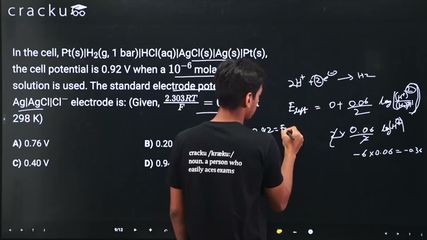
In the cell, Pt(s)|H$$_2$$(g, 1 bar)|HCl(aq)|AgCl(s)|Ag(s)|Pt(s), the cell potential is 0.92 V when a $$10^{-6}$$ molar HCl solution is used. The standard electrode potential of Ag|AgCl|Cl$$^-$$ electrode is: (Given, $$\frac{2.303RT}{F} = 0.06$$ V at 298 K)
For the given galvanic cell
$$\text{Pt(s)}|\text{H}_2\text{(g, 1 bar)}|\text{HCl(aq, }10^{-6}\text{ M)}||\text{AgCl(s)}|\text{Ag(s)}|\text{Pt(s)}$$
the left-hand electrode is the hydrogen electrode and the right-hand electrode is the silver-silver-chloride electrode. The observed cell potential is
$$E_{\text{cell}} = 0.92\ \text{V}$$
We have to find the standard electrode potential $$E^{\circ}$$ of the Ag|AgCl|Cl- half-cell.
1. Potential of the left (hydrogen) electrode
The reduction half-reaction is
$$2\text{H}^+ + 2e^- \longrightarrow \text{H}_2(g)$$
For any electrode, the Nernst equation (298 K) is stated as
$$E = E^{\circ} + \dfrac{0.0591}{n}\,\log\!\frac{\text{activity of reduced form}}{\text{activity of oxidised form}}$$
For the hydrogen electrode, $$E^{\circ}=0\ \text{V},\; n=2,$$ the pressure of $$\text{H}_2$$ is 1 bar and the activity of $$\text{H}^+$$ equals its molarity. Hence
$$E_{\text{left}} = 0 + \dfrac{0.0591}{2}\,\log\!\left(\dfrac{(a_{\text{H}^+})^{2}}{1}\right) = 0.0591\log(a_{\text{H}^+}) = 0.0591\log(10^{-6}).$$
Because $$\log(10^{-6}) = -6,$$ we get
$$E_{\text{left}} = 0.0591(-6) \approx -0.36\ \text{V}.$$
Thus, as written in reduction form, the hydrogen electrode has a potential of $$-0.36\ \text{V}.$$ In the cell notation it is on the left, so it actually functions as the anode (oxidation). The numerical value for the reduction potential is what we need for the cell-EMF relation:
$$E_{\text{anode (red)}} = -0.36\ \text{V}.$$
2. Relation between cell EMF and the right-hand reduction potential
By definition,
$$E_{\text{cell}} = E_{\text{cathode (red)}} - E_{\text{anode (red)}}.$$
Therefore
$$E_{\text{right}} = E_{\text{cathode (red)}} = E_{\text{cell}} + E_{\text{anode (red)}} = 0.92\ \text{V} + (-0.36\ \text{V}) = 0.56\ \text{V}.$$
3. Nernst equation for the Ag|AgCl|Cl- electrode
The reduction half-reaction is
$$\text{AgCl(s)} + e^- \longrightarrow \text{Ag(s)} + \text{Cl}^-.$$
Here $$n = 1.$$ Stating the Nernst equation first,
$$E = E^{\circ}_{\text{Ag/AgCl}} - 0.0591\log[\text{Cl}^-],$$
because the solid Ag and AgCl have unit activity and the only variable is the chloride-ion activity.
The chloride-ion concentration comes from the 10-6 M HCl solution, so
$$[\text{Cl}^-] = 10^{-6}\ \text{M}, \quad \log[\text{Cl}^-] = -6.$$
Substituting $$E = 0.56\ \text{V}$$ and $$\log[\text{Cl}^-] = -6$$ gives
$$0.56 = E^{\circ}_{\text{Ag/AgCl}} - 0.0591(-6) = E^{\circ}_{\text{Ag/AgCl}} + 0.3546.$$
Now, rearranging,
$$E^{\circ}_{\text{Ag/AgCl}} = 0.56 - 0.3546 \approx 0.205\ \text{V}.$$
With the rounded value of 0.06 V supplied for $$\tfrac{2.303RT}{F},$$ we obtain
$$E^{\circ}_{\text{Ag/AgCl}} \approx 0.20\ \text{V}.$$
Hence, the correct answer is Option B.
Was this solution helpful?
Click on the Email ☝️ to Watch the Video Solution
Create a FREE account and get:
_1.webp)

Educational materials for JEE preparation

Ask our AI anything

AI can make mistakes. Please verify important information.
AI can make mistakes. Please verify important information.


