
Join Our JEE Preparation Group
Prep with like-minded aspirants; Get access to free daily tests and study material.
Sign in
Please select an account to continue using cracku.in
↓ →
Join Our JEE Preparation Group
Prep with like-minded aspirants; Get access to free daily tests and study material.
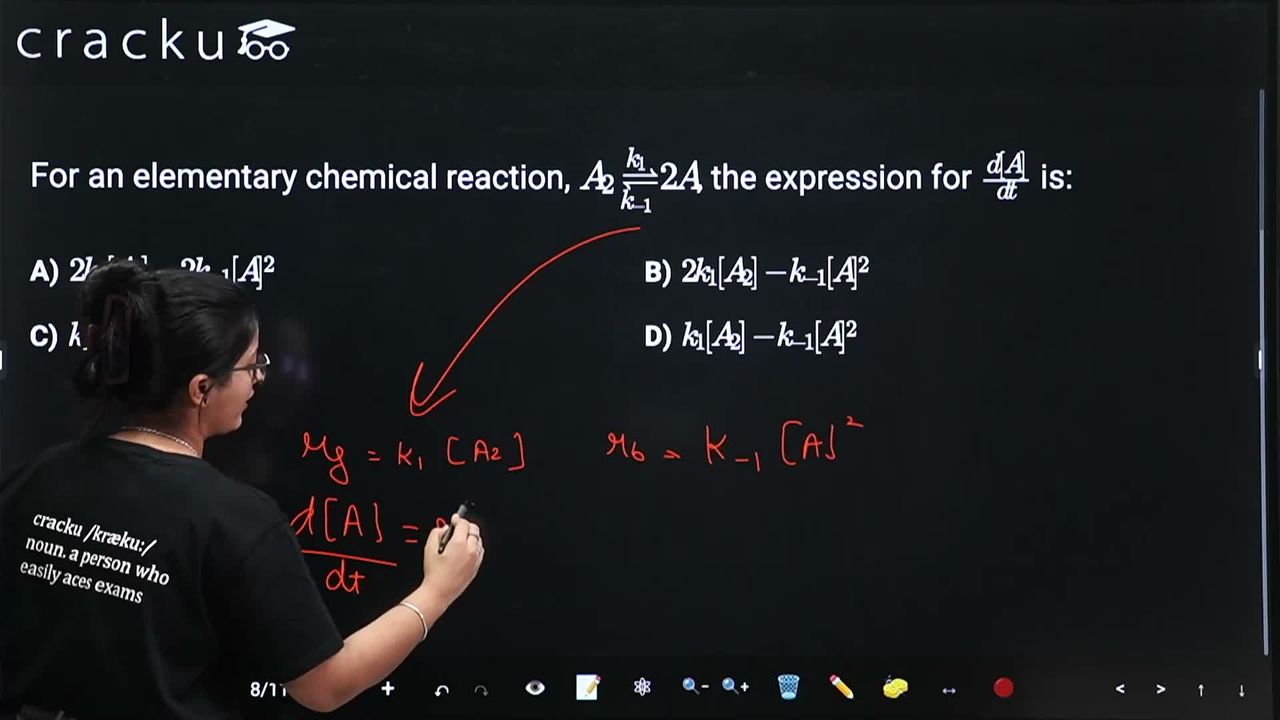
For an elementary chemical reaction, $$A_2 \underset{k_{-1}}{\overset{k_1}{\rightleftharpoons}} 2A$$, the expression for $$\frac{d[A]}{dt}$$ is:
We have the reversible elementary reaction $$A_2 \;\underset{k_{-1}}{\overset{k_1}{\rightleftharpoons}}\; 2A.$$
For any elementary step, the rate law is directly proportional to the product of the concentrations of the reactant molecules raised to the power of their stoichiometric coefficients. Therefore:
1. Forward step $$A_2 \longrightarrow 2A$$ has rate
$$r_{\text{f}} = k_1[A_2].$$
2. Backward step $$2A \longrightarrow A_2$$ has rate
$$r_{\text{b}} = k_{-1}[A]^2$$
because two molecules of $$A$$ collide simultaneously in this elementary process.
Next, we translate these molecular events into the rate of change of concentration of $$A$$. The forward step creates two moles of $$A$$ per molecular event, while the backward step consumes two moles of $$A$$ per molecular event. Hence:
$$\frac{d[A]}{dt} = (+2)\,r_{\text{f}} \;-\; (2)\,r_{\text{b}}.$$
Substituting $$r_{\text{f}} = k_1[A_2]$$ and $$r_{\text{b}} = k_{-1}[A]^2$$ we obtain
$$\frac{d[A]}{dt} = 2\,k_1[A_2] \;-\; 2\,k_{-1}[A]^2.$$
So the required expression matches Option A.
Hence, the correct answer is Option A.
Was this solution helpful?
Click on the Email ☝️ to Watch the Video Solution
Create a FREE account and get:
_1.webp)

Educational materials for JEE preparation

Ask our AI anything

AI can make mistakes. Please verify important information.
AI can make mistakes. Please verify important information.


