
Join Our JEE Preparation Group
Prep with like-minded aspirants; Get access to free daily tests and study material.
Sign in
Please select an account to continue using cracku.in
↓ →
Join Our JEE Preparation Group
Prep with like-minded aspirants; Get access to free daily tests and study material.
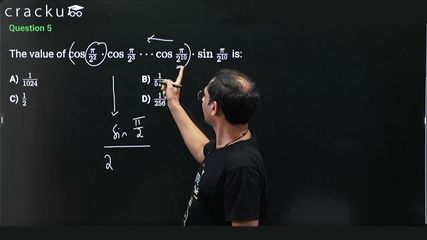
The value of $$\cos\frac{\pi}{2^2} \cdot \cos\frac{\pi}{2^3} \cdots \cos\frac{\pi}{2^{10}} \cdot \sin\frac{\pi}{2^{10}}$$ is:
First, recall the well-known double-angle identity for sine:
$$\sin(2\theta)=2\sin\theta\cos\theta.$$
We shall apply this identity successively to break the sine of a larger angle into sines and cosines of smaller and smaller angles until the desired product appears.
Take $$\theta=\dfrac{\pi}{2^{2}}.$$ Then $$2\theta=\dfrac{\pi}{2},$$ and the identity gives
$$\sin\!\Bigl(\dfrac{\pi}{2}\Bigr)=2\sin\!\Bigl(\dfrac{\pi}{2^{2}}\Bigr)\cos\!\Bigl(\dfrac{\pi}{2^{2}}\Bigr).$$
But $$\sin\!\bigl(\dfrac{\pi}{2}\bigr)=1,$$ so we obtain
$$1=2\sin\!\Bigl(\dfrac{\pi}{2^{2}}\Bigr)\cos\!\Bigl(\dfrac{\pi}{2^{2}}\Bigr). \quad -(1)$$
Now apply the same identity once more, this time to the angle $$\dfrac{\pi}{2^{3}}.$$ Since $$2\!\left(\dfrac{\pi}{2^{3}}\right)=\dfrac{\pi}{2^{2}},$$ we get
$$\sin\!\Bigl(\dfrac{\pi}{2^{2}}\Bigr)=2\sin\!\Bigl(\dfrac{\pi}{2^{3}}\Bigr)\cos\!\Bigl(\dfrac{\pi}{2^{3}}\Bigr). \quad -(2)$$
Substituting the value of $$\sin\!\bigl(\dfrac{\pi}{2^{2}}\bigr)$$ from (2) into (1), we have
$$1=2\Bigl[2\sin\!\Bigl(\dfrac{\pi}{2^{3}}\Bigr)\cos\!\Bigl(\dfrac{\pi}{2^{3}}\Bigr)\Bigr]\cos\!\Bigl(\dfrac{\pi}{2^{2}}\Bigr) =2^{2}\sin\!\Bigl(\dfrac{\pi}{2^{3}}\Bigr)\cos\!\Bigl(\dfrac{\pi}{2^{3}}\Bigr)\cos\!\Bigl(\dfrac{\pi}{2^{2}}\Bigr).$$
We can clearly see a pattern forming. Repeating this process again and again, each time halving the angle, produces additional cosine factors and an additional power of 2 in front. After proceeding down to the angle $$\dfrac{\pi}{2^{10}},$$ the cumulative result is
$$1 =2^{9}\sin\!\Bigl(\dfrac{\pi}{2^{10}}\Bigr)\, \cos\!\Bigl(\dfrac{\pi}{2^{10}}\Bigr) \cos\!\Bigl(\dfrac{\pi}{2^{9}}\Bigr) \cos\!\Bigl(\dfrac{\pi}{2^{8}}\Bigr) \cdots \cos\!\Bigl(\dfrac{\pi}{2^{2}}\Bigr).$$
Writing the product of cosines in ascending order of the denominators and grouping conveniently, this is
$$1 =2^{9}\Bigl[\sin\!\Bigl(\dfrac{\pi}{2^{10}}\Bigr)\prod_{k=2}^{10}\cos\!\Bigl(\dfrac{\pi}{2^{k}}\Bigr)\Bigr].$$
Observe that the bracketed expression is exactly the quantity asked for in the question, namely
$$\cos\!\Bigl(\dfrac{\pi}{2^{2}}\Bigr)\cos\!\Bigl(\dfrac{\pi}{2^{3}}\Bigr)\cdots\cos\!\Bigl(\dfrac{\pi}{2^{10}}\Bigr)\sin\!\Bigl(\dfrac{\pi}{2^{10}}\Bigr).$$
Denote this required value by $$P.$$ From the equation just obtained we therefore have
$$1 = 2^{9} P \quad\Longrightarrow\quad P = \dfrac{1}{2^{9}} = \dfrac{1}{512}.$$
Hence, the correct answer is Option B.
Was this solution helpful?
Click on the Email ☝️ to Watch the Video Solution
Create a FREE account and get:
_1.webp)

Educational materials for JEE preparation

Ask our AI anything

AI can make mistakes. Please verify important information.
AI can make mistakes. Please verify important information.


