
Join Our JEE Preparation Group
Prep with like-minded aspirants; Get access to free daily tests and study material.
Sign in
Please select an account to continue using cracku.in
↓ →
Join Our JEE Preparation Group
Prep with like-minded aspirants; Get access to free daily tests and study material.
Let $$f: (-1, 1) \to R$$ be a function defined by $$f(x) = \max\left\{-|x|, -\sqrt{1-x^2}\right\}$$. If $$K$$ be the set of all points at which $$f$$ is not differentiable, then $$K$$ has exactly:
We are given the function $$f:(-1,1)\to\mathbb R$$ defined by
$$f(x)=\max\left\{-\,|x|,\;-\sqrt{\,1-x^{2}\,}\right\}$$
On the interval $$(-1,1)$$ the two candidate functions inside the maximum are
$$g_{1}(x)=-\,|x| \quad\text{and}\quad g_{2}(x)=-\sqrt{\,1-x^{2}\,}.$$
To decide which of the two is actually equal to $$f(x)$$ at a particular point, we compare their values. For this we first find the points where the two are equal:
We set $$g_{1}(x)=g_{2}(x)$$, so
$$-\,|x|=-\sqrt{\,1-x^{2}\,}\;.$$
Multiplying both sides by $$-1$$ (which does not affect equality) gives
$$|x|=\sqrt{\,1-x^{2}\,}.$$
Both sides are non-negative, so we can square them safely:
$$|x|^{2}=\left(\sqrt{\,1-x^{2}\,}\right)^{2}\;\Longrightarrow\;x^{2}=1-x^{2}.$$
Adding $$x^{2}$$ to both sides yields
$$2x^{2}=1\;\Longrightarrow\;x^{2}=\frac12\;\Longrightarrow\;x=\pm\frac1{\sqrt2}.$$
Thus the two graphs meet only at $$x=\dfrac1{\sqrt2}$$ and $$x=-\dfrac1{\sqrt2}.$$ Next we check which of the two functions is larger (because the larger one is selected by the max operator) on either side of these points.
Take $$x=0$$. We have $$g_{1}(0)=0$$ and $$g_{2}(0)=-1.$$ Clearly $$g_{1}(0)>g_{2}(0),$$ so near the origin the function $$f$$ equals $$g_{1}(x)=-\,|x|.$$
Take $$x=0.9$$ (any value with $$|x|$$ close to 1). Then
$$g_{1}(0.9)=-0.9,\qquad g_{2}(0.9)=-\sqrt{1-0.9^{2}}=-\sqrt{0.19}\approx-0.435.$$
Now $$g_{2}(0.9)>g_{1}(0.9),$$ so near the ends of the interval $$(-1,1)$$ the function $$f$$ equals $$g_{2}(x)=-\sqrt{1-x^{2}}.$$ Therefore the piece-wise description of $$f$$ is
$$ f(x)= \begin{cases} -\,|x|, & |x|\le\dfrac1{\sqrt2},\\[6pt] -\sqrt{\,1-x^{2}\,}, & |x|\ge\dfrac1{\sqrt2}. \end{cases} $$
We now locate the points where $$f$$ fails to be differentiable. There are two possible sources:
(i) points where the selected branch itself is not differentiable;
(ii) junction points where the branch changes (i.e. where $$|x|=\dfrac1{\sqrt2}$$).
First consider $$g_{1}(x)=-\,|x|.$$ The absolute-value function $$|x|$$ is not differentiable at $$x=0,$$ therefore $$g_{1}(x)$$ is not differentiable at $$x=0$$. Since $$|0|=\dfrac0{\sqrt2}\le\dfrac1{\sqrt2},$$ the branch $$g_{1}$$ is indeed active at $$x=0$$, so
$$x=0$$ is a point where $$f$$ is not differentiable.
Everywhere else $$g_{1}$$ has a constant one-sided derivative: for $$x>0,\;g_{1}'(x)=-1;$$ for $$x<0,\;g_{1}'(x)=+1.$$ So no other singularity comes from $$g_{1}$$ itself.
Next consider $$g_{2}(x)=-\sqrt{\,1-x^{2}\,}.$$ Inside $$(-1,1)$$ the function $$\sqrt{\,1-x^{2}\,}$$ is differentiable, so its negative is also differentiable; hence $$g_{2}$$ has no internal cusps.
Thus the remaining possible trouble points are where the branch changes, namely $$x=\dfrac1{\sqrt2}$$ and $$x=-\dfrac1{\sqrt2}.$$ We inspect the derivatives on either side of each such point.
Formula for the derivative of $$g_{2}$$: First write $$g_{2}(x)=-\sqrt{\,1-x^{2}\,}.$$ Using the chain rule,
$$\frac{d}{dx}\bigl[-\sqrt{\,1-x^{2}\,}\bigr] =-\frac1{2\sqrt{\,1-x^{2}\,}}\cdot(-2x) =\frac{x}{\sqrt{\,1-x^{2}\,}}.$$
Now compute the derivatives at the junctions.
1. Point $$x=\dfrac1{\sqrt2}>0$$ Left of this point the active branch is $$g_{1}(x)=-|x|$$ with derivative $$-1.$$ Right of this point the active branch is $$g_{2}(x)$$ with derivative
$$g_{2}'\!\left(\frac1{\sqrt2}\right) =\frac{\frac1{\sqrt2}}{\sqrt{1-\frac12}} =\frac{\frac1{\sqrt2}}{\frac1{\sqrt2}} =1.$$
The left-hand derivative is $$-1$$ and the right-hand derivative is $$+1,$$ so they are unequal. Hence
$$x=\dfrac1{\sqrt2}$$ is a point where $$f$$ is not differentiable.
2. Point $$x=-\dfrac1{\sqrt2}<0$$ Left of this point (more negative) the active branch is $$g_{2}$$ with derivative
$$g_{2}'\!\left(-\frac1{\sqrt2}\right) =\frac{-\frac1{\sqrt2}}{\sqrt{1-\frac12}} =\frac{-\frac1{\sqrt2}}{\frac1{\sqrt2}} =-1.$$
Right of this point the active branch is $$g_{1}(x)=-|x|$$ which, for negative $$x,$$ has derivative $$+1.$$ Again the two one-sided derivatives, $$-1$$ and $$+1,$$ are different, so
$$x=-\dfrac1{\sqrt2}$$ is also a point where $$f$$ is not differentiable.
Combining all our findings, the set $$K$$ of points of non-differentiability is
$$K=\left\{-\dfrac1{\sqrt2},\;0,\;\dfrac1{\sqrt2}\right\},$$
which clearly contains exactly three elements.
Hence, the correct answer is Option C.
Was this solution helpful?
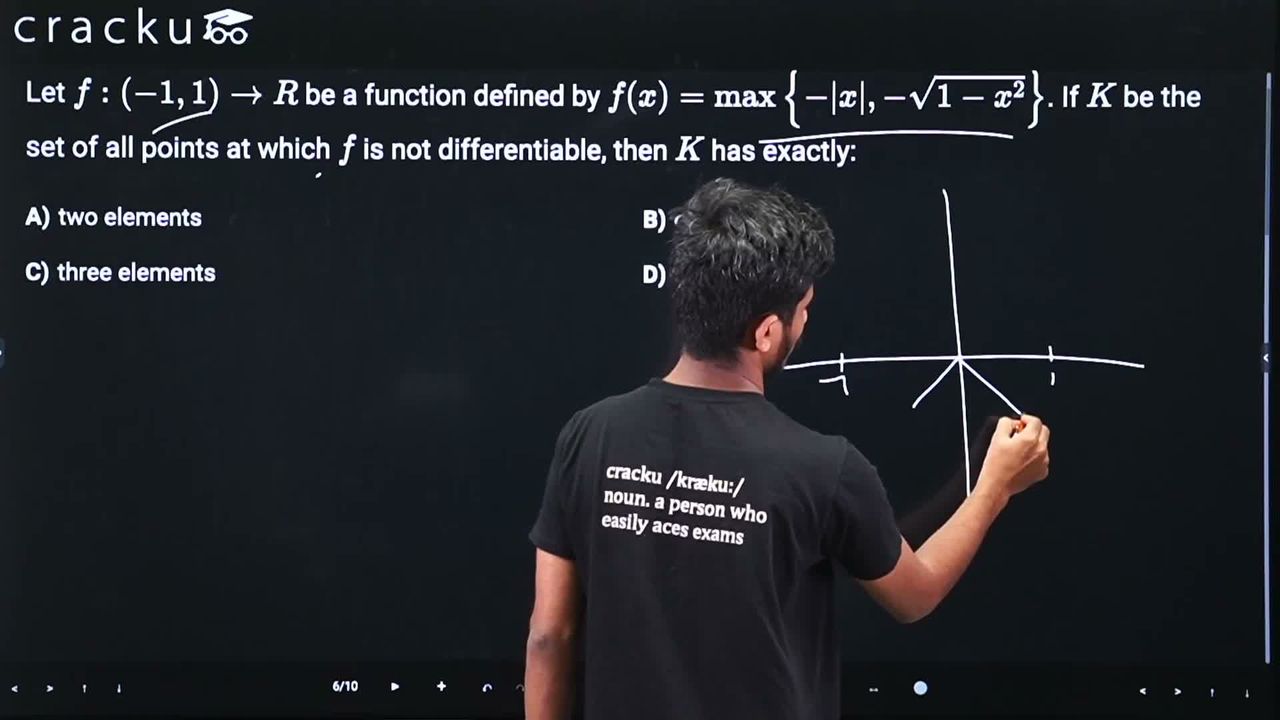
Click on the Email ☝️ to Watch the Video Solution
Create a FREE account and get:
_1.webp)

Educational materials for JEE preparation

Ask our AI anything

AI can make mistakes. Please verify important information.
AI can make mistakes. Please verify important information.


