
Join Our JEE Preparation Group
Prep with like-minded aspirants; Get access to free daily tests and study material.
Sign in
Please select an account to continue using cracku.in
↓ →
Join Our JEE Preparation Group
Prep with like-minded aspirants; Get access to free daily tests and study material.
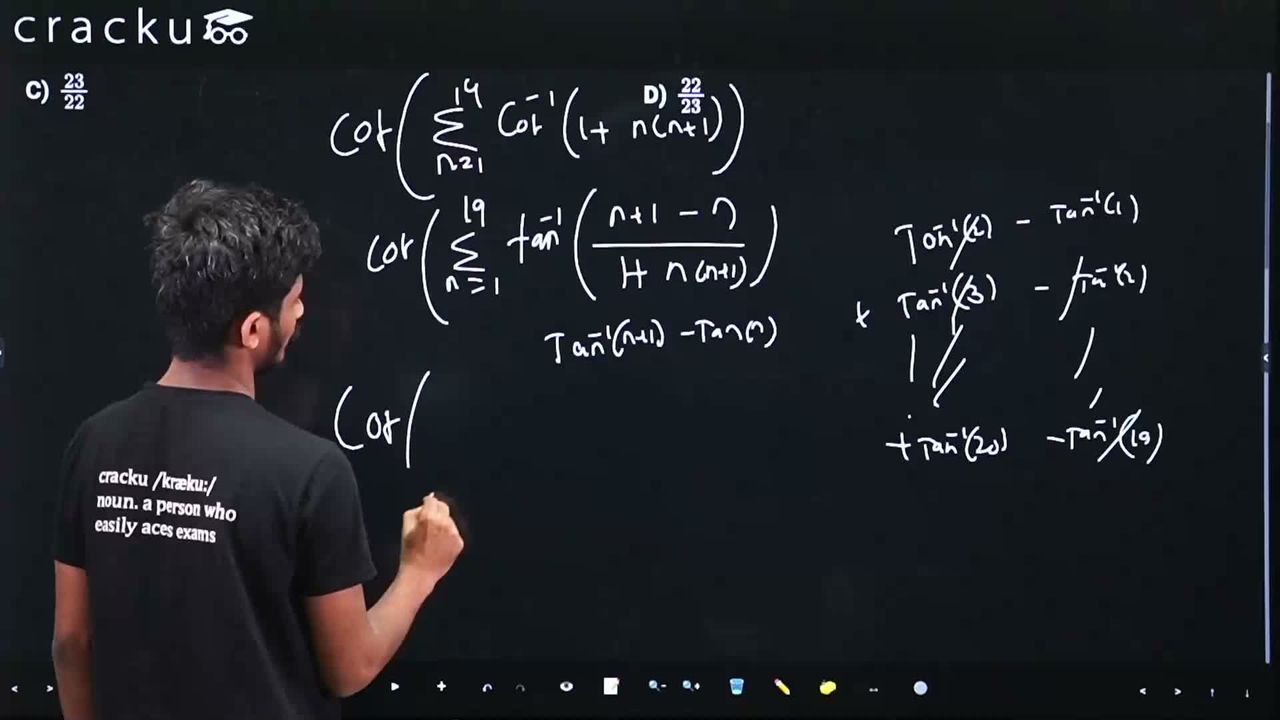
The value of $$\cot\left(\sum_{n=1}^{19} \cot^{-1}\left(1 + \sum_{p=1}^{n} 2p\right)\right)$$ is:
We have to evaluate the quantity
$$\cot\!\left(\;\sum_{n=1}^{19} \cot^{-1}\!\left(1+\sum_{p=1}^{n}2p\right)\right).$$
First let us simplify the inner summation. The sum of the first $$n$$ even natural numbers can be written as $$2$$ times the sum of the first $$n$$ natural numbers. Using the well-known formula
$$1+2+\dots +n=\frac{n(n+1)}{2},$$
we get
$$\sum_{p=1}^{n}2p \;=\;2\left(\frac{n(n+1)}{2}\right)=n(n+1).$$
So the expression inside each $$\cot^{-1}$$ becomes
$$1+\sum_{p=1}^{n}2p = 1+n(n+1)=n^2+n+1.$$
Therefore the entire angle whose cotangent is being taken is
$$S=\sum_{n=1}^{19}\cot^{-1}\!\bigl(n^2+n+1\bigr).$$
To telescope this sum, it is easier to convert $$\cot^{-1}$$ to $$\tan^{-1}$$. Recall that for any positive $$x$$ we have
$$\cot^{-1}x = \tan^{-1}\!\left(\frac1x\right).$$
Applying this to each term,
$$\cot^{-1}\!\bigl(n^2+n+1\bigr)=\tan^{-1}\!\left(\frac1{n^2+n+1}\right).$$
Now we invoke the subtraction formula for $$\tan^{-1}$$. For real numbers $$\alpha$$ and $$\beta$$,
$$\tan^{-1}\alpha-\tan^{-1}\beta=\tan^{-1}\!\left(\frac{\alpha-\beta}{1+\alpha\beta}\right).$$
If we choose $$\alpha=n+1$$ and $$\beta=n$$, then
$$\tan^{-1}(n+1)-\tan^{-1}n=\tan^{-1}\!\left(\frac{(n+1)-n}{1+n(n+1)}\right) =\tan^{-1}\!\left(\frac1{n^2+n+1}\right).$$
This is exactly the form we obtained above. Hence, for every $$n\ge1$$,
$$\cot^{-1}\!\bigl(n^2+n+1\bigr)=\tan^{-1}(n+1)-\tan^{-1}n.$$
Substituting this identity into the sum for $$S$$ gives
$$S=\sum_{n=1}^{19}\Bigl[\tan^{-1}(n+1)-\tan^{-1}n\Bigr].$$
Observe that this is a telescoping series: consecutive terms cancel pairwise.
Explicitly, writing out the first few terms,
$$\bigl[\tan^{-1}2-\tan^{-1}1\bigr]+\bigl[\tan^{-1}3-\tan^{-1}2\bigr] +\dots+\bigl[\tan^{-1}20-\tan^{-1}19\bigr].$$
All the intermediate $$\tan^{-1}2,\tan^{-1}3,\dots,\tan^{-1}19$$ terms cancel, leaving only
$$S=\tan^{-1}20-\tan^{-1}1.$$
Next we need $$\cot S$$. First find $$\tan S$$ using the subtraction formula for tangent:
For angles $$A$$ and $$B$$,
$$\tan(A-B)=\frac{\tan A-\tan B}{1+\tan A\,\tan B}.$$
Taking $$A=\tan^{-1}20$$ (so $$\tan A=20$$) and $$B=\tan^{-1}1$$ (so $$\tan B=1$$), we have
$$\tan S=\tan\!\bigl(\tan^{-1}20-\tan^{-1}1\bigr) =\frac{20-1}{1+20\cdot1} =\frac{19}{21}.$$
Finally, since $$\cot S$$ is the reciprocal of $$\tan S$$,
$$\cot S=\frac{1}{\tan S}=\frac{21}{19}.$$
Hence, the correct answer is Option A.
Was this solution helpful?
Click on the Email ☝️ to Watch the Video Solution
Create a FREE account and get:
_1.webp)

Educational materials for JEE preparation

Ask our AI anything

AI can make mistakes. Please verify important information.
AI can make mistakes. Please verify important information.


