
Join Our JEE Preparation Group
Prep with like-minded aspirants; Get access to free daily tests and study material.
Sign in
Please select an account to continue using cracku.in
↓ →
Join Our JEE Preparation Group
Prep with like-minded aspirants; Get access to free daily tests and study material.
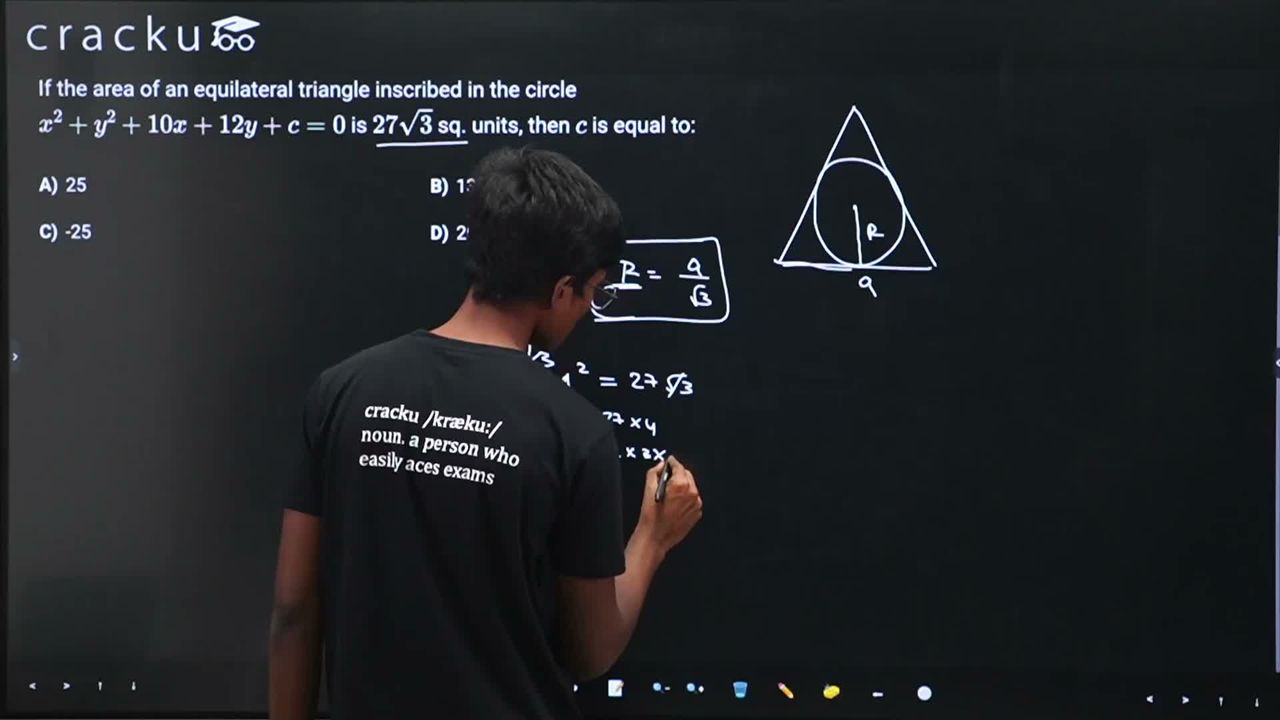
If the area of an equilateral triangle inscribed in the circle $$x^2 + y^2 + 10x + 12y + c = 0$$ is $$27\sqrt{3}$$ sq. units, then $$c$$ is equal to:
We start with the given circle
$$x^{2}+y^{2}+10x+12y+c=0.$$
To recognise its centre and radius, we complete the squares. Write the quadratic terms together:
$$\bigl(x^{2}+10x\bigr)+\bigl(y^{2}+12y\bigr)= -\,c.$$
Now add and subtract the necessary constants inside each bracket. The coefficient of $$x$$ is $$10$$, so half of it is $$5$$ and its square is $$25$$. For $$y$$, the coefficient is $$12$$, half is $$6$$ and its square is $$36$$. Inserting these we get
$$\bigl(x^{2}+10x+25-25\bigr)+\bigl(y^{2}+12y+36-36\bigr)= -\,c.$$
Group the perfect squares and the constants separately:
$$(x+5)^{2}+(y+6)^{2}-25-36= -\,c.$$
Combine the constants $$-25-36=-61$$ and move them to the right side:
$$(x+5)^{2}+(y+6)^{2}=61-c.$$
Hence the circle is centred at $$(-5,-6)$$ and its radius is
$$R=\sqrt{61-c}.$$
Next, an equilateral triangle is inscribed in this circle. For an equilateral triangle the standard relation between the side length $$a$$ and the circum-radius $$R$$ is
$$R=\frac{a}{\sqrt{3}}$$ (circumradius formula for an equilateral triangle).
The area formula for an equilateral triangle is
$$\text{Area}=\frac{\sqrt{3}}{4}\,a^{2}.$$
We are told that the area equals $$27\sqrt{3}$$, so substituting this value gives
$$\frac{\sqrt{3}}{4}\,a^{2}=27\sqrt{3}.$$
Divide both sides by $$\sqrt{3}$$:
$$\frac{1}{4}\,a^{2}=27.$$
Multiply by $$4$$:
$$a^{2}=108.$$
Take the square root (the side length is positive):
$$a=\sqrt{108}=6\sqrt{3}.$$
Now substitute this $$a$$ into the circumradius formula:
$$R=\frac{a}{\sqrt{3}}=\frac{6\sqrt{3}}{\sqrt{3}}=6.$$
Thus the radius of the given circle must be
$$R=6.$$
But from the circle’s equation we already have
$$R=\sqrt{61-c}.$$
Equate the two expressions for $$R$$:
$$\sqrt{61-c}=6.$$
Square both sides to remove the square root:
$$61-c=36.$$
Solve for $$c$$ by moving terms:
$$c=61-36=25.$$
Hence, the correct answer is Option A.
Was this solution helpful?
Click on the Email ☝️ to Watch the Video Solution
Create a FREE account and get:
_1.webp)

Educational materials for JEE preparation

Ask our AI anything

AI can make mistakes. Please verify important information.
AI can make mistakes. Please verify important information.


