
Join Our JEE Preparation Group
Prep with like-minded aspirants; Get access to free daily tests and study material.
Sign in
Please select an account to continue using cracku.in
↓ →
Join Our JEE Preparation Group
Prep with like-minded aspirants; Get access to free daily tests and study material.
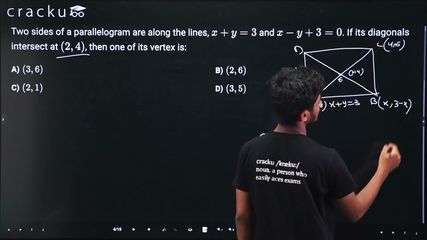
Two sides of a parallelogram are along the lines, $$x + y = 3$$ and $$x - y + 3 = 0$$. If its diagonals intersect at $$(2, 4)$$, then one of its vertex is:
Let us denote the two given non-parallel lines as
$$L_1:\;x+y=3\quad\text{and}\quad L_2:\;x-y+3=0\;(\text{or }x-y=-3).$$
These are the directions of two adjacent sides of the required parallelogram. For any straight line written in the form $$ax+by=c$$ a direction vector is $$\bigl(b,-a\bigr).$$ So, for the two lines we obtain
Direction of $$L_1: (1,-1),\qquad$$ Direction of $$L_2: (1,1).$$
Choose two vectors along the sides
$$\vec{v_1}=k(1,-1)=\,(k,\,-k),\qquad \vec{v_2}=m(1,1)=\,(m,\,m),$$
where the non-zero scalars $$k$$ and $$m$$ are still unknown.
Let $$A(x_1,y_1)$$ be one vertex of the parallelogram. With the standard Labelling $$AB\parallel L_1,\;AD\parallel L_2$$ we get
$$B=A+\vec{v_1},\quad D=A+\vec{v_2},\quad C=A+\vec{v_1}+\vec{v_2}.$$
In every parallelogram the diagonals bisect each other. Hence the common midpoint $$M$$ of the diagonals satisfies the midpoint formula
$$M=\frac{A+C}{2}=\frac{A+(A+\vec{v_1}+\vec{v_2})}{2} =\frac{2A+\vec{v_1}+\vec{v_2}}{2}.$$
The problem states that the diagonals meet at $$M(2,4).$$ Putting $$M(2,4)$$ into the last relation gives
$$2M=(4,8)=2A+\vec{v_1}+\vec{v_2}.$$
Re-arranging for the unknown vertex $$A$$ we obtain
$$2A=(4,8)-(\vec{v_1}+\vec{v_2})\;\Longrightarrow\; A=(2,4)-\frac{\vec{v_1}+\vec{v_2}}{2}.$$
Compute $$\vec{v_1}+\vec{v_2}:$$
$$\vec{v_1}+\vec{v_2}=(k+m,\,-k+m).$$
Therefore
$$A=\Bigl(2-\dfrac{k+m}{2},\;4-\dfrac{m-k}{2}\Bigr).$$
We now look among the four given options to see whether any one of them can be expressed by suitable integers $$k$$ and $$m.$$ Start with Option A, the point $$(3,6).$$ Equating coordinate-wise,
$$2-\dfrac{k+m}{2}=3\quad\text{and}\quad 4-\dfrac{m-k}{2}=6.$$
First equation:
$$2-\dfrac{k+m}{2}=3 \;\Longrightarrow\; -\dfrac{k+m}{2}=1 \;\Longrightarrow\; k+m=-2.$$
Second equation:
$$4-\dfrac{m-k}{2}=6 \;\Longrightarrow\; -\dfrac{m-k}{2}=2 \;\Longrightarrow\; m-k=-4.$$
Now solve the simultaneous linear equations
$$\begin{cases} k+m=-2\\ m-k=-4 \end{cases}\qquad\Longrightarrow\qquad \begin{aligned} \;2m&=-6&\Longrightarrow&m=-3,\\ k&=1. \end{aligned}$$
Both $$k=1$$ and $$m=-3$$ are admissible (they merely determine the lengths and directions of the sides). Hence with these values the point $$(3,6)$$ is indeed a vertex of a parallelogram whose sides are parallel to the two given lines and whose diagonals meet at $$(2,4).$$
Having found one working choice, the answer is fixed because a parallelogram is fully determined by the two direction lines and the point of intersection of its diagonals; only four possible vertices exist, and among the options only $$(3,6)$$ satisfies the required relations.
Hence, the correct answer is Option A.
Was this solution helpful?
Click on the Email ☝️ to Watch the Video Solution
Create a FREE account and get:
_1.webp)

Educational materials for JEE preparation

Ask our AI anything

AI can make mistakes. Please verify important information.
AI can make mistakes. Please verify important information.


