
Join Our JEE Preparation Group
Prep with like-minded aspirants; Get access to free daily tests and study material.
Sign in
Please select an account to continue using cracku.in
↓ →
Join Our JEE Preparation Group
Prep with like-minded aspirants; Get access to free daily tests and study material.
With the usual notation in $$\triangle ABC$$, if $$\angle A + \angle B = 120^{\circ}$$, $$a = \sqrt{3} + 1$$ units and $$b = \sqrt{3} - 1$$ units, then the ratio $$\angle A : \angle B$$ is:
Let us use Napier's tangent analogy for triangle $$ABC$$:
$$\tan\left(\frac{A - B}{2}\right) = \frac{a - b}{a + b} \cot\left(\frac{C}{2}\right)$$
First, calculate the difference and the sum of the sides $$a$$ and $$b$$:
$$a - b = (\sqrt{3} + 1) - (\sqrt{3} - 1) = 2$$
$$a + b = (\sqrt{3} + 1) + (\sqrt{3} - 1) = 2\sqrt{3}$$
Thus, the ratio of the difference to the sum of the sides is:
$$\frac{a - b}{a + b} = \frac{2}{2\sqrt{3}} = \frac{1}{\sqrt{3}}$$
Next, find angle $$C$$ using the sum of angles in a triangle. We are given:
$$A + B = 120^\circ$$
Since the sum of all angles in triangle $$ABC$$ is $$180^\circ$$:
$$C = 180^\circ - (A + B) = 180^\circ - 120^\circ = 60^\circ$$
Therefore, half of angle $$C$$ is:
$$\frac{C}{2} = 30^\circ$$
Substitute these values into Napier's analogy:
$$\tan\left(\frac{A - B}{2}\right) = \frac{1}{\sqrt{3}} \cot(30^\circ)$$
Since $$\cot(30^\circ) = \sqrt{3}$$, we get:
$$\tan\left(\frac{A - B}{2}\right) = \frac{1}{\sqrt{3}} \times \sqrt{3} = 1$$
This gives:
$$\frac{A - B}{2} = 45^\circ$$
$$A - B = 90^\circ$$
We now have a system of linear equations for angles $$A$$ and $$B$$:
$$A + B = 120^\circ$$
$$A - B = 90^\circ$$
Adding the two equations:
$$2A = 210^\circ \implies A = 105^\circ$$
Subtracting the second equation from the first:
$$2B = 30^\circ \implies B = 15^\circ$$
Finally, calculate the ratio of angle $$A$$ to angle $$B$$:
$$\frac{A}{B} = \frac{105^\circ}{15^\circ} = 7$$
Therefore, the ratio of angle $$A$$ to angle $$B$$ is $$7 : 1$$.
ALTERNATE :
We have a triangle $$\triangle ABC$$ with the usual notation: side $$a$$ is opposite angle $$A$$ and side $$b$$ is opposite angle $$B$$. The given data are
$$\angle A+\angle B = 120^{\circ}, \qquad a = \sqrt{3}+1, \qquad b = \sqrt{3}-1.$$
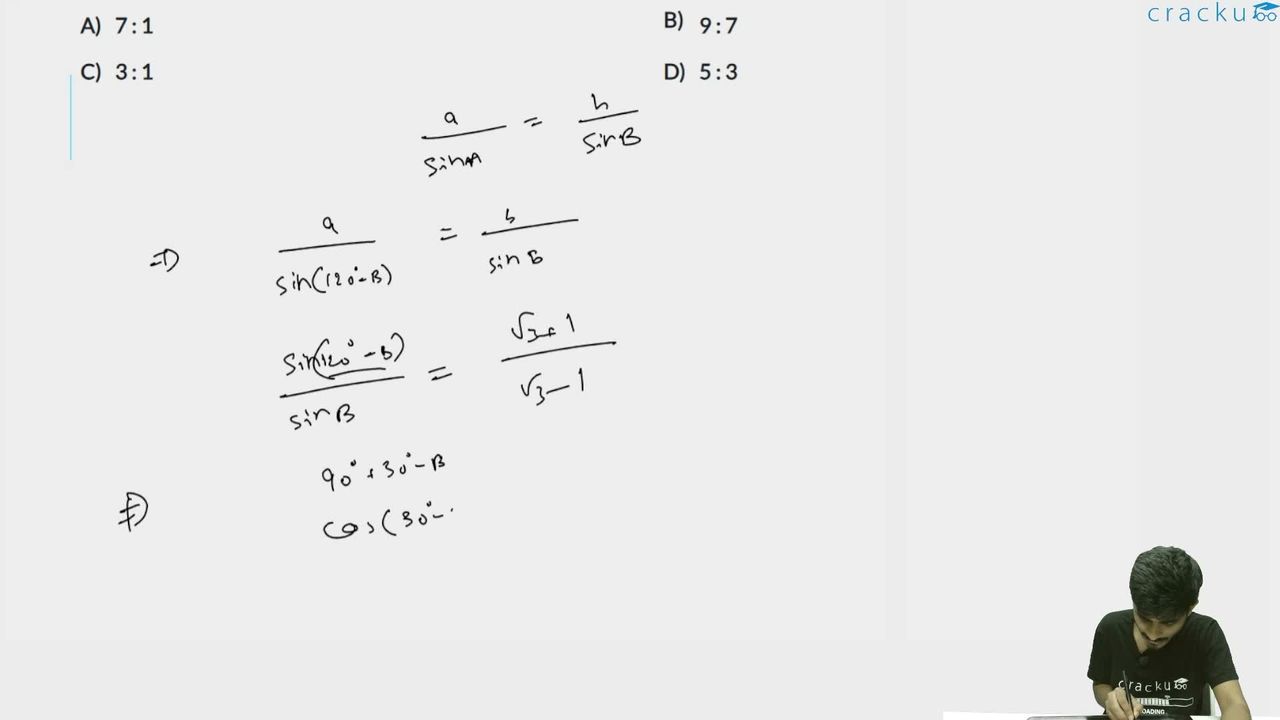
From the Law of Sines, which states $$\dfrac{a}{\sin A}=\dfrac{b}{\sin B}=\dfrac{c}{\sin C},$$ we obtain the proportionality
$$\dfrac{a}{b}=\dfrac{\sin A}{\sin B}. \quad -(1)$$
Substituting the given side lengths into (1) gives
$$\dfrac{\sin A}{\sin B}=\dfrac{\sqrt{3}+1}{\sqrt{3}-1}.$$
To simplify the right-hand side we rationalise the denominator:
$$\dfrac{\sqrt{3}+1}{\sqrt{3}-1}\times\dfrac{\sqrt{3}+1}{\sqrt{3}+1} =\dfrac{(\sqrt{3}+1)^{2}}{(\sqrt{3})^{2}-1^{2}} =\dfrac{3+1+2\sqrt{3}}{3-1} =\dfrac{4+2\sqrt{3}}{2} =2+\sqrt{3}.$$
Hence
$$\dfrac{\sin A}{\sin B}=2+\sqrt{3}. \quad -(2)$$
Now let us set $$\angle A = x^{\circ}.$$ Because $$\angle A+\angle B=120^{\circ},$$ we can write $$\angle B = 120^{\circ}-x^{\circ}.$$ Substituting these into equation (2) yields
$$\dfrac{\sin x}{\sin(120^{\circ}-x)} = 2+\sqrt{3}. \quad -(3)$$
We next expand the denominator using the sine subtraction formula $$\sin(\alpha-\beta)=\sin\alpha\cos\beta-\cos\alpha\sin\beta.$$ Taking $$\alpha=120^{\circ}$$ and $$\beta=x$$ gives
$$\sin(120^{\circ}-x)=\sin120^{\circ}\cos x-\cos120^{\circ}\sin x.$$
Because $$\sin120^{\circ}=\dfrac{\sqrt{3}}{2}$$ and $$\cos120^{\circ}=-\dfrac12,$$ we have
$$\sin(120^{\circ}-x)=\dfrac{\sqrt{3}}{2}\cos x-\left(-\dfrac12\right)\sin x =\dfrac{\sqrt{3}}{2}\cos x+\dfrac12\sin x =\dfrac{\sqrt{3}\cos x+\sin x}{2}.$$
Substituting this expression back into (3) we get
$$\dfrac{\sin x}{\dfrac{\sqrt{3}\cos x+\sin x}{2}}=2+\sqrt{3}.$$ Multiplying numerator and denominator by $$2$$ yields
$$\dfrac{2\sin x}{\sqrt{3}\cos x+\sin x}=2+\sqrt{3}.$$
Cross-multiplying, we obtain
$$2\sin x=(2+\sqrt{3})(\sqrt{3}\cos x+\sin x).$$
Expanding the right-hand side gives
$$2\sin x=(2+\sqrt{3})\sqrt{3}\cos x+(2+\sqrt{3})\sin x =(2\sqrt{3}+3)\cos x+(2+\sqrt{3})\sin x.$$
Bringing all terms to the left and combining like terms:
$$2\sin x-(2+\sqrt{3})\sin x-(2\sqrt{3}+3)\cos x=0,$$ $$\bigl[2-(2+\sqrt{3})\bigr]\sin x-(2\sqrt{3}+3)\cos x=0,$$ $$-\sqrt{3}\sin x-(2\sqrt{3}+3)\cos x=0.$$
Multiplying by $$-1$$ simplifies this to
$$\sqrt{3}\sin x+(2\sqrt{3}+3)\cos x=0.$$
Dividing throughout by $$\cos x$$ (which is non-zero for the angle we will obtain) gives an equation in $$\tan x$$:
$$\sqrt{3}\tan x+(2\sqrt{3}+3)=0,$$ $$\tan x=-\dfrac{2\sqrt{3}+3}{\sqrt{3}}.$$
Splitting the numerator and simplifying:
$$-\dfrac{2\sqrt{3}}{\sqrt{3}}-\dfrac{3}{\sqrt{3}} =-(2+\sqrt{3}).$$
Thus
$$\tan x=-(2+\sqrt{3}). \quad -(4)$$
We recognise that $$\tan75^{\circ}=2+\sqrt{3},$$ so equation (4) becomes
$$\tan x=-\tan75^{\circ}.$$
The principal value that satisfies this while lying between $$0^{\circ}$$ and $$120^{\circ}$$ is
$$x=105^{\circ},$$ because $$\tan105^{\circ}=\tan(180^{\circ}-75^{\circ})=-\tan75^{\circ}.$$
Therefore
$$\angle A = 105^{\circ}, \qquad \angle B = 120^{\circ}-105^{\circ}=15^{\circ}.$$
The required ratio is then
$$\angle A:\angle B = 105^{\circ}:15^{\circ}=7:1.$$
Hence, the correct answer is Option A.
Was this solution helpful?
Click on the Email ☝️ to Watch the Video Solution
Create a FREE account and get:
_1.webp)

Educational materials for JEE preparation

Ask our AI anything

AI can make mistakes. Please verify important information.
AI can make mistakes. Please verify important information.


