
Join Our JEE Preparation Group
Prep with like-minded aspirants; Get access to free daily tests and study material.
Sign in
Please select an account to continue using cracku.in
↓ →
Join Our JEE Preparation Group
Prep with like-minded aspirants; Get access to free daily tests and study material.
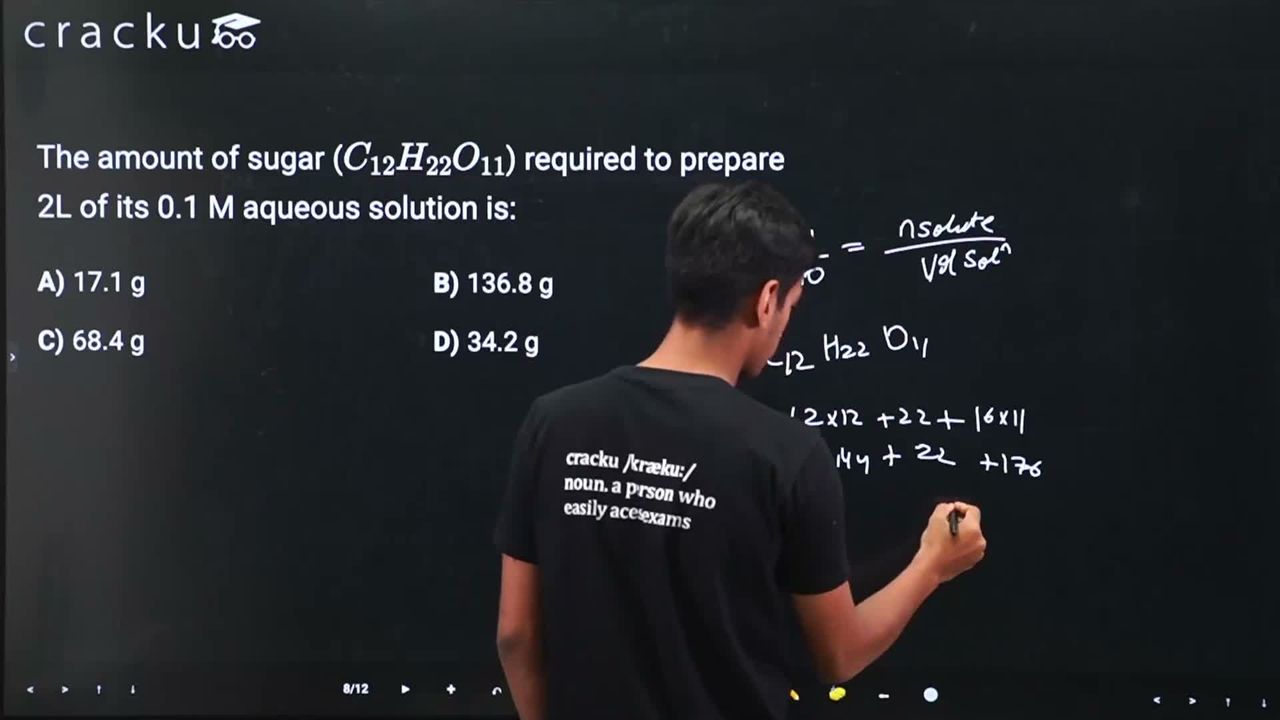
The amount of sugar ($$C_{12}H_{22}O_{11}$$) required to prepare 2L of its 0.1 M aqueous solution is:
We have to prepare a $$0.1 \text{ M}$$ aqueous solution of sucrose, whose chemical formula is $$C_{12}H_{22}O_{11}$$. By definition, molarity (M) is given by the formula $$M = \dfrac{\text{moles of solute}}{\text{volume of solution in litres}}.$$
Re-arranging, the moles of solute required are $$\text{moles} = M \times \text{volume}.$$ Substituting the given data, $$M = 0.1\ \text{mol L}^{-1}$$ and $$\text{volume} = 2\ \text{L},$$ we obtain
$$\text{moles} = 0.1 \times 2 = 0.2\ \text{mol}.$$
Now we need the molar mass of sucrose. We add the atomic masses of all atoms present in one molecule:
$$ \begin{aligned} M_{\text{sucrose}} &= 12(\text{C}) + 22(\text{H}) + 11(\text{O}) \\ &= 12 \times 12\ \text{g mol}^{-1} + 22 \times 1\ \text{g mol}^{-1} + 11 \times 16\ \text{g mol}^{-1} \\ &= 144 + 22 + 176 \\ &= 342\ \text{g mol}^{-1}. \end{aligned} $$
The mass of sucrose required is obtained from $$\text{mass} = \text{moles} \times \text{molar mass}.$$ Substituting the moles $$0.2\ \text{mol}$$ and the molar mass $$342\ \text{g mol}^{-1},$$ we get
$$\text{mass} = 0.2 \times 342 = 68.4\ \text{g}.$$
Hence, the correct answer is Option C.
Was this solution helpful?
Click on the Email ☝️ to Watch the Video Solution
Create a FREE account and get:
_1.webp)

Educational materials for JEE preparation

Ask our AI anything

AI can make mistakes. Please verify important information.
AI can make mistakes. Please verify important information.


