Group
Group
 Group
Group


 Preferred Source

 Google Discover
JEE d and f-Block Elements PYQ
Solving JEE d and f-Block Elements PYQ problems helps students understand how the properties of transition and inner-transition elements are tested in JEE Main and JEE Advanced. Questions from this chapter generally examine electronic configurations, oxidation states, magnetic behaviour, colours, catalytic properties and important compounds.
The d-block contains elements in which the differentiating electron enters the $$(n−1)d$$ orbital. Their general electronic configuration is:
$$(n−1)d1−10ns0−2$$
Transition elements are d-block elements that have a partially filled d-subshell in their atoms or in at least one common oxidation state. Therefore, all transition elements belong to the d-block, but every d-block element is not necessarily considered a transition element.
The f-block contains elements in which the differentiating electron enters the $$(n−2)f$$ orbital. It includes lanthanoids and actinoids. Regular JEE PYQ practice helps students distinguish factual questions from problems that require electronic configuration, magnetic moment or oxidation-state calculations.
JEE d and f-Block Elements Important PYQ PDF
The JEE d and f-Block Elements Important PYQ PDF provided below contains selected previous-year questions for chapter-wise practice. It can be used after completing the chapter or during final revision to check your understanding of important trends, exceptions and reactions.
Students can include this PDF in their JEE Study Material and attempt its questions without checking the answers. While reviewing the solutions, classify errors such as incorrect electronic configuration, missed exceptions, inaccurate oxidation states or confusion between lanthanoids and actinoids.
Try completing the PDF within a fixed time. Mark questions based on facts that you could not recall and revise those points directly from NCERT before attempting the questions again.
Important Topics Covered in d and f-Block Elements PYQs
Questions from d and f-block elements require a combination of conceptual understanding and factual recall. Important areas covered in previous-year questions include:
- Position of d-block and f-block elements
- Electronic configurations and their exceptions
- Variable oxidation states
- Atomic and ionic radii
- Ionisation enthalpy
- Coloured ions and compounds
- Magnetic properties and magnetic moment
- Formation of complex compounds
- Catalytic behaviour of transition metals
- Interstitial compounds and alloys
- Preparation and properties of potassium dichromate
- Preparation and properties of potassium permanganate
- Lanthanoid contraction and its consequences
- Oxidation states of lanthanoids and actinoids
- Comparison between lanthanoids and actinoids
The spin-only magnetic moment is calculated using:
$$μ=n(n+2) BM$$
Here, n represents the number of unpaired electrons and BM stands for Bohr Magneton. Students should first determine the correct oxidation state and electronic configuration before counting the unpaired electrons.
The dichromate and chromate ions exist in equilibrium depending on the $$pH$$
$$2CrO42−+2H+⇌Cr2O72−+H2O$$
Chromate ions are yellow, while dichromate ions are orange. Such reactions and colour changes should be included in a concise JEE Mains Formula Sheet or revision chart for quick recall.
How to Solve d and f-Block Elements PYQs Effectively
Begin by identifying whether the question tests a periodic trend, electronic configuration, chemical reaction or factual property. For calculation-based JEE Advanced Questions, write the oxidation state first and then determine the number of d-electrons.
Use the following approach:
- Write the atomic number and ground-state electronic configuration.
- Account for exceptional configurations such as chromium and copper.
- Remove electrons from the outer ns orbital before the (n−1)d orbital when forming cations.
- Calculate the oxidation state before finding the d-electron count.
- Use the number of unpaired electrons to calculate the magnetic moment.
- Check whether the ion has a partially filled d-orbital when predicting colour.
- Compare oxidation states using electronic stability and periodic trends.
- Revise NCERT reactions, colours and compounds regularly.
For example:
$$Cr:[Ar]3d54s1$$
$$Cu:[Ar]3d104s1$$
For iron:
$$Fe:[Ar]3d64s2$$
$$Fe2+:[Ar]3d6$$
$$Fe3+:[Ar]3d5$$
Do not assume that every ion containing a transition metal is coloured. Ions with d0 or d10 configurations are generally colourless because d-d transitions are not possible. However, some compounds can still show colour due to charge-transfer transitions.
After completing topic-wise practice, take a JEE Advanced Mock Test to assess recall, accuracy and question selection under time pressure. Maintain a one-page revision table containing configurations, oxidation states, colours, magnetic properties and essential reactions.
List of JEE d and f-Block Elements PYQs
The questions listed below can be attempted as a timed chapter-wise test. They cover conceptual, factual and calculation-based problems from the d-block and f-block elements.
Solve them without checking the answers. After completing the test, review every incorrect, guessed and skipped question, revise the relevant NCERT Solutions and reattempt it.
Question 1
Consider the following reactions $$K_{2}Cr_{2}O_{7}\xrightarrow[-H_{2}O]{KOH}[A]\xrightarrow[-H_{2}O]{H_{2}SO_{4}}[B]+K_{2}SO_{4}$$ The products [A] and [B], respectively are :
correct answer:- 3
Question 2
Four successive members of the first row of transition elements are listed below with atomic numbers. Which one of them is expected to have the highest $$E^\circ_{M^{3+}/M^{2+}}$$ value?
correct answer:- 2
Question 3
Magnetic moment of $$\text{Gd}^{3+}$$ ion ($$Z = 64$$) is
correct answer:- 3
Question 4
Given below are two statements:
Statement I: The number of pairs, from the following, in which both the ions are coloured in aqueous solution is 3.
$$[Sc^{3+},Ti^{3+}],[Mn^{2+},Cr^{2+}],[Cu^{2+},Zn^{2+}]$$ and $$[Ni^{2+},Ti^{4+}]$$
Statement II: $$Th^{4+}$$ is the strongest reducing agent among $$Th^{4+},Ce^{4+},Gd^{3+}\text{ and }Eu^{2+}$$.
In the light of the above statements, choose the correct answer from the options given below
correct answer:- 4
Question 5
In context with the transition elements, which of the following statements is incorrect?
correct answer:- 2

Question 6
The transition metal having highest 3rd ionisation enthalpy is:
correct answer:- 2
Question 7
Statement I:
Leaching of gold with cyanide ion in absence of air/$$O_2$$ leads to cyano complex of Au(III).
Statement II:
Zinc is oxidized during the displacement reaction carried out for gold extraction.
In the light of the above statements, choose the correct answer from the options given below
correct answer:- 4
Question 8
Iron exhibits $$+2$$ and $$+3$$ oxidation states. Which of the following statements about iron is incorrect?
correct answer:- 4
Question 9
Due to the phenomenon of lanthanide contraction, which of the following pairs of transition elements exhibit nearly identical atomic and ionic radii?
correct answer:- 2
Question 10
The actinoids exhibits more number of oxidation states in general than the lanthanoids. This is because
correct answer:- 4

Question 11
Of the following outer electronic configurations of atoms, the highest oxidation state is achieved by which one of them?
correct answer:- 2
Question 12
When dark green crystals of potassium manganate ($$\text{K}_2\text{MnO}_4$$) are treated with a neutral or acidic aqueous solution, a disproportionation reaction takes place. The solution turns purple due to the formation of compound A , along with a dark brown precipitate of compound B . What are the correct molecular formulas for A and B , and the change in oxidation state of manganese from the starting material to compound A ?
correct answer:- 2
Question 13
In 3d series, the metal having the highest $$M^{2+}/M$$ standard electrode potential is
correct answer:- 3
Question 14
The number of statement(s) correct from the following for Copper is/are
(A) Cu(II) complexes are always paramagnetic
(B) Cu(I) complexes are generally colourless
(C) Cu(I) is easily oxidized
(D) In Fehling solution, the active reagent has Cu(I)
correct answer:- 3
Question 15
The orange colour of $$K_2Cr_2O_7$$ and purple colour of $$KMnO_4$$ is due to
correct answer:- 1

Question 16
In following pairs, the one in which both transition metal ions are colourless is
correct answer:- 1
Question 17
A transition metal $$(M)$$ among $$Mn, Cr, Co$$ and $$Fe$$ has the highest standard electrode potential ($$M^{3+}/M^{2+}$$). It forms a metal complex of the type $$[M(CN)_6]^{4-}$$. The number of electrons present in the $$e_g$$ orbital of the complex is ______.
correct answer:- 1
Question 18
Among Sc, Mn, Co and Cu, identify the element with highest enthalpy of atomisation. The spin only magnetic moment value of that element in its +2 oxidation state is ________ BM (in nearest integer).
correct answer:- 4
Question 19
The spin-only magnetic moment value of $$M^{n+}$$ ion formed among Ni, Zn, Mn and Cu that has the least enthalpy of atomisation is _________. (in nearest integer)
Here n is equal to the number of diamagnetic complexes among $$K_2[NiCl_4]$$, $$[Zn(H_2O)_6]Cl_2$$, $$K_3[Mn(CN)_6]$$ and $$[Cu(PPh_3)_3I]$$
correct answer:- 0
Question 20
The metal ions that have the calculated spin only magnetic moment value of 4.9 B.M. are
A. $$Cr^{2+}$$
B. $$Fe^{2+}$$
C. $$Fe^{3+}$$
D. $$Co^{2+}$$
E. $$Mn^{3+}$$
Choose the
correct
answer from the options given below
correct answer:- 4

Question 21
The correct statements about metal carbonyls are
A. The metal-carbon bonds in metal carbonyls possess both $$\sigma$$ and $$\pi$$-character.
B. Due to synergic bonding interactions between metal and CO ligand, the metal-carbon bond becomes weak.
C. The metal-carbon $$\sigma$$ bond is formed by the donation of lone pair of electrons on the carbonyl carbon into a vacant orbital of metal.
D. The metal-carbon $$\pi$$ bond is formed by the donation of electrons from filled d-orbital of metal into vacant $$\pi^*$$ orbital of CO.
Choose the correct answer from the options given below:
correct answer:- 2
Question 22
Which one is correct statement?
When $$CO_2$$ is passed into aqueous:
correct answer:- 1
Question 23
Which of the following pair is not isoelectronic species?
(Atomic numbers Ho=67; Er=68; Yb=70; Lu=71; Eu=63; Tb=65; Tm=69)
correct answer:- 4
Question 24
More numbers of oxidation states are exhibited by the actinides than by the lanthanoids. The main reason for this:
correct answer:- 1
Question 25
Question: In the structure of the dichromate ion $$Cr_2O_7^{2-}$$, what is the total number of $$Cr-O$$ bonds that are exactly equivalent in length?
correct answer:- 6

Question 26
Potassium dichromate acts as a strong oxidizing agent in acidic solution. During this process, the oxidation state changes from
correct answer:- 12
Question 27
Given below are two statements for catalytic properties of transition metals.
Statement I :
First row transition metals which act as catalyst utilise their 3d electrons only for formation of bonds between reactant molecules and atoms on the surface of catalyst.
Statement II :
There is increase in the concentration of reactants on the surface of catalyst which strengthens the bonds in reacting molecules.
In the light of the above statements, choose the correct answer from the options given below :
correct answer:- 2
Question 28
The spin-only magnetic moment formula $$\mu = \sqrt{n(n+2)}\text{ BM}$$ works accurately for most 3d transition metal ions. However, some heavier lanthanoid ions show significant orbital angular momentum contribution, requiring the use of the total angular momentum quantum number $$J$$
Which of the following gaseous trivalent lanthanoid ions ($$Ln^{+3}$$) possesses a ground-state electronic configuration where the spin-only magnetic moment calculation predicts a value of
0 BM
, but its actual experimental magnetic moment is non-zero at room temperature due to low-lying excited states?
correct answer:- 2
Question 29
The amphoteric oxide among $$V_{2}O_{3}$$ and $$V_{2}O_{5}$$ , upon reaction with alkali leads to formation of an oxide anion. The oxidation state of V in the oxide anion is :
correct answer:- 4
Question 30
The nature of oxides V$$_2$$O$$_3$$ and CrO is indexed as 'X' and 'Y' type respectively. The correct set of X and Y is:
correct answer:- 3
Question 31
Among the following ores Bauxite, Siderite, Cuprite, Calamine, Haematite, Kaolinite, Malachite, Magnetite, Sphalerite, Limonite, Cryolite, the number of principal ores of iron is
correct answer:- 4
Question 32
The correct order of first ($$\Delta_i H_1$$) and second ($$\Delta_i H_2$$) ionisation enthalpy values of Cr and Mn are :
A. $$\Delta_i H_1$$ : Cr > Mn
B. $$\Delta_i H_2$$ : Cr > Mn
C. $$\Delta_i H_1$$ : Mn > Cr
D. $$\Delta_i H_2$$ : Mn > Cr
Choose the correct answer from the options given below :
correct answer:- 2
Question 33
The reaction representing the Mond process for metal refining is ______
correct answer:- 1
Question 34
Niobium ( Nb ) and ruthenium (Ru) have "x" and "y" number of electrons in their respective 4 d orbitals The value of x+y is _______.
correct answer:- 11
Question 35
Match List I with List II.
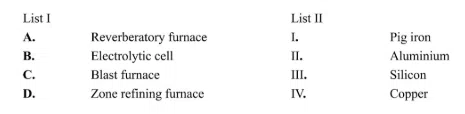
correct answer:- 1
Question 36
Given below are two statements:
Statement (I) : In the Lanthanoids, the formation of $$Ce^{+4}$$ is favoured by its noble gas configuration.
Statement (II) : $$Ce^{+4}$$ is a strong oxidant reverting to the common +3 state.
In the light of the above statements, choose the most appropriate answer from the options given below:
correct answer:- 2
Question 37
The correct order of $$E^0_{M^{2+}/M}$$ values with negative sign for the four successive elements Cr, Mn, Fe and Co is
correct answer:- 1
Question 38
Identity the incorrect pair from the following:
correct answer:- 4
Question 39
Lanthanoid contraction is caused due to
correct answer:- 4
Question 40
When acidic potassium dichromate $$(\text{K}_2\text{Cr}_2\text{O}_7$$) solution is treated with an excess of hydrogen peroxide $$(\text{H}_2\text{O}_2)$$ in the presence of an organic solvent like ether, a deep blue colored compound X is formed in the organic layer. Compound X rapidly decomposes in water to evolve oxygen gas. What is the oxidation state of Chromium in compound X , and how many peroxy $$(-\text{O}-\text{O}-)$$ linkages does it contain?
correct answer:- 1
.webp)