Group
Group
 Group
Group


 Preferred Source

 Google Discover

JEE Purification & Characterisation PYQ
Solving JEE Purification & Characterisation PYQ problems helps students understand how organic compounds are separated, purified, identified and analysed. Questions from this chapter commonly test crystallisation, sublimation, distillation, chromatography, qualitative analysis and quantitative elemental analysis.
Most purification questions are concept-based rather than calculation-heavy. Students are generally required to select a suitable technique by comparing physical properties such as solubility, boiling point, volatility and sublimability. Characterisation questions may involve identifying the elements present in an organic compound or calculating its percentage composition.
The topic becomes easier when students understand the principle behind each technique instead of simply memorising its name. Regularly solving JEE Purification & Characterisation Questions helps students distinguish between similar methods and remember important experimental conditions, observations and calculations.
JEE Purification & Characterisation Important PYQ PDF
The JEE Purification & Characterisation Important PYQ PDF provided below contains selected previous-year questions for focused chapter-wise practice. It covers crystallisation, sublimation, simple and fractional distillation, steam distillation, differential extraction, chromatography and elemental analysis.
Attempt every question independently before checking the solution. Begin by identifying the property that differentiates the components of the given mixture. Then select the purification technique that uses that difference effectively.
Students should also solve questions from JEE Mains Previous Papers to understand how these concepts are presented in the actual examination. After completing the PDF, revise incorrect answers using reliable JEE Study Material and attempt the difficult questions again.
Important Topics Covered in Purification & Characterisation PYQs
Purification and characterisation are important parts of organic chemistry. Questions may directly test the working principle of a method or provide the properties of a mixture and ask students to select the most suitable technique.
Important topics include:
- Crystallisation and selection of a suitable solvent
- Sublimation
- Simple distillation
- Fractional distillation
- Distillation under reduced pressure
- Steam distillation
- Differential extraction
- Chromatography
- Adsorption and partition chromatography
- Paper and thin-layer chromatography
- Retention factor
- Detection of carbon and hydrogen
- Lassaigne’s test
- Detection of nitrogen, sulphur and halogens
- Dumas method for nitrogen estimation
- Kjeldahl method for nitrogen estimation
- Carius method for halogen and sulphur estimation
- Estimation of carbon and hydrogen
- Percentage composition of organic compounds
How to Solve Purification & Characterisation PYQs Effectively
Begin by determining whether the question is based on purification, qualitative detection or quantitative estimation. This helps narrow down the required principle and prevents confusion between methods that appear similar.
Follow these steps while solving questions:
- Identify the physical or chemical property involved.
- Determine whether the components are solids, liquids or dissolved substances.
- Compare their solubility, boiling points and volatility.
- Select the purification method that uses the relevant difference.
- For chromatography, identify the stationary and mobile phases.
- For elemental analysis, determine the element being tested.
- Note the purpose of every reagent used in the procedure.
- For numerical problems, write the measured quantity before calculating the percentage.
- Check units and stoichiometric ratios carefully.
- Verify whether the selected method satisfies all the given conditions.
Students frequently confuse simple distillation with fractional distillation. Simple distillation is generally suitable when the difference in boiling points is sufficiently large, whereas fractional distillation is used for miscible liquids with closer boiling points.
Another common mistake is choosing crystallisation for every solid mixture. The method works only when a suitable difference in solubility exists between the desired compound and its impurities.
In chromatography questions, do not confuse adsorption with partition. Adsorption chromatography depends on the different degrees of adsorption on a solid surface, while partition chromatography involves the distribution of substances between two phases.
During Lassaigne’s test for halogens, the sodium extract is boiled with nitric acid before adding silver nitrate. This removes interfering sulphide and cyanide ions. Such procedural details are frequently tested directly in JEE.
After completing chapter-wise practice, attempt a JEE Mains Mock Test to evaluate recall and accuracy under exam conditions. Analyse every incorrect, guessed and skipped problem, and maintain an error log covering confusing techniques, reagents, observations and quantitative-analysis calculations.
List of JEE Purification & Characterisation PYQs
The questions listed below can be attempted as a timed chapter-wise test. They cover purification methods, chromatography, qualitative detection and quantitative elemental analysis.
Solve the questions without checking the answers. After completing the test, review every incorrect, guessed and skipped question. Revise the underlying principle and attempt the question again to ensure that the method has been properly understood.
Question 1
0.8 g of an organic compound was analysed by Kjeldahl's method for the estimation of nitrogen. If the percentage of nitrogen in the compound was found to be 42%, then _________ mL of 1M H$$_2$$SO$$_4$$ would have been neutralized by the ammonia evolved during the analysis.
correct answer:- 12
Question 2
Consider two chemical reactions (A) and (B) that take place during metallurgical process:
(A) ZnCO$$_{3(s)} \xrightarrow{\Delta}$$ ZnO$$_{(s)}$$ + CO$$_{2(g)}$$
(B) 2ZnS$$_{(s)}$$ + 3O$$_{2(g)} \xrightarrow{\Delta}$$ 2ZnO$$_{(s)}$$ + 2SO$$_{2(g)}$$
The correct option of names given to them respectively is:
correct answer:- 1
Question 3
Which of the following compound is added to the sodium extract before addition of silver nitrate for testing of halogens?
correct answer:- 1
Question 4
Which one of the following techniques is not used to spot components of a mixture separated on thin layer chromatographic plate?
correct answer:- 3
Question 5
Compound that will give positive Lassaigne's test for both nitrogen and halogen is
correct answer:- 2

Question 6
Match List I with List II: LIST I (Technique): A. Distillation B. Fractional distillation C. Steam distillation D. Distillation under reduced pressure. LIST II (Application): I. Separation of glycerol from spent-lye II. Aniline - Water mixture III. Separation of crude oil fractions IV. Chloroform-Aniline. Choose the correct answer from the options given below:
correct answer:- 2
Question 7
The fragrance of flowers is due to the presence of some steam volatile organic compounds called essential oils. These are generally insoluble in water at room temperature but are miscible with water vapour in the vapour phase. A suitable method for the extraction of these oils from the flowers is:
correct answer:- 4
Question 8
In sulphur estimation. 0.471 g of an organic compound gave 1.4439 g of barium sulphate. The percentage of sulphur in the compound is _____ (Nearest Integer)
(Given: Atomic mass Ba: 137u, S: 32u, O: 16u)
correct answer:- 42
Question 9
Given below are two statements:
Statement I: Griss-Ilosvay test is used for the detection of nitrite ion, which involves the use of sulphanilic acid and $$\alpha-naphthylamine$$ reagent.
Statement II: In the above test, sulphanilic acid is diazotized by the acidified nitrite ion, which on further coupling with $$\alpha-naphthylamine$$ forms an azo-dye.
In the light of the above statements, choose the correct answer from the options given below
correct answer:- 4
Question 10
correct answer:- 2

Question 11
Question Stem (Q17 & Q18): Consider the following reaction sequence in which J , K , L and M are the major products.
1,3-dimethylbenzene ($$m$$-xylene) $$\xrightarrow[\text{3. sodium 3-nitrophenoxide (}\mathrm{NaO}\text{-}\mathrm{C_6H_4}\text{-}\mathrm{NO_2}\text{)}]{\text{1. } \mathrm{ClCH_2COCl},\ \text{anhyd. } \mathrm{AlCl_3}\quad\text{2. NaI, heat}} \mathbf{J} \xrightarrow[\text{2. } \mathrm{PBr_3}]{\text{1. } \mathrm{NaBH_4}} \mathbf{K}\ (\text{molar mass } 350\ \mathrm{g/mol})$$
$$\mathbf{K} \xrightarrow{\mathrm{NH_3}\ (\text{excess})} \mathbf{L}\ (\text{nitrogen containing compound})$$
$$\mathbf{K} \xrightarrow{\mathrm{PhSNa}} \mathbf{M}\ (\text{sulphur containing compound})$$
Given: Atomic mass (in amu): H : 1, C : 12, N : 14, O : 16, S : 32, Br : 80, Ba : 137
The volume of 1 M aqueous $$\mathrm{H_2SO_4}$$ required to completely neutralize the ammonia evolved from 5.72 g of L in Kjeldahl's method of nitrogen estimation is ___ mL.
correct answer:- 10.00
Question 12
Question Stem (Q17 & Q18): Consider the following reaction sequence in which J , K , L and M are the major products.
1,3-dimethylbenzene ($$m$$-xylene) $$\xrightarrow[\text{3. sodium 3-nitrophenoxide (}\mathrm{NaO}\text{-}\mathrm{C_6H_4}\text{-}\mathrm{NO_2}\text{)}]{\text{1. } \mathrm{ClCH_2COCl},\ \text{anhyd. } \mathrm{AlCl_3}\quad\text{2. NaI, heat}} \mathbf{J} \xrightarrow[\text{2. } \mathrm{PBr_3}]{\text{1. } \mathrm{NaBH_4}} \mathbf{K}\ (\text{molar mass } 350\ \mathrm{g/mol})$$
$$\mathbf{K} \xrightarrow{\mathrm{NH_3}\ (\text{excess})} \mathbf{L}\ (\text{nitrogen containing compound})$$
$$\mathbf{K} \xrightarrow{\mathrm{PhSNa}} \mathbf{M}\ (\text{sulphur containing compound})$$
Given: Atomic mass (in amu): H : 1, C : 12, N : 14, O : 16, S : 32, Br : 80, Ba : 137
In sulphur estimation by Carius method, the amount of $$\mathrm{BaSO_4}$$ formed from 3.79 g of M is ___ g.
correct answer:- 2.33
Question 13
0.1 mol of the following given antiviral compound (P) will weigh _______ $$\times 10^{-1}$$ g.
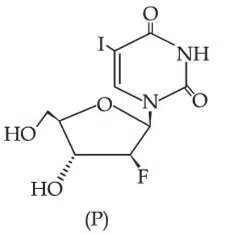
(Given: molar mass in g mol$$^{-1}$$ H: 1, C: 12, N: 14, O: 16, F: 19, I: 127)
correct answer:- 372
Question 14
During estimation of nitrogen by Dumas' method of compound X (0.42 g) :
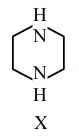
_________ mL of $$N_2$$ gas will be liberated at STP. (nearest integer)
(Given molar mass in g mol$$^{-1}$$ : C : 12, H : 1, N : 14)
correct answer:- 111
Question 15
The technique used for purification of steam volatile water immiscible substance is :
correct answer:- 4

Question 16
Given below are two statements :
Statement I : A mixture of C$$_{12}$$H$$_{22}$$O$$_{11}$$ (sugar) and NaCl can be separated by dissolving sugar in alcohol, due to differential solubility.
Statement II : Rose essence from rose petals is separated by steam distillation due to its high volatility and insolubility in H$$_2$$O.
In the light of the above statements, choose the correct answer from the options given below :
correct answer:- 1
Question 17
The principle of column chromatography is:
correct answer:- 1
Question 18
Which method of purification is used when the difference in the boiling points of two liquids is low (<25K)?
correct answer:- 1
Question 19
Copper wire test for halogens is known as
correct answer:- 2
Question 20
On a thin layer chromatographic plate, an organic compound moved by $$3.5 \text{ cm}$$, while the solvent moved by $$5 \text{ cm}$$. The retardation factor of the organic compound is ____________ $$\times 10^{-1}$$.
correct answer:- 7

Question 21
Chromatographic technique/s based on the principle of differential adsorption is/are
A. Column chromatography B. Thin layer chromatography C. Paper chromatography
Choose the most appropriate answer from the options given below:
correct answer:- 3
Question 22
1.4 g of an organic compound was digested according to Kjeldahl's method and the ammonia evolved was absorbed in 60 mL of M/10 $$H_2SO_4$$ solution. The excess sulphuric acid required 20 mL of M/10 NaOH solution for neutralization. The percentage of nitrogen in the compound is:
correct answer:- 4
Question 23
Question Stem (Q17 & Q18): Consider the following reaction sequence in which J , K , L and M are the major products.
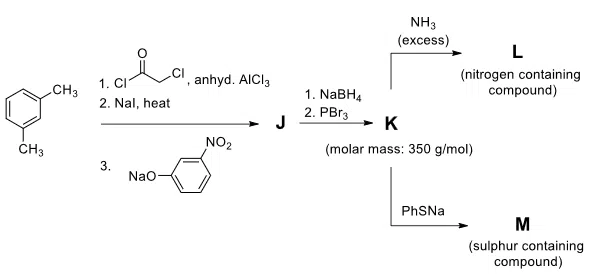
Given: Atomic mass (in amu): H : 1, C : 12, N : 14, O : 16, S : 32, Br : 80, Ba : 137
The volume of 1 M aqueous $$\mathrm{H_2SO_4}$$ required to completely neutralize the ammonia evolved from 5.72 g of L in Kjeldahl's method of nitrogen estimation is ___ mL.
correct answer:- 10.00
Question 24
The ammonia evolved from the treatment of $$0.30$$ g of an organic compound for the estimation of nitrogen was passed in $$100$$ mL of $$0.1$$ M sulphuric acid. The excess of acid required $$20$$ mL of $$0.5$$ M sodium hydroxide solution for complete neutralization. The organic compound is
correct answer:- 3
Question 25
Match the organic compounds in column - I with the Lassaigne's test result in column - II appropriately:
Column - I Column - II
A. Aniline i. Red colour with FeCl$$_3$$
B. Benzene sulfonic acid ii. Violet color with sodium nitroprusside
C. Thiourea iii. Blue color with acidic solution of FeSO$$_4$$
correct answer:- 2

Question 26
The correct match between items of List-I and List-II is
List - I List - II
(A) Coloured impurity (P) Steam distillation
(B) Mixture of o-nitrophenol and p-nitrophenol (Q) Fractional distillation
(C) Crude Naphtha (R) Charcoal treatment
(D) Mixture of glycerol and sugars (S) Distillation under reduced pressure
correct answer:- 3
Question 27
In Dumas' method for the estimation of nitrogen, $$0.5\text{ g}$$ of an organic compound yielded $$60\text{ mL}$$ of nitrogen gas collected at $$300\text{ K}$$ temperature and $$715\text{ mm Hg}$$ pressure. Calculate the percentage composition of nitrogen in the compound.
(Given: Aqueous tension at $$300\text{ K} = 15\text{ mm Hg}$$).
correct answer:- 4
Question 28
Which one of the following set of elements can be detected using sodium fusion extract?
correct answer:- 1
Question 29
A flask contains a mixture of isohexane and 3-methylpentane. One of the liquids boils at 63$$^\circ$$C while the other boils at 60$$^\circ$$C. What is the best way to separate the two liquids and which one will be distilled out first?
correct answer:- 1
Question 30
In Dumas' method for estimation of nitrogen, 0.5 gram of an organic compound gave 60 mL of nitrogen collected at 300 K temperature and 715 mm Hg pressure. The percentage composition of nitrogen in the compound (Aqueous tension at 300 K = 15 mm Hg) is
correct answer:- 4