
Join Our JEE Preparation Group
Prep with like-minded aspirants; Get access to free daily tests and study material.
Sign in
Please select an account to continue using cracku.in
↓ →
Join Our JEE Preparation Group
Prep with like-minded aspirants; Get access to free daily tests and study material.
Chromatographic technique/s based on the principle of differential adsorption is/are
A. Column chromatography B. Thin layer chromatography C. Paper chromatography
Choose the most appropriate answer from the options given below:
We need to identify which chromatographic techniques are based on the principle of differential adsorption.
A. Column Chromatography:
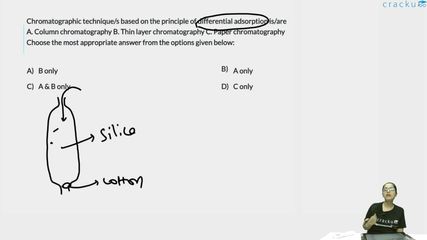
In column chromatography, the stationary phase is a solid adsorbent (such as silica gel or alumina) packed in a column. Components of the mixture are separated based on their different degrees of adsorption on the solid stationary phase. This is based on the principle of differential adsorption.
B. Thin Layer Chromatography (TLC):
In TLC, a thin layer of adsorbent (silica gel or alumina) is coated on a glass plate. The components separate based on their different adsorption affinities for the stationary solid phase. This is also based on the principle of differential adsorption.
C. Paper Chromatography:
In paper chromatography, water trapped in the cellulose fibres of the paper acts as the stationary phase (liquid), and the mobile phase is an organic solvent. Components separate based on their different partition coefficients between the two liquid phases. This is based on the principle of differential partition, not adsorption.
Therefore, only Column Chromatography (A) and Thin Layer Chromatography (B) are based on differential adsorption.
The correct answer is Option 3: A & B only.
Was this solution helpful?
Click on the Email ☝️ to Watch the Video Solution
Create a FREE account and get:
_1.webp)

Educational materials for JEE preparation

Ask our AI anything

AI can make mistakes. Please verify important information.
AI can make mistakes. Please verify important information.
