
Join Our JEE Preparation Group
Prep with like-minded aspirants; Get access to free daily tests and study material.
Sign in
Please select an account to continue using cracku.in
↓ →
Join Our JEE Preparation Group
Prep with like-minded aspirants; Get access to free daily tests and study material.
1.4 g of an organic compound was digested according to Kjeldahl's method and the ammonia evolved was absorbed in 60 mL of M/10 $$H_2SO_4$$ solution. The excess sulphuric acid required 20 mL of M/10 NaOH solution for neutralization. The percentage of nitrogen in the compound is:
First, we need to find the percentage of nitrogen in the organic compound using Kjeldahl's method. The compound weighs 1.4 grams. After digestion, the ammonia evolved is absorbed in 60 mL of M/10 $$H_2SO_4$$ solution. M/10 means the molarity is 0.1 mol/L, so this is a 0.1 M $$H_2SO_4$$ solution.
The ammonia reacts with sulfuric acid according to the reaction: $$2NH_3 + H_2SO_4 \rightarrow (NH_4)_2SO_4$$. This shows that 2 moles of ammonia react with 1 mole of sulfuric acid.
The excess sulfuric acid is then neutralized by 20 mL of M/10 NaOH solution. M/10 NaOH is also 0.1 M, meaning 0.1 mol/L.
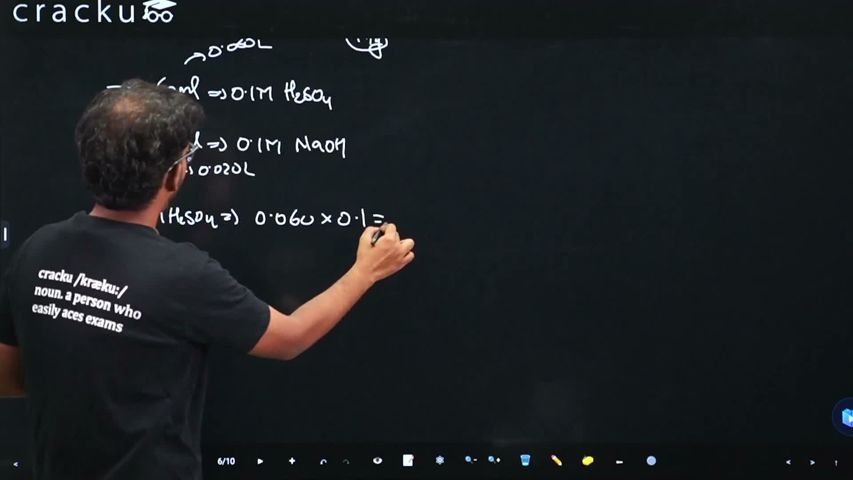
To find the moles of sulfuric acid initially added: volume is 60 mL, which is 60/1000 = 0.06 liters. Molarity is 0.1 M, so moles of $$H_2SO_4$$ added = volume in liters × molarity = 0.06 × 0.1 = 0.006 moles.
Now, the excess sulfuric acid is neutralized by NaOH. The reaction between NaOH and $$H_2SO_4$$ is: $$2NaOH + H_2SO_4 \rightarrow Na_2SO_4 + 2H_2O$$. This shows that 2 moles of NaOH react with 1 mole of $$H_2SO_4$$.
Moles of NaOH used: volume is 20 mL = 20/1000 = 0.02 liters, molarity is 0.1 M, so moles of NaOH = 0.02 × 0.1 = 0.002 moles.
Since 2 moles of NaOH neutralize 1 mole of $$H_2SO_4$$, the moles of excess $$H_2SO_4$$ = moles of NaOH / 2 = 0.002 / 2 = 0.001 moles.
The moles of $$H_2SO_4$$ consumed by ammonia = total moles added - excess moles = 0.006 - 0.001 = 0.005 moles.
From the reaction $$2NH_3 + H_2SO_4 \rightarrow (NH_4)_2SO_4$$, 1 mole of $$H_2SO_4$$ reacts with 2 moles of $$NH_3$$. Therefore, moles of ammonia produced = 2 × moles of $$H_2SO_4$$ consumed = 2 × 0.005 = 0.01 moles.
In Kjeldahl's method, each mole of ammonia comes from one mole of nitrogen in the compound. So, moles of nitrogen = moles of ammonia = 0.01 moles.
Mass of nitrogen = moles × atomic mass = 0.01 × 14 = 0.14 grams (since atomic mass of nitrogen is 14 g/mol).
Mass of the organic compound is 1.4 grams. Percentage of nitrogen = (mass of nitrogen / mass of compound) × 100 = (0.14 / 1.4) × 100.
First, 0.14 divided by 1.4 is 0.1. Then, 0.1 × 100 = 10. So, the percentage is 10%.
Hence, the correct answer is Option D.
Was this solution helpful?
Click on the Email ☝️ to Watch the Video Solution
Create a FREE account and get:
_1.webp)

Educational materials for JEE preparation

Ask our AI anything

AI can make mistakes. Please verify important information.
AI can make mistakes. Please verify important information.
