
Join Our JEE Preparation Group
Prep with like-minded aspirants; Get access to free daily tests and study material.
Sign in
Please select an account to continue using cracku.in
↓ →
Join Our JEE Preparation Group
Prep with like-minded aspirants; Get access to free daily tests and study material.
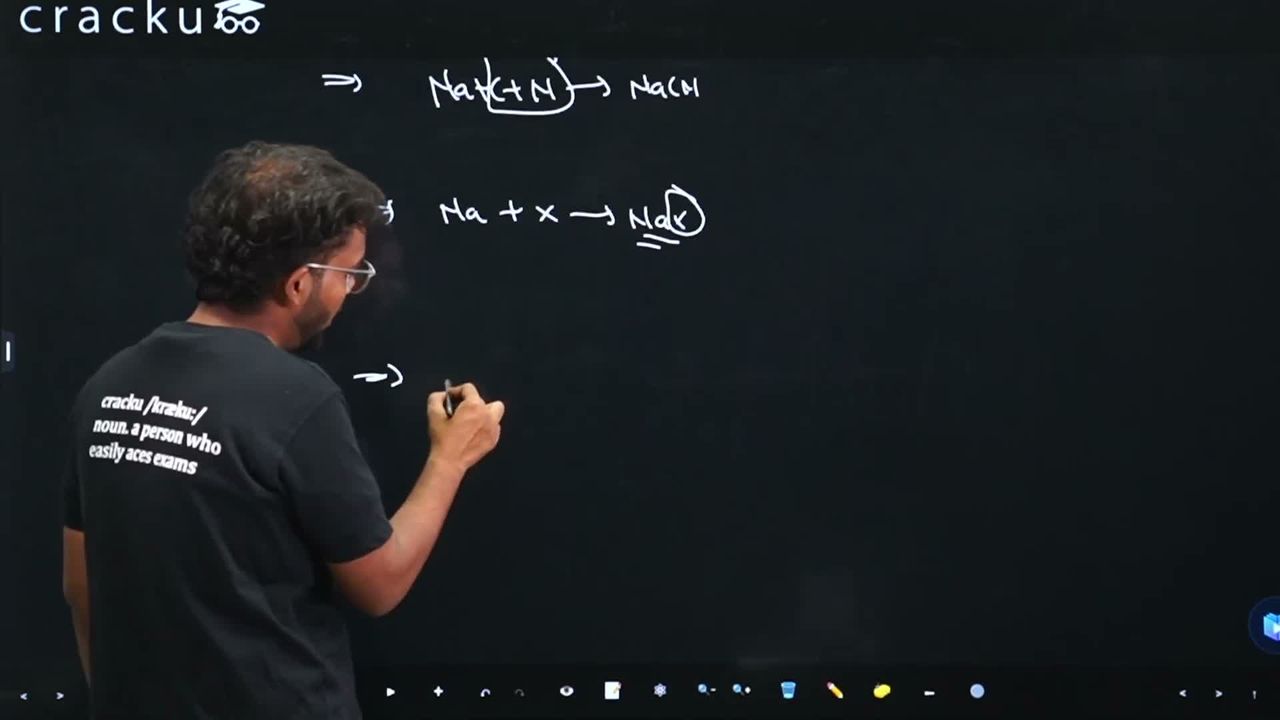
Lassaigne's test detects nitrogen and halogens in organic compounds by fusing the compound with sodium metal. The key reactions are:
For nitrogen: $$\text{Na} + \text{C} + \text{N} \rightarrow \text{NaCN}$$
For halogens: $$\text{Na} + \text{X} \rightarrow \text{NaX}$$
For the test to detect nitrogen, the compound must contain carbon (to form NaCN).
Let us examine each option:
Option A: $$\text{N}_2\text{H}_4 \cdot \text{HCl}$$ (Hydrazine hydrochloride) — Contains N and Cl, but no carbon. Without carbon, NaCN cannot form, so nitrogen detection fails.
Option B: $$\text{CH}_3\text{NH}_2 \cdot \text{HCl}$$ (Methylamine hydrochloride) — Contains C, N, and Cl. Carbon is present, so NaCN forms (positive nitrogen test). Cl is present, so NaCl forms (positive halogen test). Both tests are positive.
Option C: $$\text{NH}_4\text{Cl}$$ — Contains N and Cl, but no carbon. Nitrogen test fails.
Option D: $$\text{NH}_2\text{OH} \cdot \text{HCl}$$ (Hydroxylamine hydrochloride) — Contains N and Cl, but no carbon. Nitrogen test fails.
The answer is Option B: $$\text{CH}_3\text{NH}_2 \cdot \text{HCl}$$.
Was this solution helpful?
Click on the Email ☝️ to Watch the Video Solution
Create a FREE account and get:
_1.webp)

Educational materials for JEE preparation

Ask our AI anything

AI can make mistakes. Please verify important information.
AI can make mistakes. Please verify important information.
