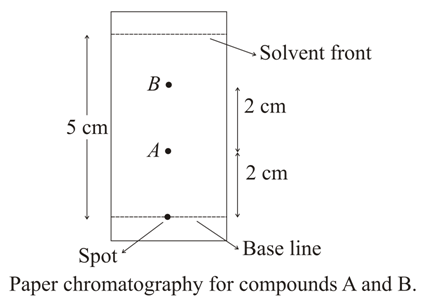
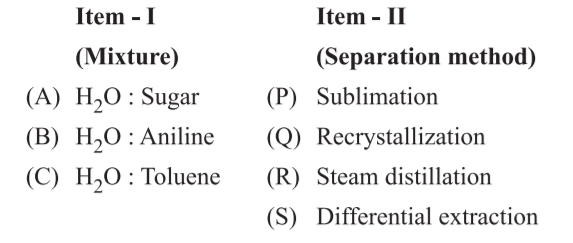
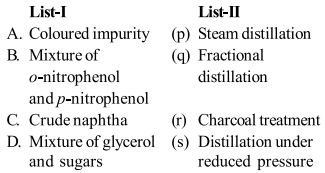
Given below are two statements:
Statement I: Griss-Ilosvay test is used for the detection of nitrite ion, which involves the use of sulphanilic acid and $$\alpha-naphthylamine$$ reagent.
Statement II: In the above test, sulphanilic acid is diazotized by the acidified nitrite ion, which on further coupling with $$\alpha-naphthylamine$$ forms an azo-dye.
In the light of the above statements, choose the correct answer from the options given below
JEE Purification & Characterisation Questions
We need to evaluate two statements about the Griss-Ilosvay test for nitrite ion.
Statement I: The Griss-Ilosvay test uses sulphanilic acid and α-naphthylamine for nitrite detection.
This is TRUE. This is the standard reagent combination for the test.
Statement II: Sulphanilic acid is diazotized by acidified nitrite ion, which then couples with α-naphthylamine to form an azo dye.
This is TRUE. The nitrite first diazotizes sulphanilic acid to form a diazonium salt, which then couples with α-naphthylamine to produce a red/orange azo dye.
Both statements are true, which corresponds to Option 4.
Given below are two statements :
Statement I: Sublimation is used for the separation and purification of compounds with low melting Point.
Statement II: The boiling point of a liquid increases as the external pressure is reduced.
In the light of the above statements, choose the correct answer from the options given below :
Sublimation is defined as the process in which a solid converts directly into vapour without passing through the liquid state. This process is feasible only when the substance has a significant vapour pressure at a temperature below its melting point. Therefore, sublimation depends on the vapour pressure characteristics of a compound, not on having a low melting point. Hence Statement I is false.
The boiling point of a liquid is the temperature at which its vapour pressure $$P_{\text{vap}}$$ equals the external pressure $$P_{\text{ext}}$$: $$P_{\text{vap}} = P_{\text{ext}}$$ When the external pressure is reduced, the temperature required for the vapour pressure to reach that lower external pressure also decreases. Thus the boiling point decreases as the external pressure is reduced. Statement II claims the boiling point increases on reducing external pressure, which contradicts this principle. Hence Statement II is false.
Since both Statement I and Statement II are false, the correct choice is Option B.
Given below are two statements :
Statement I : A mixture of C$$_{12}$$H$$_{22}$$O$$_{11}$$ (sugar) and NaCl can be separated by dissolving sugar in alcohol, due to differential solubility.
Statement II : Rose essence from rose petals is separated by steam distillation due to its high volatility and insolubility in H$$_2$$O.
In the light of the above statements, choose the correct answer from the options given below :
Given below are two statements :
Statement I : Vapours of the liquid with higher boiling point condense before vapours of the liquid with lower boiling points in fractional distillation.
Statement II : The vapours rising up in the fractionating column become richer in high boiling component of the mixture.
In the light of the above statements, choose the correct answer from the options given below :
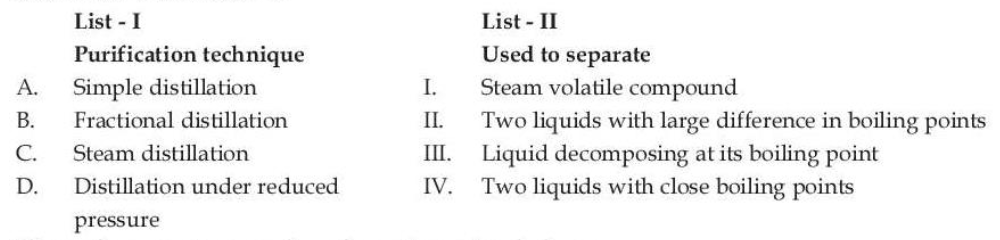
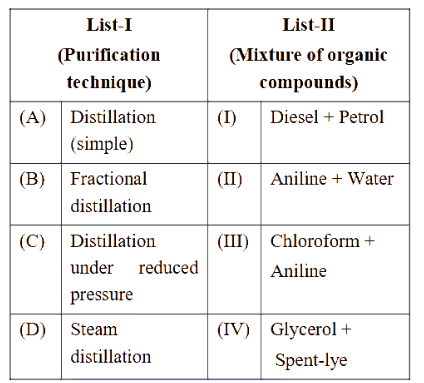
Match the List I with List II:

Choose the correct answer from the options given below:
Given below are two statements :
**Statement (I) :** 1,2,3-Trihydroxypropane can be separated from water by simple distillation.
**Statement (II) :** An azeotropic mixture cannot be separated by fractional distillation.
In the light of the above statements, choose the correct answer from the options given below :
The compound 1,2,3-trihydroxypropane is commonly called glycerol.
Boiling points
• Water : $$373\ \text{K} \ (100^{\circ}\text{C})$$
• Glycerol : $$563\ \text{K} \ (290^{\circ}\text{C})$$
For separation by simple distillation two conditions must be satisfied: (i) the components should be non-reactive and miscible, and (ii) their boiling points should differ by more than about $$25\ ^{\circ}\text{C}$$. The difference here is nearly $$190^{\circ}\text{C}$$, far exceeding the required gap. During heating, water vapourises at $$100^{\circ}\text{C}$$ and is collected; glycerol, with a very high boiling point, remains in the distillation flask. Hence glycerol (1,2,3-trihydroxypropane) can indeed be separated from water by simple distillation. Therefore, Statement (I) is true.
An azeotropic mixture boils at a fixed temperature without any change in composition because both the liquid and its vapour have identical compositions at the boiling point. Since fractional distillation works on the principle that vapour is richer in the more volatile component, it fails when this condition is absent. Consequently, an azeotrope cannot be resolved into its components by ordinary fractional distillation (special techniques such as azeotropic or pressure-swing distillation are required). Hence, Statement (II) is also true.
Both statements are correct, so the appropriate choice is:
Option A which is: Both Statement I and Statement II are true
Compounds that should not be used as primary standards in titrimetric analysis are:
A. $$Na_2Cr_2O_7$$
B. Oxalic acid
C. NaOH
D. $$FeSO_4 \cdot 6H_2O$$
E. Sodium tetraborate
Choose the most appropriate answer from the options given below:
In titrimetric (volumetric) analysis a primary standard is the substance that is weighed accurately, dissolved, and its solution is used to standardise another reagent. For a compound to serve as a primary standard it must satisfy all the conditions below:
• Very high purity and known formula
• Stable in air (non-hygroscopic, non-deliquescent, does not react with $$CO_2$$ or $$O_2$$)
• Reasonably high molar/equivalent mass (reduces weighing error)
• Soluble in the chosen solvent and gives a stoichiometric reaction
• Non-toxic and easily available
Let us test each compound given in the question against the above requirements.
Case A:$$Na_2Cr_2O_7$$ (sodium dichromate)
This salt is strongly hygroscopic and absorbs moisture from air, so its weighed mass does not give a fixed number of moles. Hence it fails the “stable in air” criterion and should not be used as a primary standard.
Oxalic acid, generally used as the dihydrate $$H_2C_2O_4\cdot 2H_2O$$, is available in high purity, has a fixed water of crystallisation, is not hygroscopic, and has a suitable equivalent mass. Therefore it is a good primary standard and is widely used for standardising $$KMnO_4$$.
Case C:NaOH (sodium hydroxide) readily absorbs both $$H_2O$$ (moisture) and $$CO_2$$ from the atmosphere, forming $$Na_2CO_3$$. Because of this, its composition changes while weighing. Thus NaOH cannot be used as a primary standard.
Case D:$$FeSO_4\cdot 6H_2O$$ (ferrous sulphate hexahydrate) slowly oxidises to $$Fe^{3+}$$ in air and also effloresces (loses water). Hence its exact formula weight changes with time. It is therefore unsuitable as a primary standard.
Case E:Sodium tetraborate (borax), $$Na_2B_4O_7\cdot 10H_2O$$, is available in very pure form, is not appreciably hygroscopic, and has a high equivalent mass. Because it meets all the criteria, it is an excellent primary standard for acid-base titrations.
Summarising the suitability:
• Not suitable → A ($$Na_2Cr_2O_7$$), C (NaOH), D ($$FeSO_4\cdot 6H_2O$$)
• Suitable → B (oxalic acid), E (sodium tetraborate)
The compounds that should NOT be used as primary standards are therefore A, C and D only.
Option D is correct.
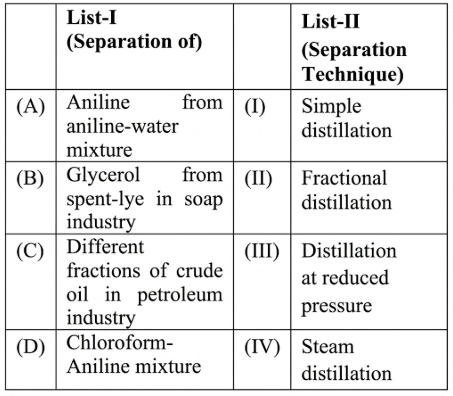
Match List-I (Separation of) with List-II (Separation Technique) :

Choose the correct answer from the options given below :
In separation techniques we always match the physical property of the mixture with the most suitable method:
Case A: Aniline-water mixture
Aniline boils around $$184^{\circ}\text{C}$$ and is immiscible with water. When such a liquid is subjected to steam, the total vapour pressure is the sum of the individual vapour pressures, so the mixture boils below $$100^{\circ}\text{C}$$ and aniline distils along with steam. Hence the correct technique is steam distillation.
Case B: Glycerol from spent-lye in the soap industry
Pure glycerol decomposes near its normal boiling point $$\left(\approx 290^{\circ}\text{C}\right)$$. To avoid decomposition it is distilled under low pressure, so that it boils at a much lower temperature. Therefore we need distillation at reduced (vacuum) pressure.
Case C: Different fractions of crude oil
Crude petroleum contains components whose boiling ranges overlap over fairly narrow intervals. Separation is done in a fractionating column where rising vapours repeatedly condense and revapourise. This is classical fractional distillation.
Case D: Chloroform-aniline mixture
Chloroform boils at $$61^{\circ}\text{C}$$ while aniline boils at $$184^{\circ}\text{C}$$. Such a large difference means the lower-boiling component can be collected first without elaborate apparatus. Hence we use simple distillation.
Summarising the matches:
(A) Aniline / water → IV Steam distillation
(B) Glycerol / spent-lye → III Distillation at reduced pressure
(C) Crude-oil fractions → II Fractional distillation
(D) Chloroform / aniline → I Simple distillation
Therefore the correct choice is Option A.
The purification method based on the following physical transformation is :
In Dumas' method for estimation of nitrogen 0.4 g of an organic compound gave 60 mL of nitrogen collected at 300 K temperature and 715 mm Hg pressure. The percentage composition of nitrogen in the compound is (Given: Aqueous tension at 300 K = 15 mm Hg)
In Dumas’ method the nitrogen gas collected over water is always moist, so we must first obtain the volume of dry nitrogen using Dalton’s law of partial pressures.
Total pressure of the gas mixture, $$P_{\text{total}} = 715 \text{ mm Hg}$$
Aqueous tension of water at $$300 \text{ K},\, P_{\text{H}_2\text{O}} = 15 \text{ mm Hg}$$
Hence, pressure of dry nitrogen
$$P_{\text{N}_2} = P_{\text{total}} - P_{\text{H}_2\text{O}} = 715 - 15 = 700 \text{ mm Hg}$$
Convert this pressure into atmospheres because the gas constant $$R$$ in SI units involves atmospheres:
$$1 \text{ atm} = 760 \text{ mm Hg}$$, therefore
$$P = \frac{700}{760} \text{ atm} = 0.921 \text{ atm}$$ (rounded to three significant figures)
The measured volume of nitrogen is
$$V = 60 \text{ mL} = 0.060 \text{ L}$$
Temperature is
$$T = 300 \text{ K}$$
Use the ideal-gas equation $$PV = nRT$$ to find the number of moles of nitrogen.
Gas constant, $$R = 0.0821 \text{ L atm mol}^{-1}\text{K}^{-1}$$
Substituting the values:
$$n = \frac{PV}{RT} = \frac{0.921 \times 0.060}{0.0821 \times 300}$$
Calculate the numerator:
$$0.921 \times 0.060 = 0.0553$$
Calculate the denominator:
$$0.0821 \times 300 = 24.63$$
Hence,
$$n = \frac{0.0553}{24.63} = 0.00224 \text{ mol}$$
Mass of nitrogen present:
Molar mass of $$\text{N}_2 = 28 \text{ g mol}^{-1}$$, so
$$m_{\text{N}_2} = n \times 28 = 0.00224 \times 28 = 0.0628 \text{ g}$$
The original mass of the organic compound taken was $$0.400 \text{ g}$$. Therefore, percentage of nitrogen in the compound is
$$\%\text{N} = \frac{0.0628}{0.400} \times 100 = 15.7\%$$ (to three significant figures)
Thus the percentage composition of nitrogen in the compound is $$\mathbf{15.71\%}$$.
Option A is correct.
Match List-I with List-II.

Choose the correct answer from the options given below :
Case A : Simple distillation
Simple (ordinary) distillation is used when the two liquids are completely miscible and their boiling points differ by more than about $$25^{\circ}\text{C}$$.
Chloroform boils at $$61^{\circ}\text{C}$$ while aniline boils at $$184^{\circ}\text{C}$$, a difference of $$123^{\circ}\text{C}$$.
Therefore the pair chloroform + aniline can be separated by ordinary distillation.
Hence (A) → (III).
Case B : Fractional distillation
Fractional distillation is chosen for mixtures whose components are miscible and have boiling points that are close to each other (difference less than about $$25^{\circ}\text{C}$$).
Petrol and diesel are overlapping fractions of petroleum whose components possess closely spaced boiling ranges; they are separated industrially in a fractionating tower.
Hence (B) → (I).
Case C : Distillation under reduced pressure (vacuum distillation)
When a liquid has a very high boiling point and tends to decompose at its normal boiling point, it is distilled at a lowered external pressure so that it boils at a lower temperature.
Glycerol (bp $$\approx 563\ \text{K}$$) is separated from spent-lye (the residual liquor in soap manufacture) by vacuum distillation to avoid its decomposition.
Hence (C) → (IV).
Case D : Steam distillation
Steam distillation is applicable to compounds that are volatile in steam, immiscible with water, and possess high boiling points.
Aniline is immiscible with water and forms a separate layer; it distils along with steam at a temperature much lower than its normal boiling point, allowing its separation from water.
Hence (D) → (II).
Collecting all matches:
(A) - (III), (B) - (I), (C) - (IV), (D) - (II).
This correspondence is provided by Option D.
Given below are two statements : Statement (I): In partition chromatography, stationary phase is thin film of liquid present in the inert support. Statement (II) : In paper chromatography, the material of paper acts as a stationary phase. In the light of the above statements, choose the correct answer from the options given below :
Statement I: In partition chromatography, the stationary phase is a thin film of liquid present on an inert support. This is correct - partition chromatography is based on the partitioning of components between a liquid stationary phase held on a solid support and a mobile phase.
Statement II: In paper chromatography, the material of paper acts as the stationary phase. This is incorrect. In paper chromatography, the water trapped in the cellulose fibers of the paper acts as the stationary phase (liquid), not the paper material itself. Paper chromatography is actually a type of partition chromatography.
The correct answer is Option 1: Statement I is true but Statement II is false.
During estimation of nitrogen by Dumas' method of compound X (0.42 g) :

_________ mL of $$N_2$$ gas will be liberated at STP. (nearest integer)
(Given molar mass in g mol$$^{-1}$$ : C : 12, H : 1, N : 14)
In Dumas' method for estimation of nitrogen, 0.5 gram of an organic compound gave 60 mL of nitrogen collected at 300 K temperature and 715 mm Hg pressure. The percentage composition of nitrogen in the compound (Aqueous tension at 300 K = 15 mm Hg) is
In Dumas’ method, nitrogen is collected over water, so the measured pressure includes the vapour pressure of water (aqueous tension).
To obtain the pressure of dry nitrogen, subtract the aqueous tension from the total pressure.
Total pressure of the gas mixture at $$300\ \text{K} = 715\ \text{mm Hg}$$.
Aqueous tension of water at $$300\ \text{K} = 15\ \text{mm Hg}$$.
Pressure of dry $$N_2$$:
$$P_{N_2}=715\ \text{mm Hg}-15\ \text{mm Hg}=700\ \text{mm Hg}$$.
Convert this pressure to atmospheres (because the gas constant $$R$$ we shall use is in $$\text{L atm mol}^{-1}\text{K}^{-1}$$):
$$P=\frac{700}{760}\ \text{atm}=0.921\ \text{atm}$$.
Volume of nitrogen collected:
$$V =60\ \text{mL}=0.06\ \text{L}$$.
Temperature:
$$T =300\ \text{K}$$.
Ideal gas equation: $$PV = nRT$$.
Gas constant: $$R =0.0821\ \text{L atm mol}^{-1}\text{K}^{-1}$$.
Calculate moles of nitrogen:
$$n=\frac{PV}{RT}= \frac{0.921 \times 0.06}{0.0821 \times 300}$$.
Numerator: $$0.921 \times 0.06 = 0.05526$$.
Denominator: $$0.0821 \times 300 = 24.63$$.
Thus,
$$n = \frac{0.05526}{24.63}=0.002244\ \text{mol}$$.
Molar mass of $$N_2 =28\ \text{g mol}^{-1}$$.
Mass of nitrogen present:
$$m = n \times 28 = 0.002244 \times 28 = 0.06283\ \text{g}$$.
Mass of the organic sample taken: $$0.5\ \text{g}$$.
Percentage of nitrogen in the compound:
$$\%N = \frac{0.06283}{0.5} \times 100 = 12.57\%$$.
The percentage composition of nitrogen in the compound is $$\mathbf{12.57\%}$$.
Hence, the correct choice is Option D.
0.5 g of an organic compound on combustion gave 1.46 g of $$CO_2$$ and 0.9 g of $$H_2O$$. The percentage of carbon in the compound is _________. (Nearest integer)
[Given : Molar mass (in g mol$$^{-1}$$) C : 12, H : 1, O : 16]
The percentage of an element in an unknown organic compound can be obtained from its combustion data by first calculating the mass of that element present in the measured amounts of $$CO_2$$ and $$H_2O$$, then relating that mass to the original mass of the compound.
Mass of organic compound taken: $$0.5 \text{ g}$$.
Step 1: Find mass of carbon present
• Every mole of $$CO_2$$ contains one mole of carbon.
• Molar mass of $$CO_2$$ is $$44 \text{ g mol}^{-1}$$, and the mass of carbon in each mole is $$12 \text{ g}$$.
Therefore the mass of carbon obtained from $$1.46 \text{ g}$$ of $$CO_2$$ is
$$\text{mass of C}=1.46\; \frac{12}{44}$$
Simplifying,
$$\text{mass of C}=1.46 \times 0.2727 = 0.398 \text{ g (approximately)}$$.
Step 2: Calculate percentage of carbon
Percentage of carbon $$= \frac{\text{mass of C in product}}{\text{mass of original sample}}\times 100$$
$$\%\,\text{C}= \frac{0.398}{0.5}\times 100 = 79.6$$
Rounding to the nearest integer, the percentage of carbon is $$\mathbf{80}$$.
Hence, the required percentage of carbon in the organic compound is 80 %.
In Dumas' method for estimation of nitrogen 1g of an organic compound gave 150 mL of nitrogen collected at 300K temperature and 900 mm Hg pressure. The percentage composition of nitrogen in the compound is ________ % (nearest integer). (Aqueous tension at 300 K = 15 mm Hg)
In Dumas’ method the nitrogen gas is collected over water, so the measured pressure is the total (nitrogen + water-vapour) pressure. We must first obtain the partial pressure of dry nitrogen.
Total pressure of the gas mixture, $$P_{\text{total}} = 900 \text{ mm Hg}$$
Aqueous tension at $$300 \text{ K},\; P_{\text{H}_2O} = 15 \text{ mm Hg}$$
Therefore, pressure of dry $$N_2$$ is
$$P_{N_2} = P_{\text{total}} - P_{\text{H}_2O} = 900 - 15 = 885 \text{ mm Hg}$$
Convert this pressure into atmospheres for use in the ideal-gas equation:
$$P_{N_2} = \frac{885}{760} \text{ atm} = 1.164 \text{ atm (approx)}$$
Volume of nitrogen collected,
$$V = 150 \text{ mL} = 0.150 \text{ L}$$
Temperature,
$$T = 300 \text{ K}$$
Ideal-gas constant (in compatible units),
$$R = 0.0821 \text{ L atm mol}^{-1}\text{ K}^{-1}$$
Using the ideal-gas equation $$PV = nRT$$ to find the moles of $$N_2$$:
$$n = \frac{PV}{RT} = \frac{(1.164)\,(0.150)}{(0.0821)\,(300)}$$
Calculate $$n$$:
Numerator: $$1.164 \times 0.150 = 0.1746$$
Denominator: $$0.0821 \times 300 = 24.63$$
$$n = \frac{0.1746}{24.63} = 0.00709 \text{ mol}$$
Mass of nitrogen present (each mole of $$N_2$$ weighs $$28 \text{ g}$$):
$$m_{N} = n \times 28 = 0.00709 \times 28 = 0.1985 \text{ g}$$
The organic sample weighed $$1.00 \text{ g}$$, so the percentage of nitrogen is
$$\%N = \frac{0.1985}{1.00} \times 100 = 19.85\%$$
To the nearest integer, the percentage composition of nitrogen in the compound is **20 %**.
In the sulphur estimation, 0.20 g of a pure organic compound gave 0.40 g of barium sulphate. The percentage of sulphur in the compound is ______ $$\times 10^{-1}%$$. (Molar mass : O = 16, S=32, Ba = 137 in $$gmol^{-1}$$)
In sulphur estimation, the organic compound is converted to $$BaSO_4$$.
Molar mass of $$BaSO_4 = 137 + 32 + 64 = 233$$ g/mol.
Mass of S in $$BaSO_4$$ = $$\frac{32}{233} \times 0.40 = \frac{12.8}{233}$$ g
Percentage of S = $$\frac{32}{233} \times \frac{0.40}{0.20} \times 100 = \frac{32 \times 200}{233} = \frac{6400}{233} = 27.47\%$$
In the form $$x \times 10^{-1}\%$$: $$27.47 = 274.7 \times 10^{-1}$$, so $$x \approx 275$$.
The answer is 275.
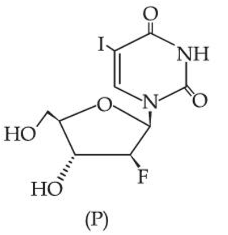
0.1 mol of the following given antiviral compound (P) will weigh _______ $$\times 10^{-1}$$ g.
(Given: molar mass in g mol$$^{-1}$$ H: 1, C: 12, N: 14, O: 16, F: 19, I: 127)
Which among the following purification methods is based on the principle of "Solubility" in two different solvents?
The purification method based on the principle of solubility in two different solvents is Differential Extraction.
In differential extraction, a substance is partitioned between two immiscible solvents based on its different solubilities in each.
The answer is Option (4): $$\boxed{\text{Differential Extraction}}$$.
'Adsorption' principle is used for which of the following purification method?
We need to identify which purification method uses the principle of adsorption.
Analysis of each method:
Extraction: This method is based on the principle of differential solubility of a compound in two immiscible solvents. It does not use adsorption.
Chromatography: This technique separates components of a mixture based on differential adsorption of the components on an adsorbent (stationary phase). The mixture is passed through a column of adsorbent (such as silica gel or alumina), and different components are adsorbed to different extents, allowing separation. Column chromatography, thin-layer chromatography (TLC), and other forms all rely on this principle.
Distillation: This method separates liquids based on differences in their boiling points. It does not involve adsorption.
Sublimation: This method separates substances based on their ability to sublime (convert directly from solid to vapor). It does not use adsorption.
The correct answer is Option (2): Chromatography.
The technique used for purification of steam volatile water immiscible substance is :
{image}
Which of the following nitrogen containing compound does not give Lassaigne's test?
Lassaigne's test involves fusing the organic compound with sodium metal to convert covalent organic compounds into ionic compounds (NaCN for N-containing compounds).
Hydrazine (N₂H₄) does not contain carbon. In Lassaigne's test, N is detected through the formation of NaCN, which requires both N and C. Since hydrazine has no carbon, it cannot form NaCN and hence does not give a positive Lassaigne's test for nitrogen.
The correct answer is Option 4: Hydrazine.
Chromatographic technique/s based on the principle of differential adsorption is/are
A. Column chromatography B. Thin layer chromatography C. Paper chromatography
Choose the most appropriate answer from the options given below:
We need to identify which chromatographic techniques are based on the principle of differential adsorption.
A. Column Chromatography:
In column chromatography, the stationary phase is a solid adsorbent (such as silica gel or alumina) packed in a column. Components of the mixture are separated based on their different degrees of adsorption on the solid stationary phase. This is based on the principle of differential adsorption.
B. Thin Layer Chromatography (TLC):
In TLC, a thin layer of adsorbent (silica gel or alumina) is coated on a glass plate. The components separate based on their different adsorption affinities for the stationary solid phase. This is also based on the principle of differential adsorption.
C. Paper Chromatography:
In paper chromatography, water trapped in the cellulose fibres of the paper acts as the stationary phase (liquid), and the mobile phase is an organic solvent. Components separate based on their different partition coefficients between the two liquid phases. This is based on the principle of differential partition, not adsorption.
Therefore, only Column Chromatography (A) and Thin Layer Chromatography (B) are based on differential adsorption.
The correct answer is Option 3: A & B only.
The adsorbent used in adsorption chromatography is/are: A. silica gel, B. alumina, C. quick lime, D. magnesia. Choose the most appropriate answer from the options given below:
{image}
The fragrance of flowers is due to the presence of some steam volatile organic compounds called essential oils. These are generally insoluble in water at room temperature but are miscible with water vapour in the vapour phase. A suitable method for the extraction of these oils from the flowers is:
We need to identify the suitable method for extracting essential oils from flowers.
Key Concept: The essential oils are (i) steam-volatile organic compounds, (ii) insoluble in water at room temperature, and (iii) miscible with water vapour in the vapour phase.
Option D: Steam distillation is the correct method. In steam distillation, steam is passed through the plant material. The essential oils, being volatile, vaporize along with the steam at a temperature below their normal boiling point. The mixed vapours of water and oil are then condensed. Since the oils are immiscible with water at room temperature, the condensed mixture separates into two layers, allowing the essential oil to be easily separated. This method is specifically designed for compounds that are steam-volatile but water-insoluble—exactly matching the properties described in the question.
The correct answer is Option D.
In Kjeldahl's method for estimation of nitrogen, $$CuSO_4$$ acts as :
In Kjeldahl's method, we need to identify the role of $$CuSO_4$$.
Kjeldahl's method overview:
This method estimates nitrogen content in organic compounds through three steps: digestion, distillation, and titration.
Role of $$CuSO_4$$ in the digestion step:
During digestion, the organic compound is heated with concentrated $$H_2SO_4$$. The nitrogen in the organic compound is converted to ammonium sulfate $$(NH_4)_2SO_4$$. $$CuSO_4$$ acts as a catalyst in this process:
- The $$Cu^{2+}$$ ions accelerate the oxidative breakdown of the organic compound.
- They help achieve faster and more complete conversion of organic nitrogen to $$NH_4^+$$.
- Without the catalyst, the digestion would be much slower and may be incomplete.
$$K_2SO_4$$ is also added to raise the boiling point of the acid mixture, but $$CuSO_4$$ specifically serves as a catalytic agent.
The correct answer is Option B: Catalytic agent.
Lassaigne's test is used for detection of:
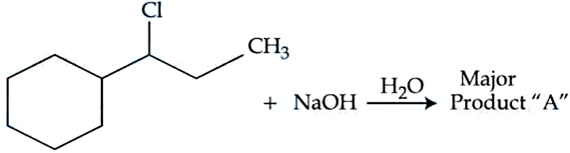
{image}
Consider the above chemical reaction. Product "A " is :
Given below are two statements : Statement (I) : $$S_N2$$ reactions are 'stereospecific', indicating that they result in the formation of only one stereo-isomer as the product. Statement (II) : $$S_N1$$ reactions generally result in formation of product as racemic mixtures. In the light of the above statements, choose the correct answer from the options given below :
We need to evaluate both statements about nucleophilic substitution reactions.
Statement (I): $$S_N2$$ reactions are 'stereospecific', indicating that they result in the formation of only one stereo-isomer as the product.
In $$S_N2$$ reactions, the nucleophile attacks from the back side of the carbon bearing the leaving group (backside attack). This results in a Walden inversion, producing a single stereoisomer with inverted configuration. Hence, $$S_N2$$ reactions are indeed stereospecific. Statement I is true.
Statement (II): $$S_N1$$ reactions generally result in formation of product as racemic mixtures.
In $$S_N1$$ reactions, the rate-determining step involves the formation of a planar carbocation intermediate. The nucleophile can attack this planar carbocation from either side with nearly equal probability, leading to a mixture of both R and S configurations — a racemic mixture. Statement II is true.
Since both statements are true, the correct answer is Option 4: Both Statement I and Statement II are true.
Which among the following compounds will undergo fastest $$S_N2$$ reaction.
- Option A: (Bromomethyl)cyclobutane
- The carbon attached to $$-\text{Br}$$ is directly bonded to only one other carbon (the cyclobutane ring carbon).
- This is a primary ($$1^\circ$$) alkyl halide. It has the least steric hindrance, leaving the backside wide open for a nucleophilic attack.
- Option B:
- The carbon attached to $$-\text{Br}$$ is bonded to two other carbons (the ring and a methyl group).
- This is a secondary ($$2^\circ$$) alkyl halide. Increased steric hindrance slows the reaction down.
- Option C: 1-Bromo-1-methylcyclobutane
- The carbon attached to $$-\text{Br}$$ is a tertiary ring carbon.
- This is a tertiary ($$3^\circ$$) alkyl halide. Tertiary halides are too crowded for backside attack and generally do not undergo $$\text{S}_\text{N}2$$ reactions at all.
- Option D:
- The carbon attached to $$-\text{Br}$$ is a tertiary ($$3^\circ$$) alkyl halide attached to a bulky neopentyl-like branch system. Extremely sterically hindered.
The general rate of reactivity for $$\text{S}_\text{N}2$$ reactions follows the order:
$$\text{Methyl} > 1^\circ > 2^\circ > 3^\circ$$
Given below are two statements : one is labelled as Assertion (A) and the other is labelled as Reason (R). Assertion (A) : $$S_N2$$ reaction of $$C_6H_5CH_2Br$$ occurs more readily than the $$S_N2$$ reaction of $$CH_3CH_2Br$$. Reason (R) : The partially bonded unhybridized p-orbital that develops in the trigonal bipyramidal transition state is stabilized by conjugation with the phenyl ring. In the light of the above statements, choose the most appropriate answer from the options given below :
We need to evaluate the Assertion (A) and Reason (R) about $$S_N2$$ reactions of benzyl bromide versus ethyl bromide.
Considering Assertion (A): "$$S_N2$$ reaction of $$C_6H_5CH_2Br$$ (benzyl bromide) occurs more readily than the $$S_N2$$ reaction of $$CH_3CH_2Br$$ (ethyl bromide)."
This assertion is correct. Benzyl bromide undergoes $$S_N2$$ reactions faster than ethyl bromide. The relative reactivity order for $$S_N2$$ reactions is: benzyl > allyl > primary > secondary. The enhanced reactivity of benzyl halides in $$S_N2$$ is due to stabilization of the transition state (explained below).
Considering Reason (R): "The partially bonded unhybridized p-orbital that develops in the trigonal bipyramidal transition state is stabilized by conjugation with the phenyl ring."
This reason is correct and provides the correct explanation for Assertion (A). Here is why:
In an $$S_N2$$ mechanism, the nucleophile attacks the substrate carbon from the backside while the leaving group departs simultaneously. The transition state has a trigonal bipyramidal geometry around the central carbon.
In this transition state, the central carbon changes from $$sp^3$$ hybridization (in the reactant) toward $$sp^2$$-like character. The carbon develops a partially bonded, unhybridized p-orbital that is perpendicular to the plane formed by the three remaining substituents.
In benzyl bromide, this developing p-orbital at the transition state can overlap (conjugate) with the $$\pi$$-electron system of the adjacent phenyl ring. This conjugation delocalizes electron density and stabilizes the transition state, thereby lowering the activation energy.
In ethyl bromide, there is no such conjugation possible with the methyl group, so the transition state is not stabilized to the same extent.
Since both (A) and (R) are correct, and (R) is the correct explanation for (A), the correct answer is Option (4): Both (A) and (R) are correct and (R) is the correct explanation of (A).
Following Kjeldahl's method, 1 g of organic compound released ammonia, that neutralised 10 mL of $$2M$$ $$H_2SO_4$$. The percentage of nitrogen in the compound is ______ %.
Find the percentage of nitrogen using Kjeldahl's method.
Volume = 10 mL = 0.01 L, Molarity = 2 M.
$$ \text{Moles of } H_2SO_4 = 2 \times 0.01 = 0.02 \text{ mol} $$
The reaction is: $$2NH_3 + H_2SO_4 \rightarrow (NH_4)_2SO_4$$
1 mol $$H_2SO_4$$ neutralises 2 mol $$NH_3$$.
$$ \text{Moles of } NH_3 = 2 \times 0.02 = 0.04 \text{ mol} $$
Each mole of $$NH_3$$ contains 1 mole of N (atomic mass = 14 g/mol).
$$ \text{Mass of N} = 0.04 \times 14 = 0.56 \text{ g} $$
$$ \% N = \frac{\text{Mass of N}}{\text{Mass of compound}} \times 100 = \frac{0.56}{1} \times 100 = 56\% $$
The answer is 56%.

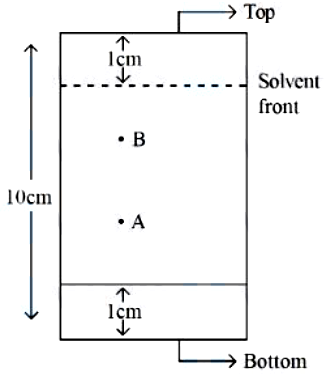
In the given TLC, the distance of spot A & B are $$5 \text{ cm}$$ & $$7 \text{ cm}$$, from the bottom of TLC plate, respectively. $$R_f$$ value of B is $$x \times 10^{-1}$$ times more than A. The value of $$x$$ is ______.
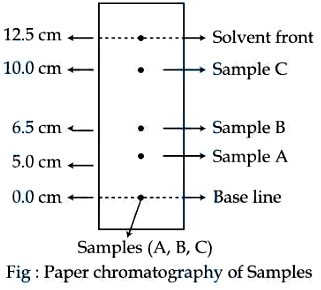
Using the given figure, the ratio of $$R_f$$ values of sample A and sample C is $$x \times 10^{-2}$$. Value of $$x$$ is _____
$$R_f = \frac{\text{Distance traveled by the substance from the base line}}{\text{Distance traveled by the solvent from the base line}}$$
- For Sample A:
$$R_f(A) = \frac{5.0}{12.5}$$ - For Sample C:
$$R_f(C) = \frac{10.0}{12.5}$$
$$\text{Ratio} = \frac{R_f(A)}{R_f(C)} = \frac{\frac{5.0}{12.5}}{\frac{10.0}{12.5}} = \frac{5.0}{10.0} = 0.5$$
We are given that the ratio is equal to $$x \times 10^{-2}$$:
$$0.5 = x \times 10^{-2}$$
$$x = \frac{0.5}{10^{-2}} = 0.5 \times 10^2 = 50$$
On a thin layer chromatographic plate, an organic compound moved by $$3.5 \text{ cm}$$, while the solvent moved by $$5 \text{ cm}$$. The retardation factor of the organic compound is ____________ $$\times 10^{-1}$$.
The retardation factor ($$R_f$$) in thin layer chromatography is defined as:
$$ R_f = \frac{\text{Distance moved by compound}}{\text{Distance moved by solvent}} $$
Given:
Distance moved by compound = $$3.5$$ cm
Distance moved by solvent = $$5$$ cm
Substituting:
$$ R_f = \frac{3.5}{5} = 0.7 $$
Expressing in the required form:
$$ R_f = 7 \times 10^{-1} $$
Therefore, the answer is $$\boxed{7}$$.
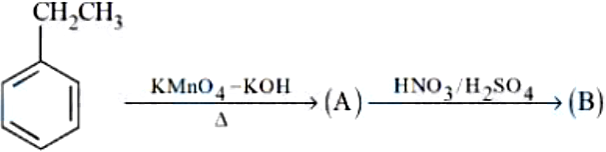
Major product $$B$$ of the following reaction has ______ $$\pi$$-bond.

Step 1: Formation of Product (A)
- Reactant: Ethylbenzene ($$\text{C}_6\text{H}_5\text{CH}_2\text{CH}_3$$)
- Reagent: $$\text{KMnO}_4\text{ / KOH, }\Delta$$ (Strong oxidizing agent)
- Reaction: Vigorous oxidation of the alkyl side chain containing benzylic hydrogens. Regardless of the chain length, the alkyl group is completely oxidized down to a carboxylic acid group attached to the benzene ring.
- Product (A): Benzoic acid ($$\text{C}_6\text{H}_5\text{COOH}$$)
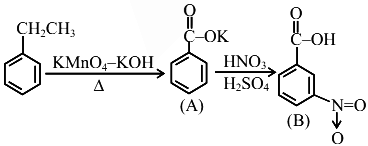
Step 2: Formation of Major Product (B)
- Reactant: Benzoic acid ($$\text{C}_6\text{H}_5\text{COOH}$$)
- Reagent: $$\text{HNO}_3\text{ / H}_2\text{SO}_4$$ (Nitrating mixture)
- Reaction: Electrophilic aromatic substitution (Nitration). Since the carboxylic acid group ($$-\text{COOH}$$) is a strongly deactivating and meta-directing group, the nitro group ($$-\text{NO}_2$$) attacks the meta position.
- Product (B): m-Nitrobenzoic acid (3-nitrobenzoic acid)
Step 3: Counting the $$\pi$$-bonds in Product (B)
- Benzene Ring: Contains 3 $$\pi$$-bonds (alternate double bonds).
- Carboxylic Acid Group ($$-\text{COOH}$$): Contains 1 $$\pi$$-bond (from the $$\text{C}=\text{O}$$ double bond).
- Nitro Group ($$-\text{NO}_2$$): Contains 1 $$\pi$$-bond (resonating within the $$-\text{N}=\text{O}$$ bond system).
$$\text{Total }\pi\text{-bonds} = 3 + 1 + 1 = 5$$
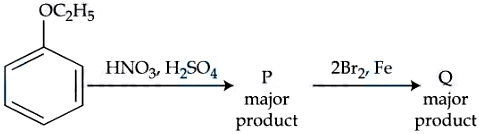
The ratio of number of oxygen atoms to bromine atoms in the product Q is ___________ $$\times 10^{-1}$$.
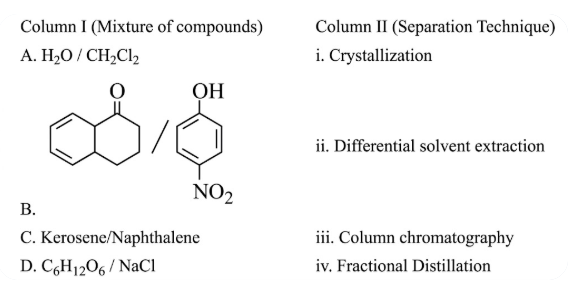
Match items of column I and II
Compound that will give positive Lassaigne's test for both nitrogen and halogen is
Lassaigne's test detects nitrogen and halogens in organic compounds by fusing the compound with sodium metal. The key reactions are:
For nitrogen: $$\text{Na} + \text{C} + \text{N} \rightarrow \text{NaCN}$$
For halogens: $$\text{Na} + \text{X} \rightarrow \text{NaX}$$
For the test to detect nitrogen, the compound must contain carbon (to form NaCN).
Let us examine each option:
Option A: $$\text{N}_2\text{H}_4 \cdot \text{HCl}$$ (Hydrazine hydrochloride) — Contains N and Cl, but no carbon. Without carbon, NaCN cannot form, so nitrogen detection fails.
Option B: $$\text{CH}_3\text{NH}_2 \cdot \text{HCl}$$ (Methylamine hydrochloride) — Contains C, N, and Cl. Carbon is present, so NaCN forms (positive nitrogen test). Cl is present, so NaCl forms (positive halogen test). Both tests are positive.
Option C: $$\text{NH}_4\text{Cl}$$ — Contains N and Cl, but no carbon. Nitrogen test fails.
Option D: $$\text{NH}_2\text{OH} \cdot \text{HCl}$$ (Hydroxylamine hydrochloride) — Contains N and Cl, but no carbon. Nitrogen test fails.
The answer is Option B: $$\text{CH}_3\text{NH}_2 \cdot \text{HCl}$$.
Solution & Explanation
Statements:
- A. Compound 'c' is more polar than 'a' and 'b'
- B. Compound 'a' is least polar
- C. Compound 'b' comes out of the column before 'c' and after 'a'
- D. Compound 'a' spends more time in the column
- The stationary phase (column material) is polar.
- Highly polar compounds stick strongly to the column and move slowly (stay near the top).
- Non-polar compounds do not stick well and move quickly (drop to the bottom first).
- Polarity: a (Most Polar) > b > c (Least Polar)
- Elution Order (Exit Speed): c comes out first, then b, and a comes out last.
- ❌ Statement A is INCORRECT: It states 'c' is the most polar. Since 'c' moved fastest to the bottom, it is actually the least polar.
- ❌ Statement B is INCORRECT: It states 'a' is the least polar. Since 'a' is stuck at the top, it is the most polar.
- ❌ Statement C is INCORRECT: It states 'b' comes out before 'c'. Because 'c' is at the bottom, 'c' must exit the column before 'b'.
- ✅ Statement D is CORRECT: It states 'a' spends more time in the column. Since 'a' moves the slowest, it stays inside the longest.
Since we are identifying the incorrect statements, the answer must include A, B, and C.
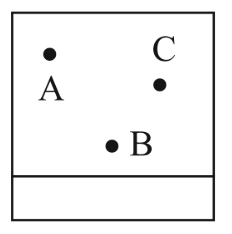
Thin layer chromatography of a mixture shows the following observation.
The correct order of elution in the silica gel column chromatography is
Based on the Thin Layer Chromatography (TLC) plate shown in the image,
1. TLC Plate (Retention Factor)
- On a standard silica gel TLC plate, the stationary phase (silica) is polar, and the solvent (mobile phase) is non-polar/less polar.
- More polar compounds stick strongly to the silica and travel a shorter distance (lower spot).
- Less polar compounds move easily with the solvent and travel a longer distance (higher spot).
Looking at the heights of the spots on your TLC plate:
- A travelled the highest hence Least polar
- C travelled to the middle hence Moderately polar
- B stayed the lowest hence Most polar
2. Column Chromatography Elution Order
Column chromatography works on the exact same principle, but the compounds drain out from the bottom of the column one by one (elute):
- The least polar compound interacts the least with the silica gel and rushes out first.
- The most polar compound binds tightly to the silica gel and comes out last.
Therefore, the order of elution from first to last is:
A,C ,B
Correct Answer:
Option C: A, C, B
Using column chromatography, mixture of two compounds 'A' and 'B' was separated. 'A' eluted first, this indicates 'B' has
In column chromatography, the component that elutes first has weaker adsorption to the stationary phase (adsorbent).
Since A eluted first, A has weaker adsorption. This means B has stronger adsorption (retained longer on the column).
In terms of R$$_f$$ value (from TLC): A would have a higher R$$_f$$ (moves further) and B would have a lower R$$_f$$ (moves less, stronger adsorption).
The correct answer is Option 1: low R$$_f$$, stronger adsorption.
In sulphur estimation. 0.471 g of an organic compound gave 1.4439 g of barium sulphate. The percentage of sulphur in the compound is _____ (Nearest Integer)
(Given: Atomic mass Ba: 137u, S: 32u, O: 16u)
In sulphur estimation, 0.471 g of an organic compound gave 1.4439 g of barium sulphate (BaSO$$_4$$).
Molar mass of BaSO$$_4$$ = 137 + 32 + 64 = 233 g/mol.
$$\text{Mass of S} = \frac{32}{233} \times 1.4439 = \frac{46.2048}{233} = 0.19831 \text{ g}$$
$$\% \text{S} = \frac{0.19831}{0.471} \times 100 = 42.10\%$$
Rounding to the nearest integer: $$\approx 42\%$$.
The percentage of sulphur in the compound is $$\mathbf{42}$$.
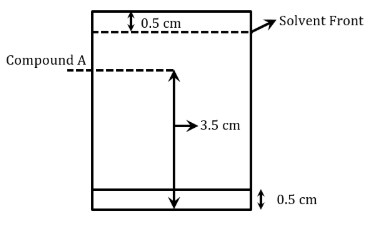
Following chromatogram was developed by adsorption of compound 'A' on a 6 cm TLC glass plate. Retardation factor of the compound 'A' is ______ $$\times 10^{-1}$$.
Which one of the following techniques is not used to spot components of a mixture separated on thin layer chromatographic plate?
We need to identify which technique is not used to spot (visualize) components on a thin layer chromatographic (TLC) plate.
Common Techniques for Visualizing TLC Spots:
Option A: $$I_2$$ (Solid) — Used
Iodine vapour chamber is a widely used technique. The TLC plate is placed in a closed chamber with iodine crystals. The iodine vapour gets adsorbed by the organic compounds, forming brown spots.
Option B: U.V. Light — Used
Many TLC plates contain a fluorescent indicator. Under UV light (254 nm or 366 nm), the spots appear as dark patches against a fluorescent background.
Option C: Visualisation agent as a component of mobile phase — Not Used
The mobile phase (solvent) is used to separate the components by carrying them up the plate. The visualization agent is never added as part of the mobile phase because it would interfere with the separation process. Visualization is done after the separation is complete.
Option D: Spraying of an appropriate reagent — Used
Spraying reagents like ninhydrin (for amino acids), sulfuric acid, or other specific reagents onto the plate is a standard technique to make invisible spots visible.
Hence, the correct answer is Option C: Visualisation agent as a component of mobile phase.
The formula of the purple colour formed in Lassaigne's test for sulphur using sodium nitroprusside is
We need to identify the formula of the purple-coloured compound formed in Lassaigne's test for sulphur using sodium nitroprusside. In this test the organic compound is fused with sodium metal to form sodium sulphide $$Na_2S$$ if sulphur is present.
$$2Na + S \rightarrow Na_2S$$
The sodium extract is then treated with sodium nitroprusside solution $$Na_2[Fe(CN)_5(NO)]$$ and the sulphide ions react to form a purple-coloured complex:
$$Na_2S + Na_2[Fe(CN)_5(NO)] \rightarrow Na_4[Fe(CN)_5(NOS)]$$
In this reaction, the $$S^{2-}$$ ion reacts with the $$NO^+$$ group in nitroprusside to form the thionitrosyl group $$NOS^-$$, resulting in the purple-coloured complex $$Na_4[Fe(CN)_5(NOS)]$$.
Option A: $$Na_4[Fe(CN)_5(NOS)]$$ — This is the correct formula of the purple complex formed in Lassaigne's test for sulphur. Option B: $$NaFe[Fe(CN)_6]$$ — This is Turnbull's blue, not related to the sulphur test. Option C: $$Na[Cr(NH_3)_2(NCS)_4]$$ — This is Reinecke's salt. Option D: $$Na_2[Fe(CN)_5(NO)]$$ — This is sodium nitroprusside itself (the reagent, not the product).
Hence, the correct answer is Option A: $$Na_4[Fe(CN)_5(NOS)]$$.
Given below are two statements: one is labelled as Assertion and the other is labelled as Reason.
Assertion: A mixture contains benzoic acid and naphthalene. The pure benzoic acid can be separated out by the use of benzene.
Reason: Benzoic acid is soluble in hot water.
In the light of the above statements, choose the most appropriate answer from the options given below.
Analyzing the Assertion:
"A mixture contains benzoic acid and naphthalene. The pure benzoic acid can be separated out by the use of benzene."
Both benzoic acid and naphthalene are soluble in benzene. So benzene cannot be used to selectively dissolve one and leave the other behind. The standard method to separate benzoic acid from naphthalene would be to use a sodium bicarbonate solution (which dissolves benzoic acid as sodium benzoate, leaving naphthalene behind) or to use hot water (benzoic acid is soluble in hot water, naphthalene is not).
Therefore, the Assertion is false.
Analyzing the Reason:
"Benzoic acid is soluble in hot water."
This is a well-known fact. Benzoic acid has limited solubility in cold water but dissolves readily in hot water. This is the basis for its purification by recrystallization.
Therefore, the Reason is true.
Hence, the correct answer is Option D: Assertion is false but Reason is true.
Match List-I with List-II
| List-I (Mixture) | List-II (Purification Process) |
|---|---|
| A. Chloroform & Aniline | I. Steam distillation |
| B. Benzoic acid & Naphthalene | II. Sublimation |
| C. Water & Aniline | III. Distillation |
| D. Naphthalene & Sodium chloride | IV. Crystallisation |
We need to match each mixture with its appropriate purification process.
A. Chloroform & Aniline → III. Distillation
Chloroform (boiling point ≈ 61°C) and aniline (boiling point ≈ 184°C) are both liquids that are miscible with each other. Since there is a large difference in their boiling points (about 123°C), they can be easily separated by simple distillation.
B. Benzoic acid & Naphthalene → IV. Crystallisation
Both benzoic acid and naphthalene are solids. Benzoic acid is soluble in hot water and crystallises out upon cooling, while naphthalene is insoluble in water. So benzoic acid can be separated by dissolving the mixture in hot water, filtering to remove naphthalene, and then crystallising benzoic acid from the filtrate.
C. Water & Aniline → I. Steam distillation
Aniline is sparingly soluble in water and is steam volatile. Steam distillation is used to separate aniline from water, as aniline distils over with steam at a temperature below its normal boiling point.
D. Naphthalene & Sodium chloride → II. Sublimation
Naphthalene sublimes (converts directly from solid to vapor) upon heating, while sodium chloride does not. So heating the mixture causes naphthalene to sublime, leaving behind sodium chloride.
The correct matching is: A-III, B-IV, C-I, D-II
The correct answer is Option D.
Which technique among the following, is most appropriate in separation of a mixture of $$100 \text{ mg}$$ of $$p$$-nitrophenol and picric acid?
We need to find the most appropriate technique for separating a mixture of $$100 \text{ mg}$$ of $$p$$-nitrophenol and picric acid.
The total quantity of the mixture is $$100 \text{ mg}$$, which is a very small amount (milligram scale).
Steam distillation is used to separate volatile compounds that are immiscible with water. While $$p$$-nitrophenol is steam volatile, this technique is generally used for larger quantities and is not ideal for milligram-scale separations.
A 2-5 ft long column of silica gel is used for preparative column chromatography. This technique is suitable for separating gram-scale quantities (typically 1-100 g). For just $$100 \text{ mg}$$, using such a long column would result in significant loss of sample and poor separation efficiency.
Sublimation is used when one component sublimes and the other does not. Neither $$p$$-nitrophenol nor picric acid readily sublimes under normal conditions, so this technique is not appropriate here.
Preparative TLC is specifically designed for separating small quantities of compounds, typically in the range of $$1 \text{ mg}$$ to $$100 \text{ mg}$$. The mixture is spotted on a thick TLC plate, developed in a suitable solvent, and the separated bands are scraped off and extracted. This is the most appropriate technique for $$100 \text{ mg}$$ of a mixture.
Since the quantity is only $$100 \text{ mg}$$, preparative TLC is the most suitable technique for this separation.
Hence, the correct answer is Option D: Preparative TLC (Thin Layer Chromatography).
Given below are two statements: One is labelled as Assertion A and the other is labelled as Reason R
Assertion A: Thin layer chromatography is an adsorption chromatography.
Reason R: A thin layer of silica gel is spread over a glass plate of suitable size in thin layer chromatography which acts as an adsorbent.
In the light of the above statements, choose the correct answer from the options given below
We are given an assertion-reason question about Thin Layer Chromatography (TLC).
Assertion A: Thin layer chromatography is an adsorption chromatography.
This is true. In TLC, the separation of components occurs based on the principle of adsorption. The components of the mixture are adsorbed to different extents on the stationary phase (the thin layer of adsorbent), and they move at different rates when a solvent (mobile phase) moves up the plate by capillary action.
Reason R: A thin layer of silica gel is spread over a glass plate of suitable size in TLC which acts as an adsorbent.
This is also true. In TLC, a thin layer (about 0.2 mm thick) of an adsorbent such as silica gel ($$SiO_2 \cdot xH_2O$$) or alumina ($$Al_2O_3$$) is coated uniformly on a glass plate. This layer acts as the stationary phase and serves as the adsorbent.
Now, the reason directly explains why TLC is classified as adsorption chromatography — it is because the stationary phase (silica gel layer) functions as an adsorbent, and separation occurs through differential adsorption of components on this layer. So R is the correct explanation of A.
Hence, the correct answer is Option A.
In Carius method of estimation of halogen, $$0.45 \text{ g}$$ of an organic compound gave $$0.36 \text{ g}$$ of $$AgBr$$. Find out the percentage of bromine in the compound. (Molar masses: $$AgBr = 188 \text{ g mol}^{-1}; Br = 80 \text{ g mol}^{-1}$$)
In the Carius method for estimation of bromine, the organic compound is heated with fuming $$HNO_3$$ in the presence of $$AgNO_3$$. The bromine in the compound is converted to $$AgBr$$.
Given:
Mass of organic compound = $$0.45 \text{ g}$$
Mass of $$AgBr$$ formed = $$0.36 \text{ g}$$
Molar mass of $$AgBr = 188 \text{ g mol}^{-1}$$
Atomic mass of $$Br = 80 \text{ g mol}^{-1}$$
$$ \text{Moles of } AgBr = \frac{0.36}{188} $$
Since 1 mole of $$AgBr$$ contains 1 mole of $$Br$$:
$$ \text{Moles of } Br = \frac{0.36}{188} $$
$$ \text{Mass of } Br = \frac{0.36}{188} \times 80 = \frac{28.8}{188} = 0.15319 \text{ g} $$
$$ \% \text{ of } Br = \frac{\text{Mass of Br}}{\text{Mass of compound}} \times 100 $$
$$ \% \text{ of } Br = \frac{0.15319}{0.45} \times 100 = 34.04\% $$
The correct answer is Option A: $$34.04\%$$.
During halogen test, sodium fusion extract is boiled with concentrated $$HNO_3$$ to
In the Lassaigne's test (sodium fusion extract test) for halogens, the sodium fusion extract is boiled with concentrated $$HNO_3$$ before adding $$AgNO_3$$.
Purpose:
During sodium fusion, if nitrogen or sulphur is present in the organic compound, sodium cyanide ($$NaCN$$) or sodium sulphide ($$Na_2S$$) may form. These interfere with the silver nitrate test for halogens because:
$$NaCN + AgNO_3 \to AgCN \downarrow$$ (white precipitate)
$$Na_2S + 2AgNO_3 \to Ag_2S \downarrow$$ (black precipitate)
These precipitates would give false positive results for halogens. Boiling the extract with concentrated $$HNO_3$$ decomposes these interfering compounds:
$$NaCN + HNO_3 \to NaNO_3 + HCN \uparrow$$
$$Na_2S + 2HNO_3 \to 2NaNO_3 + H_2S \uparrow$$
The volatile $$HCN$$ and $$H_2S$$ escape, leaving only the halide ions in solution for accurate detection with $$AgNO_3$$.
The correct answer is Option B: to decompose cyanide or sulphide of sodium.
Match List - I with List - II.
| List-I (Anion) | List-II (gas evolved on reaction with dil. $$H_2SO_4$$) |
|---|---|
| (A) $$CO_3^{2-}$$ | (I) Colourless gas which turns lead acetate paper black. |
| (B) $$S^{2-}$$ | (II) Colourless gas which turns acidified potassium dichromate solution green. |
| (C) $$SO_3^{2-}$$ | (III) Brown fumes which turns acidified KI solution containing starch blue. |
| (D) $$NO_2^-$$ | (IV) Colourless gas evolved with brisk effervescence, which turns lime water milky. |
Choose the correct answer from the options given below
We need to match each anion with the gas evolved when it reacts with dilute $$H_2SO_4$$.
(A) $$CO_3^{2-}$$ reacts with $$H_2SO_4$$ to give carbon dioxide: $$CO_3^{2-} + H_2SO_4 \rightarrow CO_2 + H_2O + SO_4^{2-}$$. Carbon dioxide is a colourless gas that is evolved with brisk effervescence and turns lime water milky: $$CO_2 + Ca(OH)_2 \rightarrow CaCO_3\downarrow + H_2O$$. Therefore it matches with (IV).
(B) $$S^{2-}$$ reacts with $$H_2SO_4$$ to give hydrogen sulfide: $$S^{2-} + H_2SO_4 \rightarrow H_2S + SO_4^{2-}$$. Hydrogen sulfide is a colourless gas with a rotten egg smell and turns lead acetate paper black: $$Pb(CH_3COO)_2 + H_2S \rightarrow PbS\downarrow(\text{black}) + 2CH_3COOH$$. Therefore it matches with (I).
(C) $$SO_3^{2-}$$ reacts with $$H_2SO_4$$ to give sulfur dioxide: $$SO_3^{2-} + H_2SO_4 \rightarrow SO_2 + H_2O + SO_4^{2-}$$. Sulfur dioxide is a colourless gas with a pungent smell; it acts as a reducing agent and turns acidified potassium dichromate solution green: $$K_2Cr_2O_7 + 3SO_2 + H_2SO_4 \rightarrow K_2SO_4 + Cr_2(SO_4)_3(\text{green}) + H_2O$$. Therefore it matches with (II).
(D) $$NO_2^-$$ reacts with $$H_2SO_4$$ to form nitrous acid which decomposes to nitrogen dioxide: $$NO_2^- + H_2SO_4 \rightarrow HNO_2 \rightarrow NO_2(\text{brown fumes})$$. The brown fumes oxidize iodide ions to iodine, turning starch solution blue: $$2NO_2 + 2KI \rightarrow 2KNO_2 + I_2$$ and $$I_2 + \text{starch} \rightarrow \text{blue colour}$$. Therefore it matches with (III).
The correct answer is Option D: A - IV, B - I, C - II, D - III.
Which of the following is structure of a separating funnel?
A $$0.166$$ g sample of an organic compound was digested with conc. $$H_2SO_4$$ and then distilled with NaOH. The ammonia gas evolved was passed through $$50.0$$ mL of $$0.5$$ N $$H_2SO_4$$. The used acid required $$30.0$$ mL of $$0.25$$ N NaOH for complete neutralization. The mass percentage of nitrogen in the organic compound is ______
$$0.2$$ g of an organic compound was subjected to estimation of nitrogen by Dumas method in which volume of $$N_2$$ evolved (at STP) was found to be $$22.400$$ mL. The percentage of nitrogen in the compound is ______ [nearest integer] (Given: Molar mass of $$N_2$$ is $$28$$ g mol$$^{-1}$$, Molar volume of $$N_2$$ at STP: $$22.4$$ L)
We are given that 0.2 g of an organic compound produces $$N_2$$ gas with volume 22.400 mL at STP using the Dumas method.
Since the volume of $$N_2$$ must be expressed in litres, we have:
$$ V_{N_2} = 22.400 \text{ mL} = 0.02240 \text{ L} $$
Substituting this into the molar volume relation at STP (22.4 L) gives:
$$ n_{N_2} = \frac{V}{V_m} = \frac{0.02240}{22.4} = 0.001 \text{ mol} $$
This yields the mass of nitrogen as:
$$ m_{N_2} = n \times M = 0.001 \times 28 = 0.028 \text{ g} $$
From the above, the percentage of nitrogen in the compound is:
$$ \% N = \frac{m_{N_2}}{m_{\text{compound}}} \times 100 = \frac{0.028}{0.2} \times 100 = 14\% $$
Therefore, the percentage of nitrogen in the compound is 14.
While estimating the nitrogen present in an organic compound by Kjeldahl's method, the ammonia evolved from $$0.25 \text{ g}$$ of the compound neutralized $$2.5 \text{ mL}$$ of $$2M \text{ } H_2SO_4$$. The percentage of nitrogen present in organic compound is ______.
We need to find the percentage of nitrogen in the organic compound using Kjeldahl's method.
Mass of organic compound = 0.25 g
Volume of $$H_2SO_4$$ neutralised = 2.5 mL = 0.0025 L
Molarity of $$H_2SO_4$$ = 2 M
Moles of $$H_2SO_4$$ = Molarity $$\times$$ Volume (in L) = $$2 \times 0.0025 = 0.005 \text{ mol}$$
The neutralisation reaction is: $$2NH_3 + H_2SO_4 \rightarrow (NH_4)_2SO_4$$
So 1 mole of $$H_2SO_4$$ reacts with 2 moles of $$NH_3$$.
Moles of $$NH_3$$ = $$2 \times 0.005 = 0.01 \text{ mol}$$
Each mole of $$NH_3$$ contains 1 mole of nitrogen.
Moles of nitrogen = 0.01 mol
Mass of nitrogen = $$0.01 \times 14 = 0.14 \text{ g}$$
Percentage of nitrogen = $$\dfrac{0.14}{0.25} \times 100 = 56\%$$
Hence, the answer is 56.
In the estimation of bromine, $$0.5$$ g of an organic compound gave $$0.40$$ g of silver bromide. The percentage of bromine in the given compound is ______ % (nearest integer)
(Relative atomic masses of Ag and Br are 108u and 80u, respectively).
We need to find the percentage of bromine in an organic compound given that 0.5 g of the compound produced 0.40 g of silver bromide.
The molar mass of AgBr is $$M_{AgBr} = M_{Ag} + M_{Br} = 108 + 80 = 188 \text{ g/mol}$$.
The number of moles of AgBr formed is $$\text{Moles of AgBr} = \frac{0.40}{188} \text{ mol}$$. In the Carius method, all bromine is converted to AgBr, and since each molecule of AgBr contains one atom of Br, the number of moles of Br is the same: $$\text{Moles of Br} = \frac{0.40}{188} \text{ mol}$$.
The mass of bromine is calculated as $$\text{Mass of Br} = \text{Moles of Br} \times M_{Br} = \frac{0.40}{188} \times 80$$ which gives $$\text{Mass of Br} = \frac{32}{188} = 0.1702 \text{ g}$$.
The percentage of bromine in the compound is then $$\% Br = \frac{\text{Mass of Br}}{\text{Mass of compound}} \times 100 = \frac{0.1702}{0.5} \times 100 = 34.04\%$$, which rounds to 34 %.
Therefore, the correct answer is 34 %.
$$0.25$$ g of an organic compound containing chlorine gave $$0.40$$ g of silver chloride in Carius estimation. The percentage of chlorine present in the compound is ______ [in nearest integer]
(Given: Molar mass of Ag is $$108$$ g mol$$^{-1}$$ and that of Cl is $$35.5$$ g mol$$^{-1}$$)
We need to find the percentage of chlorine in an organic compound using Carius estimation. The mass of the organic compound is 0.25 g, the mass of AgCl obtained is 0.40 g, and the molar masses are Ag = 108 g/mol and Cl = 35.5 g/mol.
The molar mass of AgCl is calculated as $$M_{AgCl} = M_{Ag} + M_{Cl} = 108 + 35.5 = 143.5 \text{ g/mol}$$, and the moles of AgCl are given by $$\text{Moles of AgCl} = \dfrac{0.40}{143.5} = 2.787 \times 10^{-3} \text{ mol}$$.
Since 1 mole of AgCl contains 1 mole of Cl, the moles of Cl are $$\text{Moles of Cl} = \text{Moles of AgCl} = 2.787 \times 10^{-3} \text{ mol}$$ and its mass is $$\text{Mass of Cl} = 2.787 \times 10^{-3} \times 35.5 = 0.09894 \text{ g}$$.
The percentage of chlorine is $$\% \text{ of Cl} = \dfrac{\text{Mass of Cl}}{\text{Mass of compound}} \times 100 = \dfrac{0.09894}{0.25} \times 100 = 39.58\%$$.
Alternatively, using the direct formula $$\% \text{ of Cl} = \dfrac{\text{Mass of AgCl} \times M_{Cl}}{\text{Mass of compound} \times M_{AgCl}} \times 100$$ we obtain $$\% \text{ of Cl} = \dfrac{0.40 \times 35.5}{0.25 \times 143.5} \times 100 = \dfrac{14.2}{35.875} \times 100 = 39.58\%$$.
Rounding to the nearest integer gives $$\approx 40\%$$.
The percentage of chlorine present in the compound is 40%.
The separation of two coloured substances was done by paper chromatography. The distances travelled by solvent front, substance A and substance B from the base line are $$3.25 \text{ cm}$$, $$2.08 \text{ cm}$$ and $$1.05 \text{ cm}$$ respectively. The ratio of $$R_f$$ values of A to B is ______ (Answer the nearest integer).
We need to find the ratio of Rf values of substances A and B.
Recall the formula for Rf value
$$R_f = \dfrac{\text{Distance travelled by substance}}{\text{Distance travelled by solvent front}}$$
Calculate Rf for substance A
$$R_f(A) = \dfrac{2.08}{3.25} = 0.64$$
Calculate Rf for substance B
$$R_f(B) = \dfrac{1.05}{3.25} = 0.3231$$
Find the ratio
$$\dfrac{R_f(A)}{R_f(B)} = \dfrac{0.64}{0.3231} = \dfrac{2.08}{1.05} = 1.981$$
Round to the nearest integer
$$\dfrac{R_f(A)}{R_f(B)} \approx 2$$
The answer is 2.
Which of the following compound is added to the sodium extract before addition of silver nitrate for testing of halogens?
In the Lassaigne's test (sodium fusion test) for halogens, the sodium extract may contain sodium cyanide ($$NaCN$$) and sodium sulphide ($$Na_2S$$) along with sodium halides. Both $$CN^-$$ and $$S^{2-}$$ ions can interfere with the silver nitrate test because they form insoluble precipitates with $$Ag^+$$: $$AgCN$$ (white) and $$Ag_2S$$ (black).
To remove these interfering ions, the sodium extract is first boiled with dilute nitric acid ($$HNO_3$$) before adding silver nitrate. The nitric acid decomposes $$NaCN$$ and $$Na_2S$$: $$NaCN + HNO_3 \rightarrow NaNO_3 + HCN\uparrow$$ and $$Na_2S + 2HNO_3 \rightarrow 2NaNO_3 + H_2S\uparrow$$. The volatile $$HCN$$ and $$H_2S$$ escape, leaving only the halide ions to react with silver nitrate.
Therefore, the compound added to the sodium extract before addition of silver nitrate is nitric acid, which is option (1).
Given below are two statements : one is labelled as Assertion (A) and the other is labelled as Reason.
Assertion (A): A simple distillation can be used to separate a mixture of propanol and propanone.
Reason (R): Two liquids with a difference of more than 20°C in their boiling points can be separated by simple distillations.
In the light of the above statements, choose the most appropriate answer from the options given below:
First, we recall the working principle of simple distillation. Simple distillation is suitable for separating two miscible liquids if their boiling points differ appreciably. The empirical guideline taught in textbooks is that the boiling-point difference should be at least $$20^{\circ}\text{C}$$. If this condition is met, the vapour of the lower-boiling liquid becomes sufficiently richer in that component, condenses first, and a good separation is obtained without the need for a fractionating column.
Now we look at the two liquids mentioned in the Assertion.
We have propanone (commonly called acetone) with a boiling point of approximately $$56^{\circ}\text{C}$$, and we have propan-1-ol (commonly called 1-propanol) with a boiling point of approximately $$97^{\circ}\text{C}$$.
Let us calculate the difference in their boiling points:
$$\Delta T_{\text{b}} \;=\; 97^{\circ}\text{C} \;-\; 56^{\circ}\text{C} \;=\; 41^{\circ}\text{C}$$
We clearly see that $$\Delta T_{\text{b}} = 41^{\circ}\text{C} > 20^{\circ}\text{C}.$$
Because the boiling-point gap is more than the threshold of $$20^{\circ}\text{C},$$ the rule just recalled tells us that simple distillation will indeed be effective for this pair. Thus the statement “A simple distillation can be used to separate a mixture of propanol and propanone” is correct. Hence, Assertion (A) is true.
Next, we examine the Reason. The Reason states: “Two liquids with a difference of more than $$20^{\circ}\text{C}$$ in their boiling points can be separated by simple distillations.” This is exactly the same guideline we used above, so the Reason is also a correct scientific statement.
Furthermore, the Reason directly supplies the explanation for why simple distillation works in the specific case cited in the Assertion. We used that very rule—$$\Delta T_{\text{b}} > 20^{\circ}\text{C}$$—to justify the truth of (A). Therefore, (R) is not only true but also the correct explanation of (A).
Among the options, this correspondence matches Option B.
Hence, the correct answer is Option B.
Which one of the following set of elements can be detected using sodium fusion extract?
The qualitative analysis of organic compounds often employs the well-known lassaigne’s test, more popularly called the sodium fusion test. In this procedure the organic compound is first fused with metallic sodium. The highly reactive sodium converts any hetero-elements present in the molecule into simple, water-soluble inorganic salts, which are then identified by conventional ionic group tests.
We must recall which hetero-elements are actually converted into such ionic forms:
• $$\text{Nitrogen (N)}$$ is converted to $$\text{NaCN}$$.
• $$\text{Sulfur (S)}$$ is converted to $$\text{Na}_2\text{S}$$.
• $$\text{Halogens (X = Cl, Br, I)}$$ are converted to $$\text{NaX}$$.
• $$\text{Phosphorus (P)}$$, if present, is oxidised to $$\text{Na}_2\text{HPO}_4$$ by adding an oxidising agent (generally $$\text{NaNO}_3$$) during the fusion.
These inorganic ions are then detected by their specific confirmatory tests:
$$\text{CN}^- \; \overset{\text{FeSO}_4/\text{FeCl}_3}{\rightarrow}\; \text{Prussian blue}$$,
$$\text{S}^{2-} \; \overset{\text{Acetate‐buffered Pb}^{2+}}{\rightarrow}\; \text{Black PbS}$$,
$$\text{X}^- \; \overset{\text{AgNO}_3}{\rightarrow}\; \text{AgX precipitate}$$,
$$\text{HPO}_4^{2-} \; \overset{\text{(NH}_4)_2\text{MoO}_4 + \text{HNO}_3}{\rightarrow}\; \text{Canary yellow } (\text{NH}_4)_3\text{PO}_4\cdot12\text{MoO}_3$$.
On the other hand, $$\text{Oxygen}$$ and $$\text{Carbon}$$ are always present in organic compounds and do not need special detection; moreover they do not form such simple ionic derivatives with sodium that can be identified by ordinary wet tests during a sodium fusion.
Hence, the elements that are detected by sodium fusion extract are sulfur, nitrogen, phosphorus and halogens.
Looking at the given choices, Option A lists exactly these four elements.
Hence, the correct answer is Option A.
Which purification technique is used for high boiling organic liquid compound (decomposes near its boiling point)?
A high-boiling organic liquid that decomposes near its boiling point cannot be purified by simple distillation or fractional distillation, because heating it to its boiling point at normal pressure would cause decomposition. Steam distillation is useful for steam-volatile compounds but is not a general method for all high-boiling liquids.
Reduced pressure (vacuum) distillation lowers the boiling point of the liquid by reducing the external pressure. This allows the compound to boil and be collected at a temperature well below its decomposition temperature. Therefore, the correct purification technique for a high-boiling organic compound that decomposes near its boiling point is reduced pressure distillation.
The answer is option (4).
In chromatography technique, the purification of a compound is independent of:
In chromatography, the separation and purification of compounds depend on several factors: the differential adsorption or partition of the compound between the stationary and mobile phases (which relates to solubility), the flow rate of the solvent system (mobility), and the length of the column or TLC plate (which affects resolution).
However, the physical state of the pure compound (whether it is a solid, liquid, or gas in its pure form) does not directly affect the chromatographic separation process. What matters is how the compound interacts with the stationary and mobile phases in the dissolved state during chromatography, not what physical state the isolated pure compound exists in.
Therefore, the purification in chromatography is independent of the physical state of the pure compound. The correct answer is Option (4).
Given below are two statements:
Statement-I: Retardation factor ($$R_f$$) can be measured in meter/centimetre.
Statement-II: $$R_f$$ value of a compound remains constant in all solvents.
Choose the most appropriate answer from the options given below:
Let us analyze both statements about the retardation factor ($$R_f$$) in chromatography.
Statement-I claims that $$R_f$$ can be measured in meter/centimetre. The retardation factor is defined as $$R_f = \frac{\text{Distance moved by solute}}{\text{Distance moved by solvent front}}$$. Since it is a ratio of two distances, it is a dimensionless quantity with no units. Therefore, Statement-I is false.
Statement-II claims that the $$R_f$$ value of a compound remains constant in all solvents. This is also false because the $$R_f$$ value depends on the nature of the solvent (mobile phase), the adsorbent (stationary phase), the thickness of the layer, and the temperature. Changing the solvent will change the $$R_f$$ value of a compound.
Since both statements are false, the correct answer is option (C): Both Statement-I and Statement-II are false.
In the leaching of alumina from bauxite, the ore expected to leach out in the process by reacting with NaOH is:
In the Baeyer’s process, bauxite is digested with concentrated aqueous sodium hydroxide at about 150 °C under pressure. The basic idea is that those oxides which react with NaOH will pass into the solution, while the oxides which do not react will remain as an insoluble residue.
First, alumina itself behaves amphoterically and dissolves:
$$$\mathrm{Al_2O_3 + 2\,NaOH + 3\,H_2O \;\longrightarrow\; 2\,Na[Al(OH)_4]}$$$
Now we examine each oxide given in the options to see whether it will similarly react (leach out) or stay undissolved.
1. For $$\mathrm{Fe_2O_3}$$ and 2. for $$\mathrm{TiO_2}$$ Both of these oxides are essentially basic (or at best very weakly amphoteric) and, under the conditions of the Baeyer’s process, they do not react with concentrated NaOH. Hence they stay behind in the red mud residue and are not leached out.
3. For $$\mathrm{ZnO}$$ While zinc oxide is indeed amphoteric and can dissolve in strong alkali, ZnO is not a common impurity present in bauxite. The question speaks of “the ore expected to leach out in the process”, i.e., the impurity that really occurs in bauxite and actually goes into solution in the industrial step. Therefore, even though ZnO is amphoteric, it is not the correct choice in this context.
4. For $$\mathrm{SiO_2}$$ Silica is an acidic oxide. An acidic oxide readily reacts with a strong base such as NaOH, giving a soluble silicate:
$$$\mathrm{2\,NaOH + SiO_2 \;\longrightarrow\; Na_2SiO_3 + H_2O}$$$
Because $$\mathrm{Na_2SiO_3}$$ remains in the aqueous phase, silica gets leached out along with sodium aluminate. This behaviour exactly matches what is observed during the purification of bauxite.
Comparing all the possibilities, we see that only $$\mathrm{SiO_2}$$ is the impurity that actually dissolves (is leached) in the alkaline solution.
Hence, the correct answer is Option D.
The metal that can be purified economically by fractional distillation method is:
Fractional distillation is a purification method applicable to metals with relatively low boiling points, where the impurities have significantly different boiling points from the metal being purified. For this method to be economically viable, the metal must have a sufficiently low boiling point so that the energy cost of vaporising and redistilling the metal is not prohibitive.
Among the given options, zinc (Zn) has a boiling point of about $$907^\circ\text{C}$$, which is the lowest among the metals listed. Iron (Fe) boils at about $$2862^\circ\text{C}$$, copper (Cu) at about $$2562^\circ\text{C}$$, and nickel (Ni) at about $$2913^\circ\text{C}$$. The very high boiling points of Fe, Cu, and Ni make fractional distillation extremely energy-intensive and therefore not economically practical for these metals.
Zinc's relatively low boiling point makes it the metal that can be economically purified by fractional distillation. Zinc and its impurities (such as cadmium, which boils at $$767^\circ\text{C}$$) have boiling points different enough to allow effective separation. Zinc is indeed industrially purified by this method.
The correct answer is option 2 (Zn).
Consider two chemical reactions (A) and (B) that take place during metallurgical process:
(A) ZnCO$$_{3(s)} \xrightarrow{\Delta}$$ ZnO$$_{(s)}$$ + CO$$_{2(g)}$$
(B) 2ZnS$$_{(s)}$$ + 3O$$_{2(g)} \xrightarrow{\Delta}$$ 2ZnO$$_{(s)}$$ + 2SO$$_{2(g)}$$
The correct option of names given to them respectively is:
In metallurgy, two important thermal processes are calcination and roasting, which differ based on the ore type and conditions used.
Reaction (A): $$\text{ZnCO}_{3(s)} \xrightarrow{\Delta} \text{ZnO}_{(s)} + \text{CO}_{2(g)}$$
This is calcination — the process of heating a carbonate ore in the absence of air (or limited air) to decompose it into the metal oxide and carbon dioxide. Carbonate ores are typically subjected to calcination.
Reaction (B): $$2\text{ZnS}_{(s)} + 3\text{O}_{2(g)} \xrightarrow{\Delta} 2\text{ZnO}_{(s)} + 2\text{SO}_{2(g)}$$
This is roasting — the process of heating a sulphide ore in excess of air (in the presence of oxygen) to convert it into the metal oxide, with the release of sulphur dioxide gas. Sulphide ores are treated by roasting.
The key distinction is that calcination involves carbonate (or hydrated) ores heated in limited/no air, while roasting involves sulphide ores heated in excess air. Therefore, (A) is calcination and (B) is roasting.
Match list-I with list-II :
| List-I | List-II | |
|---|---|---|
| (a) Mercury | (i) | Vapour phase refining |
| (b) Copper | (ii) | Distillation refining |
| (c) Silicon | (iii) | Electrolytic refining |
| (d) Nickel | (iv) | Zone refining |
Choose the most appropriate answer from the option given below:
Mercury is a liquid metal with a low boiling point, so it is purified by distillation refining, giving $$a \to (ii)$$.
Copper is refined industrially by electrolytic refining, where impure copper is the anode and pure copper deposits on the cathode in a $$\text{CuSO}_4$$ solution, giving $$b \to (iii)$$.
Silicon is a semiconductor that requires extremely high purity. It is purified by zone refining, where a narrow molten zone is moved along a rod so that impurities concentrate at one end, giving $$c \to (iv)$$.
Nickel is purified by the Mond process, a vapour phase refining method. Impure nickel reacts with $$\text{CO}$$ at about 330 K to form volatile $$\text{Ni(CO)}_4$$, which is then decomposed at higher temperature (450 K) to deposit pure nickel, giving $$d \to (i)$$.
The correct matching is $$a$$-(ii), $$b$$-(iii), $$c$$-(iv), $$d$$-(i), which corresponds to option (3).
Sulphide ion is soft base and its ores are common for metals
(a) Pb (b) Al (c) Ag (d) Mg
Choose the correct answer from the options given below
According to the Hard-Soft Acid-Base (HSAB) principle, soft bases prefer to combine with soft acids, and hard bases prefer hard acids. The sulphide ion ($$\text{S}^{2-}$$) is a soft base because of its large size and high polarisability.
Among the given metals: Lead ($$\text{Pb}^{2+}$$) is a soft/borderline acid — its common ore is galena ($$\text{PbS}$$). Silver ($$\text{Ag}^+$$) is a soft acid — its common ore is argentite ($$\text{Ag}_2\text{S}$$). Aluminium ($$\text{Al}^{3+}$$) is a hard acid with a small, highly charged ion — it forms oxide/hydroxide ores such as bauxite ($$\text{Al}_2\text{O}_3 \cdot 2\text{H}_2\text{O}$$). Magnesium ($$\text{Mg}^{2+}$$) is also a hard acid — it occurs as magnesite ($$\text{MgCO}_3$$) and dolomite, not as a sulphide ore.
Since sulphide ores are common for the soft-acid metals Pb and Ag, the correct combination is (a) and (c).
The answer is option (1).
In the sulphur estimation, 0.471 g of an organic compound gave 1.44 g of barium sulfate. The percentage of sulphur in the compound is _________ (Nearest integer) (Atomic Mass of Ba = 137u)
We have an organic compound whose mass is given as $$0.471\ \text{g}$$. During sulphur estimation by the classical Carius method, all the sulphur present in the compound is converted into barium sulfate, $$\text{BaSO}_{4}$$. The experiment yields $$1.44\ \text{g}$$ of $$\text{BaSO}_{4}$$.
First, we need to know how much sulphur is present in this $$\text{BaSO}_{4}$$. For that we recall the molar mass (also called molecular weight) of barium sulfate:
$$\text{BaSO}_{4}: \quad M = M_{\text{Ba}} + M_{\text{S}} + 4\,M_{\text{O}}$$
Substituting the atomic masses, we get
$$M = 137\ \text{u} + 32\ \text{u} + 4 \times 16\ \text{u} = 137 + 32 + 64 = 233\ \text{u}$$
This means that in every $$233\ \text{g}$$ of $$\text{BaSO}_{4}$$, there are exactly $$32\ \text{g}$$ of sulphur. Hence the mass ratio of sulphur to barium sulfate is
$$\frac{m_{\text{S}}}{m_{\text{BaSO}_{4}}} = \frac{32}{233}$$
Using this ratio, the actual mass of sulphur in our sample of $$\text{BaSO}_{4}$$ is
$$m_{\text{S}} = 1.44\ \text{g} \times \frac{32}{233}$$
Carrying out the multiplication step by step,
$$1.44 \times 32 = 46.08$$
and now dividing by $$233$$,
$$m_{\text{S}} = \frac{46.08}{233}\ \text{g} \approx 0.198\ \text{g}$$
So, $$0.198\ \text{g}$$ of sulphur is present in the original $$0.471\ \text{g}$$ sample of the organic compound.
The percentage of sulphur is obtained from the general formula
$$\%\text{S} = \frac{\text{mass of S in the sample}}{\text{mass of the organic compound}} \times 100$$
Substituting the values just found,
$$\%\text{S} = \frac{0.198}{0.471} \times 100$$
Performing the division first,
$$\frac{0.198}{0.471} \approx 0.420$$
and then multiplying by $$100$$,
$$\%\text{S} \approx 42.0\%$$
Rounding to the nearest integer as required, we obtain $$42\%$$.
So, the answer is $$42\%$$.
The transformation occurring in Duma's method is given below
$$C_2H_7N + 2x + \frac{y}{2}CuO \rightarrow xCO_2 + \frac{y}{2}H_2O + \frac{z}{2}N_2 + 2x + \frac{y}{2}Cu$$
The value of y is _________. (Integer answer)
We start with the un-balanced skeletal equation given for Duma’s method:
$$C_2H_7N +\left(2x+\dfrac{y}{2}\right)CuO \;\longrightarrow\; x\,CO_2 +\dfrac{y}{2}H_2O +\dfrac{z}{2}N_2 +\left(2x+\dfrac{y}{2}\right)Cu$$
To obtain the numerical values of the unknown coefficients, we now equate the number of atoms of each element on the two sides of the arrow.
Carbon balance
There are $$2$$ carbon atoms in one molecule of $$C_2H_7N$$ on the left.
On the right, every $$CO_2$$ molecule contains one carbon atom, and the coefficient in front of $$CO_2$$ is $$x$$.
So we write
$$x = 2$$
Hydrogen balance
On the left, the compound $$C_2H_7N$$ provides $$7$$ hydrogen atoms.
On the right, each molecule of $$H_2O$$ has two hydrogens and its coefficient is $$\dfrac{y}{2}$$, giving a total of
$$\left(\dfrac{y}{2}\right)\times 2 = y$$ hydrogen atoms.
Equating the two sides, we have
$$y = 7$$
Nitrogen balance
The left side supplies one nitrogen atom.
On the right, a molecule of $$N_2$$ contains two nitrogen atoms and its coefficient is $$\dfrac{z}{2}$$, giving
$$\left(\dfrac{z}{2}\right)\times 2 = z$$ nitrogen atoms. Hence
$$z = 1$$
Oxygen balance (consistency check)
The coefficient in front of $$CuO$$ is $$2x + \dfrac{y}{2}$$, so the number of oxygen atoms on the left is also $$2x + \dfrac{y}{2}$$.
On the right, oxygen appears in $$CO_2$$ and $$H_2O$$. Counting them gives
$$\underbrace{x\times 2}_{\text{from } CO_2} + \underbrace{\left(\dfrac{y}{2}\right)\times 1}_{\text{from } H_2O} = 2x + \dfrac{y}{2}$$
Substituting $$x = 2$$ and $$y = 7$$, both sides give $$2(2) + \dfrac{7}{2} = 4 + \dfrac{7}{2}$$, confirming that oxygen is already balanced.
Thus, the integer value required for $$y$$ is
$$7$$
Hence, the correct answer is Option 7.
0.8 g of an organic compound was analysed by Kjeldahl's method for the estimation of nitrogen. If the percentage of nitrogen in the compound was found to be 42%, then _________ mL of 1M H$$_2$$SO$$_4$$ would have been neutralized by the ammonia evolved during the analysis.
In Kjeldahl’s method, the nitrogen present in the organic compound is finally converted into ammonia. That ammonia is absorbed by a known, measured volume of standard acid. By knowing how much of the acid is neutralised we can back-calculate the amount of nitrogen. Here we will move in the reverse direction: we already know the mass of nitrogen, and we have to find the volume of 1 M $$\mathrm{H_2SO_4}$$ that would be neutralised.
We are given that $$0.8\ \text{g}$$ of the organic compound contains $$42\%$$ nitrogen by mass. First we calculate the actual mass of nitrogen present:
$$\text{Mass of nitrogen}=0.8\ \text{g}\times \dfrac{42}{100}=0.336\ \text{g}$$
Next we convert this mass of nitrogen to moles. The atomic mass of nitrogen is $$14\ \text{g mol}^{-1}$$, so
$$\text{Moles of }N=\dfrac{0.336\ \text{g}}{14\ \text{g mol}^{-1}}=0.024\ \text{mol}$$
In the Kjeldahl procedure each atom of nitrogen becomes one molecule of ammonia, $$\mathrm{NH_3}$$. Therefore,
$$\text{Moles of }NH_3=\text{Moles of }N=0.024\ \text{mol}$$
Now we write the neutralisation reaction between ammonia and sulphuric acid:
$$2\,\mathrm{NH_3}+ \mathrm{H_2SO_4}\;\longrightarrow\; (\mathrm{NH_4})_2\mathrm{SO_4}$$
From the balanced equation, $$2$$ moles of $$\mathrm{NH_3}$$ require $$1$$ mole of $$\mathrm{H_2SO_4}$$. Hence the moles of $$\mathrm{H_2SO_4}$$ needed are
$$\text{Moles of }H_2SO_4=\dfrac{\text{Moles of }NH_3}{2}=\dfrac{0.024}{2}=0.012\ \text{mol}$$
The concentration (molarity) of the acid is given as $$1\ \text{M}$$, meaning
$$\text{Molarity}=\dfrac{\text{Moles of solute}}{\text{Volume of solution in litres}}$$
Re-arranging for volume, we get
$$\text{Volume}=\dfrac{\text{Moles}}{\text{Molarity}}=\dfrac{0.012\ \text{mol}}{1\ \text{mol L}^{-1}}=0.012\ \text{L}$$
Converting litres to millilitres ($$1\ \text{L}=1000\ \text{mL}$$):
$$0.012\ \text{L}\times1000=12\ \text{mL}$$
So, the answer is $$12$$.
An organic compound is subjected to chlorination to get compound A using 5.0 g of chlorine. When 0.5 g of compound A is reacted with AgNO$$_3$$ [Carius Method], the percentage of chlorine in compound A is when it forms 0.3849 g of AgCl. (Round off to the Nearest Integer)
(Atomic masses of Ag and Cl are 107.87 and 35.5 respectively)
We are given that $$0.5\ \text{g}$$ of compound A produces $$0.3849\ \text{g}$$ of silver chloride ($$\text{AgCl}$$) when treated with $$\text{AgNO}_3$$ in the Carius method. Our task is to calculate the percentage of chlorine present in compound A.
First, we note the atomic masses supplied in the question:
$$\text{Atomic mass of Ag}=107.87,\qquad \text{Atomic mass of Cl}=35.5$$
So, the molar mass of silver chloride is obtained by simple addition:
$$M_{\text{AgCl}} = M_{\text{Ag}} + M_{\text{Cl}} = 107.87 + 35.5 = 143.37\ \text{g mol}^{-1}$$
Next, we determine the number of moles of $$\text{AgCl}$$ actually formed. The basic formula for moles is
$$\text{moles} = \dfrac{\text{given mass}}{\text{molar mass}}$$
Substituting the values, we get
$$n_{\text{AgCl}} = \dfrac{0.3849}{143.37} = 0.002685\ \text{mol}\ (\text{approximately}).$$
In every mole of $$\text{AgCl}$$ there is exactly one mole of chlorine. Hence, the moles of chlorine present are the same as the moles of $$\text{AgCl}$$ formed:
$$n_{\text{Cl}} = n_{\text{AgCl}} = 0.002685\ \text{mol}.$$
We now convert these moles of chlorine to mass using the relation
$$\text{mass} = \text{moles} \times \text{atomic mass}.$$
Thus,
$$m_{\text{Cl}} = 0.002685 \times 35.5 = 0.0953\ \text{g}\ (\text{to four significant figures}).$$
Finally, the percentage of chlorine in compound A is calculated by the standard definition
$$\%\text{Cl} = \dfrac{\text{mass of Cl in the sample}}{\text{mass of the sample}} \times 100.$$
Substituting our values,
$$\%\text{Cl} = \dfrac{0.0953}{0.5} \times 100 = 19.06\%.$$
Rounding off to the nearest integer as instructed, we obtain $$19\%.$
Hence, the correct answer is Option 19.
The number of moles of CuO, that will be utilized in Dumas method for estimating nitrogen in a sample of 57.5 g of N, N-dimethylaminopentane is _________ $$\times 10^{-2}$$. (Nearest integer)
We are asked to calculate how many moles of copper(II) oxide, CuO, take part in the Dumas combustion of a given mass of the amine “N, N-dimethylaminopentane”.
First we write the molecular formula of the compound. A pentyl group contributes $$\mathrm{C_5H_{11}}$$ and two additional methyl groups are attached to the nitrogen, giving two more carbon atoms and six more hydrogens. Hence we have
$$\mathrm{C_{5+2}H_{11+6}N}=\mathrm{C_7H_{17}N}.$$
Its molar mass is obtained term by term:
$$M=\underbrace{7\times 12}_{\text{carbon}}+\underbrace{17\times 1}_{\text{hydrogen}}+\underbrace{1\times 14}_{\text{nitrogen}} =84+17+14 =115\ \text{g mol}^{-1}.$$
The sample mass is $$57.5\ \text{g}$$, so the number of moles of the amine present is
$$n_{\text{amine}}=\frac{57.5\ \text{g}}{115\ \text{g mol}^{-1}}=0.500\ \text{mol}.$$
Now we recall the stoichiometry of the Dumas combustion. For a general molecule $$\mathrm{C_xH_yN_z},$$ complete oxidation with CuO satisfies the balanced relation
$$\mathrm{C_xH_yN_z} \;+\;(2x+\tfrac{y}{2})\,\mathrm{CuO} \;\longrightarrow\; x\,\mathrm{CO_2}+ \tfrac{y}{2}\,\mathrm{H_2O}+ \tfrac{z}{2}\,\mathrm{N_2} + (2x+\tfrac{y}{2})\,\mathrm{Cu}.$$
This equality is obtained as follows. Each carbon atom requires two oxygen atoms to become $$\mathrm{CO_2}$$, and each pair of hydrogen atoms requires one oxygen atom to become $$\mathrm{H_2O}$$. Therefore, per mole of the organic compound, the total number of oxygen atoms demanded is $$2x+\dfrac{y}{2}$$. Since every mole of CuO supplies exactly one oxygen atom, the same numerical amount, $$2x+\dfrac{y}{2},$$ gives the moles of CuO used.
Substituting $$x=7$$ and $$y=17$$ for our specific amine, we get
$$n_{\text{CuO per mol amine}}=2(7)+\frac{17}{2}=14+\frac{17}{2}=14+8.5=22.5\ \text{mol}.$$
We actually have only half a mole of the amine, so the total moles of CuO consumed become
$$n_{\text{CuO total}} =0.500\ \text{mol amine}\;\times\;22.5\ \frac{\text{mol CuO}}{\text{mol amine}} =11.25\ \text{mol}.$$
It is convenient to express $$11.25$$ as a product with $$10^{-2}$$:
$$11.25\ \text{mol}=1125\times10^{-2}\ \text{mol}.$$
The problem asks for the nearest integer appearing as the coefficient in “$$\times10^{-2}$$”, which is clearly $$1125$$.
So, the answer is $$1125$$.
Using the provided information in the following paper chromatogram:
The calculated $$R_f$$ value of A is ______ $$\times 10^{-1}$$.
$$R_f = \frac{\text{Distance travelled by compound}}{\text{Distance travelled by solvent}}$$
$$R_f = \ \frac{\ 2cm}{5cm}\ =\ 4\ \times\ 10^{-1}$$
X = 4
In Carius method for estimation of halogens, 0.2 g of an organic compound gave 0.188 g of AgBr. The percentage of bromine in the compound is _________. (Nearest integer)
[Atomic mass: Ag = 108, Br = 80]
In Carius method, the halogen present in the organic compound is converted completely into its silver halide. Here the silver halide obtained is silver bromide, $$\mathrm{AgBr}$$.
The given data are:
Mass of organic compound, $$w = 0.2 \text{ g}$$
Mass of silver bromide, $$m_{\mathrm{AgBr}} = 0.188 \text{ g}$$
Atomic mass of silver, $$M_{\mathrm{Ag}} = 108$$
Atomic mass of bromine, $$M_{\mathrm{Br}} = 80$$
First, we need the molar mass of silver bromide. By definition,
$$M_{\mathrm{AgBr}} = M_{\mathrm{Ag}} + M_{\mathrm{Br}} = 108 + 80 = 188 \text{ g mol}^{-1}.$$
Now, to obtain the mass of bromine actually present in the precipitate, we use the proportion coming from the formula weight. The fraction of bromine in one mole of $$\mathrm{AgBr}$$ is
$$\frac{M_{\mathrm{Br}}}{M_{\mathrm{AgBr}}} = \frac{80}{188}.$$
Therefore, the mass of bromine in the given precipitate is
$$m_{\mathrm{Br}} = \frac{80}{188}\times m_{\mathrm{AgBr}}.$$
Substituting $$m_{\mathrm{AgBr}} = 0.188 \text{ g}$$, we get
$$m_{\mathrm{Br}} = \frac{80}{188}\times 0.188 = 0.188 \times \frac{80}{188} = 0.188 \times 0.4255319 = 0.08 \text{ g}.$$
We now calculate the percentage of bromine in the original compound sample. By definition,
$$\%\ \mathrm{Br} = \frac{\text{mass of Br in sample}}{\text{mass of sample}}\times 100 = \frac{0.08}{0.2}\times 100 = 0.4 \times 100 = 40\%.$$
After rounding to the nearest integer, the percentage remains $$40$$.
Hence, the correct answer is Option C.
Glycerol is separated in soap industries by:
We recall a basic physical-chemistry fact: the normal boiling point of a liquid is the temperature at which its vapour pressure equals the external pressure. If we lower the external pressure, the temperature needed to reach that vapour pressure also lowers. This principle is used in “distillation under reduced pressure”, sometimes called “vacuum distillation”. The relation is expressed by the Clausius-Clapeyron equation, stated first:
$$\dfrac{d\ln P}{dT}= \dfrac{\Delta H_{\text{vap}}}{RT^{2}}$$
Here $$P$$ is the vapour pressure, $$T$$ is the absolute temperature, $$R$$ is the gas constant and $$\Delta H_{\text{vap}}$$ is the molar enthalpy of vaporisation. Although we are not required to integrate it fully for this problem, the equation tells us qualitatively that if we reduce $$P$$, then for a fixed $$\Delta H_{\text{vap}}$$, the corresponding equilibrium temperature $$T$$ must also decrease.
Now, let us apply this idea to glycerol, $$\mathrm{C_{3}H_{8}O_{3}}$$. Glycerol is a highly viscous, trihydric alcohol formed as a by-product in the saponification (soap-making) process:
$$\text{Fat or oil (ester)} + 3\,\text{NaOH} \;\longrightarrow\; \text{Soap (sodium salt of fatty acid)} + \text{Glycerol}$$
Important physical data: the normal (1 atm) boiling point of glycerol is about $$290^\circ\text{C}$$. At this high temperature glycerol tends to undergo partial decomposition, charring and colouration, which is undesirable for industrial recovery. Therefore we must choose a separation technique that enables evaporation at a lower temperature so that thermal decomposition does not occur.
We examine the four given options in turn.
Option A — Fractional distillation: This is effective when two liquids have different but reasonably low boiling points and do not decompose. Glycerol itself has a single high boiling point and decomposition risk, so mere fractional distillation at atmospheric pressure is not suitable.
Option B — Differential distillation: This is essentially batch distillation without a fractionating column, again performed at atmospheric pressure. The same problem of high temperature persists, hence it is also unsuitable.
Option C — Steam distillation: Steam distillation works nicely for volatile, water-immiscible substances whose boiling points are normally >100 °C but which form a heterogeneous azeotrope with water. Glycerol, however, is completely miscible with water and therefore does not distil over with steam; it stays in the aqueous layer. Consequently steam distillation cannot separate glycerol.
Option D — Distillation under reduced pressure: By purposefully lowering the external pressure, we lower the boiling temperature according to the relation we wrote earlier. For glycerol, reducing the pressure to about $$10^{2}$$-$$10^{3}$$ Pa (a few mm Hg) brings its boiling point down to roughly $$150^\circ\text{C}$$ or even lower, which is well below the temperature at which significant decomposition occurs. Industrial soap plants therefore connect the glycerol-containing liquor to a vacuum still, remove water first, and then distil pure glycerol safely under reduced pressure.
Thus, among the four techniques listed, only “distillation under reduced pressure” specifically addresses the high-boiling, decomposition-prone nature of glycerol.
Hence, the correct answer is Option D.
While titration dilute HCl solution with aqueous NaOH, which of the following will not be required?
In an acid-base titration where a dilute $$\text{HCl}$$ solution is titrated with an aqueous $$\text{NaOH}$$ solution, we must measure the solutions accurately and detect the end-point with the help of an indicator. For accurate volume measurement we traditionally employ a burette for the titrant and a pipette for the analyte, both of which are supported on a stand with a clamp. A porcelain tile is commonly placed underneath the conical flask to provide a white background, making the indicator’s colour change more visible. The indicator most frequently chosen for a strong-acid versus strong-base titration is phenolphthalein because it changes sharply from colourless to faint pink in the pH range 8.0-10.0, exactly where the equivalence point lies for this titration. Distilled water is needed for rinsing the glassware to avoid introducing impurities that could affect the titre value. All these items are thus essential.
A Bunsen burner, however, is used for heating solutions or driving reactions that require elevated temperatures. Titrations of strong acids with strong bases are carried out at room temperature, so no heating device is necessary. Likewise, a measuring cylinder gives only approximate volumes, whereas titration demands the higher precision afforded by pipettes and burettes. Therefore a measuring cylinder is superfluous in this context. Because neither a Bunsen burner nor a measuring cylinder contributes anything crucial to the titration procedure, they are the items that will not be required.
Hence, the correct answer is Option D.
A flask contains a mixture of isohexane and 3-methylpentane. One of the liquids boils at 63$$^\circ$$C while the other boils at 60$$^\circ$$C. What is the best way to separate the two liquids and which one will be distilled out first?
We have two hydrocarbons in the same flask: isohexane and 3-methylpentane. Their normal boiling points are given as $$60^{\circ}\text C$$ and $$63^{\circ}\text C$$ respectively.
First, let us examine the temperature data. Writing the temperatures in an inequality form, we obtain
$$60^{\circ}\text C \; < \; 63^{\circ}\text C.$$
Now we calculate the difference in their boiling points:
$$\Delta T \;=\; 63^{\circ}\text C \;-\; 60^{\circ}\text C \;=\; 3^{\circ}\text C.$$
This small temperature gap is crucial. In laboratory practice, the rule of thumb is that:
If } \Delta T \;\lt\; 25^{\circ}\text C,\; \text{use fractional distillation.
Fractional distillation provides a fractionating column that offers many theoretical plates, giving repeated condensation-evaporation cycles. These cycles allow liquids whose boiling points are very close to be separated effectively. Simple distillation, on the other hand, is suitable only when the boiling-point difference is fairly large (usually $$\ge 25^{\circ}\text C$$), so it would not work efficiently here.
Therefore, the best separation technique is fractional distillation.
Next, we identify which component will come out first. The general statement is:
The liquid with the lower boiling point vaporizes (and hence distills) first.
From the inequality $$60^{\circ}\text C < 63^{\circ}\text C,$$ we see that isohexane (boiling at $$60^{\circ}\text C$$) has the lower boiling point, whereas 3-methylpentane (boiling at $$63^{\circ}\text C$$) has the higher boiling point.
Consequently, isohexane will rise through the fractionating column first and will be collected in the distillate before 3-methylpentane.
Putting both conclusions together, we state: the mixture should be separated by fractional distillation, and isohexane will be the first liquid to distill.
Hence, the correct answer is Option A.
In Carius method of estimation of halogen, 0.172 g of an organic compound showed presence of 0.08 g of bromine. Which of these is the correct structure of the compound?
In the Carius method we directly obtain the mass of halogen present. Here,
$$\text{Mass of compound taken}=0.172\ \text{g}$$
$$\text{Mass of bromine found}=0.080\ \text{g}$$
We first calculate the percentage of bromine in the unknown sample. The general relation is
$$\%\,\text{Br}=\frac{\text{mass of Br obtained}}{\text{mass of sample}}\times 100$$
Substituting the given numbers,
$$\%\,\text{Br}=\frac{0.080}{0.172}\times 100$$
$$\%\,\text{Br}=0.465116\ldots\times 100$$
$$\%\,\text{Br}=46.5116\% \approx 46.5\%$$
Now we compare this experimental value with the theoretical bromine percentages of each option. For every structure we first write its molecular formula, then its molar mass, and finally the percentage of bromine.
Option A : $$CH_3CHBr_2$$
Molecular formula: $$C_2H_4Br_2$$
Molar mass:
$$M=2(12)+4(1)+2(79.9)=24+4+159.8=187.8\ \text{g mol}^{-1}$$
Theoretical bromine percentage:
$$\%\,\text{Br}=\frac{2(79.9)}{187.8}\times 100=\frac{159.8}{187.8}\times 100=85.06\%$$
This is far higher than the required $$46.5\%$$, so Option A is rejected.
Option B : p-bromoaniline
Molecular formula: an aniline ring $$C_6H_5NH_2$$ with one Br substituent gives $$C_6H_6BrN$$.
Molar mass:
$$M=6(12)+6(1)+79.9+14=72+6+79.9+14=171.9\ \text{g mol}^{-1}$$
Theoretical bromine percentage:
$$\%\,\text{Br}=\frac{79.9}{171.9}\times 100=46.509\%\approx 46.5\%$$
This matches the experimental value almost exactly.
Option C : 3,5-dibromoaniline
Molecular formula: $$C_6H_5Br_2N$$
Molar mass:
$$M=6(12)+5(1)+2(79.9)+14=72+5+159.8+14=250.8\ \text{g mol}^{-1}$$
Theoretical bromine percentage:
$$\%\,\text{Br}=\frac{159.8}{250.8}\times 100=63.74\%$$
This value is much higher than $$46.5\%$$, so Option C is also ruled out.
Option D : $$H_3CCH_2Br$$
Molecular formula: $$C_2H_5Br$$
Molar mass:
$$M=2(12)+5(1)+79.9=24+5+79.9=108.9\ \text{g mol}^{-1}$$
Theoretical bromine percentage:
$$\%\,\text{Br}=\frac{79.9}{108.9}\times 100=73.40\%$$
Again this is far above $$46.5\%$$, so Option D is discarded.
Only p-bromoaniline shows a bromine percentage that coincides with the experimental value. Therefore the unknown compound must be p-bromoaniline.
Hence, the correct answer is Option B.
In an estimation of bromine by Carius method, $$1.6\,\text{g}$$ of an organic compound gave $$1.88\,\text{g}$$ of AgBr. The mass percentage of bromine in the compound is........ (Atomic mass, Ag = 108, Br = 80 $$\text{g mol}^{-1}$$)
We have to find the mass percentage of bromine present in the organic compound whose mass is given as $$1.6\;\text{g}$$. During the Carius estimation the bromine present in the compound is completely converted into silver bromide, $$\text{AgBr}$$, whose mass is reported to be $$1.88\;\text{g}$$. Hence the whole problem boils down to: how much bromine is contained in $$1.88\;\text{g}$$ of $$\text{AgBr}$$, and what fraction of the original $$1.6\;\text{g}$$ sample does that bromine represent?
First we need the molar mass of silver bromide. Using the given atomic masses
$$M_{\text{Ag}} = 108\;\text{g mol}^{-1}, \qquad M_{\text{Br}} = 80\;\text{g mol}^{-1}$$
we write
$$M_{\text{AgBr}} = M_{\text{Ag}} + M_{\text{Br}} = 108 + 80 = 188\;\text{g mol}^{-1}.$$
Now, the number of moles of $$\text{AgBr}$$ actually formed is obtained from the basic relation
$$n = \dfrac{m}{M},$$
where $$m$$ is mass and $$M$$ is molar mass. Substituting the known quantities,
$$n_{\text{AgBr}} = \dfrac{1.88\;\text{g}}{188\;\text{g mol}^{-1}} = 0.01\;\text{mol}.$$
In the silver bromide crystal lattice each formula unit contains exactly one bromine atom, so the amount (in moles) of bromine captured is numerically equal to the number of moles of $$\text{AgBr}$$ formed. Thus
$$n_{\text{Br}} = n_{\text{AgBr}} = 0.01\;\text{mol}.$$
To get the actual mass of bromine present we again employ
$$m = n \times M.$$
Hence, substituting,
$$m_{\text{Br}} = 0.01\;\text{mol} \times 80\;\text{g mol}^{-1} = 0.8\;\text{g}.$$
We now know that $$0.8\;\text{g}$$ of bromine came from the original $$1.6\;\text{g}$$ sample. The percentage composition by mass is therefore computed from the standard formula
$$\%\text{Br} = \dfrac{m_{\text{Br}}}{m_{\text{sample}}}\times 100.$$
Substituting the values,
$$\%\text{Br} = \dfrac{0.8\;\text{g}}{1.6\;\text{g}}\times 100 = 50.$$
Hence, the correct answer is Option 50.
The correct match between items I and II is:
The principle of column chromatography is:
First, let us recall what happens inside a column chromatographic set-up. We pack a finely divided solid, such as silica gel or alumina, into a long vertical glass tube. This packed solid is called the stationary phase. Next, a liquid or a mixture of liquids, called the mobile phase or eluent, is allowed to flow down the column under gravity. The sample that we wish to separate is introduced at the top of this column and is carried downward by the flowing solvent.
Now, the key physical phenomenon that actually brings about the separation is the tendency of different components of the mixture to cling to, or leave, the surface of the solid. In surface science, the word used for this surface attachment is “adsorption,” not “absorption.”
Adsorption means the molecules accumulate only on the surface of the solid. Absorption, on the other hand, would imply that the molecules pass into the bulk of another phase, like water soaking into a sponge; that is not what happens here. So we can immediately eliminate any option that speaks of “absorption.”
Let us examine all the options one by one:
Option A speaks of the differential adsorption of substances on the solid phase. This is precisely what we observe: each solute molecule spends part of its time adsorbed (stuck) on the stationary phase and part of its time dissolved (moving) in the mobile phase. Because different solutes have different affinities for the solid surface, they travel through the column at different average speeds and emerge separated.
Option B uses the term “differential absorption,” which, as explained, is incorrect terminology for the surface phenomenon actually taking place.
Option C mentions gravitational force. While gravity certainly makes the liquid flow downward, it is not the principle responsible for the separation of components.
Option D mentions capillary action. In a packed column the liquid does not move primarily by capillary rise; instead it flows downward under gravity, so capillary forces are not central to the chromatographic principle either.
Therefore, the only scientifically accurate description of the principle is the one stated in Option A.
Hence, the correct answer is Option A.
An organic compound is estimated through Dumas method and was found to evolve 6 moles of $$CO_2$$, 4 moles of $$H_2O$$ and 1 mole of nitrogen gas. The formula of the compound is:
From the data of the Dumas combustion we know the exact numbers of moles of the three products that are formed:
$$n_{\,CO_2}=6,\qquad n_{\,H_2O}=4,\qquad n_{\,N_2}=1$$
First we convert these moles of the products into the moles of the original elements present in the unknown compound.
Each mole of $$CO_2$$ contains exactly one mole of carbon atoms because the formula is $$CO_2$$. Therefore
$$n_{\,C}=n_{\,CO_2}=6\; \text{mol}$$
Each mole of $$H_2O$$ contains two moles of hydrogen atoms since the subscripts of hydrogen in water are 2. Thus
$$n_{\,H}=2\,n_{\,H_2O}=2\times4=8\; \text{mol}$$
Each mole of $$N_2$$ contains two moles of nitrogen atoms because nitrogen gas is di-atomic ($$N_2$$). Hence
$$n_{\,N}=2\,n_{\,N_2}=2\times1=2\; \text{mol}$$
So the mole (atom) ratio of the elements in the burnt sample is
$$C:H:N = 6:8:2$$
We obtain the simplest whole-number ratio (the empirical ratio) by dividing every number by the greatest common divisor, which is 2:
$$\frac{6}{2} : \frac{8}{2} : \frac{2}{2} = 3 : 4 : 1$$
Therefore the empirical formula is
$$C_3H_4N$$
The options offered all have even numbers of carbon and hydrogen atoms, so we scale the empirical formula by the smallest integer that converts it to one of the listed formulas. Multiplying by 2 gives
$$2\,(C_3H_4N)=C_6H_8N_2$$
This molecular formula exactly matches Option C.
Hence, the correct answer is Option C.
If Dichloromethane (DCM) and water $$H_2O$$ are used for differential extraction, which one of the following statements is correct?
We begin by recalling the principle of differential extraction. In this technique two immiscible liquids are shaken together so that a solute can distribute itself preferentially into one of the layers. For the liquids to separate properly inside the separating funnel, they must satisfy two conditions: they must be immiscible, and they must have different densities, because density decides which layer will settle at the bottom.
Now we examine the pair given in the question: dichloromethane (abbreviated as DCM, chemical formula $$CH_2Cl_2$$) and water $$H_2O$$. The first thing to note is that DCM is an organochlorine solvent, whereas water is a polar protic solvent. Because of their very different intermolecular forces, they do not mix appreciably; thus they are indeed immiscible. So options that claim miscibility or formation of a turbid/colloidal mixture can already be ruled out.
Next we must decide which of the two liquids will occupy the lower position in the separating funnel. This is governed by the density relation
$$\text{Density} = \frac{\text{Mass}}{\text{Volume}}$$
The literature values at room temperature are
$$\rho_{\text{DCM}} \approx 1.33\ \text{g\,cm}^{-3}$$
$$\rho_{H_2O} \approx 1.00\ \text{g\,cm}^{-3}$$
Since $$1.33\ \text{g\,cm}^{-3} > 1.00\ \text{g\,cm}^{-3}$$, dichloromethane is denser than water. According to the basic rule, the denser liquid settles at the bottom, while the less dense liquid forms the upper layer. Therefore DCM will form the lower layer and water will form the upper layer inside the separating funnel.
This description matches the statement in Option C: “DCM and $$H_2O$$ would stay as lower and upper layer respectively in the S.F.”
Hence, the correct answer is Option C.
In chromatography, which of the following statements is incorrect for R$$_f$$?
First, let us recall the definition of the retention factor, commonly written as $$R_f,$$ which is used for comparing how far a substance travels on a chromatographic plate.
The formula is stated as
$$ R_f=\frac{\text{Distance travelled by the centre of the spot of the solute}}{\text{Distance travelled by the solvent front}} $$
Since the solute spot can never move farther than the solvent front, the numerator is always smaller than or at most equal to the denominator. Therefore, from the above formula we immediately obtain
$$ 0 < R_f \le 1 . $$
Now we analyse each option one by one in the light of the definition.
Option A: “Higher $$R_f$$ value means higher adsorption.” We know that stronger adsorption to the stationary phase causes a compound to move more slowly; hence the distance in the numerator becomes smaller. This gives a smaller $$R_f,$$ not a higher one. Therefore, a higher $$R_f$$ actually corresponds to lower adsorption. So the statement in Option A is wrong.
Option B: “The value of $$R_f$$ cannot be more than one.” From the inequality $$0 < R_f \le 1$$ derived above, this statement is perfectly true. Hence Option B is correct and therefore not the answer we seek.
Option C: “$$R_f$$ value depends on the type of chromatography.” Different chromatographic techniques (paper, thin-layer, column, etc.) employ different stationary and mobile phases, thus altering adsorption-desorption equilibria. Consequently, $$R_f$$ indeed varies with the type of chromatography. So Option C is a correct statement.
Option D: “$$R_f$$ value of dependent on the mobile phase.” Changing the polarity or composition of the mobile phase directly affects how far a solute moves, hence changing $$R_f.$$ Therefore this statement is also correct.
Among the four given choices, only Option A makes an incorrect claim about $$R_f.$$
Hence, the correct answer is Option A.
The correct match between Item I and Item II is:
Item I Item II
(A) Benzaldehyde (P) Mobile phase
(B) Alumina (Q) Adsorbent
(C) Acetonitrile (R) Adsorbate
First, let us recall some basic terminology used in chromatographic techniques. The substance that forms the stationary surface on which separation occurs is called the adsorbent. The solvent or mixture of solvents that moves through this stationary phase is known as the mobile phase. Any compound that is being separated or analysed and therefore gets held, at least temporarily, on the stationary phase is referred to as the adsorbate.
With these definitions in mind, we identify which substance of Item I plays which role mentioned in Item II.
We have benzaldehyde, $$\mathrm{C_6H_5CHO}$$. This is an organic compound that one would normally inject or spot on the chromatographic plate or load into the column to be separated from other components. Thus benzaldehyde itself is the species that gets adsorbed on the surface of the stationary phase. Because the substance being separated is, by definition, the adsorbate, we can say
$$\text{Benzaldehyde} \; \longrightarrow \; \text{Adsorbate}.$$
Hence, benzaldehyde of Item I matches with $$\text{Item II : R (Adsorbate)}$$.
Now we look at alumina, chemically written as $$\mathrm{Al_2O_3}$$. In chromatographic practice, finely powdered alumina is commonly packed in columns or coated on plates to provide the surface to which different molecules can adhere with different strengths. The solid that provides this surface is precisely what is known as the adsorbent. Therefore,
$$\text{Alumina} \; \longrightarrow \; \text{Adsorbent}.$$
So alumina of Item I associates with $$\text{Item II : Q (Adsorbent)}$$.
Finally, we examine acetonitrile, $$\mathrm{CH_3CN}$$. It is a polar aprotic solvent widely employed as the flowing liquid in high-performance liquid chromatography (HPLC) and other chromatographic systems. Because it is the liquid that moves through the stationary phase carrying the sample along, acetonitrile functions as the mobile phase. Therefore,
$$\text{Acetonitrile} \; \longrightarrow \; \text{Mobile phase}.$$
This gives the match of acetonitrile with $$\text{Item II : P (Mobile phase)}$$.
Collecting all three pairings obtained above, we have
$$\begin{aligned} (A)&\; \text{Benzaldehyde} &\rightarrow&\; (R)\\ (B)&\; \text{Alumina} &\rightarrow&\; (Q)\\ (C)&\; \text{Acetonitrile} &\rightarrow&\; (P) \end{aligned}$$
Comparing this ordered list with the options provided, we see that it coincides exactly with Option B.
Hence, the correct answer is Option B.
The correct match between items of List-I and List-II is:
Which of the following statements is not true about partition chromatography?
First, let us recall the basic definition of partition chromatography. In this technique the separation of the components of a mixture takes place because each component distributes (or partitions) itself differently between two immiscible phases:
$$\text{solute (in mobile phase)} \rightleftharpoons \text{solute (in stationary phase)}$$
Here the mobile phase is a liquid that flows through the column or along the sheet, while the stationary phase is also a liquid but it is held in or on a finely divided inert solid support. The classical examples are paper chromatography and liquid-liquid column chromatography; in both cases the two phases are liquids.
Now we examine every given statement one by one.
Option A says, “Stationary phase is a finely divided solid adsorbent.” What really happens is that the stationary phase is liquid, yet this liquid is spread over (or trapped in) a finely divided solid matrix. So the wording may sound as if the solid itself were the stationary phase, but in fact the solid only plays the role of a support. Because the liquid is actually present on that solid, the overall description is considered acceptable in elementary discussions of partition chromatography. Therefore the essence of Option A is regarded as true for the purpose of this question.
Option B states, “Separation depends upon equilibration of solute between a mobile and a stationary phase.” This is exactly the defining principle of partition chromatography. Hence Option B is certainly true.
Option C claims, “Mobile phase can be a gas.” Let us note carefully that as soon as the mobile phase is a gas and the stationary phase is a liquid, the technique is specifically called gas-liquid chromatography (GLC). Although the mechanism behind GLC is still partition, in standard nomenclature GLC is treated as a separate category called “gas chromatography.” For the classical category named “partition chromatography,” both phases are taken to be liquids. Therefore saying that the mobile phase can be a gas is not accepted as a correct statement for ordinary partition chromatography.
Option D says, “Paper chromatography is an example of partition chromatography.” In paper chromatography water tightly held in the cellulose fibres acts as the stationary liquid, while another solvent such as ethanol-water mixture travels as the mobile liquid. So Option D is indeed true.
Summarising the truth values we have obtained:
$$ \begin{aligned} \text{Option A}& : \text{true},\\ \text{Option B}& : \text{true},\\ \text{Option C}& : \color{red}{\text{not true}},\\ \text{Option D}& : \text{true}. \end{aligned} $$
Only Option C fails to conform to the characteristic features of partition chromatography.
Hence, the correct answer is Option C.
The distillation technique most suited for separating glycerol from spent - lye in the soap industry is:
We begin by recalling a general fact from thermodynamics: the boiling point of a liquid decreases when the external pressure is lowered. Mathematically, this tendency is described by the Clausius-Clapeyron relation, which in one convenient integrated form is written as $$\ln\!\left(\dfrac{P_2}{P_1}\right)= -\dfrac{\Delta H_{\text{vap}}}{R}\left(\dfrac{1}{T_2}-\dfrac{1}{T_1}\right),$$ where $$P_1,\,P_2$$ are the vapour pressures corresponding to the absolute temperatures $$T_1,\,T_2,$$ $$\Delta H_{\text{vap}}$$ is the molar enthalpy of vaporisation, and $$R$$ is the gas constant. The key message of this formula is that if the external pressure $$P_2$$ is made smaller than $$P_1,$$ then the temperature $$T_2$$ needed for boiling becomes lower than $$T_1.$$
Now let us look at the substance we wish to separate. Glycerol (sometimes called glycerine) has a very high normal boiling point, approximately $$290^\circ\text{C}$$ at $$1\,\text{atm}.$$ If we attempted to distil glycerol by ordinary or even fractional distillation at this temperature, the prolonged strong heating would lead to its thermal decomposition, charring, and loss of product. Therefore we must find a way to make glycerol boil at a markedly lower temperature so that distillation can proceed gently.
According to the relation quoted above, lowering the external pressure achieves exactly this goal. By distilling under reduced pressure (also called vacuum distillation), the boiling point of glycerol can be cut down to roughly $$180^\circ\text{C}$$ or even lower, depending on how strong a vacuum is applied. At such temperatures glycerol remains chemically stable, and it can be separated cleanly from the aqueous alkaline solution known in the soap industry as “spent-lye.”
Let us briefly examine the other techniques listed:
• Simple distillation still operates at atmospheric pressure, so it suffers from the same overheating problem.
• Fractional distillation again does not alter the pressure; it merely provides multiple vapour-liquid equilibria for mixtures whose components have moderate boiling-point differences. It does not solve the high-temperature issue for glycerol.
• Steam distillation is useful for substances that are immiscible with water and volatile in steam. Glycerol, however, is miscible with water and is not sufficiently volatile in steam, so this method will not work either.
Thus, the only technique that tackles the core difficulty—glycerol’s very high boiling point—is to perform the distillation while the pressure is reduced.
Hence, the correct answer is Option B.
In Carius method of estimation of halogens, 250 mg of an organic compound gave 141 mg AgBr. What is the percentage of bromine in the compound (atomic mass of Ag = 108 and atomic number of Br = 80)?
In the Carius method for estimating halogens, the bromine present in the organic compound is converted into silver bromide (AgBr) during the process. This means that all the bromine from the organic compound ends up in the AgBr precipitate. Therefore, the mass of bromine in the AgBr is equal to the mass of bromine that was originally in the organic compound.
Given:
Mass of organic compound = 250 mg
Mass of AgBr obtained = 141 mg
Atomic mass of silver (Ag) = 108
Atomic number of bromine (Br) is given as 80, but atomic number is not used in mass calculations. Since bromine's actual atomic number is 35, this must be a typo, and we assume it refers to the atomic mass of bromine, which is approximately 80 g/mol. So, atomic mass of Br = 80.
First, find the molar mass of AgBr. This is the sum of the atomic masses of silver and bromine:
Molar mass of AgBr = atomic mass of Ag + atomic mass of Br = 108 + 80 = 188 g/mol.
The mass fraction of bromine in AgBr is the ratio of the atomic mass of bromine to the molar mass of AgBr. So, the mass of bromine in the AgBr precipitate is calculated as:
Mass of Br = $$\left( \frac{\text{atomic mass of Br}}{\text{molar mass of AgBr}} \right) \times \text{mass of AgBr}$$
Substitute the values:
Mass of Br = $$\left( \frac{80}{188} \right) \times 141 \text{mg}$$
Simplify the fraction $$\frac{80}{188}$$ by dividing both numerator and denominator by their greatest common divisor, which is 4:
$$\frac{80 \div 4}{188 \div 4} = \frac{20}{47}$$
So, $$\frac{80}{188} = \frac{20}{47}$$
Now, mass of Br = $$\left( \frac{20}{47} \right) \times 141 \text{mg}$$
Next, compute $$\frac{141}{47}$$:
Since 47 multiplied by 3 equals 141 (because $$47 \times 3 = 141$$), so $$\frac{141}{47} = 3$$.
Therefore, mass of Br = $$20 \times 3 = 60 \text{mg}$$
This mass of bromine (60 mg) came entirely from the 250 mg of the organic compound. The percentage of bromine in the compound is given by:
Percentage of bromine = $$\left( \frac{\text{mass of Br}}{\text{mass of compound}} \right) \times 100$$
Substitute the values:
Percentage of bromine = $$\left( \frac{60}{250} \right) \times 100$$
Simplify $$\frac{60}{250}$$ by dividing both numerator and denominator by 10:
$$\frac{60 \div 10}{250 \div 10} = \frac{6}{25}$$
So, $$\frac{60}{250} = \frac{6}{25}$$
Now, percentage = $$\frac{6}{25} \times 100$$
Compute $$\frac{6}{25} \times 100 = 6 \times \frac{100}{25} = 6 \times 4 = 24$$ (since $$\frac{100}{25} = 4$$)
Alternatively, $$\frac{60}{250} \times 100 = \frac{60 \times 100}{250} = \frac{6000}{250}$$
Divide 6000 by 250: $$6000 \div 250 = 24$$
So, the percentage of bromine is 24.
Hence, the correct answer is Option B.
1.4 g of an organic compound was digested according to Kjeldahl's method and the ammonia evolved was absorbed in 60 mL of M/10 $$H_2SO_4$$ solution. The excess sulphuric acid required 20 mL of M/10 NaOH solution for neutralization. The percentage of nitrogen in the compound is:
First, we need to find the percentage of nitrogen in the organic compound using Kjeldahl's method. The compound weighs 1.4 grams. After digestion, the ammonia evolved is absorbed in 60 mL of M/10 $$H_2SO_4$$ solution. M/10 means the molarity is 0.1 mol/L, so this is a 0.1 M $$H_2SO_4$$ solution.
The ammonia reacts with sulfuric acid according to the reaction: $$2NH_3 + H_2SO_4 \rightarrow (NH_4)_2SO_4$$. This shows that 2 moles of ammonia react with 1 mole of sulfuric acid.
The excess sulfuric acid is then neutralized by 20 mL of M/10 NaOH solution. M/10 NaOH is also 0.1 M, meaning 0.1 mol/L.
To find the moles of sulfuric acid initially added: volume is 60 mL, which is 60/1000 = 0.06 liters. Molarity is 0.1 M, so moles of $$H_2SO_4$$ added = volume in liters × molarity = 0.06 × 0.1 = 0.006 moles.
Now, the excess sulfuric acid is neutralized by NaOH. The reaction between NaOH and $$H_2SO_4$$ is: $$2NaOH + H_2SO_4 \rightarrow Na_2SO_4 + 2H_2O$$. This shows that 2 moles of NaOH react with 1 mole of $$H_2SO_4$$.
Moles of NaOH used: volume is 20 mL = 20/1000 = 0.02 liters, molarity is 0.1 M, so moles of NaOH = 0.02 × 0.1 = 0.002 moles.
Since 2 moles of NaOH neutralize 1 mole of $$H_2SO_4$$, the moles of excess $$H_2SO_4$$ = moles of NaOH / 2 = 0.002 / 2 = 0.001 moles.
The moles of $$H_2SO_4$$ consumed by ammonia = total moles added - excess moles = 0.006 - 0.001 = 0.005 moles.
From the reaction $$2NH_3 + H_2SO_4 \rightarrow (NH_4)_2SO_4$$, 1 mole of $$H_2SO_4$$ reacts with 2 moles of $$NH_3$$. Therefore, moles of ammonia produced = 2 × moles of $$H_2SO_4$$ consumed = 2 × 0.005 = 0.01 moles.
In Kjeldahl's method, each mole of ammonia comes from one mole of nitrogen in the compound. So, moles of nitrogen = moles of ammonia = 0.01 moles.
Mass of nitrogen = moles × atomic mass = 0.01 × 14 = 0.14 grams (since atomic mass of nitrogen is 14 g/mol).
Mass of the organic compound is 1.4 grams. Percentage of nitrogen = (mass of nitrogen / mass of compound) × 100 = (0.14 / 1.4) × 100.
First, 0.14 divided by 1.4 is 0.1. Then, 0.1 × 100 = 10. So, the percentage is 10%.
Hence, the correct answer is Option D.
Match the organic compounds in column - I with the Lassaigne's test result in column - II appropriately:
Column - I Column - II
A. Aniline i. Red colour with FeCl$$_3$$
B. Benzene sulfonic acid ii. Violet color with sodium nitroprusside
C. Thiourea iii. Blue color with acidic solution of FeSO$$_4$$
We have to recognise which coloured reaction is produced by the Lassaigne’s extract of each given compound. In every case the organic compound is first fused with metallic sodium so that the hetero-atoms (N, S, X) are converted into water-soluble ionic species. Then the extract is tested with suitable reagents.
For nitrogen alone, the sodium fusion converts N into the cyanide ion:
$$Na + C + N \;\rightarrow\; NaCN$$
The classical Prussian-blue test is then carried out. The formula applied is:
$$NaCN + FeSO_4 + \text{alkaline medium} \;\longrightarrow\; Na_4[Fe(CN)_6]$$
$$3\,Na_4[Fe(CN)_6] + 4\,FeCl_3 \;\overset{\,HCl\,}{\rightarrow}\; Fe_4[Fe(CN)_6]_3 + NaCl$$
The complex $$Fe_4[Fe(CN)_6]_3$$ is Prussian blue. So, if a compound contains nitrogen but no sulphur, the Lassaigne’s extract gives a blue colour with an acidic solution of $$FeSO_4$$.
Aniline, $$C_6H_5NH_2$$, contains nitrogen only. Hence its extract develops the blue colour with $$FeSO_4$$. Therefore,
$$\text{Aniline} \;\longrightarrow\; \text{Blue colour with acidic } FeSO_4$$
So A matches (iii).
For sulphur alone, the sodium fusion gives the sulphide ion:
$$Na + S \;\rightarrow\; Na_2S$$
The standard sulphur test employs sodium nitroprusside. The reaction is:
$$Na_2S + Na_2[Fe(CN)_5NO] \;\longrightarrow\; [Fe(CN)_5NOS]^{4-}$$
This complex imparts a violet or purple colour. Hence a compound containing only sulphur gives a violet colour with sodium nitroprusside.
Benzene sulphonic acid, $$C_6H_5SO_3H$$, contains sulphur but not nitrogen. Its extract therefore gives the violet colour.
$$\text{Benzene sulphonic acid} \;\longrightarrow\; \text{Violet colour with sodium nitroprusside}$$
Thus B matches (ii).
When both nitrogen and sulphur are present simultaneously, fusion produces the thiocyanate ion:
$$Na + C + N + S \;\rightarrow\; NaSCN$$
On treating the extract with neutral or slightly acidic $$FeCl_3$$ solution, a deep blood-red complex $$[Fe(SCN)]^{2+}$$ appears:
$$3\,NaSCN + FeCl_3 \;\rightarrow\; Fe(SCN)_3 + 3\,NaCl$$
The characteristic observation is a red colour with $$FeCl_3$$.
Thiourea, $$SC(NH_2)_2$$, contains both N and S. Therefore its extract produces the red colour with ferric chloride.
$$\text{Thiourea} \;\longrightarrow\; \text{Red colour with } FeCl_3$$
Consequently, C matches (i).
Collecting the three correct pairings, we get
$$A \;-\; iii,\quad B \;-\; ii,\quad C \;-\; i$$
Looking at the given options, this correspondence is listed as Option B.
Hence, the correct answer is Option B.
For the estimation of nitrogen, 1.4 g of an organic compound was digested by the Kjeldahl method and the evolved ammonia was absorbed in 60 ml of $$\frac{M}{10}$$ sulphuric acid. The unreacted acid required 20 ml of $$\frac{M}{10}$$ sodium hydroxide for complete neutralization. The percentage of nitrogen in the compound is:
We have an organic sample of mass $$w = 1.4\ \text{g}$$. It is digested according to the Kjeldahl method. The ammonia set free is absorbed in $$60\ \text{mL}$$ of sulphuric acid whose molarity is $$\dfrac{M}{10}=0.1\ M$$.
First we calculate the number of moles of sulphuric acid originally taken. Using the formula
$$\text{Moles} = M \times V(\text{in L})$$
and converting $$60\ \text{mL}$$ to litres, $$V = 60\ \text{mL}=0.060\ \text{L}$$, we get
$$n_{\text{H}_2\text{SO}_4,\ \text{initial}} = 0.1 \times 0.060 = 0.006\ \text{mol}.$$
After absorption of ammonia, some acid remains unreacted. This residual acid is back-titrated with $$20\ \text{mL}$$ of sodium hydroxide of the same molarity $$0.1\ M$$. The moles of sodium hydroxide used are
$$n_{\text{NaOH}} = 0.1 \times \dfrac{20}{1000} = 0.1 \times 0.020 = 0.002\ \text{mol}.$$
For the neutralisation reaction $$\text{H}_2\text{SO}_4 + 2\ \text{NaOH} \rightarrow \text{Na}_2\text{SO}_4 + 2\ \text{H}_2\text{O}$$, two moles of NaOH correspond to one mole of $$\text{H}_2\text{SO}_4$$. Hence the moles of sulphuric acid left unreacted are
$$n_{\text{H}_2\text{SO}_4,\ \text{left}} = \dfrac{n_{\text{NaOH}}}{2} = \dfrac{0.002}{2} = 0.001\ \text{mol}.$$
The moles of acid that actually reacted with ammonia are therefore
$$n_{\text{H}_2\text{SO}_4,\ \text{reacted}} = n_{\text{H}_2\text{SO}_4,\ \text{initial}} - n_{\text{H}_2\text{SO}_4,\ \text{left}} = 0.006 - 0.001 = 0.005\ \text{mol}.$$
In the Kjeldahl process the neutralisation step is
$$2\ \text{NH}_3 + \text{H}_2\text{SO}_4 \rightarrow (\text{NH}_4)_2\text{SO}_4.$$
Thus one mole of $$\text{H}_2\text{SO}_4$$ reacts with two moles of ammonia, and each mole of ammonia contains one mole of nitrogen. So the moles of nitrogen liberated from the compound are
$$n_{\text{N}} = 2 \times n_{\text{H}_2\text{SO}_4,\ \text{reacted}} = 2 \times 0.005 = 0.010\ \text{mol}.$$
The mass of nitrogen present is obtained by multiplying by the molar mass of nitrogen ($$14\ \text{g mol}^{-1}$$):
$$m_{\text{N}} = n_{\text{N}} \times 14 = 0.010 \times 14 = 0.14\ \text{g}.$$
The percentage of nitrogen in the sample is then
$$\%\,\text{N} = \dfrac{m_{\text{N}}}{w} \times 100 = \dfrac{0.14}{1.4} \times 100 = 0.10 \times 100 = 10\%. $$
Hence, the correct answer is Option B.
Copper wire test for halogens is known as
Beilstein test is used for the estimation of which one of the following elements?
Which method of purification is represented by the following equation: $$Ti(s) + 2I_2(g) \xrightarrow{523\ K} TiI_4(g) \xrightarrow{1700\ K} Ti(s) + 2I_2(g)$$
$$29.5$$ mg of an organic compound containing nitrogen was digested according to Kjeldahl's method and the evolved ammonia was absorbed in $$20$$ mL of $$0.1$$ M HCl solution. The excess of the acid required $$15$$ mL of $$0.1$$ M NaOH solution for complete neutralization. The percentage of nitrogen in the compound is
An organic compound having molecular mass $$60$$ is found to contain C $$= 20\%$$, H $$= 6.67\%$$ and N $$= 46.67\%$$ while rest is oxygen. On heating it gives NH$$_3$$ alongwith a solid residue. The solid residue give violet colour with alkaline copper sulphate solution. The compound is
The ammonia evolved from the treatment of $$0.30$$ g of an organic compound for the estimation of nitrogen was passed in $$100$$ mL of $$0.1$$ M sulphuric acid. The excess of acid required $$20$$ mL of $$0.5$$ M sodium hydroxide solution for complete neutralization. The organic compound is