
Join Our JEE Preparation Group
Prep with like-minded aspirants; Get access to free daily tests and study material.
Sign in
Please select an account to continue using cracku.in
↓ →
Join Our JEE Preparation Group
Prep with like-minded aspirants; Get access to free daily tests and study material.
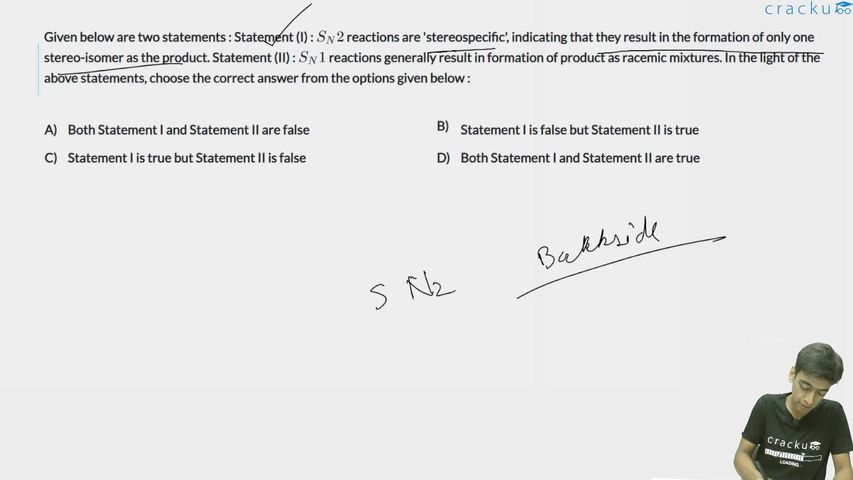
Given below are two statements : Statement (I) : $$S_N2$$ reactions are 'stereospecific', indicating that they result in the formation of only one stereo-isomer as the product. Statement (II) : $$S_N1$$ reactions generally result in formation of product as racemic mixtures. In the light of the above statements, choose the correct answer from the options given below :
We need to evaluate both statements about nucleophilic substitution reactions.
Statement (I): $$S_N2$$ reactions are 'stereospecific', indicating that they result in the formation of only one stereo-isomer as the product.
In $$S_N2$$ reactions, the nucleophile attacks from the back side of the carbon bearing the leaving group (backside attack). This results in a Walden inversion, producing a single stereoisomer with inverted configuration. Hence, $$S_N2$$ reactions are indeed stereospecific. Statement I is true.
Statement (II): $$S_N1$$ reactions generally result in formation of product as racemic mixtures.
In $$S_N1$$ reactions, the rate-determining step involves the formation of a planar carbocation intermediate. The nucleophile can attack this planar carbocation from either side with nearly equal probability, leading to a mixture of both R and S configurations — a racemic mixture. Statement II is true.
Since both statements are true, the correct answer is Option 4: Both Statement I and Statement II are true.
Was this solution helpful?
Click on the Email ☝️ to Watch the Video Solution
Create a FREE account and get:
_1.webp)

Educational materials for JEE preparation

Ask our AI anything

AI can make mistakes. Please verify important information.
AI can make mistakes. Please verify important information.
