Join WhatsApp Icon JEE WhatsApp Group
Question 46


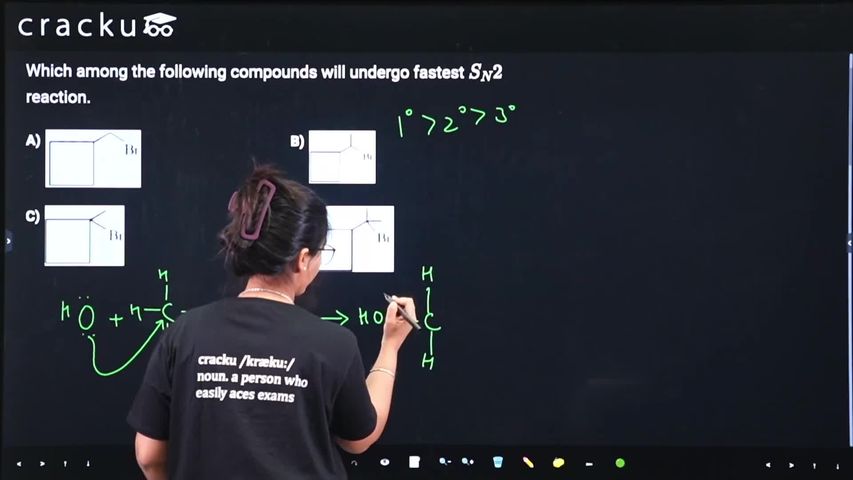
Which among the following compounds will undergo fastest $$S_N2$$ reaction.

  1. Option A: (Bromomethyl)cyclobutane
    • The carbon attached to $$-\text{Br}$$ is directly bonded to only one other carbon (the cyclobutane ring carbon).
    • This is a primary ($$1^\circ$$) alkyl halide. It has the least steric hindrance, leaving the backside wide open for a nucleophilic attack.
  2. Option B:
    • The carbon attached to $$-\text{Br}$$ is bonded to two other carbons (the ring and a methyl group).
    • This is a secondary ($$2^\circ$$) alkyl halide. Increased steric hindrance slows the reaction down.
  3. Option C: 1-Bromo-1-methylcyclobutane
    • The carbon attached to $$-\text{Br}$$ is a tertiary ring carbon.
    • This is a tertiary ($$3^\circ$$) alkyl halide. Tertiary halides are too crowded for backside attack and generally do not undergo $$\text{S}_\text{N}2$$ reactions at all.
  4. Option D:
    • The carbon attached to $$-\text{Br}$$ is a tertiary ($$3^\circ$$) alkyl halide attached to a bulky neopentyl-like branch system. Extremely sterically hindered.

The general rate of reactivity for $$\text{S}_\text{N}2$$ reactions follows the order:

$$\text{Methyl} > 1^\circ > 2^\circ > 3^\circ$$

Get AI Help

Video Solution

video

Create a FREE account and get:

  • Free JEE Mains Previous Papers PDF
  • Take JEE Mains paper tests

50,000+ JEE Students Trusted Our Score Calculator

Predict your JEE Main percentile, rank & performance in seconds

Ask AI

Ask our AI anything

AI can make mistakes. Please verify important information.