
Join Our JEE Preparation Group
Prep with like-minded aspirants; Get access to free daily tests and study material.
Sign in
Please select an account to continue using cracku.in
↓ →
Join Our JEE Preparation Group
Prep with like-minded aspirants; Get access to free daily tests and study material.
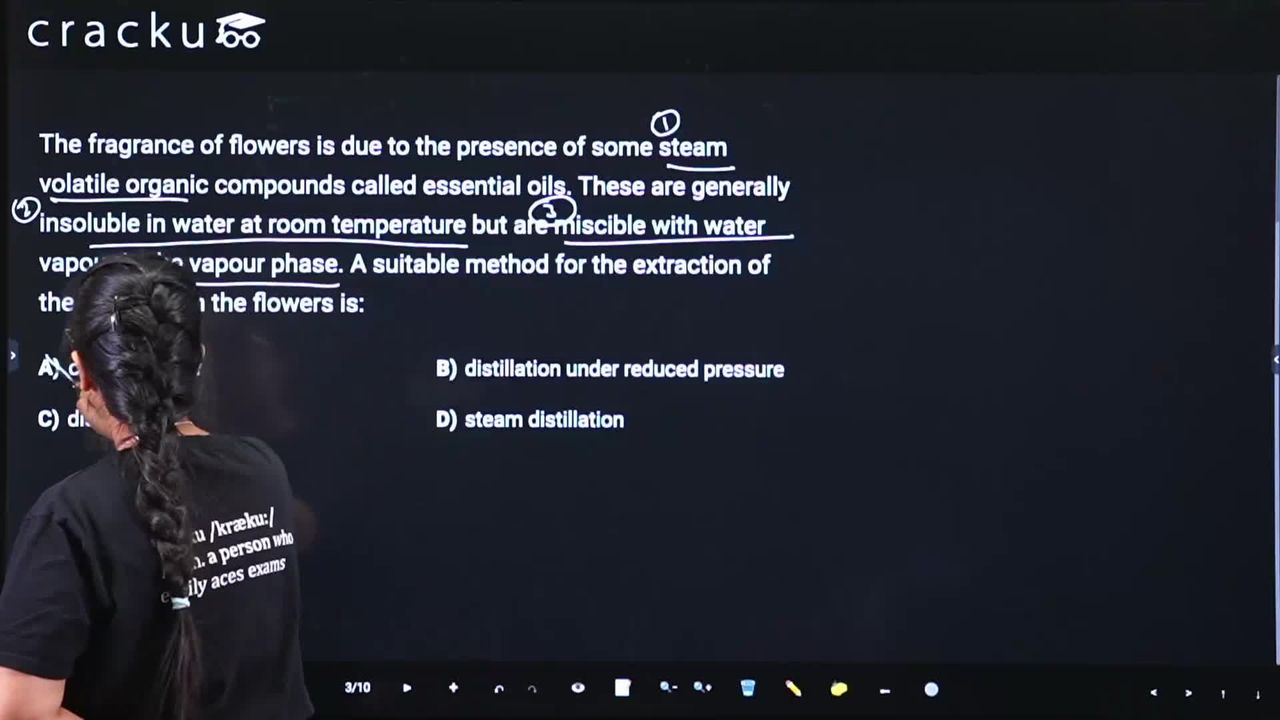
The fragrance of flowers is due to the presence of some steam volatile organic compounds called essential oils. These are generally insoluble in water at room temperature but are miscible with water vapour in the vapour phase. A suitable method for the extraction of these oils from the flowers is:
We need to identify the suitable method for extracting essential oils from flowers.
Key Concept: The essential oils are (i) steam-volatile organic compounds, (ii) insoluble in water at room temperature, and (iii) miscible with water vapour in the vapour phase.
Option D: Steam distillation is the correct method. In steam distillation, steam is passed through the plant material. The essential oils, being volatile, vaporize along with the steam at a temperature below their normal boiling point. The mixed vapours of water and oil are then condensed. Since the oils are immiscible with water at room temperature, the condensed mixture separates into two layers, allowing the essential oil to be easily separated. This method is specifically designed for compounds that are steam-volatile but water-insoluble—exactly matching the properties described in the question.
The correct answer is Option D.
Was this solution helpful?
Click on the Email ☝️ to Watch the Video Solution
Create a FREE account and get:
_1.webp)

Educational materials for JEE preparation

Ask our AI anything

AI can make mistakes. Please verify important information.
AI can make mistakes. Please verify important information.
