
Join Our JEE Preparation Group
Prep with like-minded aspirants; Get access to free daily tests and study material.
Sign in
Please select an account to continue using cracku.in
↓ →
Join Our JEE Preparation Group
Prep with like-minded aspirants; Get access to free daily tests and study material.
First, let us recall what happens inside a column chromatographic set-up. We pack a finely divided solid, such as silica gel or alumina, into a long vertical glass tube. This packed solid is called the stationary phase. Next, a liquid or a mixture of liquids, called the mobile phase or eluent, is allowed to flow down the column under gravity. The sample that we wish to separate is introduced at the top of this column and is carried downward by the flowing solvent.
Now, the key physical phenomenon that actually brings about the separation is the tendency of different components of the mixture to cling to, or leave, the surface of the solid. In surface science, the word used for this surface attachment is “adsorption,” not “absorption.”
Adsorption means the molecules accumulate only on the surface of the solid. Absorption, on the other hand, would imply that the molecules pass into the bulk of another phase, like water soaking into a sponge; that is not what happens here. So we can immediately eliminate any option that speaks of “absorption.”
Let us examine all the options one by one:
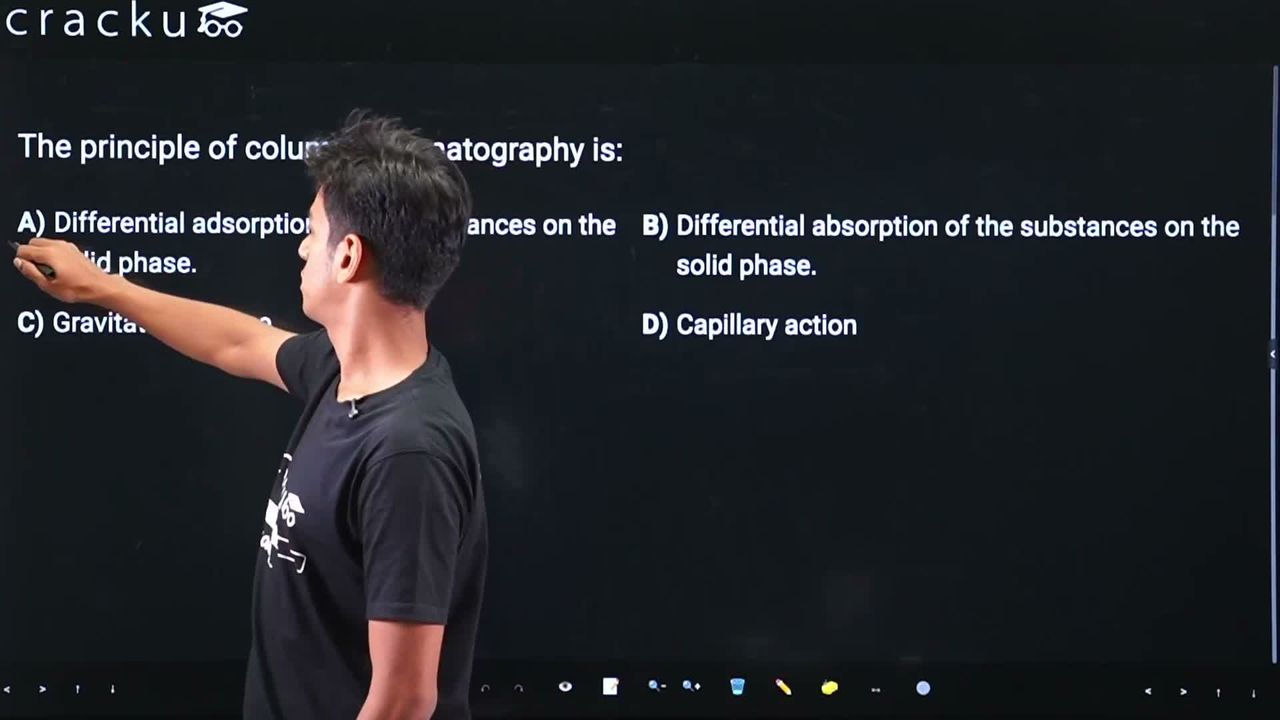
Option A speaks of the differential adsorption of substances on the solid phase. This is precisely what we observe: each solute molecule spends part of its time adsorbed (stuck) on the stationary phase and part of its time dissolved (moving) in the mobile phase. Because different solutes have different affinities for the solid surface, they travel through the column at different average speeds and emerge separated.
Option B uses the term “differential absorption,” which, as explained, is incorrect terminology for the surface phenomenon actually taking place.
Option C mentions gravitational force. While gravity certainly makes the liquid flow downward, it is not the principle responsible for the separation of components.
Option D mentions capillary action. In a packed column the liquid does not move primarily by capillary rise; instead it flows downward under gravity, so capillary forces are not central to the chromatographic principle either.
Therefore, the only scientifically accurate description of the principle is the one stated in Option A.
Hence, the correct answer is Option A.
Was this solution helpful?
Click on the Email ☝️ to Watch the Video Solution
Create a FREE account and get:
_1.webp)

Educational materials for JEE preparation

Ask our AI anything

AI can make mistakes. Please verify important information.
AI can make mistakes. Please verify important information.
