
Join Our JEE Preparation Group
Prep with like-minded aspirants; Get access to free daily tests and study material.
Sign in
Please select an account to continue using cracku.in
↓ →
Join Our JEE Preparation Group
Prep with like-minded aspirants; Get access to free daily tests and study material.
First, let us recall what “catenation” means. Catenation is the ability of an element to form long chains (or rings) by making covalent bonds with atoms of the same element. In the p-block, particularly for Group 14 elements (C, Si, Ge, Sn, Pb), this property is very important.
The strength of catenation depends mainly on the bond dissociation energy of the element-element single bond, written generally as $$E\bigl(\text{X-X}\bigr).$$ The larger this energy, the more stable the X-X bond is, and the better the element can catenate.
Empirically, the $$\text{X-X}$$ bond energies for Group 14 fall as we go down the group. Symbolically we may write
$$E(\text{C-C}) \; > \; E(\text{Si-Si}) \; > \; E(\text{Ge-Ge}) \; > \; E(\text{Sn-Sn}) \; > \; E(\text{Pb-Pb}).$$
This fall happens because atomic size increases down the group, causing the overlap of orbitals in the M-M bond to weaken and hence lowering the bond energy.
The trend in bond energy directly translates to the trend in catenation ability. Therefore we can write the qualitative order of catenation as
$$\text{C} \; > \; \text{Si} \; > \; \text{Ge} \; > \; \text{Sn} \; \bigl(\text{and Pb still lower}\bigr).$$
Often in questions Pb is not included, and sometimes Ge and Sn are declared “nearly equal” because the difference between $$E(\text{Ge-Ge})$$ and $$E(\text{Sn-Sn})$$ is not as large as the earlier gaps. Thus many textbooks write
$$\text{C} \; > \; \text{Si} \; > \; \text{Ge} \approx \text{Sn}.$$
Now we match this theoretical order with the given options.
Option A: $$\text{Ge} > \text{Sn} > \text{Si} > \text{C}$$ — completely opposite; incorrect.
Option B: $$\text{C} > \text{Sn} > \text{Si} \approx \text{Ge}$$ — places Sn above Si; incorrect.
Option C: $$\text{C} > \text{Si} > \text{Ge} \approx \text{Sn}$$ — exactly matches the theoretical order; correct.
Option D: $$\text{Si} > \text{Sn} > \text{C} > \text{Ge}$$ — does not start with C; incorrect.
Since only Option C represents the proper descending trend of catenation, we select it.
Hence, the correct answer is Option C.
Was this solution helpful?
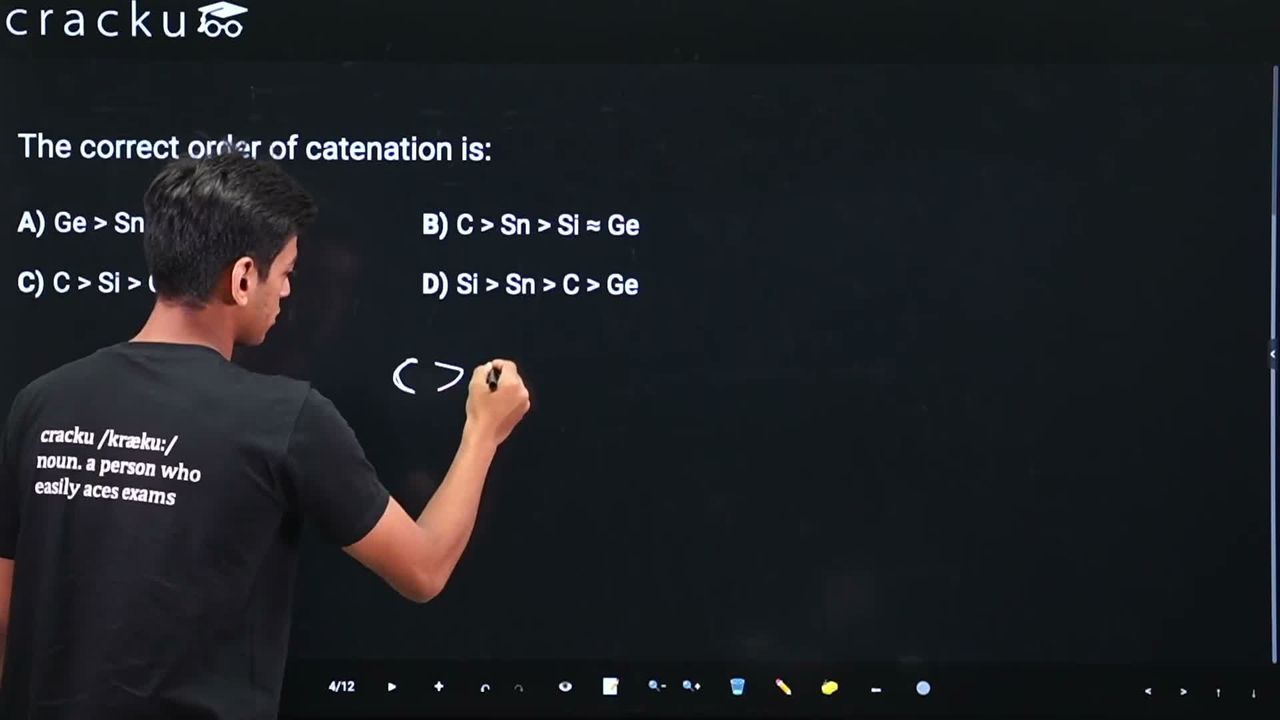
Click on the Email ☝️ to Watch the Video Solution
Create a FREE account and get:
_1.webp)

Educational materials for JEE preparation

Ask our AI anything

AI can make mistakes. Please verify important information.
AI can make mistakes. Please verify important information.
