
Join Our JEE Preparation Group
Prep with like-minded aspirants; Get access to free daily tests and study material.
Sign in
Please select an account to continue using cracku.in
↓ →
Join Our JEE Preparation Group
Prep with like-minded aspirants; Get access to free daily tests and study material.
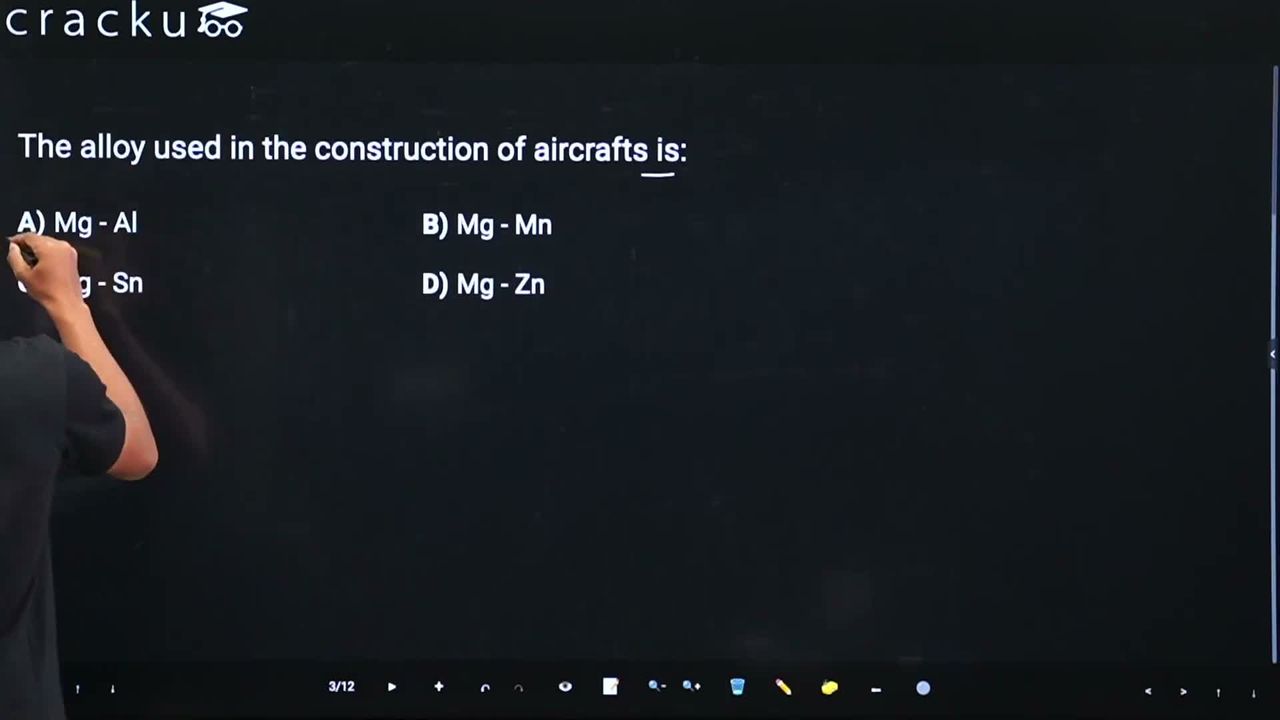
First, let us recall a well-known fact from metallurgy. In the construction of aircrafts, engineers prefer alloys that are simultaneously very light in weight and sufficiently strong. A classical choice fulfilling these conditions is the magnesium-aluminium alloy. Because magnesium has a very low density and aluminium also combines low density with good tensile strength, their alloy inherits both advantages: high strength-to-weight ratio and good corrosion resistance. Therefore, an alloy of magnesium and aluminium is widely adopted in the aviation industry for making various structural components of aircrafts.
Now we examine the options given in the question one by one:
Option A gives the alloy $$\text{Mg-Al}$$, which matches the standard light alloy used in aircraft construction.
Option B lists $$\text{Mg-Mn}$$. Although manganese can be added in small amounts to improve corrosion resistance, an alloy of only magnesium and manganese is not the principal material for aircraft bodies.
Option C shows $$\text{Mg-Sn}$$. Tin does not impart the desired combination of lightness and mechanical strength needed for aircraft structures, so this alloy is not employed for that purpose.
Option D proposes $$\text{Mg-Zn}$$. Zinc may improve certain properties when alloyed in minor proportions, yet the primary aircraft alloy is not a simple binary magnesium-zinc mixture.
Since Option A alone corresponds to the recognized magnesium-aluminium alloy used in aircraft manufacturing, we select it.
Hence, the correct answer is Option A.
Was this solution helpful?
Click on the Email ☝️ to Watch the Video Solution
Create a FREE account and get:
_1.webp)

Educational materials for JEE preparation

Ask our AI anything

AI can make mistakes. Please verify important information.
AI can make mistakes. Please verify important information.
