
Join Our JEE Preparation Group
Prep with like-minded aspirants; Get access to free daily tests and study material.
Sign in
Please select an account to continue using cracku.in
↓ →
Join Our JEE Preparation Group
Prep with like-minded aspirants; Get access to free daily tests and study material.
We begin by recalling what “water gas” actually is. Water gas is the mixture produced when steam is passed over red-hot coke or coal; the principal constituents of this mixture are carbon monoxide and hydrogen. In symbolic form we can write the main components as $$\text{CO} + \text{H}_{2}\,.$$
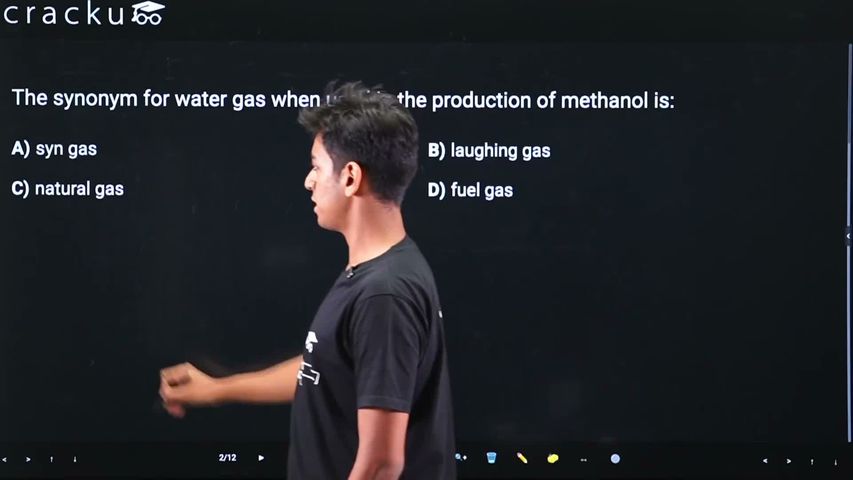
Whenever water gas is employed for the industrial synthesis of methanol, chemists very often do not keep saying “water gas”; instead, they adopt a special name that highlights the fact that this gaseous mixture is an excellent source of the two fundamental synthesis gases, namely carbon monoxide and hydrogen. The frequently used synonym in this context is “synthesis gas,” which is almost always abbreviated to “syn gas” or “syngas.”
Let us examine each option in turn.
Option A gives the term “syn gas.” This matches directly with the widely accepted abbreviation for synthesis gas. Because methanol production needs precisely a synthesis mixture of $$\text{CO}$$ and $$\text{H}_{2},$$ the use of “syn gas” is perfectly appropriate.
Option B offers “laughing gas,” which is the common name for $$\text{N}_{2}\text{O}$$ (nitrous oxide). Clearly, nitrous oxide is unrelated to the water-gas mixture and is not used for methanol synthesis, so this option is incorrect.
Option C proposes “natural gas,” whose principal component is methane $$\left(\text{CH}_{4}\right).$$ Though natural gas can be reformed to generate synthesis gas, the term “natural gas” itself is never used interchangeably with water gas; therefore this option is also incorrect.
Option D lists “fuel gas,” a very general expression for any combustible gas mixture. While water gas can indeed act as a fuel, the phrase “fuel gas” is not the specific synonym preferred in the methanol context, so this is not the right choice either.
Consequently, only Option A, “syn gas,” serves as the correct synonym for water gas when it is used in methanol production.
Hence, the correct answer is Option A.
Was this solution helpful?
Click on the Email ☝️ to Watch the Video Solution
Create a FREE account and get:
_1.webp)

Educational materials for JEE preparation

Ask our AI anything

AI can make mistakes. Please verify important information.
AI can make mistakes. Please verify important information.
