
Join Our JEE Preparation Group
Prep with like-minded aspirants; Get access to free daily tests and study material.
Sign in
Please select an account to continue using cracku.in
↓ →
Join Our JEE Preparation Group
Prep with like-minded aspirants; Get access to free daily tests and study material.
Consider the following statements
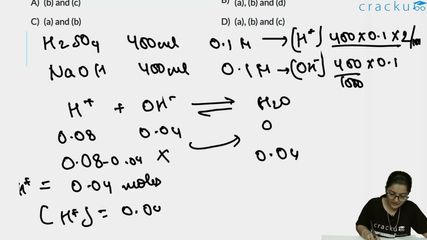
(a) The pH of a mixture containing 400 mL of 0.1 M H$$_2$$SO$$_4$$ and 400 mL of 0.1 M NaOH will be approximately 1.3.
(b) Ionic product of water is temperature dependent.
(c) A monobasic acid with K$$_a$$ = 10$$^{-5}$$ has a pH = 5. The degree of dissociation of this acid is 50%.
(d) The Le Chatelier's principle is not applicable to common-ion effect.
The correct statements are:
We examine each of the four statements one by one and keep note of their truth values.
We have statement (a): “The pH of a mixture containing 400 mL of 0.1 M H$$\_2$$SO$$\_4$$ and 400 mL of 0.1 M NaOH will be approximately 1.3.”
First we convert all the volumes to litres because molarity is defined as moles per litre.
$$400\ \text{mL}=0.400\ \text{L}$$
Now we calculate the number of moles present in each solution.
Moles of H$$\_2$$SO$$\_4$$ present
$$n\_{\text{acid}} = M \times V = 0.1\ \text{M}\times 0.400\ \text{L}=0.040\ \text{mol}$$
Every mole of H$$\_2$$SO$$\_4$$ can, in principle, furnish two moles of H$$^+$$ ions because the first ionisation is complete and, for a rough pH estimate in the presence of a strong base, the second ionisation may also be taken as essentially complete.
Total moles of acidic protons available
$$n\_{H^+,\ \text{available}} = 2 \times 0.040\ \text{mol}=0.080\ \text{mol}$$
Moles of NaOH present
$$n\_{\text{base}} = 0.1\ \text{M}\times 0.400\ \text{L}=0.040\ \text{mol}$$
Each mole of NaOH gives one mole of OH$$^-$$ ions, so OH$$^-$$ moles are also 0.040. Neutralisation occurs according to
$$H^+ + OH^- \longrightarrow H_2O$$
Moles of H$$^+$$ remaining after complete neutralisation
$$n\_{H^+,\ \text{left}} = 0.080\ \text{mol}-0.040\ \text{mol}=0.040\ \text{mol}$$
The final volume is the sum of the two individual volumes because we are simply mixing the two solutions.
$$V\_{\text{final}} = 0.400\ \text{L}+0.400\ \text{L}=0.800\ \text{L}$$
The concentration of excess H$$^+$$ ions is therefore
$$[H^+] = \dfrac{0.040\ \text{mol}}{0.800\ \text{L}} = 0.050\ \text{M}$$
We recall the definition of pH:
$$\text{pH} = -\log_{10}[H^+]$$
Substituting the value just obtained,
$$\text{pH} = -\log_{10}(0.050)= -\log_{10}(5.0\times 10^{-2})$$
$$\text{pH}= -\bigl(\log_{10}5.0 + \log_{10}10^{-2}\bigr)= -\bigl(0.6990-2\bigr)= 1.301$$
This is approximately 1.3, exactly as stated. Hence statement (a) is true.
Now statement (b): “Ionic product of water is temperature dependent.”
The ionic product of water is defined as
$$K_w=[H^+][OH^-]$$
For water the self-ionisation is an endothermic process. By Le Chatelier’s principle, an increase in temperature shifts an endothermic equilibrium to the right, so $$[H^+]$$ and $$[OH^-]$$ both increase, making $$K_w$$ larger. Conversely, lowering the temperature reduces $$K_w$$. Thus $$K_w$$ definitely changes with temperature. Hence statement (b) is true.
Next statement (c): “A monobasic acid with $$K_a=10^{-5}$$ has a pH = 5. The degree of dissociation of this acid is 50 % .”
We first note that pH = 5 implies
$$[H^+]=10^{-5}\ \text{M}$$
Because the acid is monobasic, the concentration of its conjugate base produced is the same as the concentration of $$H^+$$ formed, so
$$[A^-]=10^{-5}\ \text{M}$$
Let the initial molar concentration of the acid be $$c$$ and its degree of dissociation be $$\alpha$$. Then
$$[A^-]=c\alpha,\qquad [HA]=c(1-\alpha)$$
The acid-dissociation constant is defined by
$$K_a=\dfrac{[H^+][A^-]}{[HA]}$$
Substituting the three equilibrium concentrations,
$$10^{-5}=\dfrac{(10^{-5})(c\alpha)}{c(1-\alpha)}$$
Simplifying, the factor $$c$$ cancels out:
$$10^{-5}=10^{-5}\cdot\dfrac{\alpha}{1-\alpha}$$
Dividing both sides by $$10^{-5}$$ we obtain
$$1=\dfrac{\alpha}{1-\alpha}$$
Cross-multiplying,
$$1-\alpha=\alpha$$
$$1=2\alpha$$
$$\alpha=\dfrac12 = 0.50 = 50\ \%$$
The calculation confirms exactly what the statement claims, so statement (c) is also true.
Finally statement (d): “The Le Chatelier’s principle is not applicable to the common-ion effect.”
The common-ion effect is nothing but a special case of Le Chatelier’s principle applied to an ionic equilibrium: when an ion already present in the equilibrium mixture is supplied from an external source, the equilibrium shifts so as to reduce the stress, i.e. to consume some of that added ion. Thus the principle is directly applicable; saying it is “not applicable” is wrong. Hence statement (d) is false.
Collecting the results, statements (a), (b) and (c) are correct, while statement (d) is incorrect.
Hence, the correct answer is Option D.
Was this solution helpful?
Click on the Email ☝️ to Watch the Video Solution
Create a FREE account and get:
_1.webp)

Educational materials for JEE preparation

Ask our AI anything

AI can make mistakes. Please verify important information.
AI can make mistakes. Please verify important information.
