
Join Our JEE Preparation Group
Prep with like-minded aspirants; Get access to free daily tests and study material.
Sign in
Please select an account to continue using cracku.in
↓ →
Join Our JEE Preparation Group
Prep with like-minded aspirants; Get access to free daily tests and study material.
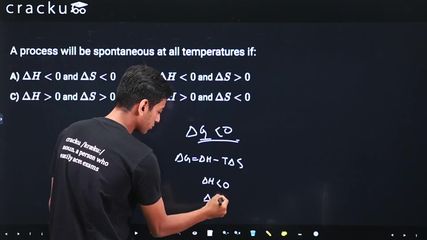
We recall the basic thermodynamic criterion for spontaneity, namely the Gibbs free-energy change. The relation is stated as
$$\Delta G \;=\; \Delta H \;-\; T\,\Delta S$$
where $$\Delta G$$ is the change in Gibbs free energy, $$\Delta H$$ is the enthalpy change, $$T$$ is the absolute temperature and $$\Delta S$$ is the entropy change. A process is spontaneous when
$$\Delta G \; < \; 0.$$
Substituting the expression for $$\Delta G$$, the condition for spontaneity becomes
$$\Delta H - T\,\Delta S \; < \; 0.$$
Now we must find which combination of signs for $$\Delta H$$ and $$\Delta S$$ guarantees that the left-hand side remains negative for every value of the temperature $$T > 0$$.
We consider each possible sign combination one by one, always remembering that $$T$$ is positive:
1. Suppose $$\Delta H < 0$$ and $$\Delta S < 0$$. Then the term $$\Delta H$$ is negative, but the term $$-T\,\Delta S$$ becomes positive because $$\Delta S$$ is negative and the minus sign in front of $$T\Delta S$$ changes it. At low temperatures the negative enthalpy might dominate and make $$\Delta G$$ negative, but as $$T$$ increases the positive contribution $$-T\Delta S$$ grows and can eventually outweigh $$\Delta H$$. Hence spontaneity would not persist at all temperatures.
2. Now take $$\Delta H < 0$$ and $$\Delta S > 0$$. Here $$\Delta H$$ is negative and the term $$-T\,\Delta S$$ is also negative because $$\Delta S$$ is positive and there is already a minus sign. Therefore both contributions are negative for every positive $$T$$, giving
$$\Delta G \;=\; \text{(negative)} + \text{(negative)} \;=\; \text{negative for all } T.$$
So the inequality $$\Delta G < 0$$ is satisfied at every temperature.
3. Consider $$\Delta H > 0$$ and $$\Delta S > 0$$. The enthalpy term is positive, while the entropy term $$-T\,\Delta S$$ is negative. At low temperatures the positive enthalpy dominates, making $$\Delta G$$ positive, so the reaction will not be spontaneous there. Thus this pair of signs does not guarantee spontaneity at all temperatures.
4. Finally, if $$\Delta H > 0$$ and $$\Delta S < 0$$, both $$\Delta H$$ and $$-T\,\Delta S$$ are positive, yielding $$\Delta G > 0$$ for every $$T$$. Such a process is never spontaneous.
Only the second combination, $$\Delta H < 0$$ along with $$\Delta S > 0$$, makes the Gibbs free-energy change negative irrespective of the temperature.
Hence, the correct answer is Option B.
Was this solution helpful?
Click on the Email ☝️ to Watch the Video Solution
Create a FREE account and get:
_1.webp)

Educational materials for JEE preparation

Ask our AI anything

AI can make mistakes. Please verify important information.
AI can make mistakes. Please verify important information.
