
Join Our JEE Preparation Group
Prep with like-minded aspirants; Get access to free daily tests and study material.
Sign in
Please select an account to continue using cracku.in
↓ →
Join Our JEE Preparation Group
Prep with like-minded aspirants; Get access to free daily tests and study material.
Consider the following table:
Gas a/(kPa dm$$^6$$ mol$$^{-1}$$) b/(dm$$^3$$ mol$$^{-1}$$)
A 642.32 0.05196
B 155.21 0.04136
C 431.91 0.05196
D 155.21 0.4382
a and b are van der Waals constants. The correct statement about the gases is:
We begin by writing the van der Waals equation. For n moles of a real gas the equation is stated as
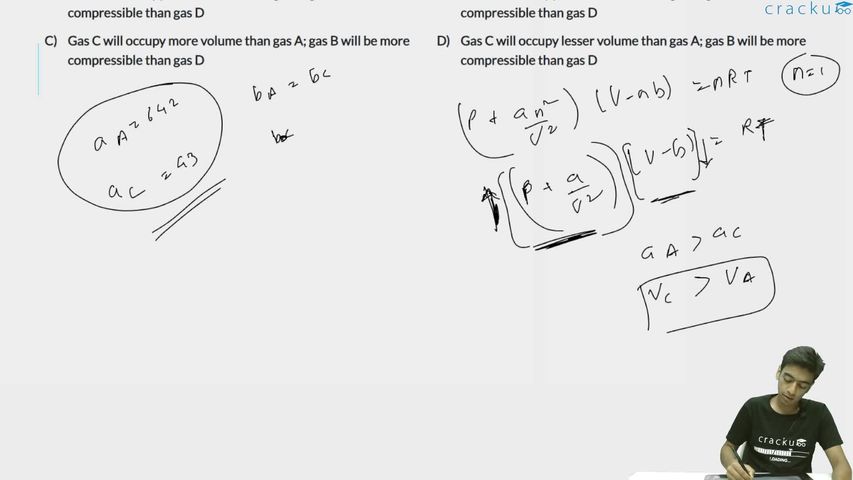
$$\left(P+\frac{a n^{2}}{V^{2}}\right)\,(V-nb)=nRT.$$
Here $$a$$ corrects the pressure term for intermolecular attractions, while $$b$$ corrects the volume term for the finite size of the molecules. A larger $$a$$ therefore signifies stronger attractions (the gas can be squeezed more easily), and a larger $$b$$ signifies a larger “excluded volume’’ per mole (each mole physically occupies more space).
To compare the four gases we put $$n=1$$ (one mole):
$$\left(P+\frac{a}{V^{2}}\right)\,(V-b)=RT. \quad -(1)$$
Throughout the comparison we imagine all gases kept at the same temperature $$T$$ and pressure $$P$$ so that the right-hand side, $$RT,$$ is the same for every gas.
Comparison of gases A and C (volume occupied)
For gas A $$a_A = 642.32\;\text{kPa dm}^6\text{ mol}^{-1},\qquad b_A = 0.05196\;\text{dm}^3\text{ mol}^{-1}.$$
For gas C $$a_C = 431.91\;\text{kPa dm}^6\text{ mol}^{-1},\qquad b_C = 0.05196\;\text{dm}^3\text{ mol}^{-1}.$$
Both gases have exactly the same value of $$b,$$ but gas A possesses a larger value of $$a$$ than gas C. From equation (1) we see that for a fixed $$P$$ the factor $$\displaystyle\left(P+\frac{a}{V^{2}}\right)$$ becomes larger when $$a$$ is larger. To keep the product equal to the constant $$RT,$$ the other factor $$(V-b)$$ must then become smaller. Therefore,
$$a_A > a_C\quad\Longrightarrow\quad (V_A-b) < (V_C-b)\quad\Longrightarrow\quad V_A < V_C.$$
Thus one mole of gas C occupies more volume than one mole of gas A under identical conditions.
Comparison of gases B and D (ease of compressibility)
For gas B $$a_B = 155.21,\; b_B = 0.04136.$$
For gas D $$a_D = 155.21,\; b_D = 0.4382.$$
Both gases have the same value of $$a,$$ so the attraction effect is identical. Their difference lies in $$b$$: gas D has a much larger excluded volume than gas B. To see how this affects compressibility, we rewrite equation (1) in the form of the compressibility factor $$Z$$:
$$Z \;=\; \frac{PV}{RT}\;=\;\frac{V}{V-b} \;-\; \frac{a}{RTV}. \quad -(2)$$
The first term $$\dfrac{V}{V-b}$$ (the repulsive correction) becomes larger as $$b$$ becomes larger, making $$Z$$ increase above 1. A larger $$Z$$ indicates that the gas resists compression (its volume is already “puffed up’’ by repulsions). Consequently, a gas with the larger $$b$$ is less compressible.
Because $$b_D \gg b_B,$$ we have
$$Z_D > Z_B \quad\Longrightarrow\quad \text{gas D is less compressible than gas B}.$$
Equivalently, gas B is more compressible than gas D.
Putting both parts together
We have shown that
(i) Gas C occupies more volume than gas A, and
(ii) Gas B is more compressible than gas D.
The option that states both facts correctly is Option C.
Hence, the correct answer is Option C.
Was this solution helpful?
Click on the Email ☝️ to Watch the Video Solution
Create a FREE account and get:
_1.webp)

Educational materials for JEE preparation

Ask our AI anything

AI can make mistakes. Please verify important information.
AI can make mistakes. Please verify important information.
