
Join Our JEE Preparation Group
Prep with like-minded aspirants; Get access to free daily tests and study material.
Sign in
Please select an account to continue using cracku.in
↓ →
Join Our JEE Preparation Group
Prep with like-minded aspirants; Get access to free daily tests and study material.
During the change of O$$_2$$ to O$$_2^-$$, the incoming electron goes to the orbital:
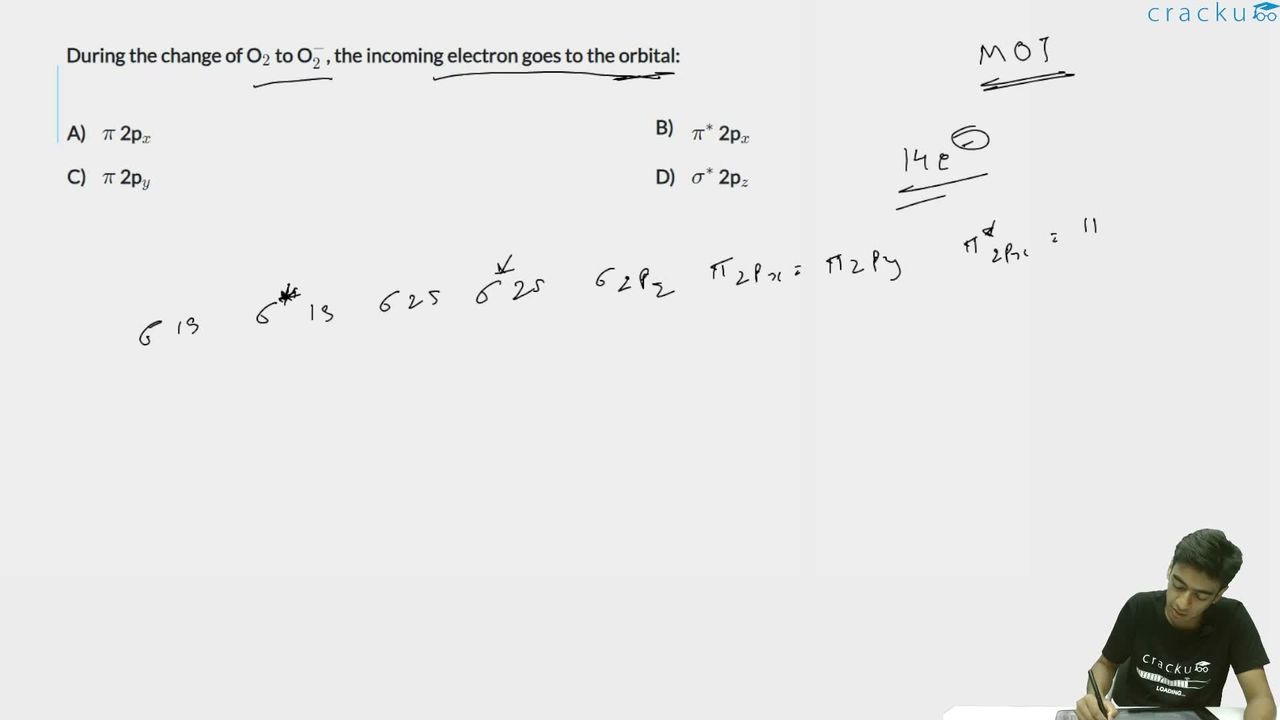
First, recall the order of molecular orbitals produced by the linear combination of the 2s and 2p atomic orbitals for homonuclear diatomic molecules with $$Z > 7$$ (that is, for O, F, Ne etc.). Stated in increasing energy, the sequence is
$$\sigma_{1s},\; \sigma_{1s}^\ast,\; \sigma_{2s},\; \sigma_{2s}^\ast,\; \sigma_{2p_z},\; \pi_{2p_x}=\pi_{2p_y},\; \pi_{2p_x}^\ast=\pi_{2p_y}^\ast,\; \sigma_{2p_z}^\ast.$$
This ordering is the foundation we shall use for electron filling (Aufbau principle), together with the Pauli exclusion principle and Hund’s rule of maximum multiplicity.
The dioxygen molecule $$\mathrm{O_2}$$ possesses a total of $$16$$ electrons (each O contributes $$8$$). We begin to place these electrons in the above energy-ordered molecular orbitals, two per orbital where possible:
$$ \begin{aligned} \sigma_{1s}^2 &\;(2\text{ e}^-)\\ \sigma_{1s}^{\ast\,2} &\;(4\text{ e}^-)\\ \sigma_{2s}^2 &\;(6\text{ e}^-)\\ \sigma_{2s}^{\ast\,2} &\;(8\text{ e}^-)\\ \sigma_{2p_z}^2 &\;(10\text{ e}^-)\\ \pi_{2p_x}^2\;\pi_{2p_y}^2 &\;(14\text{ e}^-)\\ \pi_{2p_x}^{\ast\,1}\;\pi_{2p_y}^{\ast\,1} &\;(16\text{ e}^-) \end{aligned} $$
At this stage, each of the degenerate antibonding $$\pi^\ast$$ orbitals carries one unpaired electron, in full agreement with the experimentally observed paramagnetism of $$\mathrm{O_2}$$.
Now we examine the species $$\mathrm{O_2^-}$$. The superscript “-” indicates that one additional electron is supplied to the system, giving a total of $$17$$ electrons to distribute.
After the first $$16$$ electrons have occupied the same orbitals as in neutral $$\mathrm{O_2}$$, the seventeenth electron must be placed in the next available molecular orbital of lowest energy. According to the sequence stated above, the two degenerate antibonding orbitals $$\pi_{2p_x}^\ast$$ and $$\pi_{2p_y}^\ast$$ are still the lowest in energy that are not yet completely filled.
Because these two $$\pi^\ast$$ orbitals are exactly equal in energy (degenerate), the extra electron can enter either one of them. Conventionally we choose one—for instance $$\pi_{2p_x}^\ast$$—to depict the process.
Hence the incoming electron in the conversion
$$\mathrm{O_2} \longrightarrow \mathrm{O_2^-}$$
enters the antibonding $$\pi_{2p_x}^\ast$$ molecular orbital.
Therefore, among the given options, the correct choice is
$$\pi^{\ast}\;2p_x.$$
Hence, the correct answer is Option B.
Was this solution helpful?
Click on the Email ☝️ to Watch the Video Solution
Create a FREE account and get:
_1.webp)

Educational materials for JEE preparation

Ask our AI anything

AI can make mistakes. Please verify important information.
AI can make mistakes. Please verify important information.
