Group
Group
 Group
Group
JEE Hydrocarbons PYQ
Solving JEE Hydrocarbons PYQ problems is important for mastering organic chemistry for JEE Main and JEE Advanced. This chapter mainly covers four categories: alkanes, alkenes, alkynes and aromatic hydrocarbons. Questions may test their preparation, physical and chemical properties, reaction mechanisms, product formation and relative stability.
The general formulas of open-chain hydrocarbons are:
$$Alkanes: CnH2n+2$$
$$Alkenes: CnH2n$$
$$Alkynes: CnH2n−2$$
Alkanes are saturated hydrocarbons, whereas alkenes and alkynes contain carbon-carbon double and triple bonds, respectively. Aromatic hydrocarbons, such as benzene, contain cyclic conjugated systems with special stability. Practising previous-year questions helps students understand how reaction conditions, reagents and electronic effects determine the final product.
JEE Hydrocarbons Important PYQ PDF
The JEE Hydrocarbons Important PYQ PDF provided below contains selected questions on alkanes, alkenes, alkynes and aromatic hydrocarbons. Students can use it for chapter-wise practice after completing the concepts or for quick revision before the examination.
Questions collected from JEE Mains Previous Papers help students identify recurring reactions and understand the expected level of difficulty. Attempt each problem independently before checking its answer. During analysis, classify mistakes as conceptual errors, incorrect reagent identification, mechanistic errors, or product prediction errors.
The PDF can also be attempted as a timed chapter test. Mark difficult questions and solve them again after revising the relevant reaction mechanism, rather than memorising only the final product.
Important Topics Covered in Hydrocarbons PYQs
Hydrocarbons form an essential part of the organic chemistry section of the JEE Mains Syllabus. Students should prepare all four groups because exam questions may connect multiple hydrocarbons through reaction sequences or conversions.
Alkanes
Important alkane topics include preparation through hydrogenation, Wurtz reaction, decarboxylation and Kolbe’s electrolysis. Questions may also cover conformations of ethane, combustion, cracking and free-radical halogenation.
A general combustion reaction is:
$$CnH2n+2+23n+1O2→nCO2+(n+1)H2O$$
Alkenes
Alkene questions commonly test preparation through elimination reactions, electrophilic addition, Markovnikov’s rule, peroxide effect, ozonolysis, oxidation and polymerisation.
Under normal conditions, propene reacts with HBr according to Markovnikov’s rule:
$$CH3CH=CH2+HBr→CH3CHBrCH3$$
In the presence of peroxide, $$HBr$$ gives the anti-Markovnikov product:
$$CH3CH=CH2+HBrperoxideCH3CH2CH2Br$$
The peroxide effect is generally observed with $$HBr, not HCl or HI.$$
Alkynes
Important alkyne topics include preparation through double dehydrohalogenation, addition reactions, oxidation, polymerisation and the acidic nature of terminal alkynes. The greater acidity of terminal alkynes is associated with the higher s-character of the sp-hybridised carbon.
Hydration of ethyne in the presence of mercuric sulphate produces acetaldehyde after enol-keto tautomerism:
$$HC≡CH+H2OHgSO4/H2SO4CH3CHO$$
Aromatic Hydrocarbons
Aromatic hydrocarbon questions focus on benzene, aromaticity, electrophilic aromatic substitution, directive effects and side-chain reactions. Important reactions include nitration, sulphonation, halogenation, Friedel-Crafts alkylation and Friedel-Crafts acylation.
Benzene undergoes nitration as follows:
$$C6H6+HNO3conc. H2SO4C6H5NO2+H2O$$
Other frequently tested areas include:
- Stability of carbocations and free radicals
- Relative reactivity of hydrocarbons
- Ozonolysis and oxidative cleavage
- Geometrical isomerism in alkenes
- Acidity of terminal alkynes
- Ortho, meta and para directing effects
How to Solve Hydrocarbons PYQs Effectively
Begin by classifying the compound as an alkane, alkene, alkyne or aromatic hydrocarbon. Then examine the reagent, catalyst and reaction conditions carefully because heat, light, peroxide or pressure can change the reaction pathway.
While solving JEE Questions, follow these steps:
- Identify the reactive bond or position.
- Determine whether the mechanism is ionic or free-radical.
- Check the stability of possible intermediates.
- Apply Markovnikov’s rule only under suitable conditions.
- Check for carbocation rearrangement.
- Use substituent effects in aromatic reactions.
- Verify the final product for orientation and stereochemistry.
After chapter-wise practice, attempt a JEE Mains Mock Test to evaluate speed, accuracy and reaction recall under exam conditions. Maintain a reaction chart covering reagents, conditions, intermediates and major products for faster revision.
List of JEE Hydrocarbons PYQs
The questions below cover alkanes, alkenes, alkynes and aromatic hydrocarbons. Attempt them as a timed chapter-wise test without checking the answers.
Review every incorrect, guessed or skipped question after the test. Revise the relevant concept or mechanism and reattempt the problem to build lasting understanding.
Question 1
3-Methyl-pent-2-ene on reaction with HBr in presence of peroxide forms an addition product. The number of possible stereoisomers for the product is
correct answer:- 3
Question 2
Which compound would give 5-keto-2-methyl hexanal upon ozonolysis?
correct answer:- 3
Question 3
One mole of a symmetrical alkene on ozonolysis gives two moles of an aldehyde having a molecular mass of $$44$$ u. The alkene is
correct answer:- 3
Question 4
An organic compound 'A' C$$_4$$H$$_8$$ on treatment with KMnO$$_4$$/H$$^+$$ yields compound 'B' C$$_3$$H$$_6$$O. Compound 'A' also yields compound 'B' on ozonolysis. Compound 'A' is:
correct answer:- 1
Question 5
A chloro compound "A".
(i) forms aldehydes on ozonolysis followed by the hydrolysis.
(ii) when vaporized completely 1.53 g of A, gives 448 mL of vapour at STP. The number of carbon atoms in a molecule of compound A is _________
correct answer:- 3

Question 6
The number of possible isomeric products formed when 3-chloro-1-butene reacts with HCl through carbocation formation is _______
correct answer:- 4
Question 7
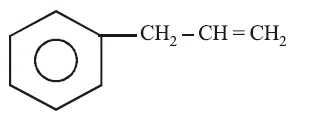
on mercuration-demercuration produces the major product:
correct answer:- 1
Question 8
The number of acyclic structural isomers (including geometrical isomers) for pentene are ___.
correct answer:- 6
Question 9
The reaction of propene with HOCl ($$Cl_2 + H_2O$$) proceeds through the intermediate:
correct answer:- 4
Question 10
Given below are two statements : one is labelled as Assertion (A) and the other is labelled as Reason (R).
Assertion (A): Treatment of bromine water with propene yields 1-bromopropan-2-ol.
Reason (R): Attack of water on bromonium ion follows Markovnikov rule and results in 1-bromopropan-2-ol.
In the light of the above statements, choose the most appropriate answer from the options given below:
correct answer:- 3

Question 11
The correct order of reactivity in electrophilic substitution reaction of the following compounds is:
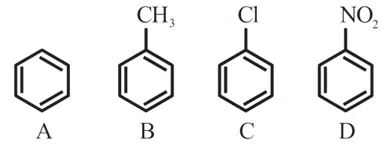
correct answer:- 4
Question 12
Consider the following two reactions A and B.
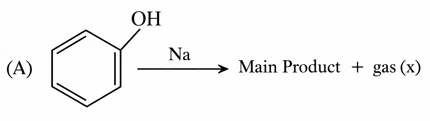
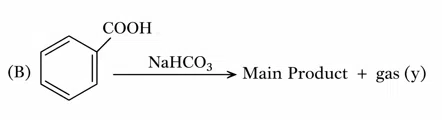
Numerical value of [ molar mass of x + molar mass of y] is __
correct answer:- 2
Question 13
Polysubstitution is a major drawback in:
correct answer:- 2
Question 14
Among the following four aromatic compounds, which one will have the lowest melting point?
correct answer:- 3
Question 15
Consider the polycyclic aromatic compound, 1-phenylnaphthalene, whose structure is shown below. The various unique carbon positions on the aromatic rings are numbered from (1) to (4) as marked:
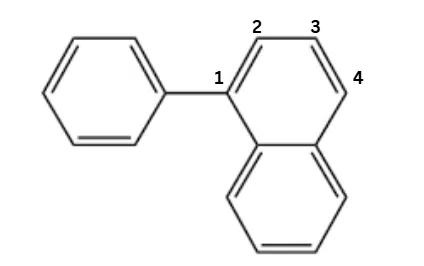
When this compound is subjected to mild electrophilic aromatic substitution (EAS) conditions,at which of the labeled positions will the electrophilic attack predominantly occur to form the major kinetic product? Write answer in integer [1 /2 /3 /4]
correct answer:- 4

Question 16
Which among the following is the strongest acid?
correct answer:- 4
Question 17
The major product obtained from the following reaction is:

correct answer:- 1
Question 18
Which one of the following reactions will not result in the formation of carbon-carbon bond?
correct answer:- 3
Question 19
Which one of the following compounds is non-aromatic?
correct answer:- 3
Question 20
Consider the following reactions. Total number of electrons in the $$\pi$$ bonds and lone pair of electrons in the product (X) is :
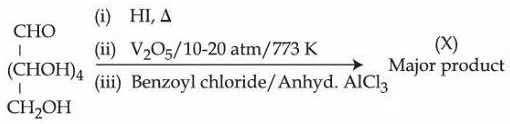
correct answer:- 4

Question 21
In a set of reactions p-nitrotoluene yielded a product E.
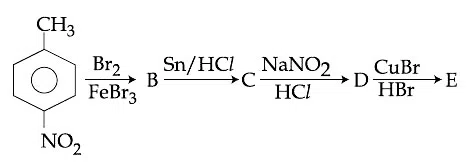
The product E would be:
correct answer:- 3
Question 22
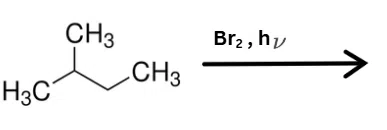
Which compound is formed as the major product?
correct answer:- 3
Question 23
An alkane (Y) requires 8 moles of oxygen for complete combustion and on chlorination with Cl$$_2$$/h$$\nu$$, (Y) gives only one monochlorinated product (Z). The total number of primary carbon atoms in (Y) is __________.
correct answer:- 4
Question 24
Number of bromo derivatives obtained on treating ethane with excess of Br$$_2$$ in diffused sunlight is ______
correct answer:- 9
Question 25
Given below are two statements regarding the conformations of ethane.
Statement I: The rotation about the carbon-carbon single bond $$\mathrm{(C-C)}$$ in ethane is not completely free and is hindered by a small energy barrier.
Statement II: This energy barrier is primarily caused by strong steric hindrance between the hydrogen atoms of adjacent methyl groups.
Choose the most appropriate answer from the options given below.
correct answer:- 3

Question 26
According to IUPAC nomenclature rules, which of the following represents the correct decreasing order of priority for the given principal functional groups?
correct answer:- 1
Question 27
Consider the isomers of hydrocarbon with molecular formula C$$_5$$H$$_{10}$$. These isomers do not decolourise KMnO$$_4$$ solution. These isomers are subjected to chlorination with chlorine in presence of light to give monochloro compounds. The total number of monochloro compounds (structural isomers only) formed is __________.
correct answer:- 14
Question 28
Total number of isomeric compounds (including stereoisomers) formed by monochlorination of 2-methylbutane is ______.
correct answer:- 6
Question 29
Which of the following alkane isomers has the lowest boiling point?
correct answer:- 4
Question 30
Consider the following sequence of reactions to give the major product $$(X)$$:
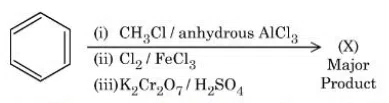
$$P$$ g of the major product $$(X)$$ formed is reacted with $$\text{NaHCO}_3$$ solution to liberate a gas which occupied 11.2 dm³ at STP. $$P$$ = _____ g.
( Given molar mass in g $$mol^{-1} H:1,C:12,O:16,Cl:35.5$$)
correct answer:- 78
Question 31
During Kolbe’s electrolytic method, an aqueous solution of sodium propanoate $$\mathrm{(CH_3CH_2COONa)}$$ is electrolyzed. Which pair of gases is evolved as the major product at the anode?
correct answer:- 2
Question 32
The hydration of propyne results in formation of
correct answer:- 1
Question 33
The reagent needed for converting:

correct answer:- 3
Question 34
Which of the following reactions will yield $$2, 2-$$dibromopropane?
correct answer:- 1
Question 35
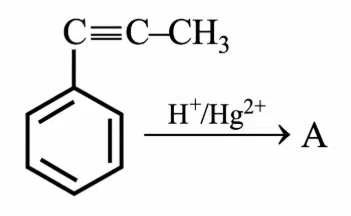
In the given reaction, the product 'A' is
correct answer:- 3
Question 36
Consider the following reactions:
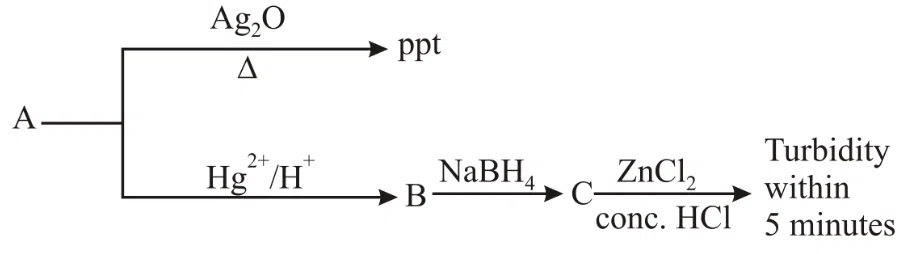
'A' is:
correct answer:- 4
Question 37
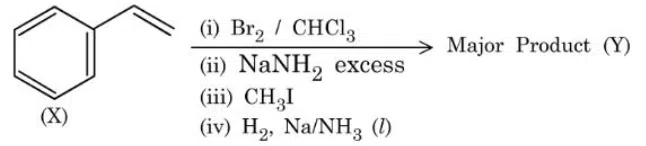
Compound (X) is subjected to the sequence of reactions as shown above:
Molar mass of the major product (Y) formed is ______ g mol$$^{-1}$$.
(Given molar mass in g mol$$^{-1}$$ C:12, H: 1, O: 16)
correct answer:- 2
Question 38
But-2-yne and hydrogen (one mole each) are separately treated with (i) Pd/C and (ii) Na/ liq. NH3 to give the products X and Y respectively.
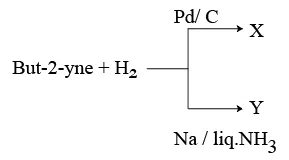
Identify the incorrect statements.
A. X and Y are stereoisomers.
B. Dipole moment of X is zero.
C. Boiling point of X is higher than Y.
D. X and Y react with $$O_{3}/Zn+H_{2}O$$ to give different products.
Choose the correct answer from the options given below :
correct answer:- 1
Question 39
The least acidic compound, among the following is:
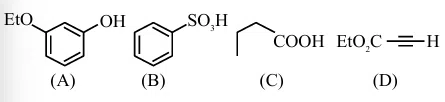
correct answer:- 1
Question 40
1,2-dibromocyclooctane is treated with

'P' is :
correct answer:- 2
.webp)