
Join Our JEE Preparation Group
Prep with like-minded aspirants; Get access to free daily tests and study material.
Sign in
Please select an account to continue using cracku.in
↓ →
Join Our JEE Preparation Group
Prep with like-minded aspirants; Get access to free daily tests and study material.
The hydration of an alkyne is normally carried out with dilute $$H_2SO_4$$ in the presence of $$HgSO_4$$ (Kucherov reaction). Under these conditions, water adds across the triple bond according to Markovnikov’s rule, giving an enol that rapidly rearranges (tautomerises) to a carbonyl compound.
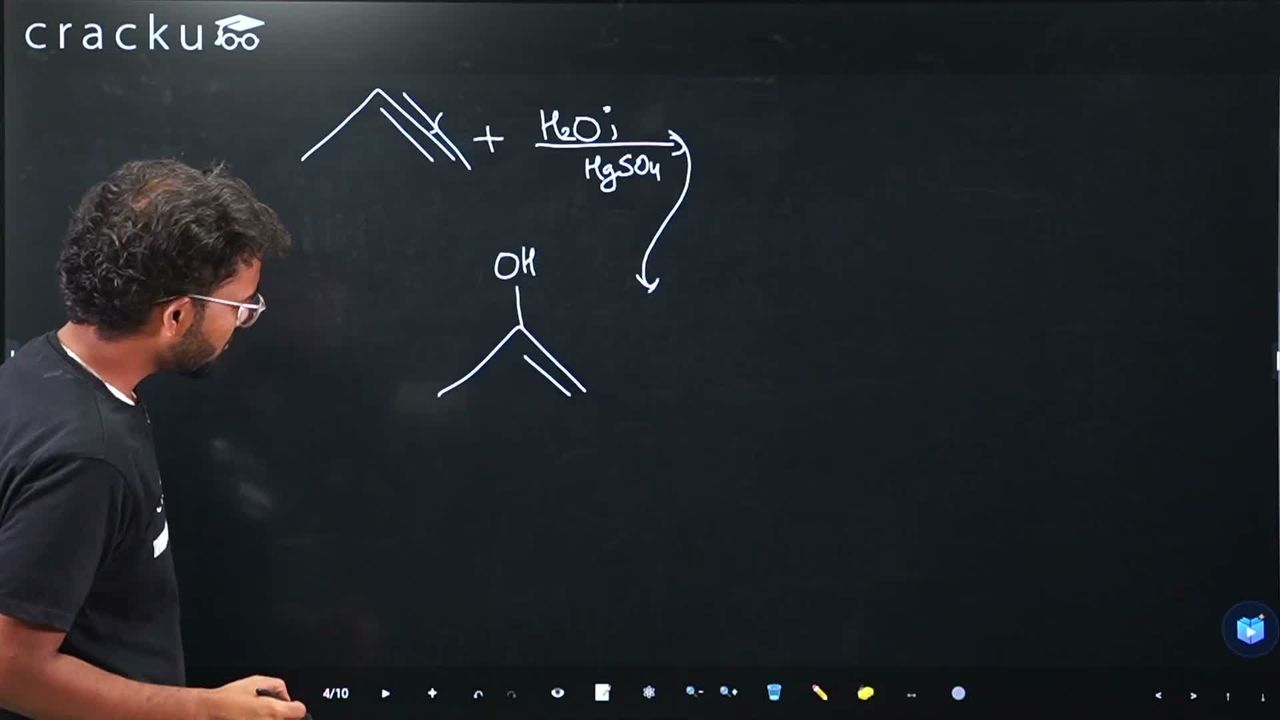
Propyne is $$CH_3-C\equiv CH$$. Add the elements of water, $$HO-H$$, so that $$OH$$ goes to the more substituted carbon of the triple bond (Markovnikov addition) and $$H$$ goes to the terminal carbon.
Step-1 (enol formation):
$$CH_3-C\equiv CH \xrightarrow[{HgSO_4}]{H_2O/H_2SO_4} CH_3-C(OH)=CH_2$$ (prop-1-en-2-ol)
Step-2 (keto-enol tautomerism): the enol rearranges by shifting the double bond and relocating the proton to give the more stable carbonyl (keto) form.
$$CH_3-C(OH)=CH_2 \longrightarrow CH_3-CO-CH_3$$
The carbonyl compound formed is $$CH_3-CO-CH_3$$, which is acetone (propan-2-one).
Therefore the major product obtained from hydration of propyne is acetone.
Option A which is: acetone
Click on the Email ☝️ to Watch the Video Solution
Create a FREE account and get:
_1.webp)

Educational materials for JEE preparation

Ask our AI anything

AI can make mistakes. Please verify important information.
AI can make mistakes. Please verify important information.


