
Join Our JEE Preparation Group
Prep with like-minded aspirants; Get access to free daily tests and study material.
Sign in
Please select an account to continue using cracku.in
↓ →
Join Our JEE Preparation Group
Prep with like-minded aspirants; Get access to free daily tests and study material.
The oxidation state of platinum in $$[Pt(NO_2)(Py)(NH_3)(NH_2OH)]^{+}$$ is $$+2$$ (all ligands except $$NO_2^-$$ are neutral, so the charge on the complex is $$+1$$ and therefore $$Pt$$ is $$+2$$).
$$Pt^{2+}$$ almost always forms square-planar complexes (coordination number $$4$$).
Square-planar geometrical isomerism arises from different pairs of ligands being trans (180° apart) or cis (90° apart).
If all four ligands were identical there would be only one arrangement, but here we have four different monodentate ligands: $$NO_2^-$$, $$Py$$, $$NH_3$$ and $$NH_2OH$$.
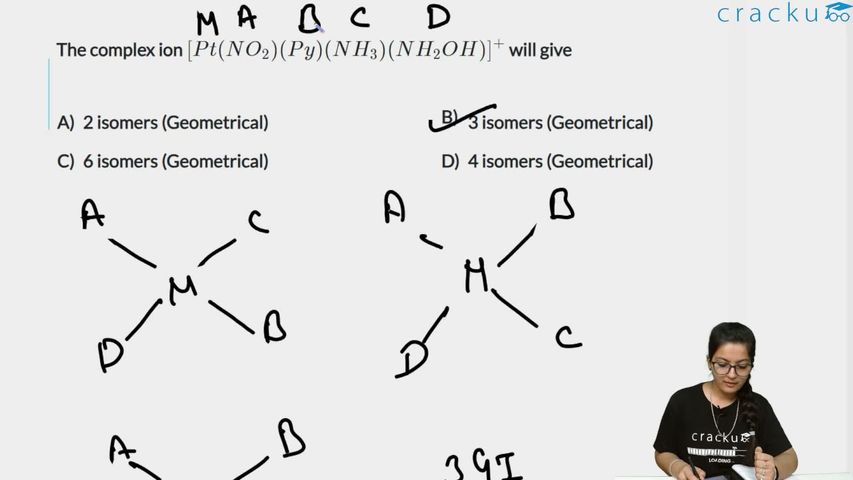
For a square-planar complex of the type $$[M\,A\,B\,C\,D]$$ (all ligands different) the possible distinct geometrical isomers can be counted as follows:
1. Fix one ligand (say $$A$$) at the top position; because rotation within the plane does not create a new isomer, this “locks” the plane’s orientation.
2. Now place a second ligand trans to $$A$$. Three different choices are available for this trans partner (any of $$B, C, D$$).
3. After the trans pair is chosen, the remaining two ligands automatically occupy the remaining two positions and are cis to each other. Interchanging those two remaining ligands is only a rotation of the square plane and therefore does not generate a new isomer.
Hence the total number of distinct square-planar arrangements for $$[M\,A\,B\,C\,D]$$ is $$3$$.
Applying this to $$[Pt(NO_2)(Py)(NH_3)(NH_2OH)]^{+}$$ with
$$A = Py,\; B = NO_2^-,\; C = NH_3,\; D = NH_2OH,$$ we obtain the three geometrical isomers:
Case 1: $$Py$$ trans $$NO_2^-$$ (therefore $$NH_3$$ cis $$NH_2OH$$)
Case 2: $$Py$$ trans $$NH_3$$ (therefore $$NO_2^-$$ cis $$NH_2OH$$)
Case 3: $$Py$$ trans $$NH_2OH$$ (therefore $$NO_2^-$$ cis $$NH_3$$)
No further distinct arrangements are possible; any attempt to draw another diagram can be rotated into one of the above three.
Therefore the complex ion exhibits exactly $$3$$ geometrical (cis-trans) isomers.
Option B which is: 3 isomers (Geometrical)
Was this solution helpful?
Click on the Email ☝️ to Watch the Video Solution
Create a FREE account and get:
_1.webp)

Educational materials for JEE preparation

Ask our AI anything

AI can make mistakes. Please verify important information.
AI can make mistakes. Please verify important information.


