
Join Our JEE Preparation Group
Prep with like-minded aspirants; Get access to free daily tests and study material.
Sign in
Please select an account to continue using cracku.in
↓ →
Join Our JEE Preparation Group
Prep with like-minded aspirants; Get access to free daily tests and study material.
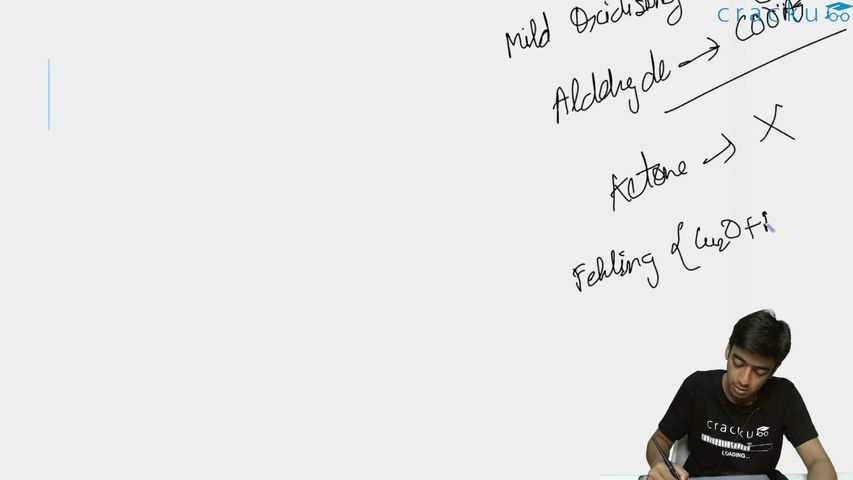
Tollen’s reagent is an ammoniacal solution of silver nitrate, $$[Ag(NH_3)_2]^{+}$$. It is a mild oxidising agent that selectively oxidises aldehydes to their corresponding carboxylate ions, while ketones are not oxidised under these conditions. During the oxidation, the reagent itself is reduced to metallic silver, often depositing as a characteristic silver mirror on the inner wall of the test tube.
Fehling solution is an alkaline solution containing complexed $$Cu^{2+}$$ ions (made by mixing Fehling-A: $$CuSO_4$$ solution and Fehling-B: alkaline sodium-potassium tartrate solution). Aldehydes reduce the deep-blue $$Cu^{2+}$$ complex to red cuprous oxide, $$Cu_2O$$, producing a brick-red precipitate. Ketones (except $$\alpha$$-hydroxy ketones) do not undergo this reaction.
Thus, both Tollen’s reagent and Fehling solution can be used as qualitative tests to distinguish aldehydes (which give a positive test) from ketones (which give a negative test).
Therefore, the pair of functional groups that can be differentiated using these reagents is:
Option C which is: ketones and aldehydes
Was this solution helpful?
Click on the Email ☝️ to Watch the Video Solution
Create a FREE account and get:
_1.webp)

Educational materials for JEE preparation

Ask our AI anything

AI can make mistakes. Please verify important information.
AI can make mistakes. Please verify important information.


