
Join Our JEE Preparation Group
Prep with like-minded aspirants; Get access to free daily tests and study material.
Sign in
Please select an account to continue using cracku.in
↓ →
Join Our JEE Preparation Group
Prep with like-minded aspirants; Get access to free daily tests and study material.
The reaction required is an electrophilic addition of two moles of $$HBr$$ to an unsymmetrical alkyne or alkene. For an alkyne, the first mole of $$HBr$$ gives a vinyl bromide; the second mole adds to the double bond formed in the first step. In the absence of peroxides, each addition follows Markovnikov’s rule: the hydrogen attaches to the carbon that already has more hydrogens and the bromine attaches to the other carbon.
Case A: $$CH_3\!-\!C\equiv CH$$ (propyne) + $$2\,HBr$$
Step 1 (first mole of $$HBr$$):
H attaches to the terminal carbon, Br to the internal carbon, giving $$CH_3\!-\!C(Br)=CH_2$$ (2-bromoprop-1-ene).
Step 2 (second mole of $$HBr$$):
H again attaches to the terminal carbon of the new double bond, Br to the same internal carbon, yielding $$CH_3\!-\!CBr_2\!-\!CH_3$$, i.e. $$2,2$$-dibromopropane.
Thus Option A furnishes the required geminal dihalide.
Case B: $$CH_3CH=CHBr$$ + $$HBr$$ → Markovnikov addition places H on $$CH_3$$ carbon and Br on the vinylic carbon that already bears Br, giving $$CH_3CH_2CHBr_2$$ (1,1-dibromopropane), not the desired product.
Case C: $$CH\equiv CH$$ + $$2\,HBr$$ → successively gives $$CH_2=CHBr$$ and then $$CH_3CHBr_2$$ (1,1-dibromoethane), which has only two carbon atoms.
Case D: $$CH_3CH=CH_2$$ + $$HBr$$ → gives the mono-bromide $$CH_3CHBrCH_3$$ (2-bromopropane), containing only one bromine atom.
Only Option A produces $$2,2$$-dibromopropane.
Answer: Option A which is: $$CH_3\!-\!C\equiv CH + 2\,HBr \longrightarrow CH_3\!-\!CBr_2\!-\!CH_3\; (2,2\text{-dibromopropane})$$
Was this solution helpful?
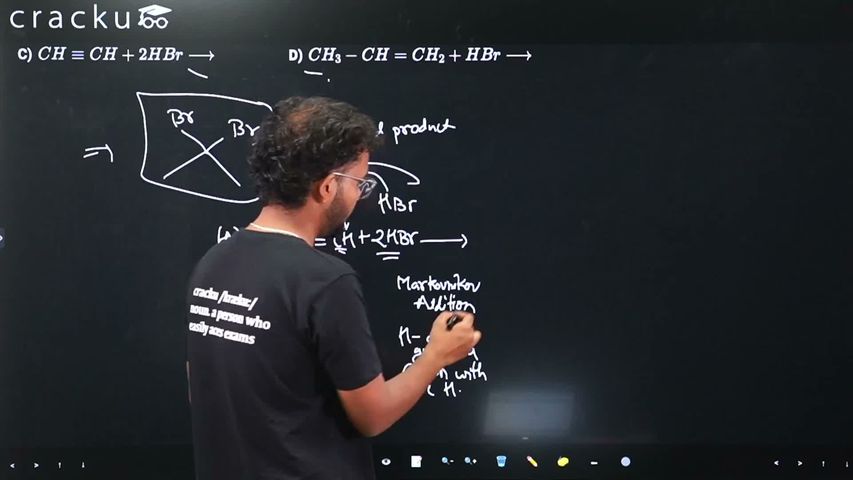
Click on the Email ☝️ to Watch the Video Solution
Create a FREE account and get:
_1.webp)

Educational materials for JEE preparation

Ask our AI anything

AI can make mistakes. Please verify important information.
AI can make mistakes. Please verify important information.
