Join Our JEE Preparation Group
Prep with like-minded aspirants; Get access to free daily tests and study material.
Sign in
Please select an account to continue using cracku.in
↓ →
Join Our JEE Preparation Group
Prep with like-minded aspirants; Get access to free daily tests and study material.
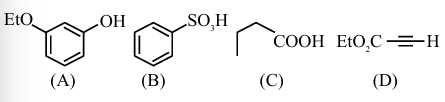
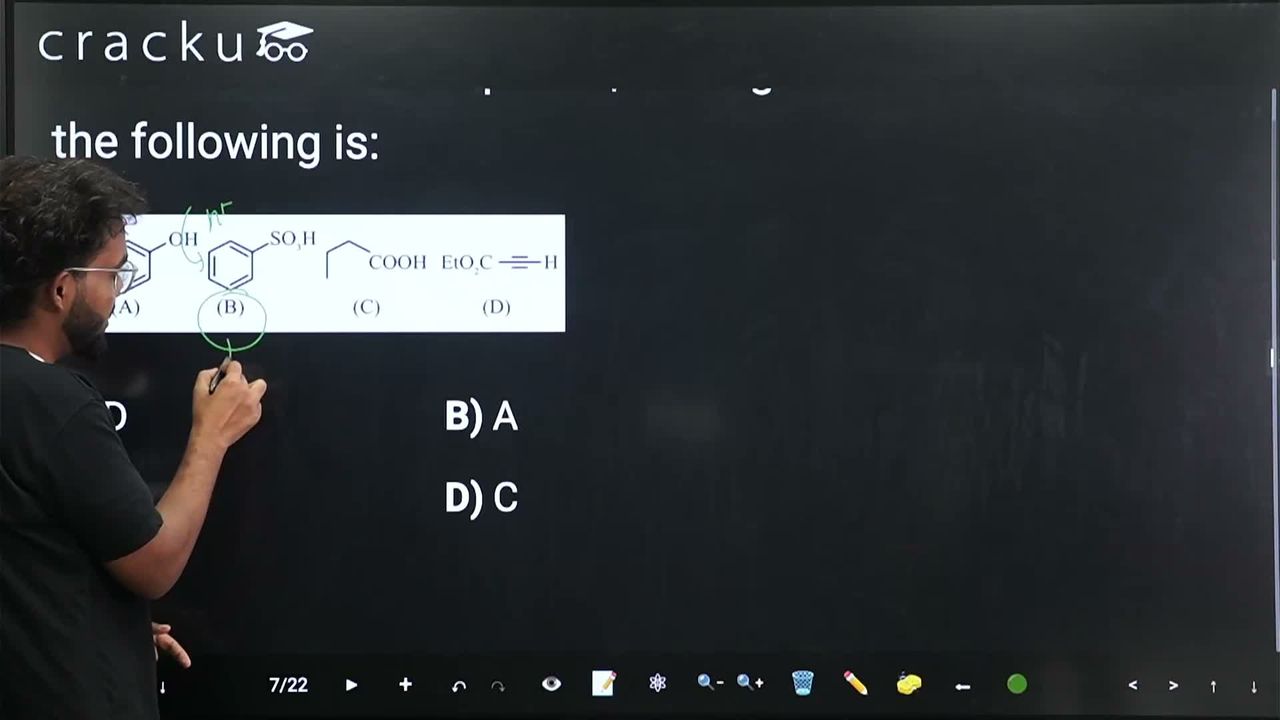
To determine the least acidic compound among the given choices, we compare the stability of the conjugate bases formed after the loss of a proton ($$H^+$$). The greater the stability of the conjugate base, the stronger the corresponding acid.
Among the given compounds, $$m$$-ethoxyphenol is a phenol. Phenols are acidic with a typical $$pK_a$$ of about $$10$$ because the resulting phenoxide ion is stabilized by resonance over the benzene ring.
Benzenesulfonic acid is a sulfonic acid and is a very strong acid with $$pK_a < 0$$. Its conjugate base, the sulfonate ion, is highly stabilized by resonance, with the negative charge delocalized over three oxygen atoms.
Pentanoic acid is a carboxylic acid with a typical $$pK_a$$ of approximately $$4.8$$. The corresponding carboxylate ion is resonance-stabilized by delocalization of the negative charge over two equivalent oxygen atoms, making it considerably more acidic than phenols.
Ethyl propiolate ($$EtO_2C-C \equiv CH$$) contains a terminal alkyne hydrogen. Although terminal alkynes are acidic due to the $$sp$$-hybridized carbon atom, their acidity is much lower, with a typical $$pK_a$$ around $$25$$. The electron-withdrawing ester group increases its acidity slightly, but it is still far less acidic than phenols, carboxylic acids, or sulfonic acids.
Therefore, the order of acidity is
$$\text{Benzenesulfonic acid} > \text{Pentanoic acid} > m\text{-Ethoxyphenol} > \text{Ethyl propiolate}.$$
Hence, the least acidic compound is
$$\boxed{\text{(D) Ethyl propiolate}}.$$
Was this solution helpful?
Click on the Email ☝️ to Watch the Video Solution
_1.webp)

Educational materials for JEE preparation

Ask our AI anything

AI can make mistakes. Please verify important information.
AI can make mistakes. Please verify important information.