Join WhatsApp Icon JEE WhatsApp Group

NTA JEE Main 2025 April 3rd Shift 1 - Chemistry

For the following questions answer them individually

Which of the following postulate of Bohr's model of hydrogen atom is not in agreement with quantum mechanical model of an atom ?

Given below are two statements :
Statement I : The N-N single bond is weaker and longer than that of P-P single bond
Statement II : Compounds of group 15 elements in +3 oxidation states readily undergo disproportionation reactions.
In the light of the above statements, choose the correct answer from the options given below

Given below are two statements
Statement I : A catalyst cannot alter the equilibrium constant $$(K_c)$$ of the reaction, temperature remaining constant
Statement II : A homogeneous catalyst can change the equilibrium composition of a system temperature remaining constant
In the light of the above statements, choose the correct answer from the options given below

In a reaction $$A + B \to C$$, initial concentrations of A and B are related as $$[A]_0 = 8[B]_0$$. The half lives of A and B are 10 min and 40 min respectively. If they start to disappear at the same time, both following first order kinetics, after how much time will the concentration of both the reactants be same?

Which of the following statements are correct?
A. The process of the addition of an electron to a neutral gaseous atom is always exothermic
B. The process of removing an electron from an isolated gaseous atom is always endothermic
C. The 1st ionization energy of the boron is less than that of the beryllium
D. The electronegativity of C is 2.5 in $$CH_4$$ and $$CCl_4$$
E. Li is the most electropositive among elements of group I

Choose the correct answer from the options given below

The correct order of the complexes $$[Co(NH_3)_4(H_2O)]^{3+}$$ (A), $$[Co(NH_3)_6]^{3+}$$ (B), $$[Co(CN)_6]^{3-}$$ (C) and $$[CoCl(NH_3)_5]^{2+}$$ (D) in terms of wavelength of light absorbed is :

Correct order of limiting molar conductivity for cations in water at 298 K is :

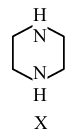
During estimation of nitrogen by Dumas' method of compound X (0.42 g) :

image


_________ mL of $$N_2$$ gas will be liberated at STP. (nearest integer)
(Given molar mass in g mol$$^{-1}$$ : C : 12, H : 1, N : 14)

Backspace
789
456
123
0.-
Clear All

0.5 g of an organic compound on combustion gave 1.46 g of $$CO_2$$ and 0.9 g of $$H_2O$$. The percentage of carbon in the compound is _________. (Nearest integer)
[Given : Molar mass (in g mol$$^{-1}$$) C : 12, H : 1, O : 16]

Backspace
789
456
123
0.-
Clear All

Given :
$$\Delta H^{\ominus}_{\text{sub}}[C(\text{graphite})] = 710$$ kJ mol$$^{-1}$$
$$\Delta_{C-H} H^{\ominus} = 414$$ kJ mol$$^{-1}$$
$$\Delta_{H-H} H^{\ominus} = 436$$ kJ mol$$^{-1}$$
$$\Delta_{C=C} H^{\ominus} = 611$$ kJ mol$$^{-1}$$

The $$\Delta H_f^{\ominus}$$ for $$CH_2=CH_2$$ is _________ kJ mol$$^{-1}$$
(nearest integer value)

Backspace
789
456
123
0.-
Clear All

In the following system,
$$PCl_5(g) \rightleftharpoons PCl_3(g) + Cl_2(g)$$ at equilibrium, upon addition of xenon gas at constant T & p, the concentration of