
 Group
Group
 Group
Group


 Preferred Source

 Google Discover
JEE Redox Reactions PYQ
Redox Reactions is an important chapter in JEE Chemistry. It helps you understand how electrons move from one substance to another during a chemical reaction. In every redox reaction, oxidation and reduction happen at the same time. One substance loses electrons, while another substance gains them. In this chapter, you study oxidation numbers, oxidising agents, reducing agents, balancing redox equations, disproportionation reactions, equivalent mass, and electron transfer. These ideas are also useful in electrochemistry, metallurgy, and inorganic chemistry. That is why a clear understanding of this chapter is important for later topics as well. Most questions from Redox Reactions are based on oxidation-state calculations, identifying the oxidising or reducing agent, and balancing chemical equations. The calculations are usually simple, but a small mistake in sign, charge, or oxidation number can change the final answer. Solving previous-year questions helps you understand the common question patterns. It also improves your speed and makes it easier to apply the rules correctly.
On this page, you can revise the key concepts, download the PYQ PDF, learn important formulas, avoid common mistakes, and practise chapter-wise questions.
With regular practice, Redox Reactions can become an easy and scoring chapter in JEE Chemistry.
JEE Redox Reactions Previous-Year Questions
Previous-year questions help you understand which topics are asked most often. In this chapter, questions commonly come from oxidation numbers, oxidising and reducing agents, balancing equations, n-factor, equivalent mass, and disproportionation.
While solving JEE Mains PYQ, first identify the elements whose oxidation numbers are changing.
An increase in oxidation number means oxidation.
A decrease in oxidation number means reduction.
Once you identify these changes, it becomes easier to find the oxidising agent and reducing agent.
The substance that gets reduced acts as the oxidising agent. The substance that gets oxidised acts as the reducing agent.
For oxidation-number questions, follow the basic rules carefully.
The oxidation number of an element in its free state is zero. Oxygen is usually −2, while hydrogen is usually +1. The sum of the oxidation numbers of all atoms must be equal to the overall charge on the molecule or ion.
However, there are some important exceptions.
Oxygen has an oxidation number of −1 in peroxides. Hydrogen has an oxidation number of −1 in metal hydrides.
While balancing a redox equation, always check the reaction medium. The method may change depending on whether the reaction takes place in acidic, basic, or neutral medium.
Try to solve each question within a fixed time. After completing the set, check every wrong answer and find the exact reason behind the mistake.
Common reasons may include:
- You used the wrong oxidation number.
- You forgot an exception for oxygen or hydrogen.
- You confused the oxidising and reducing agents.
- You balanced the atoms but not the charge.
- You ignored the reaction medium.
Keeping a short list of oxidation-number rules can make these questions much easier.
JEE Redox Reactions PYQs PDF
You can download the JEE Redox Reactions PYQs PDF from the section below.
First, solve the PDF without looking at the answers. Try to complete it in one sitting so that you can understand your current speed and accuracy.
After solving the questions, divide them into three groups:
- Questions you solved easily
- Questions that took more time
- Questions you could not solve
Revise the rules and methods used in the difficult questions. Try those questions again after a few days.
While practising these JEE Questions, do not only compare the final answer with the solution.
Check the oxidation numbers, electron change, coefficients, atoms, and total charge.
Even if the equation looks balanced, count all atoms once again. Also make sure that the charge is the same on both sides.
For questions based on the ion-electron method, write the oxidation and reduction half-reactions separately.
First, balance the atoms other than oxygen and hydrogen. Then balance oxygen using H₂O. After that, balance hydrogen according to the reaction medium.
In acidic medium, H⁺ ions are used.
In basic medium, OH⁻ ions are used. You can first balance the reaction in acidic medium and then add OH⁻ ions to both sides to remove H⁺.
When you solve the PDF again, focus mainly on the questions that were incorrect or took too much time.
Important Formulas and Rules for JEE Redox Reactions PYQs
Redox Reactions questions in JEE mainly test oxidation numbers, electron transfer, n-factor, equivalent mass and titration calculations. Understanding these relations helps you identify oxidising and reducing agents and balance redox equations correctly.
You can include the following formulas and rules in your JEE Chemistry Formula notes for quick revision.
| Concept | Formula or Rule | Simple Explanation |
|---|---|---|
| Oxidation | $$\mathrm{Oxidation\ Number\ Increases}$$ | The species loses electrons. |
| Reduction | $$\mathrm{Oxidation\ Number\ Decreases}$$ | The species gains electrons. |
| Oxidising Agent | $$\mathrm{Oxidising\ Agent\ Gains\ Electrons}$$ | It gets reduced and causes another species to undergo oxidation. |
| Reducing Agent | $$\mathrm{Reducing\ Agent\ Loses\ Electrons}$$ | It gets oxidised and causes another species to undergo reduction. |
| Oxidation-Number Rule | $$\sum\mathrm{Oxidation\ Numbers}=\mathrm{Overall\ Charge}$$ | This relation helps determine an unknown oxidation number. |
| Electron-Balance Rule | $$\mathrm{Electrons\ Lost}=\mathrm{Electrons\ Gained}$$ | The total increase and decrease in oxidation number must be equal. |
| n-Factor | $$n=\mathrm{Total\ Change\ in\ Oxidation\ Number}$$ | The n-factor depends on the reaction and final products. |
| Equivalent Mass of Oxidant | $$E=\frac{\mathrm{Molar\ Mass}}{\mathrm{Number\ of\ Electrons\ Gained}}$$ | The oxidant accepts electrons during reduction. |
| Equivalent Mass of Reductant | $$E=\frac{\mathrm{Molar\ Mass}}{\mathrm{Number\ of\ Electrons\ Lost}}$$ | The reductant releases electrons during oxidation. |
| General Equivalent Mass | $$E=\frac{\mathrm{Molar\ Mass}}{n\text{-}\mathrm{Factor}}$$ | The n-factor must be determined from the given reaction. |
| Normality | $$N=M\times n\text{-}\mathrm{Factor}$$ | Normality depends on both molarity and the reaction. |
| Redox Titration | $$N_1V_1=N_2V_2$$ | This relation is used at the equivalence point. |
| Disproportionation | $$\mathrm{Same\ Species\rightarrow Oxidation+Reduction}$$ | The same element forms products with higher and lower oxidation states. |
Common Mistakes to Avoid in JEE Redox Reactions PYQs
One common mistake is thinking that oxidation always means the addition of oxygen.
Oxidation can also mean loss of electrons, removal of hydrogen, or an increase in oxidation number.
Reduction means gain of electrons, addition of hydrogen, or a decrease in oxidation number.
Students also confuse the oxidising agent with the substance that is oxidised.
Remember that an oxidising agent accepts electrons and gets reduced. A reducing agent gives electrons and gets oxidised.
While solving JEE Redox Reactions Questions, do not find the oxidation number by looking at only one atom.
Use the total charge of the complete molecule or ion.
Another common mistake is taking the oxidation number of oxygen as −2 in every compound.
In peroxides, oxygen is −1. In superoxides, its average oxidation number is −1/2. In OF₂, oxygen has an oxidation number of +2.
Hydrogen is usually +1, but it becomes −1 in ionic metal hydrides such as NaH and CaH₂.
While balancing equations, students often balance the atoms but forget the charge.
A correctly balanced redox equation must have the same number of atoms and the same total charge on both sides.
Another mistake is using the same n-factor for a substance in every reaction.
The n-factor depends on the actual change in oxidation number, so it may change from one reaction to another.
Always check whether the reaction takes place in acidic, basic, or neutral medium. Using H⁺ in a basic-medium reaction or OH⁻ in an acidic-medium reaction can lead to the wrong equation.
Before finalising your answer, check the atoms, charge, reaction medium, and electron transfer once more.
List of JEE Redox Reactions PYQs
Use the questions given below as a short chapter test.
Try to solve them like a JEE Main Test. Set a time limit, avoid using notes, and check the answers only after completing the full set.
Question 1
For standardizing NaOH solution, which of the following is used as a primary standard?
correct answer:- 3
Question 2
When 10 mL of an aqueous solution of Fe$$^{2+}$$ ions was titrated in the presence of dil H$$_2$$SO$$_4$$ using diphenylamine indicator, 15 mL of 0.02 M solution of K$$_2$$Cr$$_2$$O$$_7$$ was required to get the end point. The molarity of the solution containing Fe$$^{2+}$$ ions is $$x \times 10^{-2}$$ M. The value of x is ___. (Nearest integer)
correct answer:- 18
Question 3
Which of the given reactions is not an example of disproportionation reaction?
correct answer:- 3
Question 4
$$H_2O_2$$ acts as a reducing agent in
correct answer:- 1
Question 5
Equal amounts (in moles) of potassium permanganate $$KMnO_4$$ are used to completely oxidize two different reducing agents in separate flasks.
In Flask A, the $$KMnO_4$$ reacts with ferrous oxalate $$FeC_2O_4$$ in a strongly acidic medium.
In Flask B, the $$KMnO_4$$ reacts with potassium iodide $$KI$$ in a faintly alkaline (neutral) medium.
What is the ratio of the number of moles of $$FeC_2O_4$$ oxidized in Flask A to the number of moles of $$KI$$ oxidized in Flask B?
correct answer:- 2

Question 6
The reaction of $$H_2O_2$$ with potassium permanganate in acidic medium leads to the formation of mainly
correct answer:- 1
Question 7
Given below are two statements: One is labelled as Assertion A and the other is labelled as Reason R
Assertion A: Permanganate titrations are not performed in presence of hydrochloric acid.
Reason R: Chlorine is formed as a consequence of oxidation of hydrochloric acid.
In the light of the above statements, choose the correct answer from the options given below
correct answer:- 1
Question 8
Given below are two statements:
Statement I:
Hydrogen peroxide can act as an oxidizing agent in both acidic and basic conditions.
Statement II:
Density of hydrogen peroxide at $$298 \text{ K}$$ is lower than that of $$D_2O$$.
In the light of the above statements. Choose the correct answer from the options
correct answer:- 3
Question 9
High purity ($$> 99.95\%$$) dihydrogen is obtained by
correct answer:- 2
Question 10
$$\text{MnO}_4^{2-}$$, in acidic medium, disproportionates to :
correct answer:- 1

Question 11
During water-gas shift reaction
correct answer:- 1
Question 12
See the following chemical reaction:
Cr$$_2$$O$$_7^{2-}$$ + XH$$^+$$ + 6Fe$$^{2+}$$ $$\to$$ YCr$$^{3+}$$ + 6Fe$$^{3+}$$ + ZH$$_2$$O
The sum of X, Y and Z is _____.
correct answer:- 23
Question 13
KMnO$$_4$$ oxidises I$$^-$$ in acidic and neutral/faintly alkaline solution, respectively to
correct answer:- 3
Question 14
Which of the following reactions are disproportionation reactions? (1) $$Cu^+ \rightarrow Cu^{2+} + Cu$$ (2) $$3MnO_4^{2-} + 4H^+ \rightarrow 2MnO_4^- + MnO_2 + 2H_2O$$ (3) $$2KMnO_4 \rightarrow K_2MnO_4 + MnO_2 + O_2$$ (4) $$2MnO_4^- + 3Mn^{2+} + 2H_2O \rightarrow 5MnO_2 + 4H^+$$. Choose the correct answer from the options given below:
correct answer:- 1
Question 15
Which one of the following reactions indicates the reducing ability of hydrogen peroxide in basic medium?
correct answer:- 3

Question 16
The dark purple colour of $$KMnO_4$$ disappears in the titration with oxalic acid in acidic medium. The overall change in the oxidation number of manganese in the reaction is
correct answer:- 1
Question 17
The products obtained from a reaction of hydrogen peroxide and acidified potassium permanganate are
correct answer:- 4
Question 18
Which respect to an ore, Ellingham diagram helps to predict the feasibility of its:
correct answer:- 4
Question 19
Identify the process in which change in the oxidation state is five:
correct answer:- 2
Question 20
The INCORRECT statement(s) about heavy water is (are):
(A) used as a moderator in nuclear reactor
(B) obtained as a by-product in fertilizer industry.
(C) used for the study of reaction mechanism
(D) has a higher dielectric constant than water
Choose the correct answer from the options given below:
correct answer:- 3

Question 21
10.0 mL of 0.05 M KMnO$$_4$$ solution was consumed in a titration with 10.0 mL of given oxalic acid dihydrate solution. The strength of given oxalic acid solution is _________ $$\times 10^{-2}$$ g/L. (Round off to the nearest integer)
correct answer:- 1575
Question 22
The oxidation states of nitrogen in NO, NO$$_2$$, N$$_2$$O and NO$$_3^-$$ are in the order of :
correct answer:- 1
Question 23
The redox reaction among the following is
correct answer:- 4
Question 24
According to the following diagram, A reduces $$BO_2$$ when the temperature is:
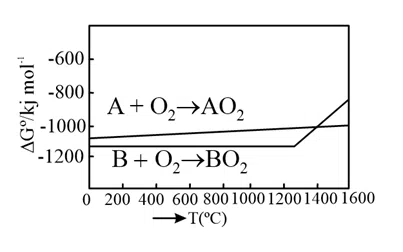
correct answer:- 2
Question 25
Chlorine undergoes disproportionation in alkaline medium as shown below :
$$aCl_2(g) + bOH^-(aq) \rightarrow cClO^-(aq) + dCl^-(aq) + eH_2O(l)$$
The values of $$a, b, c$$ and $$d$$ in a balanced redox reaction are respectively :
correct answer:- 1

Question 26
In basic medium $$CrO_4^{2-}$$ oxidises $$S_2O_3^{2-}$$ to form $$SO_4^{2-}$$ and itself changes into $$Cr(OH)_4^-$$. The volume of 0.154 M $$CrO_4^{2-}$$ required to react with 40 mL of 0.25 M $$S_2O_3^{2-}$$ is ______ mL. (Rounded-off to the nearest integer)
correct answer:- 173
Question 27
Which of the following equation depicts the oxidizing nature of $$H_2O_2$$?
correct answer:- 1
Question 28
The oxidation states of $$P$$ in H$$_4$$P$$_2$$O$$_7$$, H$$_4$$P$$_2$$O$$_5$$ and H$$_4$$P$$_2$$O$$_6$$, respectively, are:
correct answer:- 3
Question 29
In neutral or faintly alkaline medium, $$KMnO_4$$ being a powerful oxidant can oxidise, thiosulphate almost quantitatively, to sulphate. In this reaction overall change in oxidation state of manganese will be
correct answer:- 4
Question 30
Water does not produce CO on reacting with:
correct answer:- 1
Question 31
Which one of the following is an example of disproportionation reaction?
correct answer:- 1