
Join Our JEE Preparation Group
Prep with like-minded aspirants; Get access to free daily tests and study material.
Sign in
Please select an account to continue using cracku.in
↓ →
Join Our JEE Preparation Group
Prep with like-minded aspirants; Get access to free daily tests and study material.
When 10 mL of an aqueous solution of Fe$$^{2+}$$ ions was titrated in the presence of dil H$$_2$$SO$$_4$$ using diphenylamine indicator, 15 mL of 0.02 M solution of K$$_2$$Cr$$_2$$O$$_7$$ was required to get the end point. The molarity of the solution containing Fe$$^{2+}$$ ions is $$x \times 10^{-2}$$ M. The value of x is ___. (Nearest integer)
Correct Answer: 18
We are told that 10 mL of a solution containing Fe$$^{2+}$$ ions is titrated with 0.02 M K$$_2$$Cr$$_2$$O$$_7$$ in the presence of dilute H$$_2$$SO$$_4$$, using diphenylamine as the indicator. The titration requires 15 mL of the dichromate solution to reach the end point. Our task is to find the molarity of the Fe$$^{2+}$$ solution and express it in the form $$x \times 10^{-2}\,{\rm M}$$, then determine the integer $$x$$.
First, we recall the balanced redox reaction that occurs in acidic medium between dichromate ions and ferrous ions:
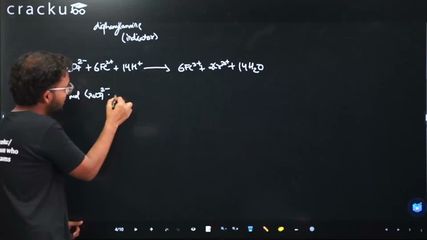
$$\text{Cr}_2\text{O}_7^{2-} + 14\,\text{H}^+ + 6\,\text{Fe}^{2+} \;\longrightarrow\; 2\,\text{Cr}^{3+} + 6\,\text{Fe}^{3+} + 7\,\text{H}_2\text{O}$$
From this equation we see clearly that 1 mole of dichromate reacts with 6 moles of Fe$$^{2+}$$.
Now we proceed step by step, starting with the dichromate solution:
Using the definition of molarity, the number of moles is given by
$$n = M \times V$$
where $$M$$ is molarity in mol L$$^{-1}$$ and $$V$$ is volume in litres.
The dichromate data are:
$$M_{\text{Cr}_2\text{O}_7^{2-}} = 0.02\,{\rm M}, \qquad V_{\text{Cr}_2\text{O}_7^{2-}} = 15\,\text{mL} = 0.015\,\text{L}$$
Substituting, we obtain
$$n_{\text{Cr}_2\text{O}_7^{2-}} = 0.02 \times 0.015 = 0.00030\;\text{mole}$$
According to the stoichiometric ratio 1 : 6, the moles of Fe$$^{2+}$$ oxidised are
$$n_{\text{Fe}^{2+}} = 6 \times n_{\text{Cr}_2\text{O}_7^{2-}} = 6 \times 0.00030 = 0.00180\;\text{mole}$$
The volume of the Fe$$^{2+}$$ solution taken is
$$V_{\text{Fe}^{2+}} = 10\,\text{mL} = 0.010\,\text{L}$$
Again invoking the molarity formula,
$$M_{\text{Fe}^{2+}} = \dfrac{n_{\text{Fe}^{2+}}}{V_{\text{Fe}^{2+}}} = \dfrac{0.00180}{0.010} = 0.18\;\text{M}$$
To express this in the required format, we write
$$0.18\;\text{M} = 18 \times 10^{-2}\;\text{M}$$
Thus, $$x = 18$$.
So, the answer is $$18$$.
Was this solution helpful?
Click on the Email ☝️ to Watch the Video Solution
Create a FREE account and get:
_1.webp)

Educational materials for JEE preparation

Ask our AI anything

AI can make mistakes. Please verify important information.
AI can make mistakes. Please verify important information.
