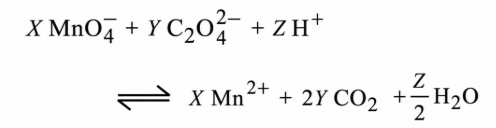
In order to oxidise a mixture of 1 mole each of $$\text{FeC}_2\text{O}_4$$, $$\text{Fe}_2(\text{C}_2\text{O}_4)_3$$, $$\text{FeSO}_4$$ and $$\text{Fe}_2(\text{SO}_4)_3$$ in acidic medium, the number of moles of $$\text{KMnO}_4$$ required is :
JEE Redox Reactions Questions
First write the reduction half-reaction for permanganate in acidic medium:
$$\text{MnO}_4^- + 8H^+ + 5e^- \;\rightarrow\; \text{Mn^{2+}} + 4H_2O$$
Every mole of $$\text{KMnO}_4$$ therefore accepts $$5$$ electrons.
Next find how many electrons are released when the given mixture is completely oxidised.
Iron centres
Fe is present as $$\text{Fe}^{2+}$$ in $$\text{FeC}_2\text{O}_4$$ and $$\text{FeSO}_4$$, and as $$\text{Fe}^{3+}$$ in $$\text{Fe}_2(\text{C}_2\text{O}_4)_3$$ and $$\text{Fe}_2(\text{SO}_4)_3$$.
• $$\text{Fe}^{2+} \rightarrow \text{Fe}^{3+} + e^-$$ (loss of one electron)
Number of $$\text{Fe}^{2+}$$ moles = 1 (from $$\text{FeC}_2\text{O}_4$$) + 1 (from $$\text{FeSO}_4$$) = 2
Electrons released by iron = $$2 \times 1 = 2$$
Oxalate ions
In acidic medium $$\text{C}_2\text{O}_4^{2-}$$ is oxidised to $$2\,\text{CO}_2$$:
$$\text{C}_2\text{O}_4^{2-} \rightarrow 2\text{CO}_2 + 2e^-$$
Each oxalate ion therefore releases 2 electrons.
Moles of oxalate ions present:
• 1 from $$\text{FeC}_2\text{O}_4$$
• 3 from $$\text{Fe}_2(\text{C}_2\text{O}_4)_3$$
Total oxalate moles = $$1 + 3 = 4$$
Electrons released by oxalate = $$4 \times 2 = 8$$
Total electrons released by the mixture
$$2 (\text{from Fe}) + 8 (\text{from oxalate}) = 10$$
Moles of $$\text{KMnO}_4$$ required
Since each mole of $$\text{KMnO}_4$$ accepts 5 electrons,
$$\text{Moles of } \text{KMnO}_4 = \frac{10 \text{ electrons}}{5 \text{ electrons per mole}} = 2$$
Hence, the number of moles of $$\text{KMnO}_4$$ needed is 2.
Option B which is: $$2$$
$$\text{MnO}_4^{2-}$$, in acidic medium, disproportionates to :
We need to find the disproportionation products of $$MnO_4^{2-}$$ in acidic medium and recall that disproportionation is a reaction where the same element is simultaneously oxidized and reduced; here Mn is in the +6 oxidation state in $$MnO_4^{2-}$$.
In acidic medium the reaction is given by: $$3MnO_4^{2-} + 4H^+ \rightarrow 2MnO_4^- + MnO_2 + 2H_2O$$
On verifying oxidation states, Mn in $$MnO_4^{2-}$$ is +6, in $$MnO_4^-$$ it is +7 (oxidation) and in $$MnO_2$$ it is +4 (reduction), which confirms disproportionation since Mn(+6) is oxidized to Mn(+7) and reduced to Mn(+4).
The correct answer is Option (1): $$MnO_4^-$$ and $$MnO_2$$.
For the given reaction;
$$CaCO_{3}+2HCl\rightarrow CaCl_{2}+H_{2}O+CO_{2}$$
If 90 g $$CaCO_{3}$$ is added to 300 mL of HCI which contains 38.55% HCI by mass and has density 1.13 g $$mol^{-1}$$, then which of the following option is correct ?
Given molar mass of H, Cl, Ca and Oare 1, 35.5, 40 and 16 g $$mol^{-1}$$ respectively.
The reaction is: $$CaCO_{3} + 2HCl \rightarrow CaCl_{2} + H_{2}O + CO_{2}$$
Given:
- Mass of $$CaCO_{3}$$ = 90 g
- Volume of HCl solution = 300 mL
- Density of HCl solution = 1.13 g/mL (assuming typo in unit, should be g/mL instead of g mol^{-1})
- HCl solution contains 38.55% HCl by mass
- Molar masses: H = 1 g/mol, Cl = 35.5 g/mol, Ca = 40 g/mol, O = 16 g/mol
First, calculate the mass of the HCl solution:
Mass of HCl solution = density × volume = 1.13 g/mL × 300 mL = 339 g
Next, calculate the mass of HCl in the solution:
Mass of HCl = (38.55 / 100) × 339 g = 0.3855 × 339 g
Compute: 0.3855 × 300 = 115.65, 0.3855 × 39 = 15.0345, total = 115.65 + 15.0345 = 130.6845 g
So, mass of HCl = 130.6845 g
Now, find the molar masses:
Molar mass of $$CaCO_{3}$$ = Ca + C + 3O = 40 + 12 + 3×16 = 40 + 12 + 48 = 100 g/mol
Molar mass of HCl = H + Cl = 1 + 35.5 = 36.5 g/mol
Calculate moles of each reactant:
Moles of $$CaCO_{3}$$ = mass / molar mass = 90 g / 100 g/mol = 0.9 mol
Moles of HCl = mass / molar mass = 130.6845 g / 36.5 g/mol ≈ 3.5804 mol
(Calculation: 130.6845 ÷ 36.5 = 3.58039726... ≈ 3.5804 mol)
From the reaction stoichiometry, 1 mol of $$CaCO_{3}$$ requires 2 mol of HCl.
Moles of HCl required for 0.9 mol of $$CaCO_{3}$$ = 2 × 0.9 = 1.8 mol
Since available moles of HCl (3.5804 mol) are greater than required (1.8 mol), HCl is in excess, and $$CaCO_{3}$$ is the limiting reactant.
Thus, $$CaCO_{3}$$ will be completely consumed, and some HCl will remain unreacted.
Calculate the mass of HCl reacted:
Moles of HCl reacted = 1.8 mol
Mass of HCl reacted = moles × molar mass = 1.8 mol × 36.5 g/mol = 65.7 g
Mass of unreacted HCl = total mass of HCl - mass of HCl reacted = 130.6845 g - 65.7 g = 64.9845 g ≈ 64.98 g
Now, evaluate the options:
- Option A: 32.85 g of $$CaCO_{3}$$ remains unreacted. But $$CaCO_{3}$$ is completely consumed, so this is incorrect.
- Option B: 64.97 g of HCl remains unreacted. Our calculation gives 64.98 g, which is very close (likely a rounding difference).
- Option C: 97.30 g of HCl reacted. But we have 65.7 g reacted, so incorrect.
- Option D: 60.32 g of HCl remains unreacted. But we have approximately 64.98 g, so incorrect.
Thus, option B is correct.
One mole of $$Cl_{2}(g)$$ was passed into 2 L of cold 2M KOH solution. After the reaction, the concentrations of $$Cl^{-}$$ , $$ClO^{-}$$ and $$OH^{-}$$ are respectively (assume volume remains constant)
We need to find the concentrations of Cl⁻, ClO⁻, and OH⁻ after passing Cl₂ into cold KOH.
$$Cl_2 + 2KOH \rightarrow KCl + KClO + H_2O$$
1 mol Cl₂ added to 2 L of 2M KOH (total KOH = 4 mol).
Stoichiometry: 1 mol Cl₂ reacts with 2 mol KOH.
Products formed:
KCl: 1 mol → Cl⁻ = 1 mol
KClO: 1 mol → ClO⁻ = 1 mol
KOH consumed: 2 mol
KOH remaining: 4 - 2 = 2 mol → OH⁻ = 2 mol
Concentrations (in 2 L):
[Cl⁻] = 1/2 = 0.5 M
[ClO⁻] = 1/2 = 0.5 M
[OH⁻] = 2/2 = 1 M
Therefore, the answer is Option 1: 0.5M, 0.5M, 1M.
Which of the following sets includes all the species that will change the orange colour of K$$_2$$Cr$$_2$$O$$_7$$ in acidic medium?
K$$_2$$Cr$$_2$$O$$_7$$ in acidic medium furnishes the dichromate ion $$Cr_2O_7^{2-}$$ which is a strong oxidising agent.
The relevant reduction half-reaction is
$$Cr_2O_7^{2-}+14H^++6e^- \rightarrow 2Cr^{3+}+7H_2O$$
with standard potential $$E^\circ = +1.33\;V$$.
Any species that can supply electrons (i.e. can be oxidised) will reduce $$Cr_2O_7^{2-}$$ from +6 (orange) to +3 (green), hence “change the orange colour”.
Therefore we must pick only those ions/molecules that behave as reducing agents in acidic solution.
Testing the species listed in each option
1. Fe$$^{2+}$$: readily oxidises to $$Fe^{3+}$$; standard potential $$Fe^{3+}+e^- \rightarrow Fe^{2+},\;E^\circ = +0.77\;V$$. Since $$0.77\;V \lt 1.33\;V$$, $$Fe^{2+}$$ can indeed reduce dichromate.
2. Sn$$^{2+}$$: oxidises to $$Sn^{4+}$$; $$Sn^{4+}+2e^- \rightarrow Sn^{2+},\;E^\circ = +0.15\;V$$. Again $$0.15\;V \lt 1.33\;V$$, so $$Sn^{2+}$$ is a good reducing agent for dichromate.
3. I$$^-$$: oxidises to $$I_2$$; $$I_2+2e^- \rightarrow 2I^-,\;E^\circ = +0.54\;V$$. Because $$0.54\;V \lt 1.33\;V$$, iodide reduces dichromate.
4. S$$^{2-}$$: oxidises to elemental sulphur or sulphate; $$S+2e^- \rightarrow S^{2-},\;E^\circ \approx +0.14\;V$$ (to $$S$$) and even smaller versus sulphate. Hence sulphide is a powerful reducing agent for $$Cr_2O_7^{2-}$$.
All four species listed above will definitely decolourise (actually turn green) the orange dichromate solution.
Checking the other options
• Option B contains $$Fe^{3+}$$, which is the oxidised form; it cannot supply electrons. • Option C contains $$Sn^{4+}$$, another fully oxidised ion. • Option D contains $$Fe^{3+}$$, $$SO_4^{2-}$$ and $$Sn^{4+}$$ — none of these is a reducing agent under the given conditions. Hence those sets are incomplete or incorrect.
Therefore the only set that contains all species capable of reducing $$Cr_2O_7^{2-}$$ is:
Option A which is: Fe$$^{2+}$$, Sn$$^{2+}$$, I$$^-$$, S$$^{2-}$$
Consider the following reduction processes :
$$Al^{3+} + 3e^{-} \rightarrow Al(s), E^{\circ} = -1.66V$$
$$Fe^{3+} + e^{-} \rightarrow Fe^{2+}, E^{\circ} = +0.77V$$
$$Co^{3+} + e^{-} \rightarrow Co^{2+}, E^{\circ} = +1.81V$$
$$Cr^{3+} + 3e^{-} \rightarrow Cr(s), E^{\circ} = -0.74V$$
The tendency to act as reducing agent decreases in the order :
Reduction potentials given:
$$Al^{3+}/Al: E° = -1.66$$ V
$$Fe^{3+}/Fe^{2+}: E° = +0.77$$ V
$$Co^{3+}/Co^{2+}: E° = +1.81$$ V
$$Cr^{3+}/Cr: E° = -0.74$$ V
A species acts as a reducing agent when it gets oxidized. The tendency to act as a reducing agent is related to the oxidation potential (negative of reduction potential). The more negative the reduction potential, the stronger the reducing agent.
Oxidation potentials: Al: +1.66, Cr: +0.74, $$Fe^{2+}$$: -0.77, $$Co^{2+}$$: -1.81.
Reducing agent strength: $$Al > Cr > Fe^{2+} > Co^{2+}$$.
The correct answer is Option A: $$Al > Cr > Fe^{2+} > Co^{2+}$$.
Given below are some of the statements about Mn and $$Mn_{2}O_{7}$$. Identify the correct statements.
A. Mn forms the oxide $$Mn_{2}O_{7}$$, in which Mn is in its highest oxidation state.
B. Oxygen stabilizes the Mn in higher oxidation states by forming multiple bonds with Mn.
C. $$Mn_{2}O_{7}$$ is an ionic oxide.
D. The structure of $$Mn_{2}O_{7}$$ consists of one bridged oxygen.
Choose the correct answer from the options given below :
We need to identify which statements about Mn and $$Mn_2O_7$$ are correct.
In $$Mn_2O_7$$, let the oxidation state of Mn be $$x$$. Since the compound is neutral and each oxygen is $$-2$$, we have $$ 2x + 7(-2) = 0 \implies 2x = 14 \implies x = +7. $$ The maximum oxidation state of Mn (atomic number 25, configuration $$[Ar]3d^5 4s^2$$) is +7, corresponding to the loss of all seven valence electrons (five from 3d and two from 4s). Therefore, Statement A is correct.
Oxygen, being a small and highly electronegative atom, can form $$p\pi - d\pi$$ multiple bonds with transition metals. These multiple bonds help stabilize high oxidation states by accepting electron density from the metal through $$\pi$$-bonding. In $$Mn_2O_7$$, the Mn=O double bonds stabilize the +7 oxidation state, so Statement B is correct.
Statement C claims that $$Mn_2O_7$$ is an ionic oxide; this is incorrect. When a metal is in a very high oxidation state (+7), it has high polarizing power (high charge, small size), which leads to significant covalent character according to Fajans' rules. $$Mn_2O_7$$ is a dark green, oily liquid that is explosive—properties characteristic of a covalent compound rather than an ionic one. It is also an acidic oxide, forming permanganic acid $$HMnO_4$$ with water.
The structure of $$Mn_2O_7$$ consists of two $$MnO_3$$ units connected by a single bridging oxygen atom (Mn-O-Mn). Each Mn atom is tetrahedrally coordinated with three terminal oxygen atoms and one bridging oxygen atom, making Statement D correct.
The correct statements are A, B, and D. Hence, the correct answer is Option (3): A, B and D Only.
On heating a mixture of common salt and $$K_{2}Cr_{2}O_{7}$$ in equal amount along with concentrated $$H_{2}SO_{4}$$ in a test tube, a gas is evolved. Formula of the gas evolved and oxidation State of the central metal atom in the gas respectively are:
We need to identify the gas evolved when a mixture of common salt (NaCl) and potassium dichromate ($$K_2Cr_2O_7$$) is heated with concentrated $$H_2SO_4$$, and find the oxidation state of the central metal atom.
This reaction corresponds to the chromyl chloride test, a well-known reaction used for the detection of chloride ions. The balanced equation is:
$$ K_2Cr_2O_7 + 4NaCl + 6H_2SO_4 \rightarrow 2KHSO_4 + 4NaHSO_4 + 2CrO_2Cl_2\uparrow + 3H_2O $$
The gas evolved is chromyl chloride, $$CrO_2Cl_2$$. It is a dark red (reddish-brown) gas with an acrid smell.
In $$CrO_2Cl_2$$ each oxygen has oxidation state = $$-2$$ and each chlorine has oxidation state = $$-1$$. Let the oxidation state of Cr = $$x$$, then $$ x + 2(-2) + 2(-1) = 0 $$ $$ x - 4 - 2 = 0 $$ $$ x = +6 $$.
Note that the formula is $$CrO_2Cl_2$$ (one Cr atom), not $$Cr_2O_2Cl_2$$ (which would be a dimer). The chromyl chloride molecule has a tetrahedral structure around Cr, with two Cr=O double bonds and two Cr-Cl bonds.
The correct answer is Option (4): $$CrO_2Cl_2$$ and +6.
In the reaction,
$$ 2Al(s)+6HCl(aq)\rightarrow2Al^{3+}(aq)+6cl^{-}(aq)+3H_{2}(g)$$
In the reaction,
2Al (s) + 6HCl (aq) → 2$$Al^{+3}$$ (aq) + 6$$Cl^-$$ (aq) + 3$$H_2$$ (g)
(a) 6L HCl(aq) is consumed for every 3L $$H_2$$(g) produced
(b) This is incorrect statement because according to ideal gas equation (PV = nRT) volume of $$H_2$$ produces will depend on temperature and pressure.
(c) 67 .2 L $$H_2$$ (g) at STP (standard Temperature and Pressure, T = 373.15K, P = 1atm) is produced for every mole Al that reacts
(d)11.2 L $$H_2$$(g) at STP is produced for every mole HCl(aq) consumed
The oxidation state of chromium in the final product formed in the reaction between $$KI$$ and acidified $$K_2 Cr_2 O_7$$ solution is:
The reaction between $$KI$$ and acidified $$K_2Cr_2O_7$$ yields a chromium-containing product whose oxidation state must be determined.
In acidic medium, $$K_2Cr_2O_7$$ acts as a strong oxidizing agent, oxidizing $$I^-$$ to $$I_2$$, while $$Cr_2O_7^{2-}$$ (with Cr in the +6 oxidation state) undergoes reduction.
The balanced redox equation under these conditions is:
$$Cr_2O_7^{2-} + 6I^- + 14H^+ \rightarrow 2Cr^{3+} + 3I_2 + 7H_2O$$
From this equation, chromium is reduced from +6 in $$Cr_2O_7^{2-}$$ to +3 in $$Cr^{3+}$$, which subsequently forms $$Cr_2(SO_4)_3$$ or $$CrCl_3$$ depending on the acid employed. Each chromium atom thus gains 3 electrons.
Hence, the oxidation state of chromium in the product is Option C) +3.
500 mL of 1.2 M KI solution is ,nixed with 500 mL of 0.2 M $$KMnO_{4}$$ solution in basic medium. The liberated iodine was titrated with standard 0.1 M $$Na_{2}S_{2}O_{3}$$ solution in the presence of starch indicator till the blue color disappeared. The volume (in L) of $$Na_{2}S_{2}O_{3}$$ consumed is_________.(Nearest integer)
Given 500 mL of 1.2 M KI mixed with 500 mL of 0.2 M $$KMnO_4$$ in basic medium, the liberated iodine is titrated with 0.1 M $$Na_2S_2O_3$$.
We begin by calculating the moles of the reactants. Moles of KI = $$0.5 \times 1.2 = 0.6$$ mol and moles of $$KMnO_4$$ = $$0.5 \times 0.2 = 0.1$$ mol.
In basic medium, $$MnO_4^-$$ oxidizes $$I^-$$ to $$I_2$$ according to the reaction: $$2MnO_4^- + 6I^- + 4H_2O \to 2MnO_2 + 3I_2 + 8OH^-$$. Here Mn goes from +7 to +4 (gaining 3e each, total 6e for 2 Mn atoms) and I goes from -1 to 0 (losing 1e each, total 6e for 6 I atoms), so electrons are balanced.
From stoichiometry, 2 mol $$MnO_4^-$$ requires 6 mol $$I^-$$. Since we have 0.1 mol $$KMnO_4$$, it requires $$0.1 \times 3 = 0.3$$ mol $$I^-$$, whereas 0.6 mol $$I^-$$ is available, making $$KMnO_4$$ the limiting reagent.
Because 2 mol $$MnO_4^-$$ produces 3 mol $$I_2$$, 0.1 mol $$MnO_4^-$$ yields $$0.1 \times \frac{3}{2} = 0.15$$ mol $$I_2$$.
The liberated iodine is then titrated with thiosulfate according to $$I_2 + 2Na_2S_2O_3 \to 2NaI + Na_2S_4O_6$$, so the moles of $$Na_2S_2O_3$$ needed are $$2 \times 0.15 = 0.30$$ mol, which at 0.1 M corresponds to a volume of $$\frac{0.30}{0.1} = 3$$ L.
The answer is 3.
200 cc of $$ x\times 10^{-3} M$$ potassium dichromate is required to oxidise 750 cc of 0.6 M Mohr's salt solution in acidic mediun.
Here $$x$$ =___________
According to the law of equivalence,
The milliequivalents of the oxidant = ($$K_2Cr_2O_7$$, $$n=6$$)
must equal those of the reductant (Mohr's salt, $$n=1$$).
Using the formula: $$(M_1 \times n_1 \times V_1) = (M_2 \times n_2 \times V_2)$$,
we get $$(x \times 10^{-3} \times 6) \times 200 = (0.6 \times 1) \times 750$$.
This simplifies to $$1.2x = 450$$,
which yields $$x = 375$$.
500 mL of 0.2 M MnO$$_4^-$$ solution in basic medium when mixed with 500 mL of 1.5 M KI solution, oxidises iodide ions to liberate molecular iodine. This liberated iodine is then titrated with a standard $$x$$ M thiosulphate solution in presence of starch till the end point. If 300 mL of thiosulphate was consumed, then the value of $$x$$ is __________.
X and Y are the number of electrons involved, respectively during the oxidation of $$\ I^{-}\text{ to }I_{2}\text{ and }S^{2-}$$ to S by acidified $$K_{2}Cr_{2}O_{7}$$. The value of X + Y is __ .
We need to find X + Y where X is the number of electrons involved in the oxidation of $$I^-$$ to $$I_2$$ and Y is for $$S^{2-}$$ to S, by acidified $$K_2Cr_2O_7$$.
The half-reaction for oxidation of $$I^-$$ to $$I_2$$ is $$2I^- \rightarrow I_2 + 2e^-$$, and the reduction half-reaction of dichromate under acidic conditions is $$Cr_2O_7^{2-} + 14H^+ + 6e^- \rightarrow 2Cr^{3+} + 7H_2O$$. Multiplying the oxidation half-reaction by 3 balances the electrons exchanged, giving $$6I^- \rightarrow 3I_2 + 6e^-$$. Thus, X = 6 electrons.
For the oxidation of $$S^{2-}$$ to S, the half-reaction is $$S^{2-} \rightarrow S + 2e^-$$, while the reduction half-reaction remains the same. To balance the electrons, the oxidation half-reaction is multiplied by 3, resulting in $$3S^{2-} \rightarrow 3S + 6e^-$$. Hence, Y = 6 electrons.
$$X + Y = 6 + 6 = 12$$
The answer is 12.
Consider the following reactions:
$$NaCl+K_{2}Cr_{2}O_{7}+H_{2}SO_{4}\rightarrow A+KHSO_{4}+NaHSO_{4}+H_{2}O$$
$$A+NaOH\rightarrow B+NaCl+H_{2}O$$
$$B+H_{2}SO_{4}+H_{2}O_{2}\rightarrow C+Na_{2}SO_{4}+H_{2}O$$
In the product 'C, 'X' is the number of $$O_{2}^{2-}$$ units, 'Y' is the total number oxygen atoms present and 'Z' is the oxidation state of Cr·. The value of X + Y + Z is ______
We need to identify products A, B, and C through a sequence of reactions, then find X + Y + Z.
Reaction 1: Identifying product A
$$NaCl + K_2Cr_2O_7 + H_2SO_4 \rightarrow A + KHSO_4 + NaHSO_4 + H_2O$$
This is the classic chromyl chloride test. When a chloride salt is heated with potassium dichromate and concentrated sulphuric acid, chromyl chloride is formed:
$$4NaCl + K_2Cr_2O_7 + 6H_2SO_4 \rightarrow 2CrO_2Cl_2 + 4NaHSO_4 + 2KHSO_4 + 3H_2O$$
Therefore, A = $$CrO_2Cl_2$$ (chromyl chloride, a deep red oily liquid).
Reaction 2: Identifying product B
$$A + NaOH \rightarrow B + NaCl + H_2O$$
When chromyl chloride reacts with sodium hydroxide:
$$CrO_2Cl_2 + 4NaOH \rightarrow Na_2CrO_4 + 2NaCl + 2H_2O$$
Therefore, B = $$Na_2CrO_4$$ (sodium chromate, a yellow compound).
Reaction 3: Identifying product C
$$B + H_2SO_4 + H_2O_2 \rightarrow C + Na_2SO_4 + H_2O$$
When sodium chromate reacts with sulphuric acid and hydrogen peroxide, it forms chromium pentoxide ($$CrO_5$$), which is a blue-coloured compound:
$$Na_2CrO_4 + H_2SO_4 + 2H_2O_2 \rightarrow CrO_5 + Na_2SO_4 + 3H_2O$$
Therefore, C = $$CrO_5$$ (also known as perchromic acid).
Structure of $$CrO_5$$:
$$CrO_5$$ has the structure $$CrO(O_2)_2$$, meaning it contains:
- 1 oxide ion ($$O^{2-}$$)
- 2 peroxide units ($$O_2^{2-}$$)
Finding X, Y, and Z:
X = number of $$O_2^{2-}$$ units = 2
Y = total number of oxygen atoms in $$CrO_5$$ = 5 (1 from oxide + 2 + 2 from two peroxide units)
Z = oxidation state of Cr in $$CrO_5$$:
Let the oxidation state of Cr be $$x$$. Each oxide contributes $$-2$$, each peroxide unit contributes $$-2$$:
$$x + (-2) + 2(-2) = 0$$
$$x - 2 - 4 = 0 \implies x = +6$$
So Z = +6.
Final calculation:
$$X + Y + Z = 2 + 5 + 6 = 13$$
The answer is 13.
Which of the following oxidation reactions are carried out by both $$K_{2}Cr_{2}O_{7}$$ and $$KMnO_{4}$$ in acidic medium? $$A.\Gamma^{-}\rightarrow I_{2}B.S^{2-}\rightarrow S C.Fe^{2+}\rightarrow Fe^{3+}D.\Gamma^{-}\rightarrow IO_{3}^{-}E.S_{2}O_{3}^{2-}\rightarrow SO_{4}^{2-}$$ Choose the correct answer from the options given below:
We need to find which oxidation reactions are performed by both $$K_2Cr_2O_7$$ and $$KMnO_4$$ in acidic medium.
A. $$I^- \rightarrow I_2$$:
Both $$K_2Cr_2O_7$$ and $$KMnO_4$$ are strong enough oxidizing agents to oxidize iodide to iodine. YES for both.
B. $$S^{2-} \rightarrow S$$:
Both oxidizing agents can oxidize sulfide ions to elemental sulfur in acidic medium. YES for both.
C. $$Fe^{2+} \rightarrow Fe^{3+}$$:
Both $$K_2Cr_2O_7$$ and $$KMnO_4$$ readily oxidize ferrous ions to ferric ions in acidic medium. This is a standard titration reaction for both. YES for both.
D. $$I^- \rightarrow IO_3^-$$:
Oxidizing $$I^-$$ all the way to $$IO_3^-$$ requires a very strong oxidizing agent under specific conditions. Neither $$K_2Cr_2O_7$$ nor $$KMnO_4$$ in normal acidic conditions oxidizes $$I^-$$ beyond $$I_2$$ to $$IO_3^-$$. NO for both.
E. $$S_2O_3^{2-} \rightarrow SO_4^{2-}$$:
While $$KMnO_4$$ can oxidize thiosulfate to sulfate, $$K_2Cr_2O_7$$ typically does not oxidize thiosulfate cleanly to sulfate. Not reliably both.
The common reactions are A, B, and C. The answer is Option D) A, B and C Only.
Preparation of potassium permanganate from $$MnO_2$$ involves two step process in which the 1st step is a reaction with $$KOH$$ and $$KNO_3$$ to produce:
The preparation of potassium permanganate ($$KMnO_4$$) from $$MnO_2$$ involves two steps. First, $$MnO_2$$ is fused with $$KOH$$ in the presence of an oxidizing agent like $$KNO_3$$ (or atmospheric oxygen):
$$2MnO_2 + 4KOH + O_2 \to 2K_2MnO_4 + 2H_2O$$
In this step, $$Mn$$ is oxidized from +4 to +6 oxidation state, forming potassium manganate ($$K_2MnO_4$$), which is a green compound.
Then, $$K_2MnO_4$$ is oxidized to $$KMnO_4$$ (Mn goes from +6 to +7) by electrolytic oxidation or treatment with chlorine or ozone.
The product of the first step is $$K_2MnO_4$$.
The correct answer is Option D: $$K_2MnO_4$$.
The species which does not undergo disproportionation reaction is :
We need to identify the species that does NOT undergo a disproportionation reaction among the given chlorine oxyanions.
A disproportionation reaction is one in which the same element is simultaneously oxidised and reduced. For a species to undergo disproportionation, the element must be in an intermediate oxidation state so that it can go both up and down in oxidation state.
- $$ClO^-$$ (hypochlorite): Cl is in +1 oxidation state
- $$ClO_2^-$$ (chlorite): Cl is in +3 oxidation state
- $$ClO_3^-$$ (chlorate): Cl is in +5 oxidation state
- $$ClO_4^-$$ (perchlorate): Cl is in +7 oxidation state
For disproportionation to occur, the element must be able to both increase and decrease its oxidation state. The range of chlorine oxidation states is from -1 (in $$Cl^-$$) to +7 (in $$ClO_4^-$$).
- $$ClO^-$$ (+1): Can go up (to +3, +5, +7) and down (to 0, -1). Can disproportionate. Example: $$3ClO^- \rightarrow ClO_3^- + 2Cl^-$$
- $$ClO_2^-$$ (+3): Can go up and down. Can disproportionate.
- $$ClO_3^-$$ (+5): Can go up and down. Can disproportionate.
- $$ClO_4^-$$ (+7): This is the highest oxidation state of chlorine. It cannot be oxidised further. Since it can only be reduced (not oxidised), it cannot undergo disproportionation.
The correct answer is Option (4): $$ClO_4^-$$.
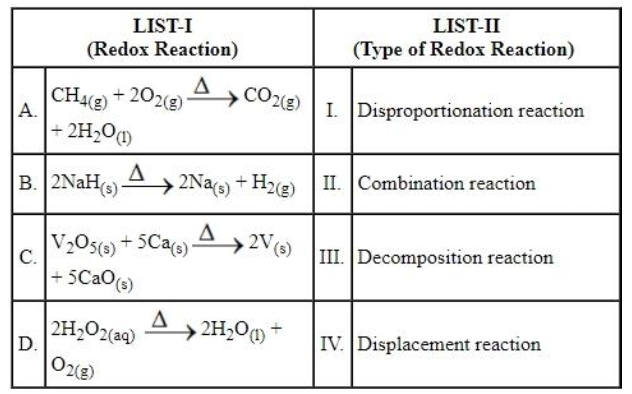
Match the LIST-I with LIST-II
Choose the correct answer from the options given below:
Given below are two statements: Statement I: In the oxalic acid vs $$KMnO_{4}$$ (in the presence of dil $$H_{2}SO_{4}$$) titration the solution needs to be heated initially to $$60^{\circ}C$$, but no heating is required in Ferrous ammonium sulphate (FAS) vs $$KMnO_{4}$$ (in the presence of dil $$H_{2}SO_{4}$$) Statement II: In oxalic acid vs $$KMnO_{4}$$ titration, the initial formation of $$Mnso_{4}$$ takes place at high temperature, which then acts as catalyst for further reaction. In the case of FAS vs $$KMnO_{4}$$, heating oxidizes $$Fe^{2+}$$ and $$Fe^{3+}$$ by oxygen of air and error may be introduced in the experiment. In the light of the above statements, choose the correct answer from the options given below
We analyze both statements about $$KMnO_4$$ titrations.
Statement I: In oxalic acid vs $$KMnO_4$$ titration, heating to 60 degrees C is needed initially, but not in FAS vs $$KMnO_4$$ titration.
The reaction of oxalic acid with $$KMnO_4$$ is slow at room temperature. Initial heating to about 60 degrees C is required to start the reaction. Once some $$Mn^{2+}$$ is formed, it acts as an autocatalyst and the reaction proceeds without further heating. For FAS (Ferrous Ammonium Sulphate) vs $$KMnO_4$$, the reaction is fast at room temperature, so no heating is needed. Statement I is TRUE.
Statement II: In oxalic acid vs $$KMnO_4$$, $$MnSO_4$$ formed initially acts as catalyst. In FAS vs $$KMnO_4$$, heating oxidizes $$Fe^{2+}$$ to $$Fe^{3+}$$ by atmospheric oxygen, introducing error.
The first part is correct: $$Mn^{2+}$$ ions (from $$MnSO_4$$) act as an autocatalyst for the permanganate-oxalate reaction. The second part is also correct: heating the FAS solution would cause aerial oxidation of $$Fe^{2+}$$ to $$Fe^{3+}$$, which would consume some $$Fe^{2+}$$ before it reacts with $$KMnO_4$$, leading to errors. Statement II is TRUE.
Both statements are true. The answer is Option B) Both Statement I and Statement II are true.
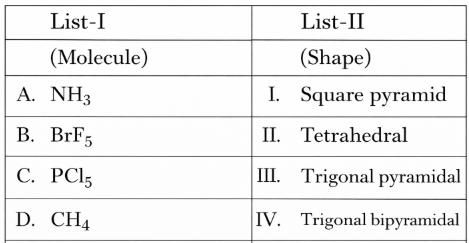
Choose the correct answer from the options given below :
$$KMnO_4$$ acts as an oxidising agent in acidic medium. 'X' is the difference between the oxidation states of Mn in reactant and product. 'Y' is the number of 'd' electrons present in the brown red precipitate formed at the end of the acetate ion test with neutral ferric chloride. The value of X + Y is ________.
In acidic medium, the purple permanganate ion $$MnO_4^-$$ present in $$KMnO_4$$ is reduced to the colourless $$Mn^{2+}$$ ion.
Step 1 - Oxidation state of Mn in the reactant:
In $$MnO_4^-$$ let the oxidation state of Mn be $$x$$. Using $$O$$ in state $$-2$$:
$$x + 4(-2) = -1 \;\;\Rightarrow\;\; x - 8 = -1 \;\;\Rightarrow\;\; x = +7$$
Step 2 - Oxidation state of Mn in the product:
In $$Mn^{2+}$$ the oxidation state is $$+2$$.
Step 3 - Difference $$X$$ between the two oxidation states:
$$X = 7 - 2 = 5$$
Step 4 - Brown-red precipitate in the acetate test:
On adding neutral $$FeCl_3$$ to an acetate solution, deep-red $$Fe(CH_3COO)_3$$ is first formed. On boiling it hydrolyses to a brown-red basic ferric acetate, commonly written as $$Fe(OH)(CH_3COO)_2$$. In both species iron is in the $$+3$$ oxidation state, i.e. present as $$Fe^{3+}$$.
Electronic configuration of $$Fe$$: $$[Ar]\,3d^6\,4s^2$$.
For $$Fe^{3+}$$ three electrons are removed (first the two 4s, then one 3d):
$$Fe^{3+} : [Ar]\,3d^5$$
Step 5 - Number of $$d$$ electrons $$Y$$ in $$Fe^{3+}$$:
$$Y = 5$$
Step 6 - Required sum:
$$X + Y = 5 + 5 = 10$$
Therefore, the value of $$X + Y$$ is $$10$$.
Some $$CO_2$$ gas was kept in a sealed container at a pressure of 1 atm and at 273 K . This entire amount of $$CO_2$$ gas was later passed through an aqueous solution of $$Ca(OH)_2$$. The excess unreacted $$Ca(OH)_2$$ was later neutralized with 0.1 M of 40 mL HCl . If the volume of the sealed container of $$CO_2$$ was $$x$$, then $$x$$ is ________$$cm^{3}$$ (nearest integer). [Given : The entire amount of $$CO_2 (g)$$reacted with exactly half the initial amount of $$Ca(OH)_2$$ present in the aqueous solution.]
We need to find the volume of the sealed container of $$CO_2$$.
We start by writing the chemical reactions involved.
$$CO_2 + Ca(OH)_2 \rightarrow CaCO_3 + H_2O$$
Next, the excess $$Ca(OH)_2$$ is neutralized by hydrochloric acid:
$$Ca(OH)_2 + 2HCl \rightarrow CaCl_2 + 2H_2O$$
Then we calculate the moles of excess $$Ca(OH)_2$$ from the titration data.
Moles of HCl = 0.1 M × 0.040 L = 0.004 mol
Moles of excess $$Ca(OH)_2$$ = $$\frac{0.004}{2} = 0.002$$ mol
The problem states that all of the $$CO_2$$ reacted with exactly half of the initial amount of $$Ca(OH)_2$$.
If the initial $$Ca(OH)_2$$ is N mol, then the reacted portion is N/2 mol and the excess is also N/2 mol.
Therefore, $$N/2 = 0.002$$ mol, so $$N = 0.004$$ mol.
It follows that the moles of $$CO_2$$ are equal to the moles of $$Ca(OH)_2$$ that reacted, which is N/2 = 0.002 mol.
Finally, applying the ideal gas law at STP (273 K, 1 atm):
$$V = n \times 22400 \text{ cm}^3/\text{mol} = 0.002 \times 22400 = 44.8 \text{ cm}^3$$
Rounding to the nearest integer gives $$x \approx 45$$ cm³.
Therefore, the volume of the sealed container of $$CO_2$$ is 45 cm³.
Which of the following cannot function as an oxidising agent?
We need to identify which species cannot function as an oxidising agent.
Key Concept: An oxidising agent accepts electrons (gets reduced). For this, the element must have the ability to decrease its oxidation state.
$$N^{3-}$$: Nitrogen is in its lowest possible oxidation state (-3). Since it cannot be reduced further (there is no lower oxidation state for nitrogen), it cannot act as an oxidising agent. It can only act as a reducing agent (losing electrons to go to higher oxidation states).
$$SO_4^{2-}$$: Sulphur is in +6 state. It can be reduced (e.g., to $$SO_2$$, $$S$$, or $$H_2S$$). It can act as an oxidising agent, especially in concentrated $$H_2SO_4$$.
$$BrO_3^-$$: Bromine is in +5 state. It can be reduced to $$Br^-$$ (0 or -1). It is a known oxidising agent.
$$MnO_4^-$$: Manganese is in +7 state. It is one of the strongest oxidising agents, capable of being reduced to $$Mn^{2+}$$, $$MnO_2$$, or $$MnO_4^{2-}$$.
The correct answer is Option 1: $$N^{3-}$$.
In which one of the following pairs the central atoms exhibit $$sp^2$$ hybridization ?
We need to find the pair where both central atoms exhibit $$sp^2$$ hybridization.
$$BF_3$$: B has 3 bond pairs, 0 lone pairs. Hybridization = $$sp^2$$. ✓
$$NO_2^-$$: N has 2 bond pairs + 1 lone pair = 3 electron groups. Hybridization = $$sp^2$$. ✓
$$H_2O$$: O has 2 bond pairs + 2 lone pairs = 4 electron groups. Hybridization = $$sp^3$$. ✗
$$NO_2$$: N has 2 bond pairs + 1 unpaired electron = 3 regions. Hybridization = $$sp^2$$. ✓
$$NH_2^-$$: N has 2 bond pairs + 2 lone pairs = 4 electron groups. Hybridization = $$sp^3$$. ✗
The pair where both are $$sp^2$$ is $$BF_3$$ and $$NO_2^-$$.
The correct answer is Option 2: $$BF_3$$ and $$NO_2^-$$.
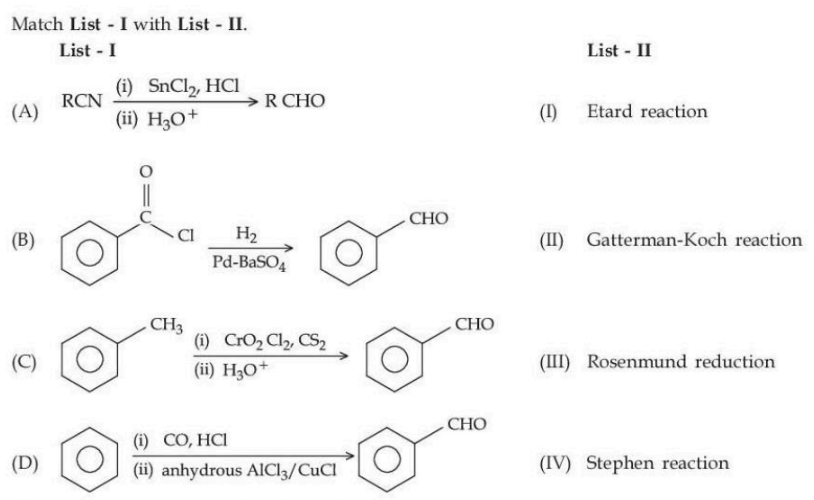
Match List I with List II
Choose the correct answer from the options given below:
When $$\psi_A$$ and $$\psi_B$$ are the wave functions of atomic orbitals, then $$\sigma^*$$ is represented by :
We need to determine the mathematical representation of an antibonding sigma molecular orbital ($$\sigma^*$$).
Recall the LCAO (Linear Combination of Atomic Orbitals) method
When two atomic orbitals $$\psi_A$$ and $$\psi_B$$ combine, they form two molecular orbitals:
- Bonding MO ($$\sigma$$): formed by constructive (in-phase) combination
- Antibonding MO ($$\sigma^*$$): formed by destructive (out-of-phase) combination
Write the mathematical expressions
The bonding molecular orbital is formed by the addition of the two wave functions:
$$\sigma = \psi_A + \psi_B$$
(with a normalisation constant, which is omitted here for simplicity)
The antibonding molecular orbital is formed by the subtraction of the two wave functions:
$$\sigma^* = \psi_A - \psi_B$$
Understand the physical meaning
In the bonding MO, the wave functions reinforce each other in the internuclear region, leading to increased electron density between the nuclei and a stable bond. In the antibonding MO ($$\sigma^*$$), the wave functions cancel in the internuclear region, creating a node (region of zero electron density) between the nuclei. This results in a destabilising effect that weakens bonding.
The correct answer is Option (2): $$\psi_A - \psi_B$$.
Chlorine undergoes disproportionation in alkaline medium as shown below :
$$aCl_2(g) + bOH^-(aq) \rightarrow cClO^-(aq) + dCl^-(aq) + eH_2O(l)$$
The values of $$a, b, c$$ and $$d$$ in a balanced redox reaction are respectively :
At room temperature, disproportionation of an aqueous solution of in situ generated nitrous acid ($$HNO_2$$) gives the species
Nitrous acid, $$HNO_2$$, is an unstable, weak, monobasic acid in which nitrogen has the oxidation state $$+3$$.
In aqueous medium at room temperature it undergoes disproportionation (simultaneous oxidation and reduction of the same species).
To find the products, we balance two half-reactions for nitrogen:
Oxidation half-reaction (N : $$+3 \rightarrow +5$$)
$$HNO_2 + H_2O \rightarrow NO_3^- + 3\,H^+ + 2\,e^-$$
Reduction half-reaction (N : $$+3 \rightarrow +2$$)
$$HNO_2 + e^- \rightarrow NO + H_2O$$
Multiply the reduction half-reaction by $$2$$ so that the electron numbers match, then add:
$$\bigl(HNO_2 + H_2O \rightarrow NO_3^- + 3\,H^+ + 2\,e^- \bigr)$$
$$+$$
$$\bigl(2\,HNO_2 + 2\,e^- \rightarrow 2\,NO + 2\,H_2O \bigr)$$
After canceling the $$2\,e^-$$ on both sides and combining water molecules, we obtain
$$3\,HNO_2 \rightarrow NO_3^- + 2\,NO + H_2O + 3\,H^+$$
In water each $$H^+$$ immediately forms $$H_3O^+$$, so the observable species in the solution (and gas phase) are
$$H_3O^+,\; NO_3^- \text{ and } NO(g)$$
Thus the disproportionation of in-situ generated $$HNO_2$$ at room temperature gives Option A.
Answer - Option A: $$H_3O^+$$, $$NO_3^-$$ and $$NO$$
Given below are two statements:
Statement I: $$S_8$$ solid undergoes disproportionation reaction under alkaline conditions to form $$S^{2-}$$ and $$S_2O_3^{2-}$$
Statement II: $$ClO_4^{-}$$ can undergo disproportionation reaction under acidic condition.
In the light of the above statements, choose the most appropriate answer from the options given below:
We need to evaluate two statements about disproportionation reactions.
A disproportionation reaction is one where the same element is simultaneously oxidized and reduced — it goes to both a higher and a lower oxidation state.
Statement I asserts that $$S_8$$ solid undergoes a disproportionation reaction under alkaline conditions to form $$S^{2-}$$ and $$S_2O_3^{2-}$$. In elemental sulfur $$S_8$$, sulfur has oxidation state 0. In $$S^{2-}$$, its oxidation state is $$-2$$ (reduction), and in $$S_2O_3^{2-}$$ (thiosulfate), the average oxidation state of sulfur is $$+2$$ (oxidation). Since sulfur in state 0 simultaneously goes to $$-2$$ and $$+2$$, this is indeed a disproportionation reaction. The reaction with NaOH can be written as:
$$S_8 + 12\,\text{NaOH} \rightarrow 4\,\text{Na}_2\text{S} + 2\,\text{Na}_2\text{S}_2\text{O}_3 + 6\,\text{H}_2\text{O}$$
Thus, Statement I is correct.
Statement II claims that $$ClO_4^-$$ can undergo disproportionation under acidic conditions. In $$ClO_4^-$$ (perchlorate), chlorine is in the $$+7$$ oxidation state, which is the highest possible for chlorine. Disproportionation requires simultaneous oxidation and reduction, but chlorine at $$+7$$ cannot be further oxidized. Therefore, $$ClO_4^-$$ cannot undergo disproportionation, making Statement II incorrect.
The correct answer is Option A: Statement I is correct but Statement II is incorrect.
Which of the following reactions are disproportionation reactions? (1) $$Cu^+ \rightarrow Cu^{2+} + Cu$$ (2) $$3MnO_4^{2-} + 4H^+ \rightarrow 2MnO_4^- + MnO_2 + 2H_2O$$ (3) $$2KMnO_4 \rightarrow K_2MnO_4 + MnO_2 + O_2$$ (4) $$2MnO_4^- + 3Mn^{2+} + 2H_2O \rightarrow 5MnO_2 + 4H^+$$. Choose the correct answer from the options given below:
Identify which reactions are disproportionation reactions.
A disproportionation reaction is one where the same element in a single oxidation state is simultaneously oxidised and reduced to two different oxidation states.
Reaction (1): $$Cu^+ \rightarrow Cu^{2+} + Cu$$
$$Cu^+$$ (+1) is oxidised to $$Cu^{2+}$$ (+2) and reduced to $$Cu$$ (0). The same element (Cu) in the same oxidation state (+1) undergoes both oxidation and reduction. This IS a disproportionation reaction.
Reaction (2): $$3MnO_4^{2-} + 4H^+ \rightarrow 2MnO_4^- + MnO_2 + 2H_2O$$
Mn in $$MnO_4^{2-}$$ is in +6 state. It goes to +7 in $$MnO_4^-$$ (oxidation) and +4 in $$MnO_2$$ (reduction). Same element, same initial state, both oxidised and reduced. This IS a disproportionation reaction.
Reaction (3): $$2KMnO_4 \rightarrow K_2MnO_4 + MnO_2 + O_2$$
Mn goes from +7 (in $$KMnO_4$$) to +6 (in $$K_2MnO_4$$) and +4 (in $$MnO_2$$). Both are reductions. The oxygen goes from -2 to 0 (oxidation). Here Mn is only reduced (to two different states), while O is oxidised. This is NOT disproportionation of a single element in one state.
Reaction (4): $$2MnO_4^- + 3Mn^{2+} + 2H_2O \rightarrow 5MnO_2 + 4H^+$$
Mn starts in two different oxidation states (+7 and +2) and goes to one state (+4). This is a comproportionation (reverse of disproportionation), NOT a disproportionation reaction.
The correct answer is Option A: 1, 2.
In acidic medium, $$K_2Cr_2O_7$$ shows oxidising action as represented in the half reaction $$Cr_2O_7^{2-} + XH^+ + Ye^- \rightarrow 2A + ZH_2O$$. X, Y, Z and A are respectively:
Balance the half-reaction: $$Cr_2O_7^{2-} + XH^+ + Ye^- \rightarrow 2A + ZH_2O$$.
In acidic medium, $$Cr_2O_7^{2-}$$ is reduced to $$Cr^{3+}$$, each Cr going from oxidation state +6 to +3. Since there are two Cr atoms on the left, the product on the right must be 2$$Cr^{3+}$$, so A = $$Cr^{3+}$$.
To balance oxygen, note the 7 oxygen atoms in $$Cr_2O_7^{2-}$$; these require 7$$H_2O$$ on the right, giving Z = 7.
Those 7$$H_2O$$ molecules contribute 14 hydrogen atoms on the right, so we add 14$$H^+$$ on the left to balance hydrogen, yielding X = 14.
Next, balance charge by adding electrons. The left side has charge $$(-2) + 14(+1) + Y(-1) = 12 - Y$$, while the right side has charge $$2(+3) + 0 = +6$$. Setting these equal gives $$ 12 - Y = 6 \implies Y = 6 $$.
Thus the balanced equation is $$Cr_2O_7^{2-} + 14H^+ + 6e^- \rightarrow 2Cr^{3+} + 7H_2O$$, and checking charges shows both sides sum to +6.
X = 14, Y = 6, Z = 7, A = $$Cr^{3+}$$.
The correct answer is Option D: 14, 6, 7 and $$Cr^{3+}$$.
Number of $$\sigma$$ and $$\pi$$ bonds present in ethylene molecule is respectively :
Ethylene ($$C_2H_4$$) has the structure: $$H_2C=CH_2$$.
Counting sigma bonds:
- C-C bond: 1 sigma bond (part of the double bond)
- C-H bonds: 4 sigma bonds (2 on each carbon)
Total sigma bonds = 5.
Counting pi bonds:
- C=C double bond contains 1 pi bond
Total pi bonds = 1.
The correct answer is Option (4): 5 and 1.
Reduction potential of ions are given below:
$$ClO_4^-$$: $$E° = 1.19$$ V; $$IO_4^-$$: $$E° = 1.65$$ V; $$BrO_4^-$$: $$E° = 1.74$$ V
The correct order of their oxidising power is:
Higher reduction potential means stronger oxidizing agent.
$$BrO_4^-: E° = 1.74$$ V (highest), $$IO_4^-: E° = 1.65$$ V, $$ClO_4^-: E° = 1.19$$ V (lowest).
Oxidising power order: $$BrO_4^- > IO_4^- > ClO_4^-$$.
The answer is Option (2): $$\boxed{BrO_4^- > IO_4^- > ClO_4^-}$$.
Given below are two statements : Statement I : $$PF_5$$ and $$BrF_5$$ both exhibit $$sp^3d$$ hybridisation. Statement II : Both $$SF_6$$ and $$[Co(NH_3)_6]^{3+}$$ exhibit $$sp^3d^2$$ hybridisation. In the light of the above statements, choose the correct answer from the options given below :
We need to evaluate two statements about hybridisation of certain molecules and complex ions.
Analysis of Statement I: "PF$$_5$$ and BrF$$_5$$ both exhibit sp$$^3$$d hybridisation."
PF$$_5$$: P has 5 valence electrons and forms 5 bonds with F atoms. There are 5 bond pairs and 0 lone pairs, giving sp$$^3$$d hybridisation and a trigonal bipyramidal geometry. ✓
BrF$$_5$$: Br has 7 valence electrons. With 5 F atoms, there are 5 bond pairs and 1 lone pair = 6 electron pairs total. This requires sp$$^3$$d$$^2$$ hybridisation (not sp$$^3$$d), giving a square pyramidal geometry.
Since BrF$$_5$$ is sp$$^3$$d$$^2$$, not sp$$^3$$d, Statement I is FALSE.
Analysis of Statement II: "Both SF$$_6$$ and [Co(NH$$_3$$)$$_6$$]$$^{3+}$$ exhibit sp$$^3$$d$$^2$$ hybridisation."
SF$$_6$$: S has 6 valence electrons and forms 6 bonds with F atoms. There are 6 bond pairs and 0 lone pairs. This gives sp$$^3$$d$$^2$$ hybridisation and an octahedral geometry. ✓
[Co(NH$$_3$$)$$_6$$]$$^{3+}$$: Co$$^{3+}$$ has the configuration [Ar]3d$$^6$$. With NH$$_3$$ being a strong field ligand, the d-electrons pair up to occupy only 3 of the 5 d-orbitals, leaving 2 inner d-orbitals available for bonding. The hybridisation is d$$^2$$sp$$^3$$ (inner orbital complex), not sp$$^3$$d$$^2$$ (which would use outer d-orbitals).
Since [Co(NH$$_3$$)$$_6$$]$$^{3+}$$ uses d$$^2$$sp$$^3$$ (inner orbital) hybridisation, not sp$$^3$$d$$^2$$, Statement II is FALSE.
The correct answer is Option (4): Both Statement I and Statement II are false.
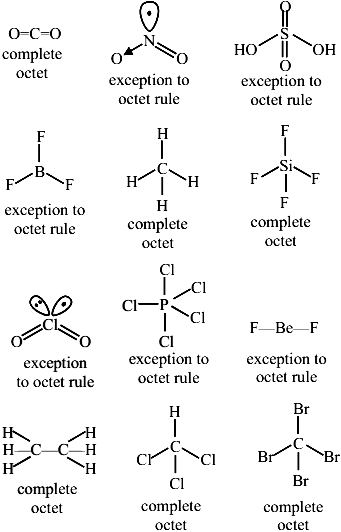
Number of molecules from the following which are exceptions to octet rule is ______ $$CO_2$$, $$NO_2$$, $$H_2SO_4$$, $$BF_3$$, $$CH_4$$, $$SiF_4$$, $$ClO_2$$, $$PCl_5$$, $$BeF_2$$, $$C_2H_6$$, $$CHCl_3$$, $$CBr_4$$
1. Complete Octet (8 Electrons)
These central atoms follow the standard rule by sharing electrons until they reach a stable count of 8.
- $$\text{CO}_2$$ (Carbon): Carbon has 4 valence electrons and forms two double bonds with Oxygen. $$4 + 4 = 8$$ electrons.
- $$\text{CH}_4$$ (Carbon): Carbon forms 4 single bonds with Hydrogen. $$4 \times 2 = 8$$ electrons.
- $$\text{SiF}_4$$ (Silicon): Like Carbon, Silicon is in Group 14 and forms 4 single bonds. $$4 \times 2 = 8$$ electrons.
- $$\text{C}_2\text{H}_6$$ (Carbons): Each Carbon forms 3 bonds with Hydrogen and 1 bond with the other Carbon. $$4 \times 2 = 8$$ electrons.
- $$\text{CHCl}_3$$ & $$\text{CBr}_4$$ (Carbon): Carbon forms 4 single bonds with halogens. $$4 \times 2 = 8$$ electrons.
2. Exceptions: Incomplete Octet (< 8 Electrons)
These central atoms are stable even though they lack a full shell of 8 electrons.
- $$\text{BF}_3$$ (Boron): Boron is in Group 13. It shares its 3 valence electrons to form 3 single bonds.
- Total: 6 electrons.
- $$\text{BeF}_2$$ (Beryllium): Beryllium is in Group 2. It shares its 2 valence electrons to form 2 single bonds.
- Total: 4 electrons.
3. Exceptions: Expanded Octet (> 8 Electrons)
Elements in Period 3 or below have empty $$d$$-orbitals that allow them to hold more than 8 electrons.
- $$\text{H}_2\text{SO}_4$$ (Sulfur): Sulfur forms 6 bonds (two double bonds with Oxygen, two single bonds with -OH).
- Total: 12 electrons.
- $$\text{PCl}_5$$ (Phosphorus): Phosphorus forms 5 single bonds with Chlorine.
- Total: 10 electrons.
- $$\text{ClO}_2$$ (Chlorine): Chlorine is bonded to two oxygens and retains lone pairs/unpaired electrons. In many Lewis representations, it exceeds 8 to reduce formal charge.
4. Exceptions: Odd-Electron Molecules
- $$\text{NO}_2$$ (Nitrogen): Nitrogen has 5 valence electrons. Because 5 is an odd number, it is impossible to pair every electron.
- Total: Nitrogen ends up with 7 valence electrons (one unpaired electron). This makes it a free radical.
Number of molecules from the following which can exhibit hydrogen bonding is _______ (nearest integer):
Number of molecules having bond order 2 from the following molecules is _____ : $$C_2, O_2, Be_2, Li_2, Ne_2, N_2, He_2$$
We need to find the number of molecules with bond order 2 from: $$C_2, O_2, Be_2, Li_2, Ne_2, N_2, He_2$$.
Using Molecular Orbital Theory, the bond order is calculated as $$\text{Bond Order} = \frac{N_b - N_a}{2}$$ where $$N_b$$ is the number of bonding electrons and $$N_a$$ is the number of antibonding electrons.
Since $$C_2$$ (12 electrons) has configuration $$(\sigma_{1s})^2(\sigma^*_{1s})^2(\sigma_{2s})^2(\sigma^*_{2s})^2(\pi_{2p})^4$$, the bond order is $$(8-4)/2 = 2$$. ✓
Now $$O_2$$ (16 electrons) has configuration $$(\sigma_{1s})^2(\sigma^*_{1s})^2(\sigma_{2s})^2(\sigma^*_{2s})^2(\sigma_{2p})^2(\pi_{2p})^4(\pi^*_{2p})^2$$, so the bond order is $$(10-6)/2 = 2$$. ✓
For $$Be_2$$ (8 electrons), the bond order is $$(4-4)/2 = 0$$. ✗
For $$Li_2$$ (6 electrons), the bond order is $$(4-2)/2 = 1$$. ✗
For $$Ne_2$$ (20 electrons), the bond order is $$(10-10)/2 = 0$$. ✗
For $$N_2$$ (14 electrons), the bond order is $$(10-4)/2 = 3$$. ✗
For $$He_2$$ (4 electrons), the bond order is $$(2-2)/2 = 0$$. ✗
Therefore the molecules with bond order 2 are $$C_2$$ and $$O_2$$.
This gives the answer $$\boxed{2}$$.
The total number of species from the following in which one unpaired electron is present, is _______
$$N_2, O_2, C_2^-, O_2^-, O_2^{2-}, H_2^+, CN^-, He_2^+$$
We need to find the total number of species from the given list that have exactly one unpaired electron. We use Molecular Orbital Theory (MOT) to determine the electronic configurations.
Recall: The molecular orbital filling order for diatomic molecules is:
For $$Z \leq 7$$ (like N, C): $$\sigma_{1s}, \sigma^*_{1s}, \sigma_{2s}, \sigma^*_{2s}, \pi_{2p_x} = \pi_{2p_y}, \sigma_{2p_z}, \pi^*_{2p_x} = \pi^*_{2p_y}, \sigma^*_{2p_z}$$
For $$Z > 7$$ (like O): $$\sigma_{1s}, \sigma^*_{1s}, \sigma_{2s}, \sigma^*_{2s}, \sigma_{2p_z}, \pi_{2p_x} = \pi_{2p_y}, \pi^*_{2p_x} = \pi^*_{2p_y}, \sigma^*_{2p_z}$$
1. $$N_2$$ (14 electrons):
Configuration: $$(\sigma_{1s})^2 (\sigma^*_{1s})^2 (\sigma_{2s})^2 (\sigma^*_{2s})^2 (\pi_{2p})^4 (\sigma_{2p_z})^2$$
All electrons are paired. Unpaired electrons = 0. Not selected.
2. $$O_2$$ (16 electrons):
Configuration: ...$$(\sigma_{2p_z})^2 (\pi_{2p})^4 (\pi^*_{2p})^2$$
The two electrons in $$\pi^*_{2p}$$ occupy one each of $$\pi^*_{2p_x}$$ and $$\pi^*_{2p_y}$$ by Hund's rule. Unpaired electrons = 2. Not selected.
3. $$C_2^-$$ (13 electrons):
$$C_2$$ has 12 electrons; adding 1 gives 13. Configuration: $$(\sigma_{1s})^2 (\sigma^*_{1s})^2 (\sigma_{2s})^2 (\sigma^*_{2s})^2 (\pi_{2p})^4 (\sigma_{2p_z})^1$$
Unpaired electrons = 1. Selected.
4. $$O_2^-$$ (17 electrons):
$$O_2$$ has 16 electrons; adding 1 gives 17. Configuration: ...$$(\pi^*_{2p})^3$$
Three electrons in two degenerate $$\pi^*$$ orbitals: 2 in one, 1 in the other. Unpaired electrons = 1. Selected.
5. $$O_2^{2-}$$ (18 electrons):
$$O_2$$ has 16 electrons; adding 2 gives 18. Configuration: ...$$(\pi^*_{2p})^4$$
Both $$\pi^*$$ orbitals are fully filled. Unpaired electrons = 0. Not selected.
6. $$H_2^+$$ (1 electron):
Configuration: $$(\sigma_{1s})^1$$
One electron in the bonding orbital. Unpaired electrons = 1. Selected.
7. $$CN^-$$ (14 electrons):
C has 6 electrons, N has 7, plus 1 for the negative charge = 14 electrons. This is isoelectronic with $$N_2$$.
Configuration is the same as $$N_2$$: all electrons paired. Unpaired electrons = 0. Not selected.
8. $$He_2^+$$ (3 electrons):
Two He atoms contribute 4 electrons; removing 1 gives 3. Configuration: $$(\sigma_{1s})^2 (\sigma^*_{1s})^1$$
Unpaired electrons = 1. Selected.
Summary: Species with exactly 1 unpaired electron: $$C_2^-$$, $$O_2^-$$, $$H_2^+$$, $$He_2^+$$.
The total count is $$\boxed{4}$$.
1 mole of PbS is oxidised by X moles of $$O_3$$ to get Y moles of $$O_2$$. X + Y =
We apply the oxidation number method to balance the redox reaction between lead sulfide and ozone.
Step 1: Oxidation half‐reaction
Sulfur in $$PbS$$ changes its oxidation state from $$-2$$ to $$+6$$ in $$SO_4^{2-}$$. In acidic medium the half‐reaction is written as:
$$S^{2-} + 4\,H_2O \;\longrightarrow\; SO_4^{2-} + 8\,H^+ + 8\,e^-$$ $$-(1)$$
Step 2: Reduction half‐reaction
Ozone is reduced to oxygen, with each oxygen atom remaining at oxidation state $$0$$. The half‐reaction in acidic medium is:
$$O_3 + 2\,H^+ + 2\,e^- \;\longrightarrow\; O_2 + H_2O$$ $$-(2)$$
Step 3: Equalize electrons
The oxidation half‐reaction (1) involves 8 electrons, while the reduction half‐reaction (2) involves 2 electrons. To balance electrons, multiply equation (2) by 4:
$$4\,O_3 + 8\,H^+ + 8\,e^- \;\longrightarrow\; 4\,O_2 + 4\,H_2O$$ $$-(3)$$
Step 4: Add half‐reactions
Adding equations (1) and (3) and cancelling common species ($$8\,e^-$$, $$8\,H^+$$ and $$4\,H_2O$$) gives:
$$S^{2-} + 4\,O_3 \;\longrightarrow\; SO_4^{2-} + 4\,O_2$$ $$-(4)$$
Step 5: Include lead ion
Since the sulfide ion comes from $$PbS$$ and the sulfate ion forms $$PbSO_4$$, we combine with $$Pb^{2+}$$ to get the overall equation:
$$PbS + 4\,O_3 \;\longrightarrow\; PbSO_4 + 4\,O_2$$ $$-(5)$$
From the balanced equation (5), 1 mole of $$PbS$$ reacts with $$X=4$$ moles of $$O_3$$ to produce $$Y=4$$ moles of $$O_2$$. Therefore,
$$X + Y = 4 + 4 = 8$$
In the Lewis dot structure for $$NO_2^-$$, total number of valence electrons around nitrogen is ______
In $$NO_2^-$$ (nitrite ion), nitrogen is the central atom.
Valence electrons: N has 5, each O has 6, plus 1 for the negative charge. Total = 5 + 6(2) + 1 = 18 valence electrons.
Lewis structure of $$NO_2^-$$:
N is bonded to 2 oxygen atoms with one double bond and one single bond (or resonance structures with 1.5 bond order each). Nitrogen has one lone pair.
Valence electrons around nitrogen:
- 2 bonding pairs (from double bond) + 1 bonding pair (from single bond) = 3 bond pairs = 6 electrons from bonds
- 1 lone pair = 2 electrons
Total = 8 electrons around nitrogen.
The answer is 8.
Only 2 mL of KMnO₄ solution of unknown molarity is required to reach the end point of a titration of 20 mL of oxalic acid (2M) in acidic medium. The molarity of KMnO₄ solution should be ______ M.
The reaction: 2KMnO₄ + 5H₂C₂O₄ + 3H₂SO₄ → 2MnSO₄ + K₂SO₄ + 10CO₂ + 8H₂O
Mole ratio: KMnO₄ : H₂C₂O₄ = 2 : 5
Moles of oxalic acid = 0.020 × 2 = 0.04 mol
Moles of KMnO₄ = (2/5) × 0.04 = 0.016 mol
Molarity of KMnO₄ = 0.016/0.002 = 8 M
The answer is 8.
Total number of species from the following which can undergo disproportionation reaction: $$H_2O_2$$, $$ClO_3^-$$, $$P_4$$, $$Cl_2$$, $$Ag$$, $$Cu^{+1}$$, $$F_2$$, $$NO_2$$, $$K^+$$
Species that can undergo disproportionation have an element in an intermediate oxidation state:
$$H_2O_2$$: O is in -1 state (can go to 0 and -2) — YES
$$ClO_3^-$$: Cl is in +5 — YES (can disproportionate)
$$P_4$$: P is in 0 state — YES (goes to -3 and +5 in alkali)
$$Cl_2$$: Cl is in 0 state — YES (goes to -1 and +1)
$$Ag$$: metallic, 0 state — NO (already in lowest practical state)
$$Cu^{+1}$$: Can go to Cu(0) and Cu(+2) — YES
$$F_2$$: F is in 0 state, but F only goes to -1 (no positive states) — NO
$$NO_2$$: N is in +4 — YES (goes to +5 and +3)
$$K^+$$: Cannot disproportionate — NO
Total = 6 (H$$_2$$O$$_2$$, ClO$$_3^-$$, P$$_4$$, Cl$$_2$$, Cu$$^{+1}$$, NO$$_2$$).
Therefore, the answer is $$\boxed{6}$$.
$$2MnO_4^- + bI^- + cH_2O \rightarrow xI_2 + yMnO_2 + zOH^-$$
If the above equation is balanced with integer coefficients, the value of $$z$$ is ________.
We need to balance the redox equation in basic medium: $$2MnO_4^- + bI^- + cH_2O \rightarrow xI_2 + yMnO_2 + zOH^-$$.
Mn in $$MnO_4^-$$ is +7 and in $$MnO_2$$ is +4, so manganese is reduced by gaining three electrons. Iodine in $$I^-$$ is -1 and in $$I_2$$ is 0, so iodine is oxidized by losing one electron.
In basic medium the half-reactions are written as follows. The reduction half-reaction is $$MnO_4^- + 2H_2O + 3e^- \rightarrow MnO_2 + 4OH^-$$ and the oxidation half-reaction is $$2I^- \rightarrow I_2 + 2e^-$$.
To equalize the electrons exchanged, multiply the reduction half-reaction by 2 and the oxidation half-reaction by 3, giving: $$2MnO_4^- + 4H_2O + 6e^- \rightarrow 2MnO_2 + 8OH^-$$ and $$6I^- \rightarrow 3I_2 + 6e^-$$.
Adding these half-reactions yields the balanced overall equation: $$2MnO_4^- + 6I^- + 4H_2O \rightarrow 3I_2 + 2MnO_2 + 8OH^-$$.
Verification confirms that manganese, iodine, oxygen, hydrogen, and charge are all balanced.
From the balanced equation: $$z = 8$$
Answer: 8
Number of moles of $$H^+$$ ions required by 1 mole of $$MnO_4^-$$ to oxidise oxalate ion to $$CO_2$$ is
We need to find the number of moles of $$H^+$$ ions required by 1 mole of $$MnO_4^-$$ to oxidise oxalate ion to $$CO_2$$.
First, we write the half-reactions for the permanganate-oxalate reaction in acidic medium. The reduction half is $$MnO_4^- + 8H^+ + 5e^- \rightarrow Mn^{2+} + 4H_2O$$, in which manganese goes from +7 to +2 by gaining five electrons, and the oxidation half for oxalate is $$C_2O_4^{2-} \rightarrow 2CO_2 + 2e^-$$, as each oxalate ion loses two electrons while carbon is oxidised from +3 to +4.
Next, balancing the electrons requires multiplying the reduction half-reaction by 2 and the oxidation half-reaction by 5, which yields $$2MnO_4^- + 16H^+ + 10e^- \rightarrow 2Mn^{2+} + 8H_2O$$ and $$5C_2O_4^{2-} \rightarrow 10CO_2 + 10e^-$$.
Combining these two balanced half-reactions gives the overall ionic equation $$2MnO_4^- + 5C_2O_4^{2-} + 16H^+ \rightarrow 2Mn^{2+} + 10CO_2 + 8H_2O$$.
Since 2 moles of $$MnO_4^-$$ consume 16 moles of $$H^+$$ in this balanced equation, one mole requires $$\frac{16}{2} = 8$$ moles of $$H^+$$.
The correct answer is 8.
In the reaction of potassium dichromate, potassium chloride and sulfuric acid (conc.), the oxidation state of the chromium in the product is +
$$K_2Cr_2O_7 + 4KCl + 6H_2SO_4 \xrightarrow{\Delta} 2CrO_2Cl_2 + 6KHSO_4 + 3H_2O$$
Rule: In any neutral molecule, the sum of oxidation states equals zero. Let the oxidation state of chromium in $$CrO_2Cl_2$$ be $$x$$. Then
$$x + 2\times(\text{ox. state of O}) + 2\times(\text{ox. state of Cl}) = 0\quad-(1)$$
We know: Oxygen has oxidation state $$-2$$ and chlorine has oxidation state $$-1$$. Substituting these into $$(1)$$ gives:
$$x + 2(-2) + 2(-1) = 0$$
$$x = 6$$
Therefore, the oxidation state of chromium in the product $$CrO_2Cl_2$$ is +6.
Total number of species from the following with central atom utilising $$sp^2$$ hybrid orbitals for bonding is ___________. $$NH_3$$, $$SO_2$$, $$SiO_2$$, $$BeCl_2$$, $$C_2H_2$$, $$C_2H_4$$, $$BCl_3$$, $$HCHO$$, $$C_6H_6$$, $$BF_3$$, $$C_2H_4Cl_2$$
We need to count the species with the central atom using sp$$^2$$ hybrid orbitals from the given list.
sp$$^2$$ hybridisation occurs when the central atom has 3 electron domains (regions of electron density), giving a trigonal planar arrangement (or bent if lone pairs are present).
Analyze each species:
(i) $$NH_3$$: N has 3 bond pairs + 1 lone pair = 4 electron domains → sp$$^3$$. ✗
(ii) $$SO_2$$: S has 2 bond pairs + 1 lone pair = 3 electron domains → sp$$^2$$. ✓
(iii) $$SiO_2$$: Each Si is bonded to 4 O atoms in a tetrahedral arrangement → sp$$^3$$. ✗
(iv) $$BeCl_2$$: Be has 2 bond pairs + 0 lone pairs = 2 electron domains → sp. ✗
(v) $$C_2H_4$$: Each C has 3 electron domains (2 C-H + 1 C=C) → sp$$^2$$. ✓
(vi) $$C_2H_2$$: Each C has 2 electron domains (1 C-H + 1 C≡C) → sp. ✗
(vii) $$BCl_3$$: B has 3 bond pairs + 0 lone pairs = 3 electron domains → sp$$^2$$. ✓
(viii) $$HCHO$$: C has 3 electron domains (2 C-H + 1 C=O) → sp$$^2$$. ✓
(ix) $$C_6H_6$$: Each C has 3 electron domains → sp$$^2$$. ✓
(x) $$BF_3$$: B has 3 bond pairs + 0 lone pairs → sp$$^2$$. ✓
(xi) $$C_2H_4Cl_2$$: Each C has 4 electron domains → sp$$^3$$. ✗
Count: SO$$_2$$, C$$_2$$H$$_4$$, BCl$$_3$$, HCHO, C$$_6$$H$$_6$$, BF$$_3$$ = 6 species.
The answer is 6.
From the given list, the number of compounds with $$+4$$ oxidation state of Sulphur: $$SO_3, H_2SO_3, SOCl_2, SF_4, BaSO_4, H_2S_2O_7$$
We need to find compounds with sulphur in +4 oxidation state:
- $$SO_3$$: S is +6
- $$H_2SO_3$$: $$2(+1) + x + 3(-2) = 0$$, so $$x = +4$$. Yes.
- $$SOCl_2$$: $$x + (-2) + 2(-1) = 0$$, so $$x = +4$$. Yes.
- $$SF_4$$: $$x + 4(-1) = 0$$, so $$x = +4$$. Yes.
- $$BaSO_4$$: $$(+2) + x + 4(-2) = 0$$, so $$x = +6$$.
- $$H_2S_2O_7$$: This is pyrosulfuric acid. $$2(+1) + 2x + 7(-2) = 0$$, so $$2x = 12$$, $$x = +6$$.
Compounds with +4 oxidation state of S: $$H_2SO_3$$, $$SOCl_2$$, $$SF_4$$ = 3 compounds.
The answer is $$\boxed{3}$$.
'25 volume' hydrogen peroxide means
Determine what "25 volume" hydrogen peroxide means in terms of mass of $$H_2O_2$$ per litre.
"25 volume" $$H_2O_2$$ means 1 L of this solution releases 25 L of $$O_2$$ at STP upon complete decomposition.
The decomposition reaction is $$2H_2O_2 \rightarrow 2H_2O + O_2$$.
Since 1 mole of $$H_2O_2$$ produces $$\frac{1}{2}$$ mole of $$O_2$$, which corresponds to 11.2 L at STP, the volume strength is $$11.2 \times M$$ where M is the molarity of $$H_2O_2$$. Equating this to 25 gives $$25 = 11.2 \times M$$, so $$M = \frac{25}{11.2} = 2.232$$ mol/L.
The molar mass of $$H_2O_2$$ is 34 g/mol, so the mass per litre is $$2.232 \times 34 \approx 75.9$$ g, which is approximately 75 g.
Comparing with the given options, 250 g/L (Option A) is too high; 75 g/L (Option B) matches our calculation $$\checkmark$$; 25 g per 100 mL = 250 g/L (Option C) is too high; and 25 g/L (Option D) is too low. Thus the correct answer is Option B.
Which of the following options are correct for the reaction?
$$2Au(CN)_2 ^-(aq) + Zn(s) \rightarrow 2Au(s) + Zn(CN)_4 ^{2-}(aq)$$
A. Redox reaction
B. Displacement reaction
C. Decomposition reaction
D. Combination reaction
We have the reaction:
$$2Au(CN)_2^-(aq) + Zn(s) \rightarrow 2Au(s) + Zn(CN)_4^{2-}(aq)$$
In $$Au(CN)_2^-$$, Au is in the +1 oxidation state, while in the product Au(s), Au is in the 0 oxidation state — so Au is reduced. Meanwhile, Zn goes from 0 (in Zn) to +2 (in $$Zn(CN)_4^{2-}$$), so Zn is oxidized. Since both oxidation and reduction occur, this is a redox reaction.
Now, Zn (a more reactive metal) displaces Au (a less reactive metal) from its complex ion, so this is also a displacement reaction.
This is not a decomposition reaction because no compound is breaking down into simpler substances on its own. It is also not a combination reaction because no two substances are combining to form a single product.
Hence, the correct answer is Option A and B only.
$$2IO_3^- + xI^- + 12H^+ \rightarrow 6I_2 + 6H_2$$ What is the value of x?
Total 12 mole of I in RHS side of the reaction. Hence on the left hand side to balance it x must be 10
In which of the following reactions the hydrogen peroxide acts as a reducing agent?
H₂O₂ acts as a reducing agent when it gets oxidized (oxygen goes from -1 to 0 or higher oxidation state).
In H₂O₂, the oxidation state of oxygen is -1.
Option A: PbS + 4H₂O₂ → PbSO₄ + 4H₂O. Here O goes from -1 in H₂O₂ to -2 in H₂O. H₂O₂ is reduced → acts as oxidizing agent.
Option B: 2Fe²⁺ + H₂O₂ → 2Fe³⁺ + 2OH⁻. Here O goes from -1 to -2. H₂O₂ is reduced → acts as oxidizing agent.
Option C: HOCl + H₂O₂ → H₃O⁺ + Cl⁻ + O₂. Here O in H₂O₂ goes from -1 to 0 (in O₂). H₂O₂ is oxidized → acts as reducing agent.
Option D: Mn²⁺ + H₂O₂ → Mn⁴⁺ + 2OH⁻. Here O goes from -1 to -2. H₂O₂ is reduced → acts as oxidizing agent.
The correct answer is Option 3: HOCl + H₂O₂ → H₃O⁺ + Cl⁻ + O₂.
During the reaction of permanganate with thiosulphate, the change in oxidation of manganese occurs by value of 3. Identify which of the below medium will favour the reaction.
In permanganate (MnO₄⁻), manganese has an oxidation state of +7.
If the change in oxidation state is 3, then Mn goes from +7 to +4, forming MnO₂.
The behavior of permanganate depends on the medium:
- In acidic medium: Mn goes from +7 to +2 (change of 5), forming Mn²⁺
- In neutral/weakly alkaline medium: Mn goes from +7 to +4 (change of 3), forming MnO₂
- In strongly alkaline medium: Mn goes from +7 to +6 (change of 1), forming MnO₄²⁻
Since the change in oxidation state is 3 (from +7 to +4), the reaction occurs in aqueous neutral medium.
The correct answer is Aqueous neutral.
During water-gas shift reaction
The water-gas shift reaction is:
$$CO + H_2O \to CO_2 + H_2$$
In this reaction:
- Carbon monoxide (CO) is oxidized to carbon dioxide (CO₂) — carbon's oxidation state changes from +2 to +4
- Water (H₂O) is reduced — hydrogen is reduced from +1 to 0 (H₂)
This matches option 1: Carbon monoxide is oxidized to carbon dioxide.
Given below are two statements: one is labelled as Assertion (A) and the other is labelled as Reason (R).
Assertion (A): An aqueous solution of KOH when for volumetric analysis, its concentration should be checked before the use.
Reason (R): On aging, KOH solution absorbs atmospheric CO$$_2$$.
In the light of the above statements, choose the correct answer from the options given below.
$$H_2O_2$$ acts as a reducing agent in
$$H_2O_2$$ acts as a reducing agent when it is oxidized, i.e., when the oxygen in $$H_2O_2$$ (oxidation state $$-1$$) is converted to a higher oxidation state.
Examining the reactions:
Option 1: $$2NaOCl + H_2O_2 \rightarrow 2NaCl + H_2O + O_2$$
Here, oxygen in $$H_2O_2$$ (oxidation state $$-1$$) is converted to $$O_2$$ (oxidation state $$0$$). The oxygen is oxidized, so $$H_2O_2$$ acts as a reducing agent.
In the other options, $$H_2O_2$$ acts as an oxidizing agent (oxygen goes from $$-1$$ to $$-2$$).
The starting material for convenient preparation of deuterated hydrogen peroxide (D$$_2$$O$$_2$$) in laboratory is:
We need to identify the starting material for the convenient laboratory preparation of deuterated hydrogen peroxide (D$$_2$$O$$_2$$).
Analysis of each option:
Option A: K$$_2$$S$$_2$$O$$_8$$ (Potassium persulfate)
The hydrolysis of potassium persulfate with heavy water (D$$_2$$O) gives D$$_2$$O$$_2$$:
$$ \text{K}_2\text{S}_2\text{O}_8 + 2\text{D}_2\text{O} \to 2\text{KDSO}_4 + \text{D}_2\text{O}_2 $$In this method, deuterium comes from D$$_2$$O (heavy water), which is readily available. This is the most convenient laboratory method for preparing D$$_2$$O$$_2$$.
Option B: 2-ethylanthraquinol
This is used in the industrial anthraquinone auto-oxidation process for large-scale H$$_2$$O$$_2$$ production. It requires catalytic hydrogenation using D$$_2$$ gas, which is not practical for routine laboratory preparation of D$$_2$$O$$_2$$.
Option C: BaO$$_2$$ (Barium peroxide)
The Merck process uses BaO$$_2$$ with dilute acid: BaO$$_2$$ + H$$_2$$SO$$_4$$ → BaSO$$_4$$ + H$$_2$$O$$_2$$. For D$$_2$$O$$_2$$, one would need D$$_2$$SO$$_4$$ (deuterated sulfuric acid), which is expensive and not conveniently available. This makes it impractical for D$$_2$$O$$_2$$ preparation.
Option D: BaO (Barium oxide)
Barium oxide is a basic oxide, not a peroxide. It cannot directly produce H$$_2$$O$$_2$$ or D$$_2$$O$$_2$$. The reaction BaO + H$$_2$$O → Ba(OH)$$_2$$ only gives a hydroxide.
The correct answer is Option A: K$$_2$$S$$_2$$O$$_8$$.
Given below are two statements:
Statement I: In redox titration, the indicators used are sensitive to change in pH of the solution.
Statement II: In acid-base titration, the indicators used are sensitive to change in oxidation potential.
In the light of the above statements, choose the most appropriate answer from the options given below
Statement I says that in redox titration, the indicators used are sensitive to change in pH of the solution. This is incorrect. Redox indicators respond to changes in the oxidation potential (electrode potential) of the solution, not to pH changes. Examples include diphenylamine and potassium permanganate, which change colour based on their oxidation state.
Statement II says that in acid-base titration, the indicators used are sensitive to change in oxidation potential. This is also incorrect. Acid-base indicators such as phenolphthalein and methyl orange are sensitive to changes in the pH of the solution, not to oxidation potential.
Both statements have the properties of the indicators swapped — redox indicators track oxidation potential while acid-base indicators track pH. Since both Statement I and Statement II are incorrect, the answer is Option B.
Identify X, Y and Z in the following reaction. (Equation not balanced)
$$ClO^. + NO_2 \rightarrow X \xrightarrow{H_2O} Y + Z$$
We are given the reaction:
$$ClO \cdot + NO_2 \rightarrow X \overset{H_2O}{\rightarrow} Y + Z$$
Step 1: Finding X
The chlorine monoxide radical ($$ClO \cdot$$) reacts with nitrogen dioxide ($$NO_2$$). The chlorine monoxide radical bonds to $$NO_2$$ through its oxygen, forming chlorine nitrate:
$$ClO \cdot + NO_2 \rightarrow ClONO_2$$
So $$X = ClONO_2$$ (chlorine nitrate).
This is an important reaction in atmospheric chemistry. Chlorine nitrate acts as a temporary reservoir for both chlorine and nitrogen oxide species in the stratosphere.
Step 2: Hydrolysis of X to find Y and Z
When chlorine nitrate ($$ClONO_2$$) reacts with water, the $$Cl-O$$ bond and the $$O-NO_2$$ bond break. The hydrolysis reaction is:
$$ClONO_2 + H_2O \rightarrow HOCl + HNO_3$$
So $$Y = HOCl$$ (hypochlorous acid) and $$Z = HNO_3$$ (nitric acid).
Verification:
- $$X = ClONO_2$$ (chlorine nitrate) ✓
- $$Y = HOCl$$ (hypochlorous acid) ✓
- $$Z = HNO_3$$ (nitric acid) ✓
This matches Option C: X = $$ClONO_2$$, Y = $$HOCl$$, Z = $$HNO_3$$.
Which one of the following is not an example of calcination?
Calcination is the process of heating an ore in the absence of air (or limited supply of air) to remove volatile substances like water, CO₂, etc.
Option 1: CaCO₃ → CaO + CO₂: This is calcination (removal of CO₂). ✓
Option 2: Fe₂O₃·xH₂O → Fe₂O₃ + xH₂O: This is calcination (removal of water). ✓
Option 3: 2PbS + 3O₂ → 2PbO + 2SO₂: This is roasting (heating a sulphide ore in the presence of oxygen/air). ✗ NOT calcination.
Option 4: CaCO₃·MgCO₃ → CaO + MgO + 2CO₂: This is calcination. ✓
The answer is option 3, which is roasting, not calcination.
Given below are two statements: one is labelled as Assertion A and the other is labelled as Reason R
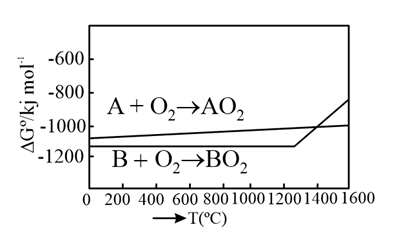
Assertion A: In the Ellingham diagram, a sharp change in slope of the line is observed from Mg $$\to$$ MgO at ~1120°C
Reason R: There is a large change of entropy associated with the change of state
In the light of the above statements, choose the correct answer from the options given below
Assertion A: Sharp change in slope at ~1120°C in the Mg → MgO Ellingham line — True. This occurs near the boiling point of Mg (1091°C).
Reason R: Large entropy change associated with change of state — True. When Mg boils, the entropy increases sharply, causing the slope change in the Ellingham diagram.
Both are true and R correctly explains A.
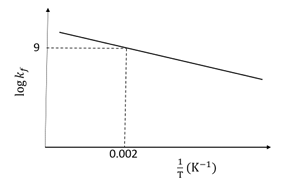
The plot of log $$k_f$$ versus $$1/T$$ for a reversible reaction A(g) $$\rightleftharpoons$$ P(g) is shown.

Pre-exponential factors for the forward and backward reactions are $$10^{15}$$ s$$^{-1}$$ and $$10^{11}$$ s$$^{-1}$$, respectively. If the value of log K for the reaction at 500 K is 6, the value of $$|\log k_b|$$ at 250 K is ______.
[K = equilibrium constant of the reaction,
$$k_f$$ = rate constant of forward reaction,
$$k_b$$ = rate constant of backward reaction]
50 mL of 0.2 molal urea solution (density = 1.012 g mL$$^{-1}$$ at 300 K) is mixed with 250 mL of a solution containing 0.06 g of urea. Both the solutions were prepared in the same solvent. The osmotic pressure (in Torr) of the resulting solution at 300 K is ____.
[Use: Molar mass of urea = 60 g mol$$^{-1}$$; gas constant, R = 62 L Torr K$$^{-1}$$ mol$$^{-1}$$; Assume, $$\Delta_{mix}H = 0$$, $$\Delta_{mix}V = 0$$]
Osmotic pressure is given by $$\pi=\dfrac{n_{\text{total}}RT}{V_{\text{solution}}}$$, where
$$n_{\text{total}}$$ = total number of moles of solute after mixing,
$$R = 62\;{\text{L Torr K}}^{-1}{\text{mol}}^{-1}$$ (given),
$$T = 300\;\text{K}$$ (given),
$$V_{\text{solution}}$$ = final volume of the mixed solution in litres.
Step 1: Moles of urea in the 50 mL, 0.2 molal solution
Molality definition: $$m = \dfrac{n}{\text{mass of solvent (kg)}}$$
Let the mass of solvent in this solution be $$w\; \text{g}$$.
Then $$n = m \times \dfrac{w}{1000} = 0.2 \times \dfrac{w}{1000}=0.0002w$$ mol.
Mass of solute $$= n \times M = 0.0002w \times 60 = 0.012w \;\text{g}$$.
Total mass of this solution $$= w + 0.012w = 1.012w \;\text{g}$$.
Using the density (1.012 g mL$$^{-1}$$):
$$\text{mass} = \text{density} \times \text{volume} = 1.012 \times 50 = 50.6 \;\text{g}$$.
So $$1.012w = 50.6 \;\Rightarrow\; w = 50.0\;\text{g}$$.
Therefore, moles of urea in this portion
$$n_1 = 0.0002 \times 50 = 0.01\;\text{mol}$$.
Step 2: Moles of urea in the 250 mL second solution
Given mass of urea = 0.06 g.
$$n_2 = \dfrac{0.06}{60} = 0.001\;\text{mol}$$.
Step 3: Total moles after mixing
$$n_{\text{total}} = n_1 + n_2 = 0.01 + 0.001 = 0.011\;\text{mol}$$.
Step 4: Total volume of the mixed solution
Assuming $$\Delta_{mix}V = 0$$ (volume is additive):
$$V_{\text{solution}} = 50\;\text{mL} + 250\;\text{mL} = 300\;\text{mL} = 0.300\;\text{L}$$.
Step 5: Osmotic pressure
$$\pi = \dfrac{n_{\text{total}} RT}{V_{\text{solution}}} = \dfrac{0.011 \times 62 \times 300}{0.300}$$
First compute the concentration:
$$\dfrac{0.011}{0.300}=0.0366667\;\text{mol L}^{-1}$$.
Then
$$\pi = 0.0366667 \times 62 \times 300 = 0.0366667 \times 18\,600 \approx 682\;\text{Torr}$$.
Hence, the osmotic pressure of the resulting solution at 300 K is 682 Torr.
The total change in the oxidation state of manganese involved in the reaction of KMnO$$_4$$ and potassium iodide in the acidic medium is _____.
In acidic medium, KMnO₄ reacts with KI:
$$2KMnO_4 + 10KI + 8H_2SO_4 \to 2MnSO_4 + 5I_2 + 6K_2SO_4 + 8H_2O$$
Manganese changes from +7 (in KMnO₄) to +2 (in MnSO₄).
Total change in oxidation state = 7 - 2 = 5.
This matches the answer key value of $$\mathbf{5}$$.
The volume of HCl, containing $$73$$ g L$$^{-1}$$, required to completely neutralise NaOH obtained by reacting $$0.69$$ g of metallic sodium with water, is ______ mL. (Nearest Integer)
(Given: molar Masses of Na, Cl, O, H are 23, 35.5, 16 and 1 g mol$$^{-1}$$ respectively)
We need to find the volume of HCl solution required to completely neutralize the NaOH obtained from the reaction of metallic sodium with water.
Find moles of Na.
Molar mass of Na = 23 g/mol
$$ \text{Moles of Na} = \frac{0.69}{23} = 0.03 \text{ mol} $$Reaction of Na with water.
$$ 2\text{Na} + 2\text{H}_2\text{O} \to 2\text{NaOH} + \text{H}_2 $$Moles of NaOH formed = Moles of Na = 0.03 mol (1:1 ratio)
Neutralization reaction.
$$ \text{NaOH} + \text{HCl} \to \text{NaCl} + \text{H}_2\text{O} $$Moles of HCl required = Moles of NaOH = 0.03 mol
Find the molarity of HCl solution.
HCl solution contains 73 g/L.
Molar mass of HCl = $$1 + 35.5 = 36.5$$ g/mol
$$ \text{Molarity} = \frac{73}{36.5} = 2 \text{ M} $$Calculate the required volume.
$$ V = \frac{\text{Moles}}{\text{Molarity}} = \frac{0.03}{2} = 0.015 \text{ L} = 15 \text{ mL} $$The volume of HCl required is $$\boxed{15}$$ mL.
When $$Fe_{0.93}O$$ is heated in presence of oxygen, it converts to $$Fe_2O_3$$. The number of correct statement/s from the following is ______.
A. The equivalent weight of $$Fe_{0.93}O$$ is $$\frac{\text{Molecular weight}}{0.79}$$
B. The number of moles of $$Fe^{2+}$$ and $$Fe^{3+}$$ in 1 mole of $$Fe_{0.93}O$$ is 0.79 and 0.14 respectively.
C. $$Fe_{0.93}O$$ is metal deficient with lattice comprising of cubic closed packed arrangement of $$O^{2-}$$ ions.
D. The % composition of $$Fe^{2+}$$ and $$Fe^{3+}$$ in $$Fe_{0.93}O$$ is 85% and 15% respectively.
We need to analyze each statement about $$Fe_{0.93}O$$.
In $$Fe_{0.93}O$$, let the number of $$Fe^{2+}$$ ions be $$x$$ and $$Fe^{3+}$$ ions be $$y$$ per formula unit.
$$x + y = 0.93$$ ... (i)
For charge neutrality with one $$O^{2-}$$: $$2x + 3y = 2$$ ... (ii)
From (i): $$x = 0.93 - y$$. Substituting in (ii):
$$2(0.93 - y) + 3y = 2$$
$$1.86 - 2y + 3y = 2$$
$$y = 0.14$$, so $$x = 0.79$$
Statement A: When $$Fe_{0.93}O$$ is oxidized to $$Fe_2O_3$$, each $$Fe^{2+}$$ loses 1 electron. The n-factor (number of electrons lost per formula unit) = number of $$Fe^{2+}$$ ions = 0.79. So equivalent weight = Molecular weight / 0.79. This is correct.
Statement B: From our calculation, moles of $$Fe^{2+} = 0.79$$ and $$Fe^{3+} = 0.14$$ per mole of $$Fe_{0.93}O$$. This is correct.
Statement C: $$Fe_{0.93}O$$ has a structure similar to FeO (rock salt type) where $$O^{2-}$$ ions form a cubic close packed (FCC) arrangement. It is a metal-deficient defect (some Fe sites are vacant or have Fe³⁺ instead of Fe²⁺). This is correct.
Statement D: % of $$Fe^{2+} = \frac{0.79}{0.93} \times 100 = 84.95\% \approx 85\%$$
% of $$Fe^{3+} = \frac{0.14}{0.93} \times 100 = 15.05\% \approx 15\%$$
This is correct.
All four statements are correct.
The answer is 4.
In alkaline medium, the reduction of permanganate anion involves a gain of _______ electrons.
We need to determine how many electrons are gained during the reduction of the permanganate anion ($$MnO_4^-$$) in alkaline medium.
The product of reduction depends on the medium:
- In acidic medium: $$MnO_4^- \to Mn^{2+}$$ (gain of 5 electrons)
- In neutral/weakly alkaline medium: $$MnO_4^- \to MnO_2$$ (gain of 3 electrons)
- In strongly alkaline medium: $$MnO_4^- \to MnO_4^{2-}$$ (gain of 1 electron)
For the standard alkaline medium reduction, the product is $$MnO_2$$.
In $$MnO_4^-$$: Let the oxidation state of Mn be $$x$$. Then $$x + 4(-2) = -1$$, giving $$x = +7$$.
In $$MnO_2$$: Let the oxidation state of Mn be $$y$$. Then $$y + 2(-2) = 0$$, giving $$y = +4$$.
Change in oxidation state: $$+7 \to +4$$, a decrease of 3.
$$MnO_4^- + 2H_2O + 3e^- \rightarrow MnO_2 + 4OH^-$$We can verify this is balanced: Mn: 1 on each side; O: 4+2=6 on left, 2+4=6 on right; H: 4 on left, 4 on right; Charge: -1-3=-4 on left, -4 on right.
The permanganate anion gains 3 electrons in alkaline medium.
Sum of oxidation states of bromine in bromic acid and perbromic acid is
We need to find the sum of oxidation states of bromine in bromic acid and perbromic acid.
For bromic acid ($$HBrO_3$$), let the oxidation state of Br be $$x$$:
$$+1 + x + 3(-2) = 0$$, so $$x = +5$$.
For perbromic acid ($$HBrO_4$$), let the oxidation state of Br be $$y$$:
$$+1 + y + 4(-2) = 0$$, so $$y = +7$$.
Hence, the sum of oxidation states = $$5 + 7 = 12$$. So, the answer is $$12$$.
The number of electrons involved in the reduction of permanganate to manganese dioxide in acidic medium is ______.
We need to find the number of electrons involved in the reduction of permanganate (MnO$$_4^-$$) to manganese dioxide (MnO$$_2$$). In MnO$$_4^-$$, let Mn have oxidation state $$x$$. Then $$x + 4(-2) = -1$$, so $$x = +7$$, and in MnO$$_2$$, $$x + 2(-2) = 0$$, so $$x = +4$$.
The change in oxidation state from +7 to +4 is a decrease of 3, so 3 electrons are involved.
The balanced half-reaction is $$ MnO_4^- + 4H^+ + 3e^- \to MnO_2 + 2H_2O $$. Verification: charge on left = $$-1 + 4 - 3 = 0$$, charge on right = 0. Oxygen atoms: left = 4, right = 2 + 2 = 4. Hydrogen atoms: left = 4, right = 4.
The number of electrons is 3.
The oxidation state of phosphorus in hypophosphoric acid is
Hypophosphoric acid has the formula $$H_4P_2O_6$$.
To find the oxidation state of phosphorus, let it be $$x$$:
$$ 4(+1) + 2(x) + 6(-2) = 0 $$
$$ 4 + 2x - 12 = 0 $$
$$ 2x = 8 $$
$$ x = +4 $$
The oxidation state of phosphorus in hypophosphoric acid is +4.
Which of the given reactions is not an example of disproportionation reaction?
A disproportionation reaction is one in which the same element in a single oxidation state is simultaneously oxidized and reduced to form products with different oxidation states.
Option A: $$2H_2O_2 \rightarrow 2H_2O + O_2$$
Oxygen in H₂O₂ has oxidation state -1. In H₂O, oxygen is -2 (reduced). In O₂, oxygen is 0 (oxidized). This IS a disproportionation reaction.
Option B: $$2NO_2 + H_2O \rightarrow HNO_3 + HNO_2$$
Nitrogen in NO₂ has oxidation state +4. In HNO₃, nitrogen is +5 (oxidized). In HNO₂, nitrogen is +3 (reduced). This IS a disproportionation reaction.
Option C: $$MnO_4^- + 4H^+ + 3e^- \rightarrow MnO_2 + 2H_2O$$
Mn in MnO₄⁻ has oxidation state +7. In MnO₂, Mn is +4. This is a simple reduction reaction where Mn goes from +7 to +4 by gaining 3 electrons. There is no simultaneous oxidation and reduction of the same element. This is NOT a disproportionation reaction.
Option D: $$3MnO_4^{2-} + 4H^+ \rightarrow 2MnO_4^- + MnO_2 + 2H_2O$$
Mn in MnO₄²⁻ has oxidation state +6. In MnO₄⁻, Mn is +7 (oxidized). In MnO₂, Mn is +4 (reduced). This IS a disproportionation reaction.
The reaction that is NOT an example of a disproportionation reaction is Option C.
Which of the following can be used to prevent the decomposition of $$H_2O_2$$?
Hydrogen peroxide (H₂O₂) tends to decompose into water and oxygen over time:
$$2H_2O_2 \rightarrow 2H_2O + O_2$$
To prevent this decomposition, a stabilizer is added that can inhibit the catalytic decomposition.
Analysis of options:
Option A: Urea
Urea is a well-known stabilizer for H₂O₂. It forms a stable adduct (urea hydrogen peroxide, UHP) with H₂O₂ and acts as a negative catalyst, slowing down the decomposition. It is commonly used in pharmaceutical and industrial applications to stabilize H₂O₂ solutions.
Option B: Formaldehyde
Formaldehyde is a reducing agent and can react with H₂O₂ rather than stabilize it.
Option C: Formic acid
Formic acid can react with H₂O₂ to form performic acid and is not used as a stabilizer.
Option D: Ethanol
Ethanol is an organic solvent that does not serve as an effective stabilizer for H₂O₂.
Therefore, the correct answer is Option A (Urea).
Which one of the following is an example of disproportionation reaction?
We need to identify which reaction is a disproportionation reaction.
What is a disproportionation reaction?
A disproportionation reaction is one in which the same element in a single oxidation state is simultaneously oxidized and reduced.
$$3MnO_4^{2-} + 4H^+ \to 2MnO_4^- + MnO_2 + 2H_2O$$
Mn in $$MnO_4^{2-}$$: oxidation state = +6
Mn in $$MnO_4^-$$: oxidation state = +7 (oxidized)
Mn in $$MnO_2$$: oxidation state = +4 (reduced)
Here, Mn(+6) is both oxidized to Mn(+7) and reduced to Mn(+4). This is a disproportionation reaction.
$$MnO_4^- + 4H^+ + 4e^- \to MnO_2 + 2H_2O$$
This is a half-reaction (reduction only), not a disproportionation.
$$10I^- + 2MnO_4^- + 16H^+ \to 2Mn^{2+} + 8H_2O + 6I_2$$
$$I^-$$ is oxidized to $$I_2$$, and $$Mn^{+7}$$ is reduced to $$Mn^{+2}$$. Different elements are oxidized and reduced — this is a simple redox reaction.
$$8MnO_4^- + 3S_2O_3^{2-} + H_2O \to 8MnO_2 + 6SO_4^{2-} + 2OH^-$$
$$Mn^{+7}$$ is reduced to $$Mn^{+4}$$, and $$S^{+2}$$ is oxidized to $$S^{+6}$$. Different elements are oxidized and reduced — not a disproportionation.
The correct answer is Option A: $$3MnO_4^{2-} + 4H^+ \to 2MnO_4^- + MnO_2 + 2H_2O$$.
Given below are two statements: One is labelled as Assertion A and the other is labelled as Reason R
Assertion A: Permanganate titrations are not performed in presence of hydrochloric acid.
Reason R: Chlorine is formed as a consequence of oxidation of hydrochloric acid.
In the light of the above statements, choose the correct answer from the options given below
We are given the following statements:
Assertion A: Permanganate titrations are not performed in the presence of hydrochloric acid.
Reason R: Chlorine is formed as a consequence of oxidation of hydrochloric acid.
Permanganate ($$KMnO_4$$) is a strong oxidising agent used in redox titrations. In acidic medium, it is typically used with dilute sulphuric acid ($$H_2SO_4$$) rather than hydrochloric acid ($$HCl$$).
The reason is that $$KMnO_4$$ is a strong enough oxidiser to oxidise $$Cl^-$$ ions from HCl to $$Cl_2$$ gas. The reaction is: $$2KMnO_4 + 16HCl \rightarrow 2KCl + 2MnCl_2 + 5Cl_2 + 8H_2O$$.
This is problematic because the $$KMnO_4$$ gets consumed not only by the analyte (the substance being titrated, such as $$Fe^{2+}$$ or oxalate) but also by the $$HCl$$. This leads to an error in the titration — more $$KMnO_4$$ is used than what is needed for the analyte alone, giving incorrect results.
So Assertion A is true — permanganate titrations are indeed not performed with HCl. Reason R is also true — chlorine gas is indeed formed because HCl gets oxidised by the strong oxidising agent $$KMnO_4$$. Moreover, R correctly explains A, because it is precisely the oxidation of HCl to $$Cl_2$$ that causes the problem and is the reason why HCl is avoided.
Hence, the correct answer is Option A: Both A and R are true and R is the correct explanation of A.
High purity ($$> 99.95\%$$) dihydrogen is obtained by
Statement from NCERT. Therefore, B is the right option.
The reaction of $$H_2O_2$$ with potassium permanganate in acidic medium leads to the formation of mainly
The reaction of $$H_2O_2$$ with $$KMnO_4$$ in acidic medium is a well-known redox reaction.
The balanced equation is:
$$2KMnO_4 + 5H_2O_2 + 3H_2SO_4 \rightarrow 2MnSO_4 + K_2SO_4 + 5O_2 + 8H_2O$$
Analysis of oxidation states:
- In $$KMnO_4$$, manganese is in the $$+7$$ oxidation state.
- In the product $$MnSO_4$$, manganese is in the $$+2$$ oxidation state.
In acidic medium, $$KMnO_4$$ acts as a strong oxidising agent and is reduced from $$Mn^{7+}$$ to $$Mn^{2+}$$. Meanwhile, $$H_2O_2$$ acts as a reducing agent and is oxidised to $$O_2$$.
Note: In neutral or weakly acidic medium, $$KMnO_4$$ is reduced to $$Mn^{4+}$$ (as $$MnO_2$$), but in strongly acidic medium, the reduction goes all the way to $$Mn^{2+}$$.
Therefore, the correct answer is Option A: $$Mn^{2+}$$.
Given below are two statements:
Statement I: Hydrogen peroxide can act as an oxidizing agent in both acidic and basic conditions.
Statement II: Density of hydrogen peroxide at $$298 \text{ K}$$ is lower than that of $$D_2O$$.
In the light of the above statements. Choose the correct answer from the options
We need to evaluate two statements about hydrogen peroxide.
Hydrogen peroxide can act as an oxidizing agent in both acidic and basic conditions. In acidic medium, $$H_2O_2$$ acts as an oxidizing agent:
$$H_2O_2 + 2H^+ + 2e^- \rightarrow 2H_2O$$
For example, it oxidizes $$Fe^{2+}$$ to $$Fe^{3+}$$ in acidic solution. In basic medium, $$H_2O_2$$ also acts as an oxidizing agent:
$$H_2O_2 + 2e^- \rightarrow 2OH^-$$
For example, it oxidizes $$Fe^{2+}$$ to $$Fe^{3+}$$ in basic solution as well. Statement I is true.
Density of hydrogen peroxide at $$298 \text{ K}$$ is lower than that of $$D_2O$$. The density of $$H_2O_2$$ at $$298 \text{ K}$$ is approximately $$1.44 \text{ g/cm}^3$$, whereas the density of $$D_2O$$ (heavy water) at $$298 \text{ K}$$ is approximately $$1.104 \text{ g/cm}^3$$. Since $$1.44 > 1.104$$, the density of $$H_2O_2$$ is higher than that of $$D_2O$$, not lower. Statement II is false.
The correct answer is Option C: Statement I is true but Statement II is false.
In neutral or alkaline solution, $$MnO_4^-$$ oxidises thiosulphate to
We need to determine the product when $$MnO_4^-$$ oxidises thiosulphate ($$S_2O_3^{2-}$$) in neutral or alkaline solution.
In neutral or alkaline medium, permanganate is reduced to $$MnO_2$$:
$$MnO_4^- + 2H_2O + 3e^- \rightarrow MnO_2 + 4OH^- \quad \cdots (i)$$
Mn changes from $$+7$$ to $$+4$$, gaining 3 electrons.
In $$S_2O_3^{2-}$$, the average oxidation state of S is:
$$2x + 3(-2) = -2 \implies x = +2$$
The average oxidation state of sulphur is $$+2$$.
With a strong oxidizing agent like $$MnO_4^-$$ in alkaline medium, thiosulphate undergoes complete oxidation to sulphate ($$SO_4^{2-}$$), where S is in the $$+6$$ state:
$$S_2O_3^{2-} + 5H_2O \rightarrow 2SO_4^{2-} + 10H^+ + 8e^-$$
Converting to basic medium by adding $$10OH^-$$ to both sides:
$$S_2O_3^{2-} + 5H_2O + 10OH^- \rightarrow 2SO_4^{2-} + 10H_2O + 8e^-$$
Simplifying:
$$S_2O_3^{2-} + 10OH^- \rightarrow 2SO_4^{2-} + 5H_2O + 8e^- \quad \cdots (ii)$$
Each sulphur atom changes from $$+2$$ to $$+6$$, losing 4 electrons per atom (8 electrons total for 2 atoms).
Multiply equation (i) by 8 and equation (ii) by 3 to equalize electrons (24 electrons):
$$8MnO_4^- + 16H_2O + 24e^- \rightarrow 8MnO_2 + 32OH^-$$
$$3S_2O_3^{2-} + 30OH^- \rightarrow 6SO_4^{2-} + 15H_2O + 24e^-$$
Adding both half-reactions:
$$8MnO_4^- + 3S_2O_3^{2-} + H_2O \rightarrow 8MnO_2 + 6SO_4^{2-} + 2OH^-$$
Conclusion:
In neutral or alkaline solution, $$MnO_4^-$$ completely oxidises thiosulphate to $$SO_4^{2-}$$.
Hence, the correct answer is Option D.
In neutral or faintly alkaline medium, $$KMnO_4$$ being a powerful oxidant can oxidise, thiosulphate almost quantitatively, to sulphate. In this reaction overall change in oxidation state of manganese will be
We are told that in neutral or faintly alkaline medium, $$KMnO_4$$ oxidises thiosulphate to sulphate. We need to find the overall change in oxidation state of manganese.
In $$KMnO_4$$, the oxidation state of Mn is $$+7$$. Now, in a neutral or faintly alkaline medium, $$KMnO_4$$ is reduced to $$MnO_2$$ (manganese dioxide), where Mn has an oxidation state of $$+4$$.
We can verify this: in strongly acidic medium, $$MnO_4^-$$ is reduced to $$Mn^{2+}$$ (change of 5). In strongly alkaline medium, it is reduced to $$MnO_4^{2-}$$ (change of 1). But in neutral or faintly alkaline medium, the product is $$MnO_2$$.
The change in oxidation state of manganese is:
$$\Delta = +7 - (+4) = 3$$
Hence, the overall change in oxidation state of manganese is 3.
Hence, the correct answer is Option D: 3.
The dark purple colour of $$KMnO_4$$ disappears in the titration with oxalic acid in acidic medium. The overall change in the oxidation number of manganese in the reaction is
We need to find the overall change in oxidation number of manganese when $$KMnO_4$$ reacts with oxalic acid in acidic medium.
The balanced reaction of $$KMnO_4$$ with oxalic acid ($$H_2C_2O_4$$) in acidic medium is:
$$2KMnO_4 + 5H_2C_2O_4 + 3H_2SO_4 \rightarrow 2MnSO_4 + K_2SO_4 + 10CO_2 + 8H_2O$$In $$KMnO_4$$:
$$+1 + x + 4(-2) = 0$$ $$x = +7$$So, the oxidation state of Mn in $$KMnO_4$$ is +7.
The purple colour of $$KMnO_4$$ disappears, which means $$Mn^{+7}$$ is reduced. In acidic medium, $$KMnO_4$$ is reduced to $$Mn^{2+}$$ (present as $$MnSO_4$$).
So, the oxidation state of Mn in the product is +2.
Change in oxidation number = Initial oxidation state - Final oxidation state
$$= +7 - (+2) = 5$$The overall change in the oxidation number of manganese is 5 (it decreases from +7 to +2).
Hence, the correct answer is Option A: $$5$$.
The products obtained from a reaction of hydrogen peroxide and acidified potassium permanganate are
We need to find the products when hydrogen peroxide reacts with acidified potassium permanganate ($$KMnO_4$$).
In acidic medium, $$KMnO_4$$ acts as a strong oxidising agent and $$H_2O_2$$ acts as a reducing agent (it gets oxidised).
Since $$MnO_4^-$$ is reduced in acidic medium, the reduction half-reaction is $$MnO_4^- + 8H^+ + 5e^- \rightarrow Mn^{2+} + 4H_2O$$. Meanwhile, $$H_2O_2$$ is oxidised according to $$H_2O_2 \rightarrow O_2 + 2H^+ + 2e^-$$.
Substituting and balancing electrons by multiplying the reduction half-reaction by 2 and the oxidation half-reaction by 5 gives the balanced half-reactions: $$2MnO_4^- + 16H^+ + 10e^- \rightarrow 2Mn^{2+} + 8H_2O$$ and $$5H_2O_2 \rightarrow 5O_2 + 10H^+ + 10e^-$$.
Combining these half-reactions yields the overall reaction $$2MnO_4^- + 5H_2O_2 + 6H^+ \rightarrow 2Mn^{2+} + 8H_2O + 5O_2$$.
Therefore, the products are $$Mn^{2+}$$, $$H_2O$$, and $$O_2$$. In acidic medium, $$KMnO_4$$ is reduced to $$Mn^{2+}$$ (not $$Mn^{4+}$$). $$Mn^{4+}$$ as $$MnO_2$$ is formed only in neutral or weakly basic medium.
Therefore, the correct answer is Option D: $$Mn^{2+}$$, $$H_2O$$, $$O_2$$ only.
The reaction of HClO$$_3$$ with HCl gives a paramagnetic gas, which upon reaction with O$$_3$$ produces
The key is to identify the paramagnetic gas formed when $$HClO_3$$ reacts with $$HCl$$ and to know how that gas behaves toward $$O_3$$.
Step 1 : Product of $$HClO_3 + HCl$$
Chloric acid reacts with concentrated hydrochloric acid in the following redox (disproportionation) reaction:
$$2\,HClO_3 + HCl \;\longrightarrow\; 2\,ClO_2 \;+\; Cl_2 \;+\; 2\,H_2O$$
$$ClO_2$$ has an odd number of electrons (it contains one unpaired electron), so it is paramagnetic. Hence the “paramagnetic gas” mentioned is $$ClO_2$$.
Step 2 : Reaction of $$ClO_2$$ with $$O_3$$
When chlorine dioxide is treated with ozone, it dimerises to give dichlorine hexoxide:
$$2\,ClO_2 + O_3 \;\longrightarrow\; Cl_2O_6 + O_2$$
The product formed is $$Cl_2O_6$$.
Among the given options, $$Cl_2O_6$$ corresponds to Option C.
Therefore, the correct answer is:
Option C which is: Cl$$_2$$O$$_6$$
Manganese (VI) has ability to disproportionate in acidic solution. The difference in oxidation states of two ions it forms in acidic solution is ______
We need to find the difference in oxidation states of the two ions formed when Manganese(VI) disproportionates in acidic solution. Manganese in the +6 oxidation state exists as the manganate ion: $$MnO_4^{2-}$$ (where Mn is +6).
In disproportionation, the same species is simultaneously oxidized and reduced. In acidic solution, $$MnO_4^{2-}$$ disproportionates as:
$$3MnO_4^{2-} + 4H^+ \to 2MnO_4^- + MnO_2 + 2H_2O$$
In $$MnO_4^-$$ (permanganate ion): Let the oxidation state of Mn be $$y$$. Then $$y + 4(-2) = -1$$, giving $$y = +7$$. In $$MnO_2$$ (manganese dioxide): Let the oxidation state of Mn be $$z$$. Then $$z + 2(-2) = 0$$, giving $$z = +4$$.
Difference in oxidation states = $$+7 - (+4) = 3$$. The answer is 3.
0.01 M KMnO$$_4$$ solution was added to 20.0 mL of 0.05 M Mohr's salt solution through a burette. The initial reading of 50 mL burette is zero. The volume of KMnO$$_4$$ solution left in the burette after the end point is ______ mL. (nearest integer)
We need to find the volume of KMnO$$_4$$ solution left in the burette after titration with Mohr's salt.
KMnO$$_4$$ solution concentration = 0.01 M, Mohr's salt (FeSO$$_4$$(NH$$_4$$)$$_2$$SO$$_4$$ · 6H$$_2$$O) solution is 20.0 mL of 0.05 M, and the burette capacity is 50 mL with an initial reading of 0.
In acidic medium: $$\text{MnO}_4^- + 5\text{Fe}^{2+} + 8\text{H}^+ \rightarrow \text{Mn}^{2+} + 5\text{Fe}^{3+} + 4\text{H}_2\text{O}$$ So 1 mole of KMnO$$_4$$ reacts with 5 moles of Fe$$^{2+}$$.
$$\text{mmol of Fe}^{2+} = 0.05 \times 20.0 = 1.0 \text{ mmol}, \quad \text{mmol of KMnO}_4 = \frac{1.0}{5} = 0.2 \text{ mmol}$$
$$V = \frac{\text{mmol}}{M} = \frac{0.2}{0.01} = 20 \text{ mL}$$
Volume left = Total volume − Volume used = 50 − 20 = 30 mL. Hence, the answer is 30 mL.
$$20 \text{ mL}$$ of $$0.02M$$ hypo solution is used for the titration of $$10 \text{ mL}$$ of copper sulphate solution, in the presence of excess of KI using starch as an indicator. The molarity of $$Cu^{2+}$$ is found to be ______ $$\times 10^{-2} M$$ (nearest integer)
Given : $$2Cu^{2+}+4I^{-}\rightarrow Cu_{2}I_{2} + I_{2}I_{2} + 2S_{2}O_{3}^{-2} \rightarrow 2I^{-} + S_{4}O_{6}^{-2}$$
We are given 20 mL of 0.02 M hypo (sodium thiosulphate, $$Na_2S_2O_3$$) solution, 10 mL of copper sulphate ($$CuSO_4$$) solution, and excess KI, and we need to find the molarity of $$Cu^{2+}$$.
Since $$2Cu^{2+} + 4I^- \rightarrow 2CuI \downarrow + I_2$$ in the presence of excess iodide ions, the liberated $$I_2$$ is then titrated with sodium thiosulphate according to $$I_2 + 2S_2O_3^{2-} \rightarrow 2I^- + S_4O_6^{2-}$$.
Substituting the values for the titration gives $$\text{Moles of } Na_2S_2O_3 = 0.02 \times \frac{20}{1000} = 4 \times 10^{-4} \text{ mol}$$, and because 1 mol of $$I_2$$ reacts with 2 mol of $$S_2O_3^{2-}$$, the moles of $$I_2$$ are $$\text{Moles of } I_2 = \frac{4 \times 10^{-4}}{2} = 2 \times 10^{-4} \text{ mol}$$.
Since 2 mol of $$Cu^{2+}$$ produce 1 mol of $$I_2$$, it follows that $$\text{Moles of } Cu^{2+} = 2 \times (2 \times 10^{-4}) = 4 \times 10^{-4} \text{ mol}$$.
Finally, dividing by the 10 mL (0.01 L) of $$Cu^{2+}$$ solution gives $$\text{Molarity} = \frac{\text{Moles}}{\text{Volume in litres}} = \frac{4 \times 10^{-4}}{10/1000} = \frac{4 \times 10^{-4}}{0.01} = 4 \times 10^{-2} \text{ M}$$. Therefore, the molarity of $$Cu^{2+}$$ is 4 $$\times 10^{-2}$$ M.
A $$2.0$$ g sample containing $$MnO_2$$ is treated with HCl liberating $$Cl_2$$. The $$Cl_2$$ gas is passed into a solution of KI and $$60.0$$ mL of $$0.1$$ M $$Na_2S_2O_3$$ is required to titrate the liberated iodine. The percentage of $$MnO_2$$ in the sample is ______ Nearest integer
[Atomic masses (in u) Mn = 55; Cl = 35.5; O = 16, I = 127, Na = 23, K = 39, S = 32]
We need to find the percentage of $$MnO_2$$ in a 2.0 g sample, given that the liberated $$Cl_2$$ reacts with KI and the liberated $$I_2$$ requires 60.0 mL of 0.1 M $$Na_2S_2O_3$$.
When $$MnO_2$$ reacts with HCl according to $$MnO_2 + 4HCl \rightarrow MnCl_2 + Cl_2 + 2H_2O$$ one mole of $$MnO_2$$ produces one mole of $$Cl_2$$. The generated $$Cl_2$$ then oxidizes KI in the reaction $$Cl_2 + 2KI \rightarrow 2KCl + I_2$$ liberating one mole of $$I_2$$ per mole of $$Cl_2$$. The liberated $$I_2$$ is titrated with $$Na_2S_2O_3$$ according to $$I_2 + 2Na_2S_2O_3 \rightarrow Na_2S_4O_6 + 2NaI$$ where each mole of $$I_2$$ consumes two moles of $$Na_2S_2O_3$$.
The moles of $$Na_2S_2O_3$$ used in the titration are given by $$\text{Moles of } Na_2S_2O_3 = M \times V = 0.1 \times \frac{60}{1000} = 6 \times 10^{-3} \text{ mol}$$. Therefore, $$\text{Moles of } I_2 = \frac{\text{Moles of } Na_2S_2O_3}{2} = \frac{6 \times 10^{-3}}{2} = 3 \times 10^{-3} \text{ mol}$$. Since one mole of $$Cl_2$$ yields one mole of $$I_2$$, the moles of $$Cl_2$$ are also $$3 \times 10^{-3}$$ mol, which means the sample contained $$3 \times 10^{-3}$$ mol of $$MnO_2$$.
Using the molar mass of $$MnO_2$$ (55 + 2(16) = 87 g/mol), the mass of $$MnO_2$$ in the sample is $$3 \times 10^{-3} \times 87 = 0.261 \text{ g}$$. Hence, the percentage of $$MnO_2$$ in the 2.0 g sample is $$\frac{0.261}{2.0} \times 100 = 13.05\%$$, which rounds to 13%.
The correct answer is 13%.
$$20 \text{ mL}$$ of $$0.02M K_2Cr_2O_7$$ solution is used for the titration of $$10 \text{ mL}$$ of $$Fe^{2+}$$ solution in the acidic medium. The molarity of $$Fe^{2+}$$ solution is ______ $$\times 10^{-2} M$$
We are given that 20 mL of 0.02 M $$K_2Cr_2O_7$$ is used to titrate 10 mL of $$Fe^{2+}$$ solution in acidic medium.
The balanced redox reaction in acidic medium is:
$$K_2Cr_2O_7 + 6Fe^{2+} + 14H^+ \rightarrow 2Cr^{3+} + 6Fe^{3+} + 2K^+ + 7H_2O$$
From the stoichiometry, 1 mole of $$K_2Cr_2O_7$$ reacts with 6 moles of $$Fe^{2+}$$.
Moles of $$K_2Cr_2O_7$$ used:
$$n_{K_2Cr_2O_7} = M \times V = 0.02 \times \frac{20}{1000} = 4 \times 10^{-4} \text{ mol}$$
Moles of $$Fe^{2+}$$ that react:
$$n_{Fe^{2+}} = 6 \times n_{K_2Cr_2O_7} = 6 \times 4 \times 10^{-4} = 24 \times 10^{-4} \text{ mol}$$
Molarity of $$Fe^{2+}$$ solution:
$$M_{Fe^{2+}} = \frac{n_{Fe^{2+}}}{V} = \frac{24 \times 10^{-4}}{10/1000} = \frac{24 \times 10^{-4}}{10^{-2}} = 24 \times 10^{-2} \text{ M}$$
Therefore, the answer is $$\textbf{24}$$.
On reaction with stronger oxidizing agent like $$KIO_4$$, hydrogen peroxide oxidizes with the evolution of $$O_2$$. The oxidation number of I in $$KIO_4$$ changes to
We are told that $$KIO_4$$ (potassium periodate) is a stronger oxidizing agent that reacts with hydrogen peroxide ($$H_2O_2$$), causing $$H_2O_2$$ to get oxidized with the evolution of $$O_2$$. We need to find the oxidation number of iodine in the product after this reaction.
In $$KIO_4$$, potassium has an oxidation state of +1 and each oxygen has -2. So the oxidation state of iodine is: $$+1 + x + 4(-2) = 0$$, which gives $$x = +7$$. So iodine starts with an oxidation state of +7.
The reaction is:
$$KIO_4 + H_2O_2 \rightarrow KIO_3 + H_2O + O_2$$
Here, $$H_2O_2$$ is oxidized (oxygen goes from -1 in $$H_2O_2$$ to 0 in $$O_2$$), while $$KIO_4$$ is reduced. The iodine in $$KIO_4$$ (oxidation state +7) is reduced to iodine in $$KIO_3$$ (potassium iodate).
In $$KIO_3$$: $$+1 + x + 3(-2) = 0$$, which gives $$x = +5$$.
So the oxidation number of iodine changes from +7 in $$KIO_4$$ to +5 in $$KIO_3$$.
Hence, the correct answer is 5.
In the titration of $$KMnO_4$$ and oxalic acid in acidic medium, the change in oxidation number of carbon at the end point is ______.
The difference in oxidation state of chromium in chromate and dichromate salts is ______
We need to find the difference in oxidation state of chromium in chromate (CrO$$_4^{2-}$$) and dichromate (Cr$$_2$$O$$_7^{2-}$$) salts. Let the oxidation state of Cr in chromate be $$x$$.
$$ x + 4(-2) = -2 $$
$$ x - 8 = -2 $$
$$ x = +6 $$
Let the oxidation state of Cr in dichromate be $$y$$.
$$ 2y + 7(-2) = -2 $$
$$ 2y - 14 = -2 $$
$$ 2y = 12 $$
$$ y = +6 $$
The difference in oxidation states:
$$ x - y = +6 - (+6) = 0 $$
Therefore, the difference in oxidation state of chromium in chromate and dichromate salts is 0.
The oxidation state of manganese in the product obtained in a reaction of potassium permanganate and hydrogen peroxide in basic medium is
We need to find the oxidation state of manganese in the product formed when potassium permanganate reacts with hydrogen peroxide in basic medium.
In basic medium, $$KMnO_4$$ reacts with $$H_2O_2$$ as follows: $$2KMnO_4 + 3H_2O_2 \rightarrow 2MnO_2 + 2KOH + 3O_2 + 2H_2O$$.
Since the permanganate ion is reduced in this reaction, the manganese-containing product is manganese dioxide, $$MnO_2$$, which appears as a brown precipitate.
Let the oxidation state of Mn in $$MnO_2$$ be $$x$$. Substituting into the charge balance gives $$x + 2(-2) = 0$$.
From the above equation, we have $$x - 4 = 0$$, which leads to $$x = +4$$.
Therefore, the oxidation state of manganese changes from +7 in $$KMnO_4$$ to +4 in $$MnO_2$$.
Hence, the answer is 4.
Given below are two statements:
Statement I: $$H_2O_2$$ can act as both oxidising and reducing agent in basic medium.
Statement II: In the hydrogen economy, the energy is transmitted in the form of dihydrogen. In the light of the above statements, choose the correct answer from the options given below:
We need to evaluate both statements about $$H_2O_2$$ and the hydrogen economy.
Consider Statement I: $$H_2O_2$$ can act as both an oxidising and a reducing agent in basic medium. In $$H_2O_2$$, the oxidation state of oxygen is $$-1$$, which lies between $$0$$ (in $$O_2$$) and $$-2$$ (in $$H_2O$$ or $$OH^-$$). Because of this intermediate oxidation state, $$H_2O_2$$ can either gain electrons (be reduced, acting as an oxidising agent) or lose electrons (be oxidised, acting as a reducing agent). When acting as an oxidising agent in basic medium, oxygen goes from $$-1$$ to $$-2$$, for example: $$H_2O_2 + 2e^- \rightarrow 2OH^-$$. When acting as a reducing agent in basic medium, oxygen goes from $$-1$$ to $$0$$, for example: $$H_2O_2 + 2OH^- \rightarrow O_2 + 2H_2O + 2e^-$$. This is seen when $$H_2O_2$$ decolourises acidified $$KMnO_4$$ (reducing agent) or when it oxidises $$I^-$$ to $$I_2$$ (oxidising agent). Statement I is true.
Consider Statement II: In the hydrogen economy, energy is transmitted in the form of dihydrogen. The hydrogen economy refers to a system in which hydrogen gas ($$H_2$$, dihydrogen) is used as the primary energy carrier. Energy from various sources (solar, nuclear, etc.) is used to produce $$H_2$$ (for example, by electrolysis of water), and this $$H_2$$ is then stored, transported, and used in fuel cells or combustion to release energy where needed. Thus, dihydrogen serves as the medium through which energy is transmitted and distributed. Statement II is true.
Since both statements are true, the correct answer is Option (2): Both statement I and statement II are true.
Hydrogen peroxide reacts with iodine in basic medium to give:
First, recall that hydrogen peroxide $$\mathrm{H_2O_2}$$ can behave both as an oxidising agent and as a reducing agent. In a basic medium, when it meets elemental iodine $$\mathrm{I_2}$$, it prefers to act as a reducing agent.
To understand what is formed, we analyse the redox process through the half-reaction method.
For hydrogen peroxide as a reductant, we write the oxidation half-reaction. The well-known relation is:
$$\mathrm{H_2O_2 \;\rightarrow\; O_2 + 2\,H^+ + 2\,e^-}$$
Because we are in basic (alkaline) medium, every $$\mathrm{H^+}$$ must be neutralised by adding an equal number of $$\mathrm{OH^-}$$ ions to both sides. Thus we add $$2\,\mathrm{OH^-}$$:
$$\mathrm{H_2O_2 + 2\,OH^- \;\rightarrow\; O_2 + 2\,H_2O + 2\,e^-}$$
Now we write the reduction half-reaction for iodine. Elemental iodine in its molecular form $$\mathrm{I_2}$$ accepts electrons to become iodide $$\mathrm{I^-}$$. The basic reduction relation is:
$$\mathrm{I_2 + 2\,e^- \;\rightarrow\; 2\,I^-}$$
Both half-reactions involve exactly $$2$$ electrons, so they already balance electrically and no scaling is needed. We now add them term by term:
$$\bigl(\mathrm{H_2O_2 + 2\,OH^- \;\rightarrow\; O_2 + 2\,H_2O + 2\,e^-}\bigr)$$
$$\bigl(\mathrm{I_2 + 2\,e^- \;\rightarrow\; 2\,I^-}\bigr)$$
Adding and cancelling the $$2\,e^-$$ on opposite sides, we obtain the overall ionic equation:
$$\mathrm{H_2O_2 + I_2 + 2\,OH^- \;\rightarrow\; 2\,I^- + 2\,H_2O + O_2}$$
The only iodine-containing species on the product side is $$\mathrm{I^-}$$, i.e. iodide ion.
Hence, the correct answer is Option C.
In polythionic acid, H$$_2$$S$$_x$$O$$_6$$ ($$x$$ = 3 to 5) the oxidation state(s) of sulphur is/are:
We start with the general molecular formula of polythionic acid: $$\mathrm{H_2S_xO_6},$$ where $$x = 3, 4, 5.$$
The experimental structures (deduced from salts, X-ray data and stepwise oxidation studies) show a straight chain of sulphur atoms. The two end sulphur atoms are each bonded to three oxygens and one sulphur, forming $$\text{-SO}_3\text{H}$$ groups. The remaining $$x-2$$ sulphur atoms are present only in the S-S chain and are not bonded to oxygen.
Whenever a sulphur atom is bonded to three oxygens in the $$\text{-SO}_3\text{H}$$ environment (exactly like in sulphurous acid fragments), its oxidation number is taken as an unknown $$+a.$$ Each “internal” sulphur that is attached only to neighbouring sulphur atoms carries no hetero-atoms, so its oxidation number is zero.
Hence, in $$\mathrm{H_2S_xO_6}$$ we have:
• 2 hydrogen atoms, each with oxidation number $$+1.$$
• 6 oxygen atoms, each with oxidation number $$-2.$$
• 2 terminal sulphur atoms with oxidation number $$+a$$ (to be found).
• $$(x-2)$$ internal sulphur atoms with oxidation number $$0.$$
Because the molecule is electrically neutral, the algebraic sum of all oxidation numbers must be zero. Writing this balance, we get:
$$2(+1) \;+\; 2(+a) \;+\; (x-2)(0) \;+\; 6(-2) \;=\; 0.$$
Simplifying step by step:
$$2 + 2a + 0 - 12 = 0,$$
$$2a - 10 = 0,$$
$$2a = 10,$$
$$a = +5.$$
Thus each terminal sulphur is in the $$+5$$ oxidation state, while every internal sulphur is in the $$0$$ oxidation state.
Therefore, the possible oxidation states of sulphur found in any polythionic acid $$\mathrm{H_2S_xO_6}$$ are $$0$$ and $$+5$$ only.
Hence, the correct answer is Option C.
In which one of the following sets all species show disproportionation reaction?
First we recall the definition of a disproportionation reaction. In such a redox process the same element present in a single oxidation state is simultaneously oxidised to a higher oxidation state and reduced to a lower oxidation state. Therefore, a necessary condition for disproportionation is that the element must be in an oxidation state which is intermediate between at least one higher and one lower stable oxidation state. Mathematically, if the element is presently in oxidation state $$x$$ while higher and lower attainable states are $$x_{\text{high}}$$ and $$x_{\text{low}},$$ then
$$x_{\text{low}} < x < x_{\text{high}}$$
must hold. If the element is already in either its maximum or minimum oxidation state, it cannot undergo disproportionation.
Now we examine every species in each option and calculate the oxidation state of the central atom to judge whether the species can disproportionate under suitable conditions.
Option A contains $$\mathrm{ClO_4^-},\; \mathrm{MnO_4^-},\; \mathrm{ClO_2^-}$$ and $$\mathrm{F_2}.$$
For $$\mathrm{ClO_4^-}$$ we have
$$\text{Let the oxidation state of Cl be } x.$$
Since the overall charge is $$-1$$ and each oxygen is $$-2,$$
$$x + 4(-2) = -1 \;\;\Longrightarrow\;\; x = +7.$$
$$+7$$ is the maximum attainable oxidation state of chlorine; no higher state exists. Hence $$\mathrm{ClO_4^-}$$ cannot disproportionate. Therefore the whole set in Option A fails the test.
Option B contains $$\mathrm{MnO_4^{2-}},\; \mathrm{ClO_2},\; \mathrm{Cl_2}$$ and $$\mathrm{Mn^{3+}}.$$ We examine them one by one.
1. For $$\mathrm{MnO_4^{2-}}$$ (manganate ion):
$$x + 4(-2) = -2 \;\;\Longrightarrow\;\; x = +6.$$
Manganese exhibits both higher $$+7$$ (in $$\mathrm{MnO_4^-}$$) and lower $$+4,\,+3,\,+2$$ states. The well-known reaction
$$3\,\mathrm{MnO_4^{2-}} + 2\,\mathrm{H_2O} \;\longrightarrow\; 2\,\mathrm{MnO_4^-} + \mathrm{MnO_2} + 4\,\mathrm{OH^-}$$
shows it disproportionating to $$+7$$ and $$+4$$ states. So $$\mathrm{MnO_4^{2-}}$$ qualifies.
2. For $$\mathrm{ClO_2}$$ (chlorine dioxide):
$$x + 2(-2) = 0 \;\;\Longrightarrow\;\; x = +4.$$
Chlorine has higher $$+5$$ (in $$\mathrm{ClO_3^-}$$) and lower $$+3$$ (in $$\mathrm{ClO_2^-}$$) states. Indeed, in alkaline medium
$$2\,\mathrm{ClO_2} + \mathrm{OH^-} \;\longrightarrow\; \mathrm{ClO_3^-} + \mathrm{ClO_2^-} + \mathrm{H^+}$$
illustrates its disproportionation. Hence $$\mathrm{ClO_2}$$ also fits.
3. For $$\mathrm{Cl_2}$$ (molecular chlorine):
The oxidation state of each chlorine atom is $$0.$$ It can increase to $$+1$$ (in $$\mathrm{ClO^-}$$) and decrease to $$-1$$ (in $$\mathrm{Cl^-}$$), so in basic solution
$$\mathrm{Cl_2} + 2\,\mathrm{OH^-} \;\longrightarrow\; \mathrm{ClO^-} + \mathrm{Cl^-} + \mathrm{H_2O}$$
is a textbook disproportionation. Thus $$\mathrm{Cl_2}$$ meets the criterion.
4. For $$\mathrm{Mn^{3+}}$$:
The oxidation state is $$+3.$$ Manganese can rise to $$+4$$ (in $$\mathrm{MnO_2}$$) and fall to $$+2$$ (in $$\mathrm{Mn^{2+}}$$). The reaction
$$2\,\mathrm{Mn^{3+}} \;\longrightarrow\; \mathrm{Mn^{2+}} + \mathrm{Mn^{4+}}$$
proves its disproportionation capability. So $$\mathrm{Mn^{3+}}$$ also satisfies the condition.
Therefore, every species in Option B can undergo a disproportionation reaction.
Option C includes $$\mathrm{Cr_2O_7^{2-}},\; \mathrm{MnO_4^-},\; \mathrm{ClO_2^-}$$ and $$\mathrm{Cl_2}.$$ For $$\mathrm{Cr_2O_7^{2-}}$$ each chromium is $$+6,$$ which is the maximum common state for chromium; chromium cannot be oxidised further, hence $$\mathrm{Cr_2O_7^{2-}}$$ cannot disproportionate. Thus Option C fails.
Option D again contains $$\mathrm{Cr_2O_7^{2-}},$$ already shown incapable of disproportionation, so this option also fails.
Only Option B features a set in which all the listed species are able to undergo disproportionation.
Hence, the correct answer is Option B.
(A) $$HOCl + H_2O_2 \to H_3O^+ + Cl^- + O_2$$
(B) $$I_2 + H_2O_2 + 2OH^- \to 2I^- + 2H_2O + O_2$$
Choose the correct option.
We need to determine the role of $$H_2O_2$$ in both reactions.
In equation (A): $$HOCl + H_2O_2 \to H_3O^+ + Cl^- + O_2$$
The oxidation state of oxygen in $$H_2O_2$$ is $$-1$$. In the product $$O_2$$, the oxidation state of oxygen is $$0$$. Since the oxidation state increases from $$-1$$ to $$0$$, oxygen is oxidised. A species that gets oxidised acts as a reducing agent. So $$H_2O_2$$ is a reducing agent in reaction (A).
In equation (B): $$I_2 + H_2O_2 + 2OH^- \to 2I^- + 2H_2O + O_2$$
Again, the oxidation state of oxygen in $$H_2O_2$$ is $$-1$$. In the product $$O_2$$, the oxidation state of oxygen is $$0$$. The oxidation state increases from $$-1$$ to $$0$$, so oxygen is oxidised. Therefore, $$H_2O_2$$ acts as a reducing agent in reaction (B) as well.
Hence, $$H_2O_2$$ acts as a reducing agent in both equations (A) and (B).
Hence, the correct answer is Option 4.
The oxidation states of nitrogen in NO, NO$$_2$$, N$$_2$$O and NO$$_3^-$$ are in the order of :
To determine the oxidation states of nitrogen in each species, we use the rule that oxygen has an oxidation state of $$-2$$ and the sum of oxidation states equals the overall charge.
In $$\text{NO}$$: $$x + (-2) = 0$$, so $$x = +2$$. In $$\text{NO}_2$$: $$x + 2(-2) = 0$$, so $$x = +4$$. In $$\text{N}_2\text{O}$$: $$2x + (-2) = 0$$, so $$x = +1$$. In $$\text{NO}_3^-$$: $$x + 3(-2) = -1$$, so $$x = +5$$.
Arranging in decreasing order: $$\text{NO}_3^- (+5) > \text{NO}_2 (+4) > \text{NO} (+2) > \text{N}_2\text{O} (+1)$$.
This matches option (1): $$NO_3^- > NO_2 > NO > N_2O$$.
Water does not produce CO on reacting with:
We need to identify which substance does NOT produce CO when reacting with water.
Carbon reacts with steam at high temperatures: $$C + H_2O \rightarrow CO + H_2$$ (water gas reaction). So carbon produces CO.
Methane reacts with steam in the steam reforming reaction: $$CH_4 + H_2O \rightarrow CO + 3H_2$$. So methane produces CO.
Propane similarly undergoes steam reforming: $$C_3H_8 + 3H_2O \rightarrow 3CO + 7H_2$$. So propane produces CO.
$$CO_2$$ reacts with water to form carbonic acid: $$CO_2 + H_2O \rightarrow H_2CO_3$$. This reaction does not produce CO. There is no standard reaction between $$CO_2$$ and water that yields CO.
Therefore, water does not produce CO on reacting with $$CO_2$$, and the correct answer is option (1).
In basic medium, H$$_2$$O$$_2$$ exhibits which of the following reactions?
(A) Mn$$^{2+} \rightarrow$$ Mn$$^{4+}$$
(B) I$$_2 \rightarrow$$ I$$^-$$
(C) PbS $$\rightarrow$$ PbSO$$_4$$
Choose the most appropriate answer from the options below :
In basic medium, $$\text{H}_2\text{O}_2$$ can act as both an oxidising agent (getting reduced to $$\text{OH}^-$$) and a reducing agent (getting oxidised to $$\text{O}_2$$). The relevant half-reactions in basic medium are:
As an oxidising agent: $$\text{H}_2\text{O}_2 + 2e^- \rightarrow 2\text{OH}^-$$
As a reducing agent: $$\text{H}_2\text{O}_2 \rightarrow \text{O}_2 + 2\text{H}^+ + 2e^-$$ (in basic medium, $$\text{H}^+$$ ions combine with $$\text{OH}^-$$, so this becomes $$\text{H}_2\text{O}_2 + 2\text{OH}^- \rightarrow \text{O}_2 + 2\text{H}_2\text{O} + 2e^-$$).
(A) $$\text{Mn}^{2+} \rightarrow \text{Mn}^{4+}$$: Manganese is oxidised from +2 to +4. Here $$\text{H}_2\text{O}_2$$ acts as the oxidising agent. In basic medium, $$\text{Mn}^{2+}$$ reacts with $$\text{H}_2\text{O}_2$$ and $$\text{OH}^-$$ to form $$\text{MnO}_2$$ (which contains $$\text{Mn}^{4+}$$). The half-reaction for Mn is: $$\text{Mn}^{2+} \rightarrow \text{MnO}_2 + 2e^-$$. The $$\text{H}_2\text{O}_2$$ provides the oxidising power by accepting these electrons. This reaction is feasible in basic medium.
(B) $$\text{I}_2 \rightarrow \text{I}^-$$: Iodine is reduced from 0 to $$-1$$. For this reduction, something must supply electrons to $$\text{I}_2$$. Here $$\text{H}_2\text{O}_2$$ acts as the reducing agent, getting oxidised to $$\text{O}_2$$. The half-reactions are: $$\text{I}_2 + 2e^- \rightarrow 2\text{I}^-$$ and $$\text{H}_2\text{O}_2 + 2\text{OH}^- \rightarrow \text{O}_2 + 2\text{H}_2\text{O} + 2e^-$$. In basic medium, the reducing power of $$\text{H}_2\text{O}_2$$ is enhanced by $$\text{OH}^-$$, making this reaction feasible.
(C) $$\text{PbS} \rightarrow \text{PbSO}_4$$: Here sulfur must be oxidised from $$-2$$ in $$\text{PbS}$$ to $$+6$$ in $$\text{PbSO}_4$$. This is an 8-electron change per sulfur atom, requiring an extremely strong oxidising agent. The standard electrode potential of $$\text{H}_2\text{O}_2$$ as an oxidiser is not sufficient to drive such a large change, even in basic medium. Concentrated $$\text{HNO}_3$$ or similar powerful oxidisers are needed for this transformation. Therefore, this reaction is not feasible with $$\text{H}_2\text{O}_2$$ in basic medium.
Since reactions (A) and (B) are feasible but (C) is not, the correct answer is Option D: (A), (B) only.
The INCORRECT statement(s) about heavy water is (are):
(A) used as a moderator in nuclear reactor
(B) obtained as a by-product in fertilizer industry.
(C) used for the study of reaction mechanism
(D) has a higher dielectric constant than water
Choose the correct answer from the options given below:
Let us examine each statement about heavy water ($$D_2O$$) one by one.
Statement (A): Heavy water is used as a moderator in nuclear reactors. This is correct — $$D_2O$$ slows down fast neutrons effectively without absorbing them, making it an excellent moderator in reactors like CANDU.
Statement (B): Heavy water is obtained as a by-product in the fertilizer industry. This is correct — heavy water is produced as a by-product during the electrolysis of water in fertilizer plants that manufacture hydrogen for ammonia synthesis.
Statement (C): Heavy water is used for the study of reaction mechanisms. This is correct — deuterium-labeled compounds (using $$D_2O$$) are widely used as tracers to study reaction mechanisms through kinetic isotope effects.
Statement (D): Heavy water has a higher dielectric constant than water. This is incorrect — the dielectric constant of heavy water ($$D_2O$$) is about 78.06 at 25°C, which is slightly lower than that of ordinary water ($$H_2O$$), which is about 78.36 at 25°C. So heavy water does NOT have a higher dielectric constant than water.
The only incorrect statement is (D), so the answer is option (C): (D) only.
The oxidation states of $$P$$ in H$$_4$$P$$_2$$O$$_7$$, H$$_4$$P$$_2$$O$$_5$$ and H$$_4$$P$$_2$$O$$_6$$, respectively, are:
For any electrically neutral molecule, the sum of the oxidation numbers of all the atoms present is zero. We shall use the usual convention that hydrogen has an oxidation number of $$+1$$ and oxygen has an oxidation number of $$-2$$.
First we consider $$\mathrm{H_4P_2O_7}.$$ Let the oxidation number of each phosphorus atom be $$x.$$ Writing the algebraic sum, we have
$$4(+1) + 2(x) + 7(-2) = 0.$$
This simplifies to $$4 + 2x - 14 = 0,$$ so $$2x - 10 = 0,$$ giving $$2x = 10$$ and finally $$x = +5.$$ Thus, in $$\mathrm{H_4P_2O_7},$$ each phosphorus is in the $$+5$$ oxidation state.
Next we take $$\mathrm{H_4P_2O_5}.$$ Again letting the oxidation number of phosphorus be $$x,$$ we write
$$4(+1) + 2(x) + 5(-2) = 0.$$
Therefore $$4 + 2x - 10 = 0,$$ which gives $$2x - 6 = 0,$$ so $$2x = 6$$ and hence $$x = +3.$$ Consequently, phosphorus is in the $$+3$$ state in $$\mathrm{H_4P_2O_5}.$$
Finally we analyse $$\mathrm{H_4P_2O_6}.$$ Setting the oxidation number of phosphorus equal to $$x,$$ we write
$$4(+1) + 2(x) + 6(-2) = 0.$$
Simplifying, $$4 + 2x - 12 = 0,$$ leading to $$2x - 8 = 0,$$ so $$2x = 8$$ and hence $$x = +4.$$ Thus, in $$\mathrm{H_4P_2O_6},$$ phosphorus has the oxidation state $$+4.$$
Collecting our results, the oxidation states of phosphorus in $$\mathrm{H_4P_2O_7},\; \mathrm{H_4P_2O_5}$$ and $$\mathrm{H_4P_2O_6}$$ are $$+5,\; +3$$ and $$+4$$ respectively.
Hence, the correct answer is Option C.
Identify the process in which change in the oxidation state is five:
We have to find in which of the given redox conversions the change in the oxidation state of the central element (or of carbon, in the last case) is exactly five. The required principle is:
Sum of oxidation numbers of all atoms in a species $$= \text{overall charge of that species}.$$
Using this rule, we shall calculate the oxidation number of the relevant atom in both the reactant and the product for every option, then subtract to obtain the magnitude of the change.
Option A : $$Cr_2O_7^{2-} \rightarrow 2\,Cr^{3+}$$
Let the oxidation number of chromium in $$Cr_2O_7^{2-}$$ be $$x$$. There are two Cr atoms and seven oxygen atoms.
Oxygen almost always has $$-2$$ as its oxidation number. Hence
$$2x + 7(-2) = -2.$$
Simplifying, $$2x - 14 = -2 \; \Longrightarrow \; 2x = +12 \; \Longrightarrow \; x = +6.$$
Thus $$Cr$$ changes from $$+6$$ in $$Cr_2O_7^{2-}$$ to $$+3$$ in $$Cr^{3+}$$. Hence
$$\Delta = 6 - 3 = 3.$$
The change is three, not five.
Option B : $$MnO_4^{-} \rightarrow Mn^{2+}$$
Let the oxidation number of manganese in $$MnO_4^{-}$$ be $$x$$. Using the same rule,
$$x + 4(-2) = -1.$$
So $$x - 8 = -1 \; \Longrightarrow \; x = +7.$$
Manganese moves from $$+7$$ in $$MnO_4^-$$ to $$+2$$ in $$Mn^{2+}$$. Therefore
$$\Delta = 7 - 2 = 5.$$
Here the change is exactly five.
Option C : $$CrO_4^{2-} \rightarrow Cr^{3+}$$
Let the oxidation number of chromium in $$CrO_4^{2-}$$ be $$x$$. We write
$$x + 4(-2) = -2.$$
This gives $$x - 8 = -2 \; \Longrightarrow \; x = +6.$$
Going from $$+6$$ to $$+3$$ yields
$$\Delta = 6 - 3 = 3.$$
The change is three, so this option does not fit.
Option D : $$C_2O_4^{2-} \rightarrow 2\,CO_2$$
For the oxalate ion $$C_2O_4^{2-}$$, let the oxidation number of carbon be $$x$$ (both carbons are equivalent).
$$2x + 4(-2) = -2.$$
Thus $$2x - 8 = -2 \; \Longrightarrow \; 2x = +6 \; \Longrightarrow \; x = +3.$$
In $$CO_2$$, oxygen is $$-2$$, so for carbon $$y + 2(-2) = 0 \Longrightarrow y = +4.$$ Therefore carbon changes from $$+3$$ to $$+4$$:
$$\Delta = 4 - 3 = 1.$$
This change is only one.
Comparing all four possibilities, only Option B gives a change of five in oxidation state.
Hence, the correct answer is Option B.
The correct statements about $$H_2O_2$$ are:
(A) used in the treatment of effluents.
(B) used as both oxidising and reducing agents.
(C) the two hydroxyl groups lie in the same plane.
(D) miscible with water.
Choose the correct answer from the options given below:
Let us examine each statement about $$H_2O_2$$ (hydrogen peroxide):
(A) $$H_2O_2$$ is used in the treatment of effluents. This is correct. Hydrogen peroxide is widely used as an oxidant for treating industrial and domestic effluents, as it can decompose organic pollutants.
(B) $$H_2O_2$$ acts as both an oxidising and reducing agent. This is correct. In $$H_2O_2$$, oxygen is in the $$-1$$ oxidation state, which is intermediate between $$0$$ (in $$O_2$$) and $$-2$$ (in $$H_2O$$). Therefore, it can be oxidised to $$O_2$$ (acting as a reducing agent) or reduced to $$H_2O$$ (acting as an oxidising agent).
(C) The two hydroxyl groups lie in the same plane. This is incorrect. The structure of $$H_2O_2$$ is non-planar. The two $$O-H$$ bonds are in different planes, with a dihedral angle of about $$111.5°$$ in the gas phase. The molecule has an open-book structure where the two $$H$$ atoms are not in the same plane as the $$O-O$$ bond.
(D) $$H_2O_2$$ is miscible with water. This is correct. Hydrogen peroxide is completely miscible with water in all proportions due to its ability to form hydrogen bonds with water molecules.
Statements (A), (B), and (D) are correct, while (C) is incorrect. The correct answer is option (2).
Which of the following equation depicts the oxidizing nature of $$H_2O_2$$?
When $$H_2O_2$$ acts as an oxidizing agent, it gets reduced (its oxygen goes from -1 oxidation state to -2). We need to identify the reaction where $$H_2O_2$$ oxidizes another species.
In option (1): $$2I^- + H_2O_2 + 2H^+ \to I_2 + 2H_2O$$. Here, iodide ($$I^-$$, oxidation state -1) is oxidized to $$I_2$$ (oxidation state 0), and $$H_2O_2$$ (oxygen in -1 state) is reduced to $$H_2O$$ (oxygen in -2 state). So $$H_2O_2$$ acts as an oxidizing agent.
In option (2): $$I_2 + H_2O_2 + 2OH^- \to 2I^- + 2H_2O + O_2$$. Here, $$H_2O_2$$ is oxidized to $$O_2$$ (oxygen goes from -1 to 0), so $$H_2O_2$$ acts as a reducing agent.
In option (3): $$Cl_2 + H_2O_2 \to 2HCl + O_2$$. Here, $$H_2O_2$$ is oxidized to $$O_2$$, so $$H_2O_2$$ acts as a reducing agent.
In option (4): $$KIO_4 + H_2O_2 \to KIO_3 + H_2O + O_2$$. Here too, $$H_2O_2$$ is oxidized to $$O_2$$, acting as a reducing agent.
Therefore, the equation depicting the oxidizing nature of $$H_2O_2$$ is option (1): $$2I^- + H_2O_2 + 2H^+ \to I_2 + 2H_2O$$.
Which of the following forms of hydrogen emits low energy $$\beta^-$$ particles?
We need to identify which form of hydrogen emits low energy $$\beta^-$$ particles.
Among the isotopes of hydrogen: Protium ($$_1^1H$$) has 1 proton and 0 neutrons, Deuterium ($$_1^2H$$) has 1 proton and 1 neutron, and Tritium ($$_1^3H$$) has 1 proton and 2 neutrons.
Protium and Deuterium are stable isotopes and are not radioactive. The proton $$H^+$$ is simply an ion and is also not radioactive.
Tritium ($$_1^3H$$) is the only radioactive isotope of hydrogen. It undergoes beta decay: $$_1^3H \to \, _2^3He + \beta^- + \bar{\nu}_e$$. The maximum energy of the emitted $$\beta^-$$ particles is about 18.6 keV, which is very low compared to beta particles from other radioactive nuclei.
The correct answer is Option (3): Tritium $$_1^3H$$.
10.0 mL of 0.05 M KMnO$$_4$$ solution was consumed in a titration with 10.0 mL of given oxalic acid dihydrate solution. The strength of given oxalic acid solution is _________ $$\times 10^{-2}$$ g/L. (Round off to the nearest integer)
First, we note that in an acidic medium the permanganate ion $$\text{MnO}_4^-$$ is reduced from the oxidation state $$+7$$ to $$+2$$. According to the change in oxidation number, each mole of $$\text{KMnO}_4$$ therefore gives up $$5$$ electrons, so its n-factor is $$5$$ in such titrations.
The molarity of the potassium permanganate solution is given as $$0.05\ \text{M}$$ and its volume used is $$10.0\ \text{mL}=0.010\ \text{L}$$. We convert this molarity into normality by multiplying by the n-factor:
$$N_1 = M_1 \times n\text{-factor} = 0.05 \times 5 = 0.25\ \text{N}.$$
The number of equivalents of $$\text{KMnO}_4$$ actually used is then
$$\text{Equivalents of }\text{KMnO}_4 = N_1 \times V_1 = 0.25\ \text{N} \times 0.010\ \text{L} = 0.0025\ \text{eq}.$$
During titration these equivalents must exactly equal the equivalents furnished by the oxalic acid dihydrate solution, because in any redox titration the two reactants exchange the same total number of electrons.
Hence for $$10.0\ \text{mL}=0.010\ \text{L}$$ of oxalic acid dihydrate solution we must also have
$$\text{Equivalents of }(\text{COOH})_2\cdot 2\text{H}_2\text{O}=0.0025\ \text{eq}.$$
Oxalic acid (or the oxalate ion that forms in acid medium) is oxidised from carbon oxidation state $$+3$$ to $$+4$$ in carbon dioxide, a change of $$+1$$ per carbon atom and hence $$+2$$ per molecule. Thus each mole of oxalic acid loses $$2$$ electrons, giving it an n-factor of $$2$$ in this reaction.
Its normality therefore is
$$N_2=\frac{\text{equivalents}}{\text{volume in L}}=\frac{0.0025}{0.010}=0.25\ \text{N}.$$
We convert this normality into molarity by dividing by the n-factor:
$$M_2=\frac{N_2}{n\text{-factor}}=\frac{0.25}{2}=0.125\ \text{M}.$$
Now we need the strength, i.e. the mass of oxalic acid dihydrate per litre. The molar mass is calculated as follows:
$$\text{Molar mass of }H_2C_2O_4 = 2(1)+2(12)+4(16)=90\ \text{g mol}^{-1},$$
and with two waters of crystallisation
$$2\text{H}_2\text{O}=2\bigl[2(1)+16\bigr]=36\ \text{g mol}^{-1}.$$
So
$$M_{\text{dihydrate}} = 90+36 = 126\ \text{g mol}^{-1}.$$
Strength (grams per litre) is
$$S = M_2 \times M_{\text{dihydrate}} = 0.125\ \text{mol L}^{-1}\times126\ \text{g mol}^{-1} = 15.75\ \text{g L}^{-1}.$$
To fit the required form $$\text{number}\times10^{-2}\ \text{g L}^{-1}$$ we write
$$15.75\ \text{g L}^{-1}=1575\times10^{-2}\ \text{g L}^{-1}.$$
Rounded to the nearest integer, the number is $$1575$$.
So, the answer is $$1575$$.
In basic medium $$CrO_4^{2-}$$ oxidises $$S_2O_3^{2-}$$ to form $$SO_4^{2-}$$ and itself changes into $$Cr(OH)_4^-$$. The volume of 0.154 M $$CrO_4^{2-}$$ required to react with 40 mL of 0.25 M $$S_2O_3^{2-}$$ is ______ mL. (Rounded-off to the nearest integer)
In basic medium, $$CrO_4^{2-}$$ oxidises $$S_2O_3^{2-}$$ to $$SO_4^{2-}$$, and $$CrO_4^{2-}$$ itself is reduced to $$Cr(OH)_4^-$$.
First, we determine the change in oxidation states. In $$CrO_4^{2-}$$, chromium is in the +6 oxidation state, and in $$Cr(OH)_4^-$$, chromium is in the +3 oxidation state. So each Cr atom gains 3 electrons.
In $$S_2O_3^{2-}$$, the average oxidation state of sulfur is +2, and in $$SO_4^{2-}$$, sulfur is in the +6 oxidation state. Each sulfur atom loses 4 electrons, and since there are 2 sulfur atoms per $$S_2O_3^{2-}$$, each $$S_2O_3^{2-}$$ ion loses a total of 8 electrons.
Using the equivalence relation (milliequivalents of oxidant = milliequivalents of reductant): $$n_1 \times M_1 \times V_1 = n_2 \times M_2 \times V_2$$, where $$n_1 = 3$$ (n-factor of $$CrO_4^{2-}$$) and $$n_2 = 8$$ (n-factor of $$S_2O_3^{2-}$$).
Substituting: $$3 \times 0.154 \times V_1 = 8 \times 0.25 \times 40$$
$$0.462 \times V_1 = 80$$
$$V_1 = \frac{80}{0.462} = 173.16 \text{ mL} \approx 173 \text{ mL}$$
The volume of $$0.154$$ M $$CrO_4^{2-}$$ required is $$\mathbf{173}$$ mL.
In mildly alkaline medium, thiosulphate ion is oxidized by $$MnO_4^-$$ to 'A'. The oxidation state of sulphur in 'A' is ______
In mildly alkaline medium, the permanganate ion ($$MnO_4^-$$) acts as an oxidizing agent. The thiosulphate ion ($$S_2O_3^{2-}$$) is oxidized to sulphate ion ($$SO_4^{2-}$$) in alkaline conditions.
In the thiosulphate ion $$S_2O_3^{2-}$$, the average oxidation state of sulphur is +2. In mildly alkaline medium, permanganate is a strong enough oxidizer to convert thiosulphate completely to sulphate.
In the sulphate ion $$SO_4^{2-}$$, let the oxidation state of sulphur be $$x$$. Then $$x + 4(-2) = -2$$, giving $$x = +6$$.
Therefore, the product 'A' is $$SO_4^{2-}$$ and the oxidation state of sulphur in 'A' is $$6$$.
$$2MnO_4^- + bC_2O_4^{2-} + cH^+ \rightarrow xMn^{2+} + yCO_2 + zH_2O$$
If the above equation is balanced with integer coefficients, the value of c is ________. (Round off to the Nearest Integer).
We need to balance the redox equation: $$2MnO_4^- + bC_2O_4^{2-} + cH^+ \rightarrow xMn^{2+} + yCO_2 + zH_2O$$.
In the permanganate ion, Mn is in the +7 oxidation state, and it is reduced to $$Mn^{2+}$$ (oxidation state +2). The change in oxidation state per Mn atom is $$7 - 2 = 5$$. Since there are 2 $$MnO_4^-$$ ions, the total electron gain is $$2 \times 5 = 10$$ electrons.
In the oxalate ion $$C_2O_4^{2-}$$, carbon has an oxidation state of +3. In $$CO_2$$, carbon has an oxidation state of +4. Each carbon atom loses 1 electron, and each oxalate ion has 2 carbon atoms, so each oxalate ion loses 2 electrons.
For electron balance: total electrons lost = total electrons gained. So $$2b = 10$$, giving $$b = 5$$.
Now we can determine the other coefficients. Balancing carbon: $$2 \times 5 = y$$, so $$y = 10$$. Balancing Mn: $$x = 2$$. Balancing oxygen: left side has $$2 \times 4 + 5 \times 4 = 8 + 20 = 28$$ oxygen atoms; right side has $$10 \times 2 + z = 20 + z$$. So $$z = 8$$.
Balancing hydrogen: $$c = 2z = 16$$.
Let us verify the charge balance. Left side: $$2(-1) + 5(-2) + 16(+1) = -2 - 10 + 16 = +4$$. Right side: $$2(+2) = +4$$. The charges balance.
The balanced equation is $$2MnO_4^- + 5C_2O_4^{2-} + 16H^+ \rightarrow 2Mn^{2+} + 10CO_2 + 8H_2O$$.
Therefore, the value of $$c$$ is $$\mathbf{16}$$.
The reaction of sulphur in alkaline medium is given below:
$$S_{8s} + a \; OH^-_{aq} \to b \; S^{2-}_{aq} + c \; S_2O^{2-}_{3aq} + d \; H_2O_l$$
The values of 'a' is ______ (Integer answer)
We need to balance the reaction: $$S_{8}(s) + a \; OH^{-}(aq) \to b \; S^{2-}(aq) + c \; S_2O_3^{2-}(aq) + d \; H_2O(l)$$
This is a disproportionation reaction of sulphur in alkaline medium. Sulphur is simultaneously oxidised and reduced.
In $$S_8$$, the oxidation state of S is 0. In $$S^{2-}$$, it is $$-2$$. In $$S_2O_3^{2-}$$, the average oxidation state of S is $$+2$$.
Balancing sulphur atoms: $$8 = b + 2c$$
Balancing the change in oxidation state (electron transfer): each S going to $$S^{2-}$$ gains 2 electrons, so total electrons gained = $$2b$$. Each S going to $$S_2O_3^{2-}$$ loses 2 electrons, so total electrons lost = $$2 \times 2c = 4c$$. Wait — there are $$2c$$ sulphur atoms each losing 2 electrons, so total electrons lost = $$4c$$.
For electron balance: $$2b = 4c$$, which gives $$b = 2c$$.
Substituting in the sulphur balance: $$8 = 2c + 2c = 4c$$, so $$c = 2$$ and $$b = 4$$.
Now balancing oxygen: on the right side, we have $$c \times 3 = 6$$ oxygens from $$S_2O_3^{2-}$$ and $$d$$ oxygens from $$H_2O$$. On the left side, $$OH^-$$ contributes $$a$$ oxygens. So $$a = 6 + d$$.
Balancing hydrogen: $$a = 2d$$.
From $$a = 6 + d$$ and $$a = 2d$$: $$2d = 6 + d$$, so $$d = 6$$ and $$a = 12$$.
Let us verify the charge balance. Left side: $$-a = -12$$. Right side: $$-2b - 2c = -2(4) - 2(2) = -8 - 4 = -12$$. The charges balance.
The balanced equation is: $$S_8 + 12 \; OH^- \to 4 \; S^{2-} + 2 \; S_2O_3^{2-} + 6 \; H_2O$$
So, the answer is $$12$$.
When 10 mL of an aqueous solution of Fe$$^{2+}$$ ions was titrated in the presence of dil H$$_2$$SO$$_4$$ using diphenylamine indicator, 15 mL of 0.02 M solution of K$$_2$$Cr$$_2$$O$$_7$$ was required to get the end point. The molarity of the solution containing Fe$$^{2+}$$ ions is $$x \times 10^{-2}$$ M. The value of x is ___. (Nearest integer)
We are told that 10 mL of a solution containing Fe$$^{2+}$$ ions is titrated with 0.02 M K$$_2$$Cr$$_2$$O$$_7$$ in the presence of dilute H$$_2$$SO$$_4$$, using diphenylamine as the indicator. The titration requires 15 mL of the dichromate solution to reach the end point. Our task is to find the molarity of the Fe$$^{2+}$$ solution and express it in the form $$x \times 10^{-2}\,{\rm M}$$, then determine the integer $$x$$.
First, we recall the balanced redox reaction that occurs in acidic medium between dichromate ions and ferrous ions:
$$\text{Cr}_2\text{O}_7^{2-} + 14\,\text{H}^+ + 6\,\text{Fe}^{2+} \;\longrightarrow\; 2\,\text{Cr}^{3+} + 6\,\text{Fe}^{3+} + 7\,\text{H}_2\text{O}$$
From this equation we see clearly that 1 mole of dichromate reacts with 6 moles of Fe$$^{2+}$$.
Now we proceed step by step, starting with the dichromate solution:
Using the definition of molarity, the number of moles is given by
$$n = M \times V$$
where $$M$$ is molarity in mol L$$^{-1}$$ and $$V$$ is volume in litres.
The dichromate data are:
$$M_{\text{Cr}_2\text{O}_7^{2-}} = 0.02\,{\rm M}, \qquad V_{\text{Cr}_2\text{O}_7^{2-}} = 15\,\text{mL} = 0.015\,\text{L}$$
Substituting, we obtain
$$n_{\text{Cr}_2\text{O}_7^{2-}} = 0.02 \times 0.015 = 0.00030\;\text{mole}$$
According to the stoichiometric ratio 1 : 6, the moles of Fe$$^{2+}$$ oxidised are
$$n_{\text{Fe}^{2+}} = 6 \times n_{\text{Cr}_2\text{O}_7^{2-}} = 6 \times 0.00030 = 0.00180\;\text{mole}$$
The volume of the Fe$$^{2+}$$ solution taken is
$$V_{\text{Fe}^{2+}} = 10\,\text{mL} = 0.010\,\text{L}$$
Again invoking the molarity formula,
$$M_{\text{Fe}^{2+}} = \dfrac{n_{\text{Fe}^{2+}}}{V_{\text{Fe}^{2+}}} = \dfrac{0.00180}{0.010} = 0.18\;\text{M}$$
To express this in the required format, we write
$$0.18\;\text{M} = 18 \times 10^{-2}\;\text{M}$$
Thus, $$x = 18$$.
So, the answer is $$18$$.
15 mL of aqueous solution of $$Fe^{2+}$$ in acidic medium completely reacted with 20 mL of 0.03 M aqueous $$Cr_2O_7^{2-}$$. The molarity of the $$Fe^{2+}$$ solution is ________ $$\times 10^{-2}$$ M. (Round off to the Nearest Integer).
In acidic medium, dichromate oxidizes ferrous ions according to the balanced equation: $$Cr_2O_7^{2-} + 6Fe^{2+} + 14H^+ \to 2Cr^{3+} + 6Fe^{3+} + 7H_2O$$. This shows that 1 mole of $$Cr_2O_7^{2-}$$ reacts with 6 moles of $$Fe^{2+}$$.
The moles of $$Cr_2O_7^{2-}$$ used = $$20 \times 10^{-3} \times 0.03 = 6 \times 10^{-4}$$ mol. From the stoichiometry, moles of $$Fe^{2+}$$ = $$6 \times 6 \times 10^{-4} = 36 \times 10^{-4}$$ mol.
The molarity of the $$Fe^{2+}$$ solution is $$\frac{36 \times 10^{-4}}{15 \times 10^{-3}} = \frac{36}{15} \times 10^{-1} = 2.4 \times 10^{-1} = 0.24$$ M. Expressed as $$\_\_ \times 10^{-2}$$ M, this is $$24 \times 10^{-2}$$ M. The answer is 24.
Dihydrogen of high purity (> 99.95%) is obtained through:
We have to choose that experimental procedure which delivers dihydrogen whose purity is higher than $$99.95\%$$. In other words, the method must minimise every possible gaseous or vapour impurity that could mix with the $$H_{2}$$ produced.
First we examine the chemical route given in option A. The reaction involved is
$$Zn + 2\,HCl(dil.) \;\longrightarrow\; ZnCl_{2} + H_{2}\uparrow$$
During this laboratory preparation, water vapour from the acid and traces of chloride or even sulphur-containing impurities commonly present in zinc can accompany the evolved hydrogen. These side components bring the purity well below $$99.95\%$$, so option A cannot satisfy the requirement.
Now let us analyse option B, namely the electrolysis of acidified water using platinum (Pt) electrodes. The pertinent half-reactions are
At the cathode: $$2\,H^+ + 2e^- \;\longrightarrow\; H_{2}(g)$$
At the anode: $$2\,H_{2}O \;\longrightarrow\; O_{2}(g) + 4\,H^+ + 4e^-$$
Although platinum is inert, small bubbles of oxygen generated at the anode can diffuse through the electrolyte and contaminate the hydrogen collected at the cathode. Acid mists may also be entrained. The gas produced is therefore not of the exceptionally high purity demanded.
We proceed to option C, the electrolysis of brine (aqueous $$NaCl$$). The half-cell processes are
At the cathode: $$2\,H_{2}O + 2e^- \;\longrightarrow\; H_{2}(g) + 2\,OH^-$$
At the anode: $$2\,Cl^- \;\longrightarrow\; Cl_{2}(g) + 2e^-$$
Chlorine gas is formed simultaneously with hydrogen and can mix with it. Even highly efficient cell designs cannot eliminate slight chlorine carry-over, so the hydrogen obtained from brine electrolysis does not attain $$99.95\%$$ purity.
Finally, we consider option D, the electrolysis of a warm, dilute $$Ba(OH)2$$ solution employing nickel (Ni) electrodes. The reactions are
At the cathode: $$2\,H_{2}O + 2e^- \;\longrightarrow\; H_{2}(g) + 2\,OH^-$$
At the anode: $$4\,OH^- \;\longrightarrow\; O_{2}(g) + 2\,H_{2}O + 4e^-$$
Crucially, barium hydroxide is a strong base whose cation $$Ba^{2+}$$ and anion $$OH^-$$ remain completely in the liquid phase; they are non-volatile and therefore cannot accompany the gaseous products. Nickel electrodes are sturdy yet practically inert under these conditions, so they introduce no foreign gases. The only potential contaminant is oxygen, but the solubility of oxygen in the basic medium is low and the cell can be designed so that the hydrogen outlet is physically isolated from the oxygen-evolution compartment. Consequently the hydrogen collected possesses a purity better than $$99.95\%$$, the standard demanded for applications such as the electronic and metallurgical industries.
Summarising the discussion, options A, B and C each introduce impurities (acid mist, oxygen, chlorine, etc.) that limit hydrogen purity, whereas option D yields dihydrogen of the required exceptionally high purity.
Hence, the correct answer is Option D.
The equation that represents the water-gas shift reaction is:
First, we recall the definition of the water-gas shift reaction. In industrial chemistry this name is reserved for the reversible catalytic conversion in which carbon monoxide reacts with steam to give carbon dioxide and hydrogen. Symbolically we write
$$\text{CO}(g) + \text{H}_2\text{O}(g) \;\rightleftharpoons\; \text{CO}_2(g) + \text{H}_2(g).$$
The standard operating temperature for the high-temperature stage of this process is about $$673\;\text{K}$$, and it is always carried out in the presence of a suitable catalyst such as iron oxide promoted with chromium oxide. Thus, any correct option must explicitly contain (i) carbon monoxide on the reactant side, (ii) steam on the reactant side, (iii) carbon dioxide and hydrogen on the product side, and (iv) a temperature near $$673\;\text{K}$$ along with a catalyst mention.
Now we examine the four alternatives one by one.
Option A gives $$\text{CH}_4(g) + \text{H}_2\text{O}(g) \xrightarrow{1270\,\text{K}} \text{CO}(g) + 3\text{H}_2(g).$$ This is the steam-reforming reaction of methane, not the water-gas shift. The reactants and products do not match the required $$\text{CO}/\text{H}_2\text{O}$$ ⇌ $$\text{CO}_2/\text{H}_2$$ pattern.
Option B gives $$2\text{C}(s) + \text{O}_2(g) + 4\text{N}_2(g) \xrightarrow{1273\,\text{K}} 2\text{CO}(g) + 4\text{N}_2(g).$$ This merely represents the combustion of carbon in air to carbon monoxide; it again fails to involve steam and therefore cannot be the water-gas shift reaction.
Option C gives $$\text{C}(s) + \text{H}_2\text{O}(g) \xrightarrow{1270\,\text{K}} \text{CO}(g) + \text{H}_2(g).$$ Although steam is present, the solid carbon reactant shows that this is the water-gas (or carbon-steam) reaction, not the shift reaction. The essential carbon dioxide product is missing, so this option is also ruled out.
Option D gives $$\text{CO}(g) + \text{H}_2\text{O}(g) \xrightarrow{673\,\text{K}}_{\text{catalyst}} \text{CO}_2(g) + \text{H}_2(g).$$ Here every required feature is present: carbon monoxide and steam on the left, carbon dioxide and hydrogen on the right, a temperature around $$673\;\text{K}$$, and an explicit mention of a catalyst. Therefore this reaction exactly matches the definition of the water-gas shift reaction.
All other options fail to satisfy one or more of these essential criteria, so they must be rejected.
Hence, the correct answer is Option D.
The redox reaction among the following is
In such questions we first recall the definition of a redox (reduction-oxidation) reaction: it is a chemical change in which at least one element undergoes an increase in oxidation number (oxidation) while another element simultaneously shows a decrease in oxidation number (reduction). To decide which of the four given processes satisfies this condition, we calculate the oxidation numbers of every element on both sides of each reaction equation.
Let us begin with Option A, the photochemical conversion of di-oxygen to ozone. The skeletal equation is
$$3\;{\rm O_2}\;\xrightarrow{\text{sunlight}}\;2\;{\rm O_3}$$
In both $$\rm O_2$$ and $$\rm O_3$$ every oxygen atom is in the elemental state, so its oxidation number is $$0$$ on the left as well as on the right. Because no atom exhibits any change in oxidation number, this process is not redox.
Now we analyse Option B, the reaction between $$[{\rm Co(H_2O)_6}]^{3+}{\rm Cl_3^-}$$ and $$\rm AgNO_3$$. The molecular equation is
$$[{\rm Co(H_2O)_6}]{\rm Cl_3} + 3\;{\rm AgNO_3} \;\longrightarrow\;[{\rm Co(H_2O)_6}]{\rm (NO_3)_3} + 3\;{\rm AgCl}\downarrow$$
On both sides cobalt remains in the coordination sphere as $$\rm Co^{3+}$$, silver remains $$\rm Ag^{+}$$ in the ionic reagent and precipitated AgCl, chloride stays $$\rm Cl^-$$, nitrogen is $$+5$$ in each $$\rm NO_3^-$$ ion and oxygen is unchanged. Since no element experiences a change in oxidation number, this exchange of ions is a mere precipitation reaction, not a redox change.
We proceed to Option C, neutralisation of sulphuric acid with sodium hydroxide:
$$\rm H_2SO_4 + 2\,NaOH \;\longrightarrow\; Na_2SO_4 + 2\,H_2O$$
The oxidation numbers are as follows:
For sulphur in $$\rm H_2SO_4$$, applying the rule $$\sum \text{(oxidation numbers)} = \text{charge}$$, we have
$$2(+1) + x + 4(-2) = 0 \;\Longrightarrow\; x = +6$$
In $$\rm Na_2SO_4$$ the calculation
$$2(+1) + x + 4(-2) = 0 \;\Longrightarrow\; x = +6$$
gives the same value $$+6$$ for sulphur. Hydrogen is $$+1$$ in the acid and remains $$+1$$ in water; oxygen is $$-2$$ throughout; sodium is $$+1$$ on both sides. Thus the reaction involves no oxidation-number change and is therefore an acid-base, not a redox, process.
Finally, Option D describes the combination of gaseous dinitrogen with dioxygen at very high temperature (about $$2000\;{\rm K}$$):
$$\rm N_2 + O_2 \;\longrightarrow\; 2\,NO$$
We now assign oxidation numbers step by step. In their elemental forms $$\rm N_2$$ and $$\rm O_2$$ each atom possesses oxidation number $$0$$. For nitric oxide $$\rm NO$$, let the oxidation number of nitrogen be $$x$$; oxygen as usual in a neutral oxide is $$-2$$. Hence
$$x + (-2) = 0 \;\Longrightarrow\; x = +2$$
Therefore, nitrogen changes from $$0$$ to $$+2$$, which is an increase, i.e. oxidation. Concurrently oxygen changes from $$0$$ in $$\rm O_2$$ to $$-2$$ in $$\rm NO$$, a decrease, i.e. reduction. Both oxidation and reduction occur simultaneously in this single reaction, satisfying the criterion for a redox process.
Among the four alternatives, only the formation of nitric oxide in Option D exhibits simultaneous rise and fall of oxidation numbers. The other three processes show no such change.
Hence, the correct answer is Option 4.
5g of zinc is treated separately with an excess of
(a) dilute hydrochloric acid and
(b) aqueous sodium hydroxide.
The ratio of the volumes of $$H_2$$ evolved in these two reactions is:
First we note the atomic (molar) mass of zinc:
$$M_{\text{Zn}} = 65 \ \text{g mol}^{-1}$$
The mass of zinc given is
$$m_{\text{Zn}} = 5 \ \text{g}$$
Hence the number of moles of zinc present is obtained from the relation
$$n = \dfrac{m}{M}$$
Substituting the values, we get
$$n_{\text{Zn}} = \dfrac{5 \ \text{g}}{65 \ \text{g mol}^{-1}} = \dfrac{5}{65} \ \text{mol} = \dfrac{1}{13} \ \text{mol}$$
Now we consider the two separate reactions.
Reaction (a): Zinc with dilute hydrochloric acid
The balanced chemical equation is
$$\text{Zn} + 2\,\text{HCl} \longrightarrow \text{ZnCl}_2 + \text{H}_2$$
From the equation we see that
1 mol Zn → 1 mol H2
Therefore, the moles of hydrogen evolved in this case will be
$$n_{\text{H}_2,\; \text{from HCl}} = n_{\text{Zn}} = \dfrac{1}{13} \ \text{mol}$$
Reaction (b): Zinc with aqueous sodium hydroxide
The balanced chemical equation is
$$\text{Zn} + 2\,\text{NaOH} \longrightarrow \text{Na}_2\text{ZnO}_2 + \text{H}_2$$
(The product Na2ZnO2 is called sodium zincate.)
Again, we observe from the equation that
1 mol Zn → 1 mol H2
Thus the moles of hydrogen evolved here are also
$$n_{\text{H}_2,\; \text{from NaOH}} = n_{\text{Zn}} = \dfrac{1}{13} \ \text{mol}$$
Since both reactions produce the same number of moles of hydrogen gas, and equal moles of any gas occupy equal volumes under identical conditions (Avogadro’s law), the volumes of hydrogen obtained from the two experiments are equal.
Therefore,
$$V_{\text{H}_2\;(\text{from HCl})} : V_{\text{H}_2\;(\text{from NaOH})} = 1 : 1$$
Hence, the correct answer is Option B.
Oxidation number of potassium in K$$_2$$O, K$$_2$$O$$_2$$ and KO$$_2$$, respectively, is:
First, we recall the fundamental rule for any electrically neutral compound: the algebraic sum of the oxidation numbers of all the atoms present is always equal to zero. We write this rule as $$\text{Sum of all oxidation numbers}=0.$$ We apply this idea one compound at a time.
We start with potassium oxide, $$\mathrm{K_2O}.$$ In ordinary oxides, oxygen always carries the oxidation number $$-2.$$ Let the oxidation number of potassium be $$x.$$ The formula contains two potassium atoms and one oxygen atom, so we write the sum:
$$2\,x + (-2) = 0.$$
Now we isolate $$x$$ by shifting $$-2$$ to the other side:
$$2\,x = +2.$$
Dividing both sides by $$2,$$ we obtain
$$x = +1.$$
Hence, in $$\mathrm{K_2O}$$ each potassium atom has oxidation number $$+1.$$
Next, we examine potassium peroxide, $$\mathrm{K_2O_2}.$$ In a peroxide ion $$\left(\mathrm{O_2^{2-}}\right),$$ each oxygen possesses oxidation number $$-1.$$ Again let the oxidation number of potassium be $$x.$$ The compound has two potassium atoms and two oxygen atoms, therefore
$$2\,x + 2\,(-1) = 0.$$
Multiplying out the terms we have
$$2\,x - 2 = 0.$$
Adding $$2$$ on both sides gives
$$2\,x = +2.$$
Dividing by $$2$$ yields
$$x = +1.$$
Thus, in $$\mathrm{K_2O_2}$$ also, each potassium atom carries oxidation number $$+1.$$
Finally, we turn to potassium superoxide, $$\mathrm{KO_2}.$$ A superoxide ion $$\left(\mathrm{O_2^{-}}\right)$$ bears an overall charge of $$-1,$$ so the average oxidation number of each oxygen is $$-\dfrac12.$$ Denote the oxidation number of potassium by $$x.$$ The formula contains one potassium atom and two oxygen atoms, so the sum statement becomes
$$x + 2\left(-\dfrac12\right) = 0.$$
Simplifying the product $$2\left(-\dfrac12\right)$$ we get $$-1,$$ hence
$$x - 1 = 0.$$
Adding $$1$$ to both sides gives
$$x = +1.$$
Consequently, in $$\mathrm{KO_2}$$ the oxidation number of potassium is again $$+1.$$
We have now determined the oxidation numbers of potassium in all three compounds:
$$\mathrm{K_2O} : +1,\qquad \mathrm{K_2O_2} : +1,\qquad \mathrm{KO_2} : +1.$$
These values correspond exactly to the pattern given in Option B.
Hence, the correct answer is Option B.
The compound that cannot act both as oxidizing and reducing agent is:
We start by recalling that a substance can behave as a reducing agent only when the central atom present in it can be oxidised to a still higher oxidation state, and it can behave as an oxidising agent only when that atom can be reduced to a lower oxidation state. Therefore, to decide whether a compound can show both behaviours, we must inspect the oxidation state of the central element and see whether states both above and below that value are possible for that element.
Now we examine each option one by one, writing the oxidation state of the central atom in every compound.
For $$H_3PO_4$$ we let the oxidation state of phosphorus be $$x$$. Using the fact that the oxidation state of hydrogen is $$+1$$ and that of oxygen is $$-2$$, we write the charge-balance equation
$$3(+1) + x + 4(-2) = 0.$$
Simplifying term by term, we have
$$3 + x - 8 = 0,$$
so
$$x = +5.$$
Phosphorus belongs to group 15, and its highest attainable oxidation state is $$+5$$ (equal to its group number). Hence it cannot be oxidised any further. Because further oxidation is impossible, $$H_3PO_4$$ cannot act as a reducing agent. However, the oxidation state $$+5$$ can certainly decrease to $$+3, +1,$$ or $$-3,$$ so reduction is possible and the compound may show oxidising behaviour. Therefore $$H_3PO_4$$ cannot exhibit both actions simultaneously; it can at best act only as an oxidising agent.
For $$HNO_2$$ we assign the oxidation state of nitrogen as $$y$$:
$$1(+1) + y + 2(-2) = 0 \;\Rightarrow\; 1 + y - 4 = 0 \;\Rightarrow\; y = +3.$$
Nitrogen can be oxidised to $$+5$$ (in $$HNO_3$$) and reduced to $$-3$$ (in $$NH_3$$), so it can act both as reducing and as oxidising agent.
For $$H_2SO_3$$ we let the oxidation state of sulphur be $$z$$:
$$2(+1) + z + 3(-2) = 0 \;\Rightarrow\; 2 + z - 6 = 0 \;\Rightarrow\; z = +4.$$
Sulphur can move up to $$+6$$ (in $$H_2SO_4$$) or down to $$-2$$ (in $$H_2S$$); thus $$H_2SO_3$$ can show both behaviours too.
For $$H_2O_2$$ the oxidation state of oxygen is $$-1$$ (because $$2(+1) + 2x = 0 \Rightarrow x = -1$$). Oxygen can be oxidised to $$0$$ (in $$O_2$$) or reduced to $$-2$$ (in $$H_2O$$), so hydrogen peroxide also acts both as oxidising and reducing agent.
Combining all these observations, the only compound that lacks the ability to behave both as oxidising and reducing agent is $$H_3PO_4$$, since its central atom phosphorus is already at its maximum oxidation state of $$+5$$ and cannot be oxidised any further.
Hence, the correct answer is Option A.
An Ellingham diagram provides information about:
First, recall the relation that connects the standard Gibbs free energy change $$\Delta G^\circ$$ of a reaction with its enthalpy change $$\Delta H^\circ$$ and entropy change $$\Delta S^\circ$$:
$$\Delta G^\circ = \Delta H^\circ - T\,\Delta S^\circ$$
Here $$T$$ is the absolute temperature. This equation clearly shows that $$\Delta G^\circ$$ varies linearly with temperature when $$\Delta H^\circ$$ and $$\Delta S^\circ$$ are taken as temperature-independent over a limited range. Plotting $$\Delta G^\circ$$ on the y-axis against $$T$$ on the x-axis therefore gives a straight line. The slope of this line is $$-\Delta S^\circ$$ and the y-intercept is $$\Delta H^\circ$$. Such a plot for a series of oxidation reactions of metals
$$\text{Metal} + \dfrac{1}{2}\,\text{O}_2 \;\longrightarrow\; \text{Metal oxide}$$
is called an Ellingham diagram. Because each line corresponds to the formation of a particular metal oxide, the diagram directly depicts how the standard Gibbs free energy of formation of that oxide changes with temperature.
We have, therefore, that an Ellingham diagram conveys the temperature dependence of $$\Delta G_f^\circ$$ for metal oxides. It tells us at which temperature a metal oxide becomes thermodynamically unstable (i.e., when its line rises above that of another reaction, indicating that reduction becomes spontaneous). It does not give information about pH, electrode potential at various pressures, or the rate (kinetics) of the reduction.
Looking at the given options:
A. speaks of pH and potential - this is not what an Ellingham diagram shows.
B. speaks of temperature dependence of the standard Gibbs energies of formation of some metal oxides - this matches exactly.
C. refers to pressure dependence of electrode potentials - not shown by Ellingham diagrams.
D. refers to kinetics - Ellingham diagrams are purely thermodynamic, not kinetic.
Hence, the correct answer is Option 2.
According to the following diagram, A reduces $$BO_2$$ when the temperature is:
A 20.0 mL solution containing 0.2 g impure $$H_2O_2$$ reacts completely with 0.316 g of $$KMnO_4$$ in acid solution. The purity of $$H_2O_2$$ (in %) is __________ (mol. wt. of $$H_2O_2$$ = 34; mol. wt. of $$KMnO_4$$ = 158)
We are told that a 20.0 mL sample of an impure $$H_2O_2$$ solution contains 0.2 g of the impure reagent and that this entire 0.2 g reacts completely with 0.316 g of $$KMnO_4$$ in acidic medium. Our goal is to find what fraction of that 0.2 g is actually pure $$H_2O_2$$, and then convert that fraction into a percentage.
First, let us calculate the amount (in moles) of $$KMnO_4$$ that took part in the reaction. The molar mass of $$KMnO_4$$ is given as 158.
We have: $$\text{moles of }KMnO_4=\frac{\text{mass}}{\text{molar mass}}=\frac{0.316\;\text{g}}{158\;\text{g mol}^{-1}}$$
Simplifying the fraction: $$\frac{0.316}{158}=0.00200$$
So, $$n(KMnO_4)=0.00200\;\text{mol}$$.
Next, we write the redox reaction between $$KMnO_4$$ and $$H_2O_2$$ in acidic solution:
$$2\,MnO_4^- + 5\,H_2O_2 + 6\,H^+ \;\longrightarrow\; 2\,Mn^{2+} + 5\,O_2 + 8\,H_2O$$
From this balanced equation, the stoichiometric ratio is:
$$2\;\text{mol }KMnO_4 \;\longrightarrow\; 5\;\text{mol }H_2O_2$$
Therefore, $$1\;\text{mol }KMnO_4 \;\longrightarrow\; \frac{5}{2}=2.5\;\text{mol }H_2O_2$$.
Using this ratio, the moles of $$H_2O_2$$ that actually reacted are:
$$n(H_2O_2)=2.5 \times n(KMnO_4)=2.5 \times 0.00200=0.00500\;\text{mol}$$
Now we find the mass corresponding to these moles of pure $$H_2O_2$$. The molar mass of $$H_2O_2$$ is given as 34.
$$\text{mass of pure }H_2O_2 = n \times \text{molar mass} = 0.00500\;\text{mol} \times 34\;\text{g mol}^{-1}=0.170\;\text{g}$$
This 0.170 g of pure $$H_2O_2$$ was present in the original impure sample that weighed 0.200 g. Hence the purity percentage is:
$$\text{Purity }(\%)=\frac{\text{mass of pure }H_2O_2}{\text{mass of impure sample}}\times100 =\frac{0.170}{0.200}\times100=85\%$$
So, the answer is $$85\%$$.
Consider the following equations:
$$2Fe^{2+} + H_2O_2 \to xA + yB$$ (in basic medium)
$$2MnO_4^- + 6H^+ + 5H_2O_2 \to x'C + y'D + z'E$$ (in acidic medium)
The sum of the stoichiometric coefficients x, y, x', y' and z' for products A, B, C, D and E respectively, is
First we deal with the reaction that occurs in basic medium:
$$2Fe^{2+}+H_2O_2 \rightarrow xA+yB$$
In basic medium, the usual redox couples are
$$Fe^{3+}/Fe^{2+}\;,\qquad H_2O_2/\,OH^-$$
We write the two half-reactions and state the rule that “electrons lost in oxidation must equal electrons gained in reduction.”
Oxidation half-reaction (ferrous to ferric):
$$Fe^{2+}\;\longrightarrow\;Fe^{3+}+e^-$$
Reduction half-reaction (peroxide to hydroxide in basic medium):
$$H_2O_2+2e^-\;\longrightarrow\;2OH^-$$
To equalise electrons, we multiply the oxidation half by 2 so that both halves involve two electrons:
$$2Fe^{2+}\;\longrightarrow\;2Fe^{3+}+2e^-$$
Adding the two balanced halves gives
$$2Fe^{2+}+H_2O_2\;\longrightarrow\;2Fe^{3+}+2OH^-$$
Hence the products are
$$A=Fe^{3+},\qquad B=OH^-$$
with stoichiometric coefficients
$$x=2,\qquad y=2$$
Now we balance the second reaction that takes place in acidic medium:
$$2MnO_4^-+6H^++5H_2O_2 \rightarrow x'C+y'D+z'E$$
In acidic solution the relevant redox couples are
$$MnO_4^-/Mn^{2+}\;,\qquad H_2O_2/O_2$$
Reduction half-reaction (permanganate to manganous):
$$MnO_4^-+8H^++5e^-\;\longrightarrow\;Mn^{2+}+4H_2O$$
Oxidation half-reaction (hydrogen peroxide to oxygen):
$$H_2O_2\;\longrightarrow\;O_2+2H^++2e^-$$
To match the electron count we take the least common multiple of 5 and 2, which is 10. So,
multiply the permanganate half by 2:
$$2MnO_4^-+16H^++10e^-\;\longrightarrow\;2Mn^{2+}+8H_2O$$
multiply the peroxide half by 5:
$$5H_2O_2\;\longrightarrow\;5O_2+10H^++10e^-$$
Adding the two adjusted half-reactions and cancelling the 10 electrons yields
$$2MnO_4^-+16H^++5H_2O_2\;\longrightarrow\;2Mn^{2+}+8H_2O+5O_2+10H^+$$
Subtracting $$10H^+$$ from both sides gives the fully balanced overall equation in acidic medium:
$$2MnO_4^-+6H^++5H_2O_2\;\longrightarrow\;2Mn^{2+}+8H_2O+5O_2$$
Thus the products are
$$C=Mn^{2+},\qquad D=H_2O,\qquad E=O_2$$
with stoichiometric coefficients
$$x'=2,\qquad y'=8,\qquad z'=5$$
Finally we add all the required coefficients:
$$x+y+x'+y'+z'=2+2+2+8+5=19$$
So, the answer is $$19$$.
The volume strength of 8.9 M $$H_2O_2$$ solution calculated at 273 K and 1 atm is ......... ($$R = 0.0821$$ L atm K$$^{-1}$$ mol$$^{-1}$$) (rounded off to the nearest integer)
First, recall the definition of volume strength. It is the volume (expressed in millilitres, at 273 K and 1 atm) of $$O_2$$ gas that is liberated from 1 mL of a hydrogen-peroxide solution when the peroxide decomposes completely.
The balanced decomposition reaction is
$$2\,H_2O_2 \;\longrightarrow\; 2\,H_2O + O_2$$
From this equation, 2 moles of $$H_2O_2$$ give 1 mole of $$O_2$$.
We are given a solution that is $$8.9\;{\rm M}$$, meaning
$$8.9\;{\rm mol\;H_2O_2\;per\;L\;of\;solution}.$$
So, in exactly $$1\;{\rm L} = 1000\;{\rm mL}$$ of this solution, the moles of peroxide are
$$n_{\!H_2O_2}=8.9.$$
Using the stoichiometric ratio $$\dfrac{1\;{\rm mol}\;O_2}{2\;{\rm mol}\;H_2O_2},$$ the moles of oxygen that can be produced from these 8.9 moles of peroxide are
$$n_{O_2}= \dfrac{8.9}{2}=4.45\;{\rm mol}.$$
To find the volume occupied by these $$O_2$$ moles at 273 K and 1 atm, we invoke the ideal-gas equation
$$PV = nRT.$$
Substituting $$P = 1\;{\rm atm},\; n = 4.45\;{\rm mol},\; R = 0.0821\;{\rm L\,atm\,K^{-1}\,mol^{-1}},\; T = 273\;{\rm K},$$ we obtain
$$V = \dfrac{nRT}{P} = 4.45 \times 0.0821 \times 273.$$
Now multiply step by step:
$$0.0821 \times 273 = 22.4133,$$ $$4.45 \times 22.4133 \approx 99.7392\;{\rm L}.$$
Thus, $$1\;{\rm L}$$ of the solution liberates approximately $$99.74\;{\rm L}$$ of $$O_2$$ gas at the stated conditions.
Convert this gas volume to millilitres because volume strength is stated per millilitre of solution:
$$99.74\;{\rm L} = 99.74 \times 1000 = 9.974 \times 10^{4}\;{\rm mL}.$$
Since these $$9.974 \times 10^{4}\;{\rm mL}$$ of gas come from $$1000\;{\rm mL}$$ of solution, the volume of gas corresponding to 1 mL of solution is
$$\dfrac{9.974 \times 10^{4}\;{\rm mL}}{1000\;{\rm mL}} = 99.74\;{\rm mL}.$$
Rounded to the nearest whole number, this becomes $$100\;{\rm mL}.$$
Therefore, the solution is called a 100-volume hydrogen-peroxide solution.
Hence, the correct answer is Option A (100).
The volume, in mL, of $$0.02\,\text{M}\,\text{K}_2\text{Cr}_2\text{O}_7$$ solution required to react with $$0.288\,\text{g}$$ of ferrous oxalate in acidic medium is............ (Molar mass of Fe = $$56\,\text{g mol}^{-1}$$)
Chlorine reacts with hot and concentrated NaOH and produces compounds (X) and (Y). Compound (X) gives white precipitate with silver nitrate solution. The average bond order between Cl and O atoms in (Y) is
We have chlorine reacting with hot and concentrated sodium hydroxide. The balanced equation actually taught in the N.C.E.R.T. text is
$$3\,\text{Cl}_2 + 6\,\text{NaOH}\;(\text{hot, conc.}) \;\longrightarrow\; 5\,\text{NaCl} + \text{NaClO}_3 + 3\,\text{H}_2\text{O}$$
From this single reaction we can immediately identify the two products that contain chlorine in different oxidation states:
$$\text{NaCl}\;(\text{X}) \quad\text{and}\quad \text{NaClO}_3\;(\text{Y}).$$
Compound (X) is $$\text{NaCl}$$. When treated with silver-nitrate solution $$\text{AgNO}_3$$, it forms a curdy white precipitate of $$\text{AgCl}$$, exactly as described in the statement of the question, so our identification of (X) is consistent.
Therefore compound (Y) must be $$\text{NaClO}_3$$. In aqueous solution this salt furnishes the chlorate ion $$\text{ClO}_3^-$$, and it is in this ion that we have to discuss the average bond order of the Cl-O bonds.
First, recall the definition that will be used. For a species that shows resonance, the conventional (Pauling) bond order is defined as
$$\text{Bond order} \;=\; \frac{\text{Total bond multiplicity in all canonical forms}}{\text{Number of equivalent bonds}\;\times\;\text{Number of canonical forms}}.$$
Put colloquially, we count the value (1 for a single, 2 for a double, etc.) of each Cl-O bond in every possible resonance structure, add them all up, and then divide by the number of resonance structures times the three equivalent Cl-O positions. Every Cl-O bond in the real molecule has the same “average” order obtained in this way.
Now let us draw the lowest-energy (formal-charge-minimised) resonance structures of $$\text{ClO}_3^-$$. In each of them chlorine is hypervalent (uses a 3d orbital) and expands its octet. The pattern is
Cl has two Cl=O double bonds and one Cl-O− single bond.
Because any one of the three oxygen atoms can be the one that bears the negative charge, we obtain three canonical forms, all of equal weight:
Structure 1: O=Cl=O with one O−
Structure 2: O=Cl-O−=O
Structure 3: O−-Cl=O=O
Let us now tabulate the bond multiplicities.
• In any one canonical form there are exactly two Cl=O double bonds. Each double bond carries a multiplicity of 2.
• In the same canonical form there is exactly one Cl-O single bond. A single bond carries a multiplicity of 1.
Therefore, in a single canonical form the total Cl-O bond multiplicity is
$$2 + 2 + 1 \;=\; 5.$$
There are exactly $$3$$ such canonical forms. Hence the grand total of Cl-O bond multiplicity summed over all canonical forms is
$$5 \times 3 \;=\; 15.$$
The number of equivalent Cl-O bond positions is $$3$$ (because there are three oxygens attached to the same chlorine). The Pauling definition now gives
$$\text{Average bond order} \;=\; \frac{15}{3 \times 3} \;=\; \frac{15}{9} \;=\; \frac{5}{3} \;=\; 1.67.$$\
Thus every Cl-O bond in the chlorate ion possesses an average order of $$\displaystyle 1.67$$, exactly as required.
So, the answer is $$1.67$$.
The sum of the total number of bonds between chromium and oxygen atoms in chromate and dichromate ions is ___________.
First, we consider the chromate ion, whose formula is $$\mathrm{CrO_4^{2-}}$$. The ion contains one chromium atom and four oxygen atoms. Every oxygen atom is directly bonded to the single chromium atom. So, counting each chromium-oxygen linkage once, we have
$$$\text{Number of Cr-O bonds in chromate } = 4.$$$
Now we turn to the dichromate ion, whose formula is $$\mathrm{Cr_2O_7^{2-}}$$. We can picture it as two $$\mathrm{CrO_4^{2-}}$$ tetrahedra that share one oxygen atom. This shared (bridging) oxygen links the two chromium atoms together. Let us count the chromium-oxygen bonds one by one.
Each chromium is still surrounded by four oxygen atoms. Three of those oxygens are terminal (they are bonded to only that one chromium), while the fourth oxygen is the single bridging atom that connects to both chromiums. Hence, looking at all the bonds emanating from the two chromiums, we have
$$$\begin{aligned} \text{Terminal Cr-O bonds } &= 2 \text{ chromiums}\times 3 \text{ bonds per chromium}=6,\\[2mm] \text{Bridging Cr-O bonds } &= 2 \text{ bonds} \;(\text{one from each Cr to the same O}).\\ \end{aligned}$$$
Adding these gives
$$$\text{Total Cr-O bonds in dichromate } = 6 + 2 = 8.$$$
Finally, the problem asks for the sum of the chromium-oxygen bonds in both ions. Therefore,
$$$\text{Required sum}= \underbrace{4}_{\text{chromate}} + \underbrace{8}_{\text{dichromate}} = 12.$$$
So, the answer is $$12$$.
In order to oxidize a mixture of one mole of each of FeC$$_2$$O$$_4$$, Fe$$_2$$(C$$_2$$O$$_4$$)$$_3$$, FeSO$$_4$$ and Fe$$_2$$(SO$$_4$$)$$_3$$ in acidic medium, the number of moles of KMnO$$_4$$ is:
We have one mole each of $$\mathrm{FeC_2O_4},\; \mathrm{Fe_2(C_2O_4)_3},\; \mathrm{FeSO_4}$$ and $$\mathrm{Fe_2(SO_4)_3}$$. In acidic medium, $$\mathrm{KMnO_4}$$ will oxidise:
1. $$\mathrm{Fe^{2+}\; \to \; Fe^{3+}}$$
2. $$\mathrm{C_2O_4^{2-}\; \to \; 2\,CO_2}$$
The ferric compound $$\mathrm{Fe_2(SO_4)_3}$$ already contains $$\mathrm{Fe^{3+}}$$, so it does not undergo further oxidation.
Oxidation of iron(II)
Each $$\mathrm{Fe^{2+}}$$ loses one electron according to the half-reaction $$\mathrm{Fe^{2+} \to Fe^{3+} + e^{-}}$$.
Number of $$\mathrm{Fe^{2+}}$$ ions present:
$$\mathrm{FeC_2O_4}\; \text{contains one}\; Fe^{2+}$$
$$\mathrm{FeSO_4}\; \text{contains one}\; Fe^{2+}$$
So, total $$\mathrm{Fe^{2+}} = 1 + 1 = 2 \text{ mol}$$
Electrons released:
$$2 \text{ mol Fe}^{2+} \times 1 \dfrac{\text{mol e}^-}{\text{mol Fe}^{2+}} = 2 \text{ mol e}^-$$
Oxidation of oxalate
The half-reaction in acid is
$$\mathrm{C_2O_4^{2-} \to 2\,CO_2 + 2\,e^-}$$
Count of oxalate ions:
$$\mathrm{FeC_2O_4}\; \text{has } 1$$
$$\mathrm{Fe_2(C_2O_4)_3}\; \text{has } 3$$
Total oxalate ions $$= 1 + 3 = 4 \text{ mol}$$
Electrons released:
$$4 \text{ mol C}_2\mathrm{O}_4^{2-} \times 2 \dfrac{\text{mol e}^-}{\text{mol C}_2\mathrm{O}_4^{2-}} = 8 \text{ mol e}^-$$
Total electrons to be accepted
$$2 + 8 = 10 \text{ mol e}^-$$
Reduction of permanganate in acid
The standard half-reaction is
$$\mathrm{MnO_4^- + 8\,H^+ + 5\,e^- \to Mn^{2+} + 4\,H_2O}$$
So one mole of $$\mathrm{KMnO_4}$$ consumes $$5$$ moles of electrons.
Moles of $$\mathrm{KMnO_4}$$ required
Using the simple proportion
$$\dfrac{10 \text{ mol e}^-}{5 \dfrac{\text{mol e}^-}{\text{mol KMnO}_4}} = 2 \text{ mol KMnO}_4$$
Hence, the correct answer is Option B.
In the reaction of oxalate with permanganate in acidic medium, the number of electrons involved in producing one molecule of CO$$_2$$ is:
We begin by assigning oxidation numbers so that the change in oxidation state, and therefore the electron transfer, can be seen explicitly.
The oxalate ion is $$\mathrm{C_2O_4^{2-}}$$. A general rule states that the sum of oxidation numbers of all atoms in an ion equals the net charge on that ion. Oxygen almost always has oxidation number $$-2$$ in its covalent compounds and ions.
So, if the oxidation number of carbon in oxalate is $$x$$, we write
$$2\,x + 4(-2) = -2.$$
Simplifying, we have
$$2x - 8 = -2,$$
and hence
$$2x = 6.$$
Dividing both sides by $$2$$ gives
$$x = +3.$$
Therefore each carbon atom in oxalate has oxidation number $$+3$$.
Now the product formed on oxidation is carbon dioxide, $$\mathrm{CO_2}$$. In $$\mathrm{CO_2}$$ we again let the oxidation number of carbon be $$y$$. Using the same rule, we write
$$y + 2(-2) = 0,$$
because the molecule is neutral. Hence
$$y - 4 = 0,$$
which gives
$$y = +4.$$
So, in going from oxalate to carbon dioxide the oxidation number of carbon increases from $$+3$$ to $$+4$$. An increase in oxidation number by $$1$$ means that one electron is lost by that carbon atom.
Oxalate contains two carbon atoms. The half-reaction for its oxidation may therefore be written as
$$\mathrm{C_2O_4^{2-} \;\longrightarrow\; 2\,CO_2 \;+\; 2\,e^-}.$$
We see from this balanced oxidation half-reaction that the loss of $$2$$ electrons produces $$2$$ molecules of $$\mathrm{CO_2}$$.
Now we focus on the requirement of the question: the number of electrons corresponding to one molecule of $$\mathrm{CO_2}$$. We have
$$\frac{2\ \text{electrons}}{2\ \text{CO}_2} = 1\ \text{electron per CO}_2.$$
Hence exactly $$1$$ electron is involved in the formation of one molecule of carbon dioxide during the reaction of oxalate with permanganate in acidic medium.
Hence, the correct answer is Option C.
The chemical nature of hydrogen peroxide is:
We begin by recalling that the oxidation number of oxygen in hydrogen peroxide $$\mathrm{H_2O_2}$$ is $$-1$$(because the total oxidation number of the neutral molecule must be zero and hydrogen is $$+1$$, so $$2(+1)+2(x)=0\Longrightarrow x=-1$$). The value $$-1$$ lies midway between the usual oxidation numbers of oxygen in $$\mathrm{O_2^{2-}}$$ (which is $$-2$$ as in $$\mathrm{H_2O}$$, $$\mathrm{O^{2-}}$$, etc.) and in molecular oxygen $$\mathrm{O_2}$$ (which is $$0$$), as well as between $$-1$$ and $$+2$$ found in $$\mathrm{OF_2}$$. Because of this intermediate oxidation state, $$\mathrm{H_2O_2}$$ can either:
• lose electrons (be oxidised) and act as a reducing agent, or
• gain electrons (be reduced) and act as an oxidising agent.
Now we verify its dual behaviour in both acidic and basic media by writing the standard redox half-reactions.
In acidic medium
Oxidising action (hydrogen peroxide gets reduced):
$$\mathrm{H_2O_2 + 2H^+ + 2e^- \;\longrightarrow\; 2H_2O} \quad -(1)$$
Reducing action (hydrogen peroxide gets oxidised):
$$\mathrm{H_2O_2 \;\longrightarrow\; O_2 + 2H^+ + 2e^-} \quad -(2)$$
Because both half-reactions are feasible, $$\mathrm{H_2O_2}$$ acts as both an oxidising and a reducing agent in acidic solution.
In basic medium
Oxidising action (hydrogen peroxide gets reduced):
$$\mathrm{H_2O_2 + 2e^- \;\longrightarrow\; 2OH^-} \quad -(3)$$
Reducing action (hydrogen peroxide gets oxidised):
$$\mathrm{H_2O_2 + 2OH^- \;\longrightarrow\; O_2 + 2H_2O + 2e^-} \quad -(4)$$
Again, both processes are allowed, so in alkaline solution also it behaves as both oxidising and reducing agent.
Because hydrogen peroxide exhibits both oxidising and reducing properties in both acidic and basic media, we match this description with the options provided.
Option A states: “Oxidizing and reducing agent in both acidic and basic medium.” This is precisely what we have demonstrated.
Hence, the correct answer is Option A.
An example of a disproportionation reaction is
First, we recall the definition of a disproportionation reaction. A single species undergoes simultaneous oxidation as well as reduction, producing two different products that contain the same element in two different oxidation states. In symbolic terms:
$$\text{A}^{n+} \;\longrightarrow\; \text{A}^{(n+m)+} \;+\; \text{A}^{(n-k)+}$$
Here one portion of A loses electrons (oxidation, oxidation state increases by $$m$$) while another portion gains electrons (reduction, oxidation state decreases by $$k$$).
We now analyse each option by writing the oxidation state of the key element in reactants and products.
Option A: $$2KMnO_4 \;\longrightarrow\; K_2MnO_4 + MnO_2 + O_2$$
In $$KMnO_4$$, manganese has oxidation state $$+7$$ (because $$K$$ is $$+1$$ and each $$O$$ is $$-2$$: $$+1 + x + 4(-2)=0 \implies x=+7$$). In $$K_2MnO_4$$, manganese is $$+6$$ ($$2(+1)+x+4(-2)=0 \implies x=+6$$). In $$MnO_2$$, manganese is $$+4$$ ($$x+2(-2)=0 \implies x=+4$$).
Both changes $$+7 \to +6$$ and $$+7 \to +4$$ are reductions; there is no simultaneous oxidation. Hence this is not disproportionation.
Option B: $$2MnO_4^- + 10I^- + 16H^+ \;\longrightarrow\; 2Mn^{2+} + 5I_2 + 8H_2O$$
$$Mn$$ goes $$+7 \to +2$$ (reduction) while $$I$$ goes $$-1 \to 0$$ (oxidation). Two different elements change oxidation state, so again it is not disproportionation.
Option C: $$2\,CuBr \;\longrightarrow\; CuBr_2 + Cu$$
Let us calculate the oxidation states step by step.
• In $$CuBr$$ the bromide ion is $$-1$$. Setting the sum to zero: $$x+(-1)=0 \implies x=+1$$. So copper is $$+1$$.
• In $$CuBr_2$$ we have $$x+2(-1)=0 \implies x=+2$$. Thus copper becomes $$+2$$ — this is oxidation because the oxidation state increases from $$+1$$ to $$+2$$ (loss of one electron).
• In metallic $$Cu$$ the oxidation state is $$0$$. The change $$+1 \to 0$$ is reduction because the oxidation state decreases (gain of one electron).
We see the same species $$Cu^{+}$$ has simultaneously undergone oxidation ($$+1 \to +2$$) and reduction ($$+1 \to 0$$). This exactly fits the definition of disproportionation.
Option D: $$2 NaBr + Cl_2 \;\longrightarrow\; 2NaCl + Br_2$$
Here $$Cl$$ goes $$0 \to -1$$ (reduction) and $$Br$$ goes $$-1 \to 0$$ (oxidation). Two different elements again; so it is not disproportionation.
Only Option C satisfies the criterion that one element in a single oxidation state splits into two different oxidation states, evidencing both oxidation and reduction of that element.
Hence, the correct answer is Option C.
The strength of 11.2 volume solution of H$$_2$$O$$_2$$ is:
[Given that, the molar mass of H = 1 g mol$$^{-1}$$ and O = 16 g mol$$^{-1}$$]
First we recall the meaning of “11.2 volume” solution. One volume of the solution (we may conveniently take $$1\ \text{L}$$) liberates 11.2 volumes of oxygen gas at STP, that is $$11.2\ \text{L}$$ of $$\mathrm O_2$$.
Hydrogen peroxide decomposes according to
$$2\mathrm{H_2O_2}\;\longrightarrow\;2\mathrm H_2\mathrm O+\mathrm O_2$$
From the balanced equation we see that
$$2\ \text{mol H}_2\text O_2 \;\longrightarrow\;1\ \text{mol O}_2$$
The molar mass of $$\mathrm{H_2O_2}$$ is obtained from the data given:
$$M(\mathrm{H_2O_2}) = 2(1\,\text{g mol}^{-1}) + 2(16\,\text{g mol}^{-1}) = 34\ \text{g mol}^{-1}$$
Hence
$$2\ \text{mol H}_2\text O_2 = 2 \times 34\ \text{g} = 68\ \text{g}$$
At STP, one mole of any gas occupies $$22.4\ \text{L}$$. Therefore
$$68\ \text{g H}_2\text O_2 \;\longrightarrow\;22.4\ \text{L O}_2$$
Now we set up a simple proportion for the mass of $$\mathrm{H_2O_2}$$ required to give $$11.2\ \text{L O}_2$$:
$$\frac{68\ \text{g}}{22.4\ \text{L}} = \frac{x\ \text{g}}{11.2\ \text{L}}$$
Solving for $$x$$,
$$x = \frac{68 \times 11.2}{22.4}\ \text{g} = 34\ \text{g}$$
Thus, $$34\ \text{g}$$ of $$\mathrm{H_2O_2}$$ are present in the chosen $$1\ \text{L}$$ of solution. Strength in the usual “g per litre” sense is therefore
$$S = 34\ \text{g L}^{-1}$$
To express this as a percentage weight/volume (grams per 100 mL), we divide by 10:
$$\%\,(\text{w/v}) = \frac{34\ \text{g}}{1000\ \text{mL}}\times100\ \text{mL} = 3.4\ \text{g per}\ 100\ \text{mL}$$
Hence the solution is a $$3.4\%$$ w/v solution of hydrogen peroxide.
Hence, the correct answer is Option D.
The volume strength of 1M $$H_2O_2$$ is: (Molar mass of $$H_2O_2 = 34$$ g mol$$^{-1}$$)
The phrase “volume strength” of a hydrogen-peroxide solution tells us how many litres of dioxygen at STP are released by one litre of the solution when $$H_2O_2$$ decomposes. The decomposition reaction is first written:
$$2\,H_2O_2 \;\longrightarrow\; 2\,H_2O \;+\; O_2$$
From the balanced equation we see that $$2$$ moles of $$H_2O_2$$ give $$1$$ mole of $$O_2$$. So, for every mole of hydrogen peroxide the moles of oxygen obtained are
$$\text{Moles of }O_2 \;=\;\dfrac{1}{2}\times(\text{moles of }H_2O_2).$$
We are given a $$1\text{ M}$$ solution, which by definition contains $$1$$ mole of solute in $$1$$ litre of solution. Therefore, in $$1$$ litre of this solution the moles of $$H_2O_2$$ present are
$$n_{H_2O_2}=1\;\text{mol}.$$
Using the mole ratio derived above, the moles of dioxygen liberated from this one litre are
$$n_{O_2}= \dfrac{1}{2}\times 1 = 0.5\;\text{mol}.$$
At STP, one mole of any ideal gas occupies $$22.4\;\text{L}$$. Thus the volume of $$O_2$$ produced is calculated with
$$V_{O_2}=n_{O_2}\times 22.4\;\text{L mol}^{-1} = 0.5 \times 22.4 = 11.2\;\text{L}.$$
Because this volume corresponds to one litre of the hydrogen-peroxide solution, the “volume strength” is simply the number of litres of oxygen per litre of solution, namely $$11.2$$. Hence, the solution is termed an “$$11.2$$-volume” hydrogen peroxide.
So, the answer is $$11.2$$.
Assertion: For the extraction of iron, haematite ore is used.
Reason: Haematite is a carbonate ore of iron.
First, we consider the statement of the assertion. In the blast-furnace extraction of iron, the industry generally employs the ore haematite. Chemically, haematite is represented as $$\text{Fe}_2\text{O}_3$$ and is abundant, cheap, and easily reducible. Because of these practical advantages, haematite really is the ore chosen for large-scale iron production. Therefore, the assertion “For the extraction of iron, haematite ore is used” is true.
Now we examine the reason. The reason claims “Haematite is a carbonate ore of iron.” Let us recall the basic classification of iron ores. An oxide ore has iron combined with oxygen, while a carbonate ore has iron combined with the $$\text{CO}_3^{2-}$$ group.
Specifically,
$$\text{Haematite} = \text{Fe}_2\text{O}_3 \quad(\text{oxide ore})$$
$$\text{Siderite} = \text{FeCO}_3 \quad(\text{carbonate ore})$$
Clearly, haematite contains only iron and oxygen; there is no carbonate group present. Hence haematite is an oxide ore, not a carbonate ore. Consequently, the reason given in the question is false.
We have found that the assertion is correct while the reason is incorrect. The option that matches this situation is Option A: “Only the assertion is correct.”
Hence, the correct answer is Option A.
Iodine reacts with concentrated $$HNO_3$$ to yield Y along with other products. The oxidation state of iodine in Y, is:
We begin by recalling that concentrated $$\mathrm{HNO_3}$$ is a very strong oxidising agent. When elemental iodine $$\mathrm{I_2}$$ is treated with hot, concentrated $$\mathrm{HNO_3}$$, the nitric acid oxidises iodine and is itself reduced. The principal oxidation product of iodine in this medium is iodic acid, whose formula is $$\mathrm{HIO_3}$$. We symbolise this reaction as
$$\mathrm{I_2 + 10\,HNO_3 \longrightarrow 2\,HIO_3 + 10\,NO_2 + 4\,H_2O}$$
In this balanced redox equation, the species labelled $$\mathrm{HIO_3}$$ is our substance $$Y$$. The problem now reduces to finding the oxidation state of iodine in $$\mathrm{HIO_3}$$.
To do this, we apply the fundamental rule for oxidation-state calculations: the algebraic sum of oxidation numbers of all atoms in a neutral molecule must equal zero. Let us denote the unknown oxidation state of iodine by $$x$$. Then, recognising that hydrogen carries an oxidation state of $$+1$$ and oxygen carries $$-2$$, we write
$$ \underbrace{(+1)}_{\text{H}} \;+\; \underbrace{(x)}_{\text{I}} \;+\; 3\!\times\!\underbrace{(-2)}_{\text{O}} \;=\; 0 . $$
Now we perform the step-by-step algebra:
$$ +1 + x + 3(-2) = 0 $$
$$ +1 + x - 6 = 0 $$
$$ x - 5 = 0 $$
$$ x = +5 $$
Thus, the oxidation state of iodine in $$\mathrm{HIO_3}$$ (species $$Y$$) is $$+5$$.
Hence, the correct answer is Option B.
Which respect to an ore, Ellingham diagram helps to predict the feasibility of its:
We first recall what an Ellingham diagram is. It is a plot of the standard Gibbs free-energy change $$\Delta G^\circ$$ for the formation of oxides (or sulphides, halides, etc.) versus temperature $$T$$ for a variety of metals. The basic thermodynamic relation used to draw every straight line on the diagram is the fundamental Gibbs-Helmholtz equation
$$ \Delta G^\circ \;=\; \Delta H^\circ \;-\; T\,\Delta S^\circ , $$
where $$\Delta H^\circ$$ is the standard enthalpy change and $$\Delta S^\circ$$ is the standard entropy change of the oxide-formation reaction
$$ \text{Metal} \;+\; \dfrac{1}{2}\,O_2 \;\longrightarrow\; \text{Metal oxide}. $$
The slope of each line equals $$-\Delta S^\circ$$ and the intercept equals $$\Delta H^\circ$$. Because most oxide-formation reactions involve a decrease in entropy (gas is consumed), $$\Delta S^\circ$$ is negative, so the slope $$-\,\Delta S^\circ$$ is positive. Thus, the lines usually rise with increasing temperature.
Now, the sign of $$\Delta G^\circ$$ decides spontaneity:
$$ \Delta G^\circ < 0 \quad\Longrightarrow\quad \text{reaction is spontaneous}; $$
$$ \Delta G^\circ > 0 \quad\Longrightarrow\quad \text{reaction is non-spontaneous}. $$
In metallurgical practice we use the diagram exactly the other way around. Consider the reduction of a metal oxide by carbon (or by another metal):
$$ \text{Metal oxide} \;+\; C \;\longrightarrow\; \text{Metal} \;+\; CO \quad\text{(or } CO_2\text{)}. $$
We can obtain the overall $$\Delta G^\circ$$ for this reduction by subtracting the $$\Delta G^\circ$$ line of the metal from that of the reducer (carbon forming CO/CO2). If the resulting $$\Delta G^\circ$$ is negative at a certain temperature, the reduction is feasible at that temperature.
Thus, the Ellingham diagram is primarily employed to judge whether an oxide can be thermally reduced by some reducing agent such as carbon, carbon monoxide, hydrogen, or another metal. This process—smelting in a blast furnace, electrolytic cell feed preparation, etc.—is broadly classified as thermal reduction or pyrometallurgical reduction.
Let us now examine the given options with this understanding:
• Electrolysis: The feasibility of electrolytic reduction depends on decomposition potential and over-potentials, not on Ellingham lines.
• Zone refining: This relies on the difference in solubility of impurities in solid and liquid phases; Ellingham diagram is not used here.
• Vapour phase refining: This depends on the volatility of metal halides (e.g., Mond process), again unrelated to Ellingham diagram.
• Thermal reduction: Exactly what the Ellingham diagram was devised for—to see if heat plus a reducing agent will convert the oxide to metal.
Therefore, only the fourth option matches.
Hence, the correct answer is Option D.
For standardizing NaOH solution, which of the following is used as a primary standard?
First, recall what a primary standard is. A primary standard is a substance that possesses a very high purity, is stable in air, has a known and fixed composition, has a reasonably high molar mass (to minimise weighing errors), and reacts completely and stoichiometrically with the reagent being standardised. Such a substance is weighed accurately and then used to determine the exact concentration of a titrant.
We have to select a compound that can accurately standardise an aqueous $$\text{NaOH}$$ solution. Sodium hydroxide absorbs both $$\text{CO}_2$$ and moisture from air, so its concentration changes with time. Hence it cannot be weighed directly to prepare an exactly known solution; instead, it must be titrated against a primary standard acid.
Now, let us examine the given options in the light of the required properties:
$$\textbf{(A) Sodium tetraborate (Borax, } \text{Na}_2\text{B}_4\text{O}_7\cdot10\text{H}_2\text{O}\text{)}$$ Although fairly pure and stable, in basic titrations borax is generally used to standardise strong acids, not strong bases. Moreover, borax itself produces a buffered, weakly basic solution, making end-point detection with phenolphthalein less sharp for direct standardisation of $$\text{NaOH}$$.
$$\textbf{(B) Ferrous ammonium sulphate (Mohr’s salt, } \text{FeSO}_4\cdot(\text{NH}_4)_2\text{SO}_4\cdot6\text{H}_2\text{O}\text{)}$$ Mohr’s salt is mainly employed in redox titrations (e.g., with $$\text{KMnO}_4$$ or $$\text{K}_2\text{Cr}_2\text{O}_7$$). It is not an acid compound suitable for a simple acid-base titration with $$\text{NaOH}$$.
**(C)** Oxalic acid (usually the dihydrate, $$\text{(COOH)}_2\cdot2\text{H}_2\text{O}$$) Oxalic acid dihydrate is highly pure, has a fixed and known stoichiometry, is stable on storage, and possesses a reasonably high molar mass of $$126\ \text{g mol}^{-1}$$. It behaves as a diprotic acid, giving a clear stoichiometric reaction with $$\text{NaOH}$$: $$\text{(COOH)}_2 + 2\,\text{NaOH} \;\longrightarrow\; \text{Na}_2\text{C}_2\text{O}_4 + 2\,\text{H}_2\text{O}$$ Because the stoichiometry is exact and the end point with phenolphthalein is sharp, oxalic acid is ideally suited for the standardisation of sodium hydroxide solutions.
$$\textbf{(D) Dilute HCl}$$ Dilute hydrochloric acid is itself a solution of unknown exact concentration and cannot be weighed directly as a solid; hence it cannot serve as a primary standard.
From the above discussion it is evident that only oxalic acid satisfies all the criteria of a primary standard for the titration of $$\text{NaOH}$$.
Hence, the correct answer is Option C.
In KO$$_2$$, the nature of oxygen species and the oxidation state of oxygen atom are, respectively:
We start with the compound $$\mathrm{KO_2}$$. Potassium belongs to the alkali-metal group and in all its stable compounds it carries an oxidation number of $$+1$$. We write this fact explicitly:
$$\text{Oxidation number of K}=+1$$
Let the oxidation number of each oxygen atom in $$\mathrm{KO_2}$$ be $$x$$. There are two oxygen atoms, so the total contribution of oxygen to the overall charge is $$2x$$.
The compound $$\mathrm{KO_2}$$ is electrically neutral, therefore the algebraic sum of the oxidation numbers of all the atoms present must be equal to the net charge, which is zero. Using the general rule
$$\sum (\text{oxidation numbers})=\text{overall charge},$$
we can write
$$+1 + 2x = 0.$$
Now we solve this simple linear equation step by step.
Subtract $$1$$ from both sides:
$$2x = -1.$$
Divide both sides by $$2$$ to isolate $$x$$:
$$x = \frac{-1}{2}.$$
So, each oxygen atom in $$\mathrm{KO_2}$$ has an oxidation state of $$- \dfrac{1}{2}.$$
Next, we classify the type of oxygen species. The three common dioxygen anions are:
1. $$\mathrm{O^{2-}}$$ — oxide ion (oxidation state of each O = $$-2$$)
2. $$\mathrm{O_2^{2-}}$$ — peroxide ion (oxidation state of each O = $$-1$$)
3. $$\mathrm{O_2^{-}}$$ — superoxide ion (oxidation state of each O = $$-\dfrac12$$)
Because we have just calculated an oxidation state of $$-\dfrac12$$ for each oxygen atom, the dioxygen fragment must be the superoxide ion $$\mathrm{O_2^{-}}$$.
Therefore, in $$\mathrm{KO_2}$$ the oxygen species is a superoxide, and the oxidation state of each oxygen atom is $$-\dfrac12$$.
Hence, the correct answer is Option B.
Hydrogen peroxide oxidises [Fe(CN)$$_6$$]$$^{4-}$$ to [Fe(CN)$$_6$$]$$^{3-}$$ in acidic medium, but reduces [Fe(CN)$$_6$$]$$^{3-}$$ to [Fe(CN)$$_6$$]$$^{4-}$$ in alkaline medium. The other products formed are, respectively:
We are asked to find the species that accompany the iron-cyanide complex when hydrogen peroxide reacts in two different media.
First, recall the dual nature of hydrogen peroxide:
• In acidic medium it behaves as an oxidising agent and is reduced to water. • In alkaline medium it behaves as a reducing agent and is oxidised to dioxygen.
Let us tackle the acidic case step by step.
In acid, hydrogen peroxide accepts electrons. We write the two half-reactions.
Oxidation half (for the complex): $$[Fe(CN)6]^{4- \;\longrightarrow\; [Fe(CN)6]^{3-} + e^-}$$
Reduction half (for H$$_2$$O$$_2$$). The standard form is stated first: $$H_{2}O_{2} + 2H^+ + 2e^- \;\longrightarrow\; 2H_{2}O$$
To equate electrons we multiply the iron half-reaction by 2:
$$2[Fe(CN)_6]^{4-} \longrightarrow 2[Fe(CN)_6]^{3-} + 2e^-$$
Adding the two halves gives
$$2[Fe(CN)_6]^{4-} + H_2O_2 + 2H^+ \longrightarrow 2[Fe(CN)_6]^{3-} + 2H_2O$$
We see clearly that the only additional product, apart from the ferricyanide ion, is water. Hence in acidic medium H$$_2$$O is formed.
Now we move to the alkaline case where hydrogen peroxide donates electrons. The standard oxidation half-reaction in base is
$$H_{2}O_{2} + 2OH^- \longrightarrow O_{2} + 2H_{2}O + 2e^-$$
The reduction half for the iron complex is simply the reverse of the earlier oxidation step:
$$[Fe(CN)6]^{3- + e^- \;\longrightarrow\; [Fe(CN)6]^{4-}}$$
Again we multiply this half-reaction by 2 to match electrons:
$$2[Fe(CN)_6]^{3-} + 2e^- \longrightarrow 2[Fe(CN)_6]^{4-}$$
Adding the two halves gives
$$2[Fe(CN)_6]^{3-} + H_2O_2 + 2OH^- \longrightarrow 2[Fe(CN)_6]^{4-} + O_2 + 2H_2O$$
Here the extra species produced, besides the ferrocyanide ion, are O$$_2$$ and H$$_2$$O. They appear on the product side together.
Collecting our results:
• Acidic medium → additional product: $$H_{2}O$$ • Alkaline medium → additional products: $$O_{2}$$ and $$H_{2}O$$
The option that lists “H$$_2$$O” for the first reaction and “(H$$_2$$O + O$$_2$$)” for the second is Option D.
Hence, the correct answer is Option D.
The pair of compounds having metals in their highest oxidation state is:
To decide which pair shows the metals in their highest possible oxidation state, we must first calculate the oxidation number of the metal in every compound listed.
Recall the rule: The algebraic sum of the oxidation numbers of all atoms in a neutral compound is zero, while in an ion it equals the ionic charge. Oxygen almost always has $$-2$$, chlorine almost always has $$-1$$, and the cyanide ion $$CN^-$$ carries a charge of $$-1$$. We now apply this rule to every species.
Option A $$Mn_2O_7$$ and $$CrO_2Cl_2$$
For $$Mn_2O_7$$ (a neutral molecule):
Let the oxidation number of each manganese atom be $$x$$.
We have two manganese atoms, so their total contribution is $$2x$$.
There are seven oxygens, each at $$-2$$, giving $$7(-2)=-14$$.
The compound is neutral, so the total is zero:
$$2x + (-14) = 0 \;\Longrightarrow\; 2x = +14 \;\Longrightarrow\; x = +7.$$
Thus manganese is in the $$+7$$ state, the highest oxidation state known for Mn.
For $$CrO_2Cl_2$$ (chromyl chloride, also neutral):
Let chromium have oxidation number $$y$$.
Two oxygens contribute $$2(-2)=-4$$, and two chlorines contribute $$2(-1)=-2$$.
Total charge being zero, we write
$$y + (-4) + (-2) = 0 \;\Longrightarrow\; y = +6.$$
Chromium is therefore $$+6$$. Chromium cannot go beyond $$+6$$ in stable compounds, so this is also its highest oxidation state.
Option B $$[Fe(CN)_6]^{3-}$$ and $$[Cu(CN)_4]^{2-}$$
For $$[Fe(CN)_6]^{3-}$$:
Let Fe be $$z$$. Six $$CN^-$$ ligands give $$6(-1)=-6$$. The complex ion has an overall charge of $$-3$$, so:
$$z + (-6) = -3 \;\Longrightarrow\; z = +3.$$
Iron can exhibit up to $$+6$$ in ferrate $$FeO_4^{2-}$$, so $$+3$$ is not its highest.
For $$[Cu(CN)_4]^{2-}$$:
Let Cu be $$w$$. Four $$CN^-$$ ligands give $$4(-1)=-4$$. The ion’s charge is $$-2$$:
$$w + (-4) = -2 \;\Longrightarrow\; w = +2.$$
Copper can reach $$+3$$ in compounds like $$KCuO_2$$, so $$+2$$ is not its highest.
Option C $$[NiCl_4]^{2-}$$ and $$[CoCl_4]^{2-}$$
For $$[NiCl_4]^{2-}$$:
Let Ni be $$a$$. Four chlorides: $$4(-1)=-4$$. Overall charge $$-2$$:
$$a + (-4) = -2 \;\Longrightarrow\; a = +2.$$
Nickel can exhibit $$+3$$ and $$+4$$ in other species, so $$+2$$ is not the highest.
For $$[CoCl_4]^{2-}$$:
Let Co be $$b$$. Four chlorides: $$4(-1)=-4$$. Overall charge $$-2$$:
$$b + (-4) = -2 \;\Longrightarrow\; b = +2.$$
Cobalt easily attains $$+3$$ in many compounds; $$+2$$ is therefore not its highest.
Option D $$[FeCl_4]^{-}$$ and $$Co_2O_3$$
For $$[FeCl_4]^{-}$$:
Let Fe be $$c$$. Four chlorides: $$4(-1)=-4$$. Overall charge $$-1$$:
$$c + (-4) = -1 \;\Longrightarrow\; c = +3.$$
Again, iron can reach $$+6$$, so $$+3$$ is not the highest.
For $$Co_2O_3$$ (neutral):
Let Co be $$d$$. Three oxygens: $$3(-2)=-6$$. The molecule is neutral:
$$2d + (-6) = 0 \;\Longrightarrow\; 2d = +6 \;\Longrightarrow\; d = +3.$$
But cobalt is known up to $$+3$$ only in its stable compounds, so while $$+3$$ is Co's usual maximum, we have already rejected the pair because iron is not at its maximum.
Summarising, only Option A provides both metals in their respective highest oxidation states: manganese at $$+7$$ and chromium at $$+6$$.
Hence, the correct answer is Option A.
In which of the following reactions, hydrogen peroxide acts as an oxidizing agent?
We start by recalling the basic idea of redox behaviour for hydrogen peroxide. In $$H_2O_2$$ the oxidation number of each oxygen atom is $$-1$$. Whenever $$H_2O_2$$ itself is converted to $$O_2$$, the oxidation number of its oxygen rises from $$-1$$ to $$0$$, so $$H_2O_2$$ is getting oxidised; therefore it must be acting as a reducing agent in that case. Conversely, whenever $$H_2O_2$$ changes to $$H_2O$$ or $$OH^-$$, the oxidation number of its oxygen falls from $$-1$$ to $$-2$$; hence $$H_2O_2$$ is being reduced and therefore behaves as an oxidising agent.
Now we examine each option one by one, writing the oxidation numbers step by step.
Option A is
$$HOCl + H_2O_2 \rightarrow H_3O^+ + Cl^- + O_2$$
• In $$HOCl$$ the chlorine is in the $$+1$$ state.
• It becomes $$Cl^-$$ where chlorine is $$-1$$, so chlorine is reduced.
• Simultaneously $$H_2O_2$$ turns into $$O_2$$, changing oxygen from $$-1$$ to $$0$$, i.e. oxygen is oxidised.
Because $$H_2O_2$$ is oxidised, it must be the reducing agent here. So $$H_2O_2$$ is not an oxidising agent in reaction A.
Option B is
$$I_2 + H_2O_2 + 2OH^- \rightarrow 2I^- + 2H_2O + O_2$$
• Iodine goes from $$0$$ in $$I_2$$ to $$-1$$ in $$I^-$$, so iodine is reduced.
• Again $$H_2O_2$$ becomes $$O_2$$ (oxygen $$-1 \rightarrow 0$$), meaning $$H_2O_2$$ is oxidised and acts as the reducing agent.
Therefore in reaction B, $$H_2O_2$$ is not an oxidising agent.
Option C is
$$PbS + 4H_2O_2 \rightarrow PbSO_4 + 4H_2O$$
Let us assign oxidation numbers carefully:
• In $$PbS$$, sulphur is $$-2$$.
• In $$PbSO_4$$, sulphur is $$+6$$ (because the overall charge is zero and $$Pb$$ is $$+2$$).
So sulphur changes from $$-2$$ to $$+6$$, a rise of $$8$$ units; sulphur is oxidised.
Next we track $$H_2O_2$$:
• Oxygen in $$H_2O_2$$ is $$-1$$.
• Oxygen in the product $$H_2O$$ is $$-2$$.
Thus the oxygen of peroxide is reduced. Since $$H_2O_2$$ itself is reduced while the other species (sulphur in $$PbS$$) is oxidised, $$H_2O_2$$ must be supplying the oxygen and causing oxidation of $$PbS$$. That means $$H_2O_2$$ acts as the oxidising agent in reaction C.
Option D is
$$2MnO_4^- + 3H_2O_2 \rightarrow 2MnO_2 + 3O_2 + 2H_2O + 2OH^-$$
• Manganese goes from $$+7$$ in $$MnO_4^-$$ to $$+4$$ in $$MnO_2$$, so manganese is reduced.
• Yet again $$H_2O_2$$ produces $$O_2$$, oxygen moving from $$-1$$ to $$0$$, so $$H_2O_2$$ is oxidised and therefore a reducing agent here.
Summarising all four cases:
• A - $$H_2O_2$$ is reducing agent
• B - $$H_2O_2$$ is reducing agent
• C - $$H_2O_2$$ is oxidising agent
• D - $$H_2O_2$$ is reducing agent
Hence only reaction C (which corresponds to Option 3) features hydrogen peroxide acting as an oxidising agent.
Hence, the correct answer is Option C.
Which of the following reactions is an example of a redox reaction?
First, we recall the basic test for a redox (reduction-oxidation) reaction. A reaction is redox if at least one element shows an increase in its oxidation number (oxidation) while another shows a decrease (reduction). We shall therefore calculate the oxidation numbers of the key atoms on both sides of every given equation.
Option A
$$\text{XeF}_2 + \text{PF}_5 \; \rightarrow \; \text{XeF}^{+}\text{PF}_6^{-}$$
For $$\text{XeF}_2$$ we put $$\text{OS}_\text{F}=-1$$. Writing $$x$$ for the oxidation state of xenon, we have
$$x + 2(-1)=0 \;\;\Longrightarrow\;\; x=+2.$$
For $$\text{PF}_5$$, with $$\text{OS}_\text{F}=-1$$ and $$y$$ for phosphorus,
$$y + 5(-1)=0 \;\;\Longrightarrow\;\; y=+5.$$
Now consider $$\text{XeF}^{+}$$. If the oxidation state of Xe is $$x'$$, then
$$x' + (-1)=+1 \;\;\Longrightarrow\;\; x'=+2.$$
For $$\text{PF}_6^{-}$$ we set $$y'$$ for phosphorus, so
$$y' + 6(-1)=-1 \;\;\Longrightarrow\;\; y'=+5.$$
Thus Xe remains $$+2$$ and P remains $$+5$$. No oxidation state changes occur, so Option A is not redox.
Option B
$$\text{XeF}_6 + \text{H}_2\text{O} \; \rightarrow \; \text{XeOF}_4 + 2\text{HF}$$
In $$\text{XeF}_6$$, with $$x$$ for Xe,
$$x + 6(-1)=0 \;\;\Longrightarrow\;\; x=+6.$$
For $$\text{XeOF}_4$$, again letting $$x'$$ be the oxidation state of Xe, we use $$\text{OS}_\text{O}=-2$$ and obtain
$$x' + (-2) + 4(-1)=0 \;\;\Longrightarrow\;\; x'=+6.$$
The oxidation numbers of H and O in $$\text{H}_2\text{O}$$ and $$\text{HF}$$ remain $$+1$$ (for H) and $$-2$$ (for O) or $$-1$$ (for F) throughout. No element changes its oxidation state, hence Option B is not redox.
Option C
$$\text{XeF}_6 + 2\text{H}_2\text{O} \; \rightarrow \; \text{XeO}_2\text{F}_2 + 4\text{HF}$$
In $$\text{XeF}_6$$ we already found $$\text{OS}_\text{Xe}=+6$$. For $$\text{XeO}_2\text{F}_2$$ (put $$x$$ for Xe),
$$x + 2(-2) + 2(-1)=0 \;\;\Longrightarrow\;\; x=+6.$$
Again, the oxidation states of H, O and F do not change. Therefore Option C is not a redox reaction.
Option D
$$\text{XeF}_4 + \text{O}_2\text{F}_2 \; \rightarrow \; \text{XeF}_6 + \text{O}_2$$
For $$\text{XeF}_4$$ (let $$x$$ be Xe):
$$x + 4(-1)=0 \;\;\Longrightarrow\;\; x=+4.$$
For $$\text{XeF}_6$$ (let $$x'$$ be Xe):
$$x' + 6(-1)=0 \;\;\Longrightarrow\;\; x'=+6.$$
Thus Xe rises from $$+4$$ to $$+6$$, showing oxidation.
Now examine $$\text{O}_2\text{F}_2$$, which contains two oxygens and two fluorines. Putting $$y$$ for the average oxidation state of each O atom and $$\text{OS}_\text{F}=-1$$,
$$2y + 2(-1)=0 \;\;\Longrightarrow\;\; y=+1.$$
In $$\text{O}_2$$ the oxidation state of O is its elemental value $$0$$. Hence oxygen is reduced from $$+1$$ to $$0$$.
Because xenon is oxidised and oxygen is reduced, simultaneous oxidation and reduction occur; therefore Option D is a redox reaction.
Since only Option D satisfies the criterion for a redox change,
Hence, the correct answer is Option D.
The amount of arsenic pentasulphide that can be obtained when 35.5 g arsenic acid is treated with excess $$H_2S$$ in the presence of conc. HCl (assuming 100% conversion) is
To find how many moles of $$As_2S_5$$ can be formed, we first change the given mass of arsenic acid $$H_3AsO_4$$ into moles. We use the formula $$n=\dfrac{m}{M}$$, where $$n$$ is the number of moles, $$m$$ is the mass in grams, and $$M$$ is the molar mass.
Molar mass of $$H_3AsO_4$$:
We have $$3$$ hydrogen atoms, $$1$$ arsenic atom, and $$4$$ oxygen atoms.
Hydrogen: $$3\times1\ \text{g mol}^{-1}=3\ \text{g mol}^{-1}$$
Arsenic: $$1\times75\ \text{g mol}^{-1}=75\ \text{g mol}^{-1}$$
Oxygen: $$4\times16\ \text{g mol}^{-1}=64\ \text{g mol}^{-1}$$
Adding them, $$M(H_3AsO_4)=3+75+64=142\ \text{g mol}^{-1}$$.
Now we calculate the moles of arsenic acid present:
$$n(H_3AsO_4)=\dfrac{35.5\ \text{g}}{142\ \text{g mol}^{-1}}=0.25\ \text{mol}$$
Next, we need the balanced chemical equation for the conversion of arsenic acid to arsenic pentasulphide in the presence of excess $$H_2S$$ (with conc. $$HCl$$ merely providing an acidic medium). The balanced equation is
$$2\,H_3AsO_4 + 5\,H_2S \rightarrow As_2S_5 + 8\,H_2O$$
From this equation we see that 2 moles of $$H_3AsO_4$$ give 1 mole of $$As_2S_5$$. Therefore, the mole ratio is $$2:1$$.
We have only $$0.25$$ mol of $$H_3AsO_4$$, so the moles of $$As_2S_5$$ formed will be
$$n(As_2S_5)=\dfrac{0.25\ \text{mol}}{2}=0.125\ \text{mol}$$
Thus, the amount of arsenic pentasulphide obtained is $$0.125\ \text{mol}$$.
Hence, the correct answer is Option D.
Galvanization is applying a coating of:
We start by recalling what the process called “galvanization” actually means in metallurgy and corrosion science. Galvanization is a protective technique in which a base metal, most commonly iron or steel, is covered with a thin, adherent layer of a second metal that is more reactive toward oxidation, so that it preferentially corrodes and thereby shields the underlying iron or steel from rusting.
To understand why a particular metal is chosen, we remember the basic principle of sacrificial protection. A metal that is more easily oxidized, i.e., that lies above iron in the electrochemical series, will oxidize first. Its oxide layer or the metal itself forms a barrier, and any corrosive environment attacks this sacrificial layer rather than the base metal.
Among the given options, let us examine each metal in turn:
Option A gives copper, written chemically as $$Cu$$. Copper stands below iron in the electrochemical (activity) series, meaning it is less reactive than iron. If copper were coated on iron, the iron would actually corrode faster at any pinholes or scratches, because copper would act as a cathodic region. So copper is not used for galvanization.
Option C supplies lead, $$Pb$$. Lead is again less reactive than iron and is soft and toxic; though lead coatings are sometimes used for acid-resistant purposes, the word “galvanization” does not refer to applying lead.
Option D lists chromium, $$Cr$$. Chromium is indeed used for “chromium plating,” also called “chrome plating,” which gives shiny, corrosion-resistant finishes. However that is a different process, commonly referred to as electroplating or hard chrome, not galvanization in the traditional sense.
Option B presents zinc, $$Zn$$. Zinc lies above iron in the electrochemical series, meaning it is more easily oxidized. When a coating of zinc covers iron or steel, the following advantages arise:
1. The zinc layer forms a physical barrier that keeps oxygen and moisture away from the iron surface.
2. Even if the coating is scratched, zinc continues to corrode preferentially, offering sacrificial, cathodic protection to the exposed iron.
Because of these dual benefits, the industrial term “galvanization” specifically signifies applying a coating of zinc to iron or steel articles, often by hot-dip methods or electro-galvanizing.
After analyzing all the choices, only zinc satisfies the exact definition and practical usage of galvanization.
Hence, the correct answer is Option B.
Extraction of copper by smelting uses silica as an additive to remove.
During the extraction of copper from its sulphide ores, the concentrated ore is first roasted to convert most of the $$FeS$$ and a part of $$Cu_2S$$ into their oxides. This produces a molten mass containing mainly $$Cu_2S$$, $$Cu_2O$$ and $$FeO$$, along with some unchanged $$FeS$$.
At this stage the mass is transferred to a smelting furnace. Here we deliberately add powdered silica, which is chemically represented as $$SiO_2$$. First, let us recall a fundamental fact from metallurgy: an acidic oxide such as $$SiO_2$$ will combine readily with a basic oxide to form a fusible salt called slag. The overall goal is to remove unwanted basic oxides in the form of this slag, thereby preventing them from contaminating the impure copper (called matte).
Among the oxides present, $$FeO$$ is strongly basic, whereas $$Cu_2O$$ is only weakly basic and, in addition, is actually useful later because it reacts with $$Cu_2S$$ to yield metallic copper. Therefore our primary target for removal is $$FeO$$.
We thus rely on the following chemical reaction, which expresses exactly how silica removes iron(II) oxide:
$$FeO + SiO_2 \;\rightarrow\; FeSiO_3$$
Here $$FeSiO_3$$ is iron(II) silicate, a fusible, lighter slag that floats over the molten mixture and can be separated off easily. Notice that neither $$FeS$$, $$Cu_2S$$ nor $$Cu_2O$$ reacts with $$SiO_2$$ under the furnace conditions because they are not basic oxides; hence they remain in the melt or, in the case of $$Cu_2O$$, participate in a later self-reduction step.
Therefore, the specific species that silica removes is $$FeO$$.
Hence, the correct answer is Option C.
Which one of the following ores is best concentrated by froth flotation method?
First, recall the basic principle of the froth-flotation method. This method separates gangue from ore by taking advantage of the preferential wettability of the ore particles by oil and that of the gangue particles by water. Because sulphide ores tend to be hydrophobic, they attach to the air bubbles, rise with the froth, and thus get collected, while the gangue sinks.
Therefore, ores that are sulphides are best suited for this process. Let us list the given options with their chemical nature:
We have Galena: $$PbS$$, which is a sulphide ore.
Now consider Malachite: $$CuCO_3\cdot Cu(OH)_2$$, a basic carbonate of copper, not a sulphide, so it is not effectively concentrated by froth flotation.
Next, Magnetite: $$Fe_3O_4$$, an oxide ore of iron, also not suitable for froth flotation.
Finally, Siderite: $$FeCO_3$$, a carbonate ore of iron, likewise unsuitable for froth flotation.
So, among all the options, only Galena is a sulphide ore and therefore responds efficiently to the froth-flotation technique.
Hence, the correct answer is Option A.
The plot shows the variation of $$-\ln K_P$$ versus temperature for the two reactions.
$$M(s) + \frac{1}{2}O_2(g) \to MO(s)$$ and
$$C(s) + \frac{1}{2}O_2(g) \to CO(s)$$
Identify the correct statement:
The standard Gibbs free energy change for a reaction is related to the equilibrium constant by the equation: $$\Delta G^\circ = -RT \ln K_p$$
$$-\ln K_p = \frac{\Delta G^\circ}{RT}$$
In a plot of $$\frac{\Delta G^\circ}{RT}$$ versus temperature, the lower a line is, the more negative the $$\Delta G^\circ$$ value is relative to the other reaction. This indicates that the oxide formed in that reaction is more stable at that specific temperature.
For a reduction reaction like $$MO(s) + C(s) \rightarrow M(s) + CO(g)$$, the net change in Gibbs free energy ($$\Delta G^\circ_{net}$$) is: $$\Delta G^\circ_{net} = \Delta G^\circ(\text{Oxidation of Carbon}) - \Delta G^\circ(\text{Oxidation of Metal})$$
The reaction is spontaneous if $$\Delta G^\circ_{net} < 0$$. This occurs when $$\Delta G^\circ(\text{Oxidation of Carbon}) < \Delta G^\circ(\text{Oxidation of Metal})$$
Graphically, this means the line for the oxidation of carbon ($$C \rightarrow CO$$) must be below the line for the oxidation of the metal ($$M \rightarrow MO$$).
At $$T < 1200\ \text{K}$$: The curve for $$C \rightarrow CO$$ lies below the curve for $$M \rightarrow MO$$. This means $$\frac{\Delta G^\circ(C \to CO)}{RT} < \frac{\Delta G^\circ(M \to MO)}{RT}$$, which implies $$\Delta G^\circ_{net} < 0$$. Therefore, carbon can reduce the metal oxide ($$MO$$), making the reaction spontaneous.
At $$T > 1200\ \text{K}$$: The curve for $$M \rightarrow MO$$ lies below the curve for $$C \rightarrow CO$$. In this region, the metal $$M$$ is a better reducing agent than carbon, so carbon cannot reduce $$MO$$.
The reaction of zinc with dilute and concentrated nitric acid, respectively, produces:
Zinc is a highly reactive metal (above hydrogen in the electrochemical series). When it reacts with dilute $$HNO_3$$, the acid is reduced to Nitrous oxide ($$N_2O$$), commonly known as laughing gas.
$$4Zn + 10HNO_3 (\text{dilute}) \longrightarrow 4Zn(NO_3)_2 + 5H_2O + N_2O \uparrow$$
With concentrated $$HNO_3$$, the oxidizing power of the acid is at its peak. Regardless of the metal's reactivity, concentrated nitric acid is predominantly reduced to Nitrogen dioxide ($$NO_2$$), which is characterized by its pungent-smelling brown fumes.
$$Zn + 4HNO_3 (\text{conc.}) \longrightarrow Zn(NO_3)_2 + 2H_2O + 2NO_2 \uparrow$$
An element X shows +3, oxidation state in its compounds. Out of the four compounds given below, choose the incorrect formula for the element X.
First of all, we are told that the unknown element $$X$$ always exhibits an oxidation state of $$+3$$ in all its compounds.
Whenever we write a stable chemical formula, the algebraic sum of all the charges present in the whole formula must be zero, because a compound as a whole is electrically neutral. That is,
$$\text{(Total positive charge)} + \text{(Total negative charge)} = 0.$$
We shall now test each of the four given formulae one by one, using the above neutrality requirement and the fact that the oxidation state of $$X$$ is $$+3$$.
Option A: $$X_2O_3$$
• Each oxygen atom almost always has the oxidation state $$-2.$$
• There are $$3$$ oxygen atoms, so the total negative charge contributed by oxygen is
$$3 \times (-2) = -6.$$
• Let the oxidation state of each $$X$$ be $$+3$$ (as given). There are $$2$$ atoms of $$X,$$ so their total positive charge is
$$2 \times (+3) = +6.$$
• Adding the two totals gives
$$+6 + (-6) = 0.$$
Since the overall charge is zero, the formula $$X_2O_3$$ is perfectly acceptable for an element having a $$+3$$ state.
Option B: $$X_2(SO_4)_3$$
• The sulphate ion $$SO_4^{2-}$$ possesses a charge of $$-2.$$
• There are $$3$$ sulphate ions, hence the total negative charge from all the sulphate ions equals
$$3 \times (-2) = -6.$$
• Again, each $$X$$ is in the $$+3$$ state, and there are $$2$$ such atoms, so the total positive charge is
$$2 \times (+3) = +6.$$
• Adding the two totals gives
$$+6 + (-6) = 0.$$
The neutrality condition is satisfied, therefore $$X_2(SO_4)_3$$ is also a correct formula for an element with oxidation state $$+3.$$
Option C: $$XPO_4$$
• The phosphate ion $$PO_4^{3-}$$ carries a charge of $$-3.$$
• There is only one phosphate ion present, so the total negative charge is simply $$-3.$$
• The compound contains one atom of $$X,$$ each of which is $$+3,$$ so the total positive charge is $$+3.$$
The sum of the charges is
$$+3 + (-3) = 0,$$
hence the formula $$XPO_4$$ is perfectly compatible with $$X^{3+}.$$
Option D: $$X_2Cl_3$$
• Chlorine (in chloride) has the oxidation state $$-1.$$
• There are $$3$$ chloride ions, so their total negative charge is
$$3 \times (-1) = -3.$$
• Each $$X$$ is still $$+3,$$ and there are $$2$$ such atoms, giving a total positive charge of
$$2 \times (+3) = +6.$$
• Adding the two totals gives
$$+6 + (-3) = +3.$$
This sum is not zero; it equals $$+3,$$ which means the formula $$X_2Cl_3$$ is not electrically neutral. Hence this compound cannot exist if $$X$$ is strictly in the $$+3$$ oxidation state.
All the other three options satisfy charge neutrality, but Option D does not. Hence, the correct answer is Option D.
How many electrons are involved in the following redox reaction?
Cr$$_2$$O$$_7^{2-}$$ + Fe$$^{2+}$$ + C$$_2$$O$$_4^{2-}$$ → Cr$$^{3+}$$ + Fe$$^{3+}$$ + CO$$_2$$ (Unbalanced)
To determine the number of electrons involved in the redox reaction, we first need to balance the reaction since it is given unbalanced. The reaction is:
$$\text{Cr}_2\text{O}_7^{2-} + \text{Fe}^{2+} + \text{C}_2\text{O}_4^{2-} \rightarrow \text{Cr}^{3+} + \text{Fe}^{3+} + \text{CO}_2$$
We start by identifying the oxidation states of each element:
- In $$\text{Cr}_2\text{O}_7^{2-}$$, oxygen is $$-2$$. Let the oxidation state of Cr be $$x$$. Then $$2x + 7(-2) = -2$$, so $$2x - 14 = -2$$, giving $$2x = 12$$, and $$x = +6$$. Thus, Cr is $$+6$$.
- In $$\text{Fe}^{2+}$$, iron is $$+2$$.
- In $$\text{C}_2\text{O}_4^{2-}$$, oxygen is $$-2$$. Let the oxidation state of C be $$y$$. Then $$2y + 4(-2) = -2$$, so $$2y - 8 = -2$$, giving $$2y = 6$$, and $$y = +3$$. Thus, each carbon is $$+3$$.
- In $$\text{Cr}^{3+}$$, chromium is $$+3$$.
- In $$\text{Fe}^{3+}$$, iron is $$+3$$.
- In $$\text{CO}_2$$, oxygen is $$-2$$, so carbon is $$+4$$.
Now, observe the changes in oxidation states:
- Chromium is reduced from $$+6$$ to $$+3$$, gaining electrons.
- Iron is oxidized from $$+2$$ to $$+3$$, losing electrons.
- Carbon in oxalate is oxidized from $$+3$$ to $$+4$$, losing electrons.
We split the reaction into half-reactions:
Reduction: $$\text{Cr}_2\text{O}_7^{2-} \rightarrow \text{Cr}^{3+}$$
Oxidation: $$\text{Fe}^{2+} \rightarrow \text{Fe}^{3+}$$ and $$\text{C}_2\text{O}_4^{2-} \rightarrow \text{CO}_2$$
Balance the reduction half-reaction in acidic medium:
- Balance Cr atoms: $$\text{Cr}_2\text{O}_7^{2-} \rightarrow 2\text{Cr}^{3+}$$.
- Balance oxygen by adding water: $$\text{Cr}_2\text{O}_7^{2-} \rightarrow 2\text{Cr}^{3+} + 7\text{H}_2\text{O}$$.
- Balance hydrogen by adding H⁺: $$\text{Cr}_2\text{O}_7^{2-} + 14\text{H}^+ \rightarrow 2\text{Cr}^{3+} + 7\text{H}_2\text{O}$$.
- Balance charge: Left side charge is $$-2 + 14(+1) = +12$$, right side is $$2(+3) = +6$$. Add 6 electrons to the left: $$\text{Cr}_2\text{O}_7^{2-} + 14\text{H}^+ + 6e^- \rightarrow 2\text{Cr}^{3+} + 7\text{H}_2\text{O}$$.
So, reduction involves 6 electrons per $$\text{Cr}_2\text{O}_7^{2-}$$ ion.
Balance the oxidation half-reactions:
- For iron: $$\text{Fe}^{2+} \rightarrow \text{Fe}^{3+} + e^-$$. Each $$\text{Fe}^{2+}$$ loses 1 electron.
- For oxalate: $$\text{C}_2\text{O}_4^{2-} \rightarrow 2\text{CO}_2$$. Oxidation state change: Two carbons go from $$+3$$ to $$+4$$, so total loss of 2 electrons. Balance atoms and charge: Left has charge $$-2$$, right has charge $$0$$. Add 2 electrons to the right: $$\text{C}_2\text{O}_4^{2-} \rightarrow 2\text{CO}_2 + 2e^-$$. Each $$\text{C}_2\text{O}_4^{2-}$$ loses 2 electrons.
Now, combine the half-reactions. Let the number of $$\text{Cr}_2\text{O}_7^{2-}$$ ions be $$a$$, $$\text{Fe}^{2+}$$ ions be $$b$$, and $$\text{C}_2\text{O}_4^{2-}$$ ions be $$c$$.
Electron balance: Electrons gained = electrons lost. Reduction gains $$6a$$ electrons. Oxidation loses $$b$$ electrons from iron and $$2c$$ electrons from oxalate. So:
$$6a = b + 2c$$
The balanced reaction must include H⁺ and H₂O. Using the reduction half-reaction, for each $$\text{Cr}_2\text{O}_7^{2-}$$, we need 14H⁺ and produce 7H₂O. The full reaction is:
$$a \text{Cr}_2\text{O}_7^{2-} + b \text{Fe}^{2+} + c \text{C}_2\text{O}_4^{2-} + 14a \text{H}^+ \rightarrow 2a \text{Cr}^{3+} + b \text{Fe}^{3+} + 2c \text{CO}_2 + 7a \text{H}_2\text{O}$$
Balance atoms and charge:
- Oxygen: Left has $$7a + 4c$$ atoms (from $$\text{Cr}_2\text{O}_7^{2-}$$ and $$\text{C}_2\text{O}_4^{2-}$$), right has $$7a$$ from H₂O and $$4c$$ from CO₂ (since each CO₂ has 2 oxygen atoms, and $$2c$$ CO₂ has $$4c$$ oxygen atoms). So $$7a + 4c = 7a + 4c$$, balanced.
- Hydrogen: Left has $$14a$$ H atoms from H⁺, right has $$14a$$ H atoms from $$7a$$ H₂O, balanced.
- Charge: Left charge is $$-2a + 2b - 2c + 14a = 12a + 2b - 2c$$. Right charge is $$2a \times 3 + b \times 3 = 6a + 3b$$. Set equal: $$12a + 2b - 2c = 6a + 3b$$, simplifying to $$6a - b - 2c = 0$$, or $$b + 2c = 6a$$, which matches the electron balance equation.
Solve $$b + 2c = 6a$$ for positive integers $$a$$, $$b$$, $$c$$. Since the unbalanced reaction shows one of each reactant, we find minimal solutions:
- If $$a = 1$$, then $$b + 2c = 6$$. Possible pairs: $$(b, c) = (4, 1)$$ or $$(2, 2)$$.
Both are valid balanced equations:
- For $$(a, b, c) = (1, 4, 1)$$: $$\text{Cr}_2\text{O}_7^{2-} + 4\text{Fe}^{2+} + \text{C}_2\text{O}_4^{2-} + 14\text{H}^+ \rightarrow 2\text{Cr}^{3+} + 4\text{Fe}^{3+} + 2\text{CO}_2 + 7\text{H}_2\text{O}$$
- For $$(a, b, c) = (1, 2, 2)$$: $$\text{Cr}_2\text{O}_7^{2-} + 2\text{Fe}^{2+} + 2\text{C}_2\text{O}_4^{2-} + 14\text{H}^+ \rightarrow 2\text{Cr}^{3+} + 2\text{Fe}^{3+} + 4\text{CO}_2 + 7\text{H}_2\text{O}$$
In both cases, the total electrons transferred are 6, as reduction gains 6 electrons and oxidation loses 6 electrons:
- Case 1: Iron loses $$4 \times 1 = 4$$ electrons, oxalate loses $$1 \times 2 = 2$$ electrons, total 6.
- Case 2: Iron loses $$2 \times 1 = 2$$ electrons, oxalate loses $$2 \times 2 = 4$$ electrons, total 6.
The number of electrons involved is always 6 per mole of $$\text{Cr}_2\text{O}_7^{2-}$$, regardless of the coefficients chosen for the reducing agents.
Hence, the correct answer is Option A.
Consider the reaction: H$$_2$$SO$$_{3(aq)}$$ + Sn$$^{4+}_{(aq)}$$ + H$$_2$$O$$_{(l)}$$ → Sn$$^{2+}_{(aq)}$$ + HSO$$^-_{4(aq)}$$ + 3H$$^+_{(aq)}$$. Which of the following statements is correct?
First, we need to understand the reaction: $$H_{2}SO_{3}(aq) + Sn^{4+(aq) + H2O(l) -> Sn^{2+}(aq) + HSO4^{-}(aq) + 3H^{+}(aq)}$$. To determine which statement is correct, we must identify the oxidizing and reducing agents by analyzing the changes in oxidation numbers.
Recall the rules for oxidation numbers: Hydrogen (H) is usually +1, Oxygen (O) is usually -2, and the sum of oxidation numbers in a neutral compound is zero, while in an ion, it equals the charge. Let's assign oxidation numbers to each element in the reactants and products.
Starting with the reactants:
- In $$H_{2}SO_{3}$$: Hydrogen (H) is +1 (since it's combined with non-metals). Let the oxidation number of Sulfur (S) be $$x$$. Oxygen (O) is -2. So, $$2 \times (+1) + x + 3 \times (-2) = 0$$. Simplifying: $$2 + x - 6 = 0$$ → $$x - 4 = 0$$ → $$x = +4$$. Thus, S in $$H_{2}SO_{3}$$ has an oxidation number of +4.
- In $$Sn^{4+}$$: The ion has a +4 charge, so Sn has an oxidation number of +4.
- In $$H_{2}O$$: Hydrogen is +1, Oxygen is -2.
Now for the products:
- In $$Sn^{2+}$$: The ion has a +2 charge, so Sn has an oxidation number of +2.
- In $$HSO_{4}^{-}$$: Hydrogen (H) is +1. Oxygen (O) is -2. Let the oxidation number of Sulfur (S) be $$y$$. The ion has a -1 charge. So, $$+1 + y + 4 \times (-2) = -1$$. Simplifying: $$1 + y - 8 = -1$$ → $$y - 7 = -1$$ → $$y = +6$$. Thus, S in $$HSO_{4}^{-}$$ has an oxidation number of +6.
- In $$H^{+}$$: Hydrogen has an oxidation number of +1.
Now, compare the oxidation numbers:
- Sulfur (S): From +4 in $$H_{2}SO_{3}$$ to +6 in $$HSO_{4}^{-}$$. This is an increase of +2, indicating oxidation (loss of electrons).
- Tin (Sn): From +4 in $$Sn^{4+}$$ to +2 in $$Sn^{2+}$$. This is a decrease of -2, indicating reduction (gain of electrons).
Since Sulfur in $$H_{2}SO_{3}$$ is oxidized, $$H_{2}SO_{3}$$ is the reducing agent (it causes reduction by being oxidized). Since Tin in $$Sn^{4+}$$ is reduced, $$Sn^{4+}$$ is the oxidizing agent (it causes oxidation by being reduced).
Now, evaluate the options:
- Option A: "Sn^{4+} is the oxidizing agent because it undergoes oxidation" → Incorrect, because Sn^{4+} undergoes reduction, not oxidation.
- Option B: "Sn^{4+} is the reducing agent because it undergoes oxidation" → Incorrect, because Sn^{4+} undergoes reduction, and it is not the reducing agent.
- Option C: "H2SO3 is the reducing agent because it undergoes reduction" → Incorrect, because H2SO3 undergoes oxidation, not reduction.
- Option D: "H2SO3 is the reducing agent because it undergoes oxidation" → Correct, as H2SO3 undergoes oxidation and is therefore the reducing agent.
Hence, the correct answer is Option D.
In which of the following reactions $$H_2O_2$$ acts as a reducing agent?
(a) $$H_2O_2 + 2H^+ + 2e^- \to 2H_2O$$
(b) $$H_2O_2 - 2e^- \to O_2 + 2H^+$$
(c) $$H_2O_2 + 2e^- \to 2OH^-$$
(d) $$H_2O_2 + 2OH^- - 2e^- \to O_2 + 2H_2O$$
We begin by recalling that a species behaves as a reducing agent when it itself gets oxidised, that is, when it loses electrons and the oxidation number of (at least one of) its atoms increases.
In hydrogen peroxide, $$H_2O_2$$, the oxidation number of each oxygen atom is $$-1$$. If $$H_2O_2$$ is oxidised, the oxidation number of oxygen must rise from $$-1$$ to $$0$$ (in $$O_2$$) or to $$-2$$ (in $$OH^-$$ or $$H_2O$$ it actually goes down, so that would represent reduction). Oxidation will therefore be accompanied by the loss of electrons, and in a half-reaction those lost electrons will appear on the right-hand side.
Now we analyse each given half-reaction one by one, carefully watching the position of electrons and the change in oxidation number.
(a) $$H_2O_2 + 2H^+ + 2e^- \rightarrow 2H_2O$$
Here the electrons are written on the left. So $$H_2O_2$$ is gaining electrons. This means that $$H_2O_2$$ is being reduced, acting as an oxidising agent, not as a reducing agent.
(b) $$H_2O_2 \;-\; 2e^- \rightarrow O_2 + 2H^+$$
We can rewrite this more explicitly as $$H_2O_2 \rightarrow O_2 + 2H^+ + 2e^-$$. Now the electrons are on the right; $$H_2O_2$$ is losing electrons. Its oxygen atoms go from $$-1$$ in $$H_2O_2$$ to $$0$$ in $$O_2$$, an increase in oxidation number. Thus $$H_2O_2$$ is oxidised and therefore acts as a reducing agent.
(c) $$H_2O_2 + 2e^- \rightarrow 2OH^-$$
Electrons again appear on the left; $$H_2O_2$$ is gaining electrons, so it is being reduced. Its oxygen atoms change from $$-1$$ in $$H_2O_2$$ to $$-2$$ in $$OH^-$$ (a decrease in oxidation number). Hence $$H_2O_2$$ functions as an oxidising agent, not as a reducing agent.
(d) $$H_2O_2 + 2OH^- \;-\; 2e^- \rightarrow O_2 + 2H_2O$$
Again, writing the electrons on the right yields $$H_2O_2 + 2OH^- \rightarrow O_2 + 2H_2O + 2e^-$$. The electrons are produced, so $$H_2O_2$$ is losing electrons. The oxidation number of oxygen in $$H_2O_2$$ increases from $$-1$$ to $$0$$ in $$O_2$$, confirming that $$H_2O_2$$ is oxidised and therefore acts as a reducing agent.
Summarising our findings:
• Reaction (a): oxidising agent.
• Reaction (b): reducing agent.
• Reaction (c): oxidising agent.
• Reaction (d): reducing agent.
So the reactions in which $$H_2O_2$$ acts as a reducing agent are (b) and (d).
Looking at the options provided, option D corresponds to (b) and (d).
Hence, the correct answer is Option D.
Hydrogen peroxide acts both as an oxidising and as a reducing agent depending upon the nature of the reacting species. In which of the following cases H$$_2$$O$$_2$$ acts as a reducing agent in acid medium?
$$H_2O_2$$ acts as a reducing agent only in presence of strong oxidising agents (i.e., $$MnO_4^-$$).
$$2MnO_4^- + 6H^+ + 5H_2O_2 \rightarrow 2Mn^{2+} + 8H_2O + 5O_2$$
Which of the following is not formed when H$$_2$$S reacts with acidic K$$_2$$Cr$$_2$$O$$_7$$ solution?
The reaction involves hydrogen sulfide (H₂S) reacting with acidic potassium dichromate (K₂Cr₂O₇) solution. Potassium dichromate in acidic medium acts as a strong oxidizing agent, and hydrogen sulfide is a reducing agent. The typical reaction proceeds as follows.
First, the dichromate ion (Cr₂O₇²⁻) is reduced to chromium(III) ions (Cr³⁺) in acidic medium. The reduction half-reaction is:
$$\text{Cr}_2\text{O}_7^{2-} + 14\text{H}^+ + 6\text{e}^- \rightarrow 2\text{Cr}^{3+} + 7\text{H}_2\text{O}$$
Hydrogen sulfide (H₂S) is oxidized to elemental sulfur (S). The oxidation half-reaction is:
$$\text{H}_2\text{S} \rightarrow \text{S} + 2\text{H}^+ + 2\text{e}^-$$
To balance the electrons, multiply the oxidation half-reaction by 3:
$$3\text{H}_2\text{S} \rightarrow 3\text{S} + 6\text{H}^+ + 6\text{e}^-$$
Now, add this to the reduction half-reaction:
$$\text{Cr}_2\text{O}_7^{2-} + 14\text{H}^+ + 6\text{e}^- + 3\text{H}_2\text{S} \rightarrow 2\text{Cr}^{3+} + 7\text{H}_2\text{O} + 3\text{S} + 6\text{H}^+ + 6\text{e}^-$$
Cancel the common terms: 6e⁻ on both sides, and 6H⁺ from the right with 6H⁺ from the left (leaving 8H⁺ on the left):
$$\text{Cr}_2\text{O}_7^{2-} + 8\text{H}^+ + 3\text{H}_2\text{S} \rightarrow 2\text{Cr}^{3+} + 7\text{H}_2\text{O} + 3\text{S}$$
This is the net ionic equation. To write the complete molecular equation, include the potassium ions from K₂Cr₂O₇ and the sulfate ions from the acid (H₂SO₄). The acid provides H⁺ ions, and each H₂SO₄ provides 2H⁺. Since 8H⁺ are needed, 4 molecules of H₂SO₄ are required, which also provide 4 SO₄²⁻ ions.
The potassium ions (2K⁺ from K₂Cr₂O₇) and chromium ions (2Cr³⁺) will combine with sulfate ions. The 2Cr³⁺ ions require 3 SO₄²⁻ ions to form Cr₂(SO₄)₃, and the remaining SO₄²⁻ ion (from the 4 provided) combines with 2K⁺ to form K₂SO₄.
Thus, the balanced molecular equation is:
$$\text{K}_2\text{Cr}_2\text{O}_7 + 4\text{H}_2\text{SO}_4 + 3\text{H}_2\text{S} \rightarrow \text{K}_2\text{SO}_4 + \text{Cr}_2(\text{SO}_4)_3 + 7\text{H}_2\text{O} + 3\text{S}$$
The products are potassium sulfate (K₂SO₄), chromium(III) sulfate (Cr₂(SO₄)₃), water (H₂O), and elemental sulfur (S).
Now, examining the options:
A. K₂SO₄ is formed, as shown in the products.
B. Cr₂(SO₄)₃ is formed, as chromium is in the +3 oxidation state.
C. S (elemental sulfur) is formed from the oxidation of H₂S.
D. CrSO₄ would imply chromium(II) sulfate, where chromium is in the +2 oxidation state. However, in the reaction, chromium is reduced to +3, not +2, so CrSO₄ is not formed.
Hence, the correct answer is Option D.
Experimentally it was found that a metal oxide has formula $$M_{0.98}O$$. Metal M, is present as $$M^{2+}$$ and $$M^{3+}$$ in its oxide. Fraction of the metal which exists as $$M^{3+}$$ would be:
We are told that the empirical formula of the oxide is $$M_{0.98}O$$. This means that, for every one oxide ion $$O^{2-}$$ present, there are only $$0.98$$ atoms of the metal $$M$$ in the solid.
The metal occurs in two oxidation states, $$M^{2+}$$ and $$M^{3+}$$. Let us assume that a fraction $$x$$ (in decimal form) of the total metal atoms is present as $$M^{3+}$$. Consequently, the remaining fraction $$1 - x$$ will be present as $$M^{2+}$$.
So, out of the total $$0.98$$ metal atoms,
$$ \text{Number of }M^{3+}\text{ ions} = 0.98\,x, \qquad \text{Number of }M^{2+}\text{ ions} = 0.98\,(1 - x). $$
Next, we impose the requirement of overall electrical neutrality. The oxide ion carries a charge of $$-2$$. Therefore, the sum of positive charges provided by the metal ions must equal $$+2$$.
First, we compute the positive charge contributed by each type of metal ion.
Charge from $$M^{2+}: \quad 2 \times 0.98\,(1 - x) = 1.96\,(1 - x).$$
Charge from $$M^{3+}: \quad 3 \times 0.98\,x = 2.94\,x.$$
The total positive charge is the sum of these two:
$$ \text{Total positive charge} = 1.96\,(1 - x) + 2.94\,x. $$
We now set this equal to the required $$+2$$ charge from one $$O^{2-}$$:
$$ 1.96\,(1 - x) + 2.94\,x \;=\; 2. $$
Let us expand and simplify step by step.
First, expand the term $$1.96\,(1 - x)$$:
$$ 1.96\,(1 - x) = 1.96 - 1.96\,x. $$
Add the other term $$2.94\,x$$:
$$ 1.96 - 1.96\,x + 2.94\,x \;=\; 2. $$
Combine the $$x$$ terms:
$$ 1.96 + (2.94 - 1.96)\,x = 2. $$
Calculate the coefficient of $$x$$ in parentheses:
$$ 2.94 - 1.96 = 0.98, $$
so the equation becomes
$$ 1.96 + 0.98\,x = 2. $$
Now isolate $$x$$ by subtracting $$1.96$$ from both sides:
$$ 0.98\,x = 2 - 1.96 = 0.04. $$
Finally, divide by $$0.98$$ to solve for $$x$$:
$$ x = \frac{0.04}{0.98}. $$
Performing the division gives
$$ x \approx 0.040816. $$
To find the percentage of metal present as $$M^{3+}$$, we multiply the fraction by 100:
$$ \%\,M^{3+} = 0.040816 \times 100 \approx 4.08\%. $$
Hence, the correct answer is Option D.
Which one of the following cannot function as an oxidising agent?
To determine which species cannot function as an oxidizing agent, we must recall that an oxidizing agent accepts electrons and gets reduced in a redox reaction. Therefore, a species that cannot be reduced (i.e., cannot gain electrons) cannot act as an oxidizing agent. We will examine each option by checking if it can be reduced.
Starting with Option A: I$$^-$$. The iodine atom in I$$^-$$ has an oxidation state of -1, which is the lowest possible oxidation state for iodine. Since it cannot accept more electrons to be reduced further, I$$^-$$ cannot act as an oxidizing agent. Instead, it tends to lose electrons and act as a reducing agent.
Next, Option B: S(s). Sulfur in its elemental form has an oxidation state of 0. Sulfur can be reduced to lower oxidation states, such as -2 in compounds like H$$_2$$S. For example, in the reaction with iron: $$Fe + S -> FeS$$, sulfur is reduced from 0 to -2. Thus, S(s) can function as an oxidizing agent.
Option C: NO$$_3^-$$ (aq). The nitrogen atom in nitrate ion has an oxidation state of +5. Nitrogen can be reduced to lower oxidation states, such as +4 in NO$$_2$$, +2 in NO, 0 in N$$_2$$, or -3 in NH$$_3$$. For instance, in acidic conditions, nitrate oxidizes copper: $$Cu + 4H+ + 2NO_{3}- -> Cu^{2+ + 2NO2 + 2H2O}$$, where NO$$_3^-$$ is reduced. Hence, NO$$_3^-$$ can act as an oxidizing agent.
Option D: Cr$$_2$$O$$_7^{2-}$$. The chromium atoms in dichromate ion have an oxidation state of +6. Chromium can be reduced to lower oxidation states, such as +3 in Cr$$^{3+}$$. For example, in acidic medium, dichromate oxidizes Fe$$^{2+}$$: $$Cr_{2}O_{7}^{2- + 6Fe^{2+} + 14H+ -> 2Cr^{3+} + 6Fe^{3+} + 7H2O}$$, where Cr$$_2$$O$$_7^{2-}$$ is reduced. Therefore, Cr$$_2$$O$$_7^{2-}$$ can function as an oxidizing agent.
From the analysis, I$$^-$$ (Option A) cannot be reduced and thus cannot act as an oxidizing agent, while the other options can. Hence, the correct answer is Option A.
Given : $$XNa_2HAsO_3 + YNaBrO_3 + ZHCl \rightarrow NaBr + H_3AsO_4 + NaCl$$
The values of X, Y and Z in the above redox reaction are respectively :
The given redox reaction is:
$$XNa_2HAsO_3 + YNaBrO_3 + ZHCl \rightarrow NaBr + H_3AsO_4 + NaCl$$
We need to find the values of X, Y, and Z by balancing the reaction using the oxidation number method. First, we determine the oxidation states of the elements involved.
In the reactant Na₂HAsO₃:
- Sodium (Na) has an oxidation state of +1.
- Hydrogen (H) has an oxidation state of +1.
- Oxygen (O) has an oxidation state of -2.
- Let the oxidation state of arsenic (As) be a. The sum of oxidation states in Na₂HAsO₃ is zero: 2*(+1) + (+1) + a + 3*(-2) = 0 → 2 + 1 + a - 6 = 0 → a - 3 = 0 → a = +3.
In the reactant NaBrO₃:
- Sodium (Na) has an oxidation state of +1.
- Oxygen (O) has an oxidation state of -2.
- Let the oxidation state of bromine (Br) be b. The sum is: +1 + b + 3*(-2) = 0 → 1 + b - 6 = 0 → b - 5 = 0 → b = +5.
In the product NaBr:
- Sodium (Na) has an oxidation state of +1, so bromine (Br) must be -1.
In the product H₃AsO₄:
- Hydrogen (H) has an oxidation state of +1.
- Oxygen (O) has an oxidation state of -2.
- Let the oxidation state of arsenic (As) be c. The sum is: 3*(+1) + c + 4*(-2) = 0 → 3 + c - 8 = 0 → c - 5 = 0 → c = +5.
Arsenic changes from +3 to +5, losing 2 electrons per atom. Bromine changes from +5 to -1, gaining 6 electrons per atom (since +5 to -1 is a decrease of 6).
Let X be the number of Na₂HAsO₃ molecules and Y be the number of NaBrO₃ molecules. The total electrons lost by arsenic are 2X, and the total electrons gained by bromine are 6Y. For the reaction to be balanced, electrons lost must equal electrons gained:
$$2X = 6Y \rightarrow X = 3Y$$
So, X must be 3 times Y. The smallest integer solution is Y = 1 and X = 3.
Now, substitute X = 3 and Y = 1 into the reaction:
$$3Na_2HAsO_3 + NaBrO_3 + ZHCl \rightarrow NaBr + H_3AsO_4 + NaCl$$
Balance the atoms. On the reactant side:
- Sodium (Na): From 3Na₂HAsO₃ → 6 Na, from NaBrO₃ → 1 Na, total Na = 7.
- Hydrogen (H): From 3Na₂HAsO₃ → 3 H (one per molecule), from ZHCl → Z H, total H = 3 + Z.
- Arsenic (As): From 3Na₂HAsO₃ → 3 As.
- Bromine (Br): From NaBrO₃ → 1 Br.
- Oxygen (O): From 3Na₂HAsO₃ → 9 O, from NaBrO₃ → 3 O, total O = 12.
- Chlorine (Cl): From ZHCl → Z Cl.
On the product side, as written, we have NaBr, H₃AsO₄, and NaCl. However, with 3 As atoms, we need 3 H₃AsO₄. With 1 Br atom, we need 1 NaBr. Sodium atoms on the left are 7, but NaBr provides 1 Na and NaCl provides 1 Na, totaling 2 Na, which is insufficient. Therefore, we adjust the products to include coefficients:
Products should be: NaBr (for Br), 3H₃AsO₄ (for As), and NaCl for the remaining Na and Cl. Sodium required: total Na from reactants is 7. NaBr provides 1 Na, so the remaining 6 Na must come from NaCl. Thus, we need 6 NaCl.
So, the balanced products are: NaBr + 3H₃AsO₄ + 6NaCl.
Now, the product side has:
- Sodium (Na): NaBr → 1 Na, 6NaCl → 6 Na, total Na = 7.
- Hydrogen (H): 3H₃AsO₄ → 9 H.
- Arsenic (As): 3H₃AsO₄ → 3 As.
- Bromine (Br): NaBr → 1 Br.
- Oxygen (O): 3H₃AsO₄ → 12 O.
- Chlorine (Cl): 6NaCl → 6 Cl.
Set reactant and product atoms equal:
- Na: 7 = 7 → balanced.
- H: 3 + Z = 9 → Z = 6.
- As: 3 = 3 → balanced.
- Br: 1 = 1 → balanced.
- O: 12 = 12 → balanced.
- Cl: Z = 6 → balanced.
Thus, X = 3, Y = 1, Z = 6. The balanced equation is:
$$3Na_2HAsO_3 + NaBrO_3 + 6HCl \rightarrow NaBr + 3H_3AsO_4 + 6NaCl$$
Comparing with the options:
- A. 2, 1, 2
- B. 2, 1, 3
- C. 3, 1, 6
- D. 3, 1, 4
Hence, the correct answer is Option C.
Consider the following reaction:
$$x \ MnO_4^- + y \ C_2O_4^{2-} + zH^+ \rightarrow x \ Mn^{2+} + 2y \ CO_2 + \frac{z}{2} H_2O$$
The values of x, y and z in the reaction are, respectively:
We first identify that the reaction takes place in an acidic medium, so we shall balance it by the ion-electron (half-reaction) method.
We have two half-reactions:
1. Reduction of permanganate:
$$MnO_4^- \rightarrow Mn^{2+}$$
2. Oxidation of oxalate:
$$C_2O_4^{2-} \rightarrow CO_2$$
Balancing the reduction half-reaction.
• Balance manganese atoms: already 1 on each side.
• Balance oxygen atoms by adding water. There are 4 oxygen atoms on the left, so we add 4 $$H_2O$$ to the right:
$$MnO_4^- \rightarrow Mn^{2+} + 4H_2O$$
• Balance hydrogen atoms by adding $$H^+$$. We now have 8 hydrogens on the right, so we add 8 $$H^+$$ on the left:
$$MnO_4^- + 8H^+ \rightarrow Mn^{2+} + 4H_2O$$
• Balance charge by adding electrons. The total charge on the left is $$(-1)+(+8)=+7$$. The total charge on the right is $$+2$$. To reduce the left side from +7 to +2 we add 5 electrons to the left:
$$MnO_4^- + 8H^+ + 5e^- \rightarrow Mn^{2+} + 4H_2O$$
Balancing the oxidation half-reaction.
• Oxalate already has two carbon atoms, so we write two molecules of carbon dioxide on the right to keep carbon balanced:
$$C_2O_4^{2-} \rightarrow 2CO_2$$
• Oxygen is now balanced (4 on each side). No hydrogen appears, so no $$H^+$$ or $$H_2O$$ are needed here.
• Balance charge by adding electrons. The left side has a charge of $$-2$$. The right side is neutral. To make charges equal we add 2 electrons on the right:
$$C_2O_4^{2-} \rightarrow 2CO_2 + 2e^-$$
Equalising the number of electrons. The reduction half needs 5 electrons, the oxidation half releases 2 electrons. Their least common multiple is 10, so we multiply:
• The reduction half-reaction by 2:
$$2MnO_4^- + 16H^+ + 10e^- \rightarrow 2Mn^{2+} + 8H_2O$$
• The oxidation half-reaction by 5:
$$5C_2O_4^{2-} \rightarrow 10CO_2 + 10e^-$$
Adding the two half-reactions. Because both sides now contain 10 electrons, they cancel out when we add the equations:
$$2MnO_4^- + 16H^+ + 5C_2O_4^{2-} \rightarrow 2Mn^{2+} + 8H_2O + 10CO_2$$
Re-ordering the terms gives the balanced overall equation:
$$2MnO_4^- + 5C_2O_4^{2-} + 16H^+ \rightarrow 2Mn^{2+} + 10CO_2 + 8H_2O$$
Comparing with the general form given in the question,
$$x \ MnO_4^- + y \ C_2O_4^{2-} + zH^+ \rightarrow x \ Mn^{2+} + 2y \ CO_2 + \frac{z}{2} H_2O,$$
we read directly:
$$x = 2,\; y = 5,\; z = 16.$$
Hence, the correct answer is Option A.
Oxidation state of sulphur in anions $$SO_4^{2-}$$, $$S_2O_4^{2-}$$ and $$S_2O_6^{2-}$$ increases in the orders :
To determine the oxidation state of sulfur in the given anions, we recall that the oxidation state is the hypothetical charge on an atom if all bonds were ionic. The sum of oxidation states in a compound must equal the overall charge. Oxygen typically has an oxidation state of -2, except in peroxides, which is not the case here. Let the oxidation state of sulfur be denoted by $$x$$ for each anion.
First, consider the sulfate ion $$SO_4^{2-}$$. However, note that the options include $$SO_3^{2-}$$ (sulfite ion) instead of sulfate. Given the correct answer option and the context, it appears there might be a typo in the question, and we should consider sulfite ion $$SO_3^{2-}$$ instead. We will calculate for $$SO_3^{2-}$$, $$S_2O_4^{2-}$$, and $$S_2O_6^{2-}$$ as per the options.
Start with the sulfite ion $$SO_3^{2-}$$:
- It has one sulfur atom and three oxygen atoms.
- The overall charge is -2.
- So, oxidation state of sulfur + 3 × (oxidation state of oxygen) = overall charge.
- $$x + 3 \times (-2) = -2$$
- $$x - 6 = -2$$
- $$x = -2 + 6$$
- $$x = 4$$
- Thus, the oxidation state of sulfur in $$SO_3^{2-}$$ is +4.
Next, the dithionite ion $$S_2O_4^{2-}$$:
- It has two sulfur atoms and four oxygen atoms.
- The overall charge is -2.
- Assuming both sulfur atoms have the same oxidation state, we have 2 × (oxidation state of sulfur) + 4 × (oxidation state of oxygen) = overall charge.
- $$2x + 4 \times (-2) = -2$$
- $$2x - 8 = -2$$
- $$2x = -2 + 8$$
- $$2x = 6$$
- $$x = 3$$
- Thus, the oxidation state of sulfur in $$S_2O_4^{2-}$$ is +3 per sulfur atom.
Finally, the dithionate ion $$S_2O_6^{2-}$$:
- It has two sulfur atoms and six oxygen atoms.
- The overall charge is -2.
- Assuming both sulfur atoms have the same oxidation state, we have 2 × (oxidation state of sulfur) + 6 × (oxidation state of oxygen) = overall charge.
- $$2x + 6 \times (-2) = -2$$
- $$2x - 12 = -2$$
- $$2x = -2 + 12$$
- $$2x = 10$$
- $$x = 5$$
- Thus, the oxidation state of sulfur in $$S_2O_6^{2-}$$ is +5 per sulfur atom.
We have the oxidation states:
- $$S_2O_4^{2-}$$: +3
- $$SO_3^{2-}$$: +4
- $$S_2O_6^{2-}$$: +5
Arranging these in increasing order of oxidation state:
- +3 (from $$S_2O_4^{2-}$$) is less than +4 (from $$SO_3^{2-}$$), which is less than +5 (from $$S_2O_6^{2-}$$).
- So, the order is $$S_2O_4^{2-} < SO_3^{2-} < S_2O_6^{2-}$$.
Comparing with the options:
- Option A: $$S_2O_6^{2-} < S_2O_4^{2-} < SO_3^{2-}$$ → +5 < +3 < +4, which is incorrect.
- Option B: $$SO_6^{2-} < S_2O_4^{2-} < S_2O_6^{2-}$$ → Note: $$SO_6^{2-}$$ is not standard and likely a typo; ignoring this as it does not match our anions.
- Option C: $$S_2O_4^{2-} < SO_3^{2-} < S_2O_6^{2-}$$ → +3 < +4 < +5, which matches our order.
- Option D: $$S_2O_4^{2-} < S_2O_6^{2-} < SO_3^{2-}$$ → +3 < +5 < +4, but +5 is not less than +4, so incorrect.
Hence, the correct answer is Option C.
Which of the oxide groups among the following cannot be reduced by carbon?
In the following balanced reaction,
values of $$X, Y$$ and $$Z$$ respectively are
Which of the following factors is of no significance for roasting sulphide ores to the oxides and not subjecting the sulphide ores to carbon reduction directly?
Amount of oxalic acid present in a solution can be determined by its titration with $$KMnO_4$$ solution in the presence of $$H_2SO_4$$. The titration gives unsatisfactory result when carried out in the presence of HCl, because HCl
Which of the following chemical reactions depicts the oxidizing behaviour of $$H_2SO_4$$?
The oxidation state of chromium in the final product formed by the reaction between KI and acidified potassium dichromate solution is
Excess of KI reacts with $$CuSO_4$$ solution and then $$Na_2S_2O_3$$ solution is added to it. Which of the statements is incorrect for this reaction?