
Join Our JEE Preparation Group
Prep with like-minded aspirants; Get access to free daily tests and study material.
Sign in
Please select an account to continue using cracku.in
↓ →
Join Our JEE Preparation Group
Prep with like-minded aspirants; Get access to free daily tests and study material.
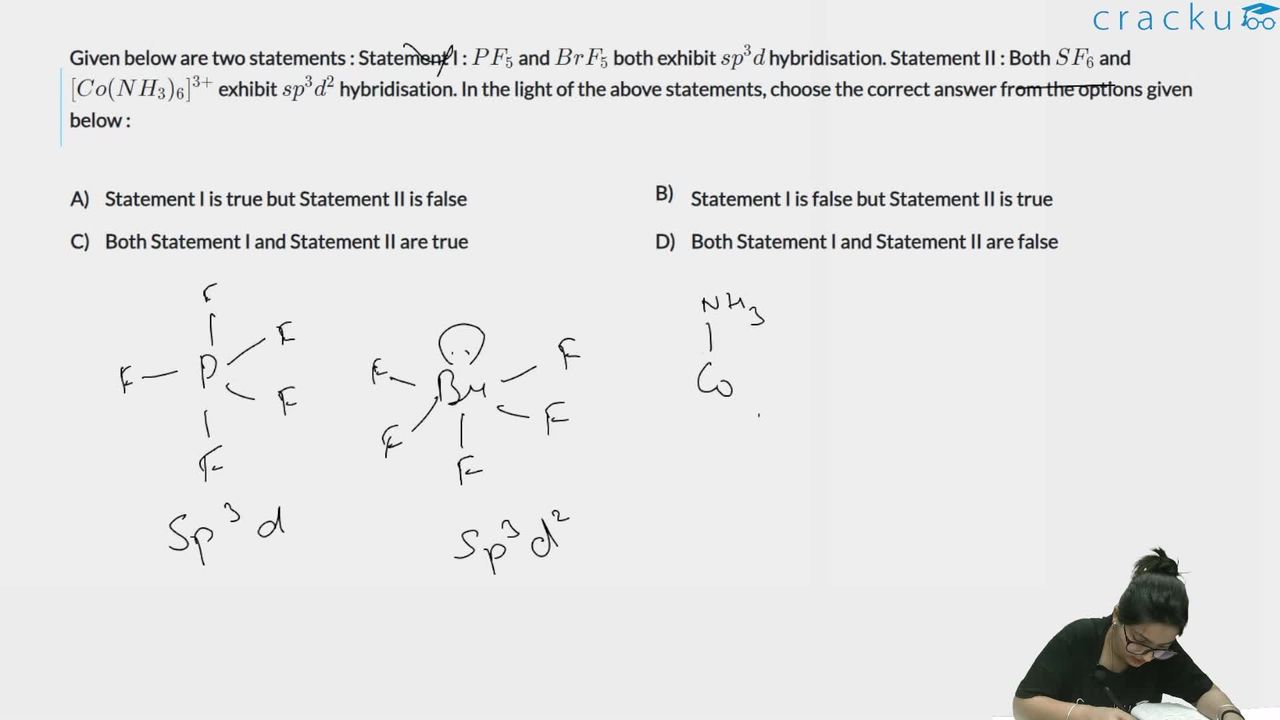
Given below are two statements : Statement I : $$PF_5$$ and $$BrF_5$$ both exhibit $$sp^3d$$ hybridisation. Statement II : Both $$SF_6$$ and $$[Co(NH_3)_6]^{3+}$$ exhibit $$sp^3d^2$$ hybridisation. In the light of the above statements, choose the correct answer from the options given below :
We need to evaluate two statements about hybridisation of certain molecules and complex ions.
Analysis of Statement I: "PF$$_5$$ and BrF$$_5$$ both exhibit sp$$^3$$d hybridisation."
PF$$_5$$: P has 5 valence electrons and forms 5 bonds with F atoms. There are 5 bond pairs and 0 lone pairs, giving sp$$^3$$d hybridisation and a trigonal bipyramidal geometry. ✓
BrF$$_5$$: Br has 7 valence electrons. With 5 F atoms, there are 5 bond pairs and 1 lone pair = 6 electron pairs total. This requires sp$$^3$$d$$^2$$ hybridisation (not sp$$^3$$d), giving a square pyramidal geometry.
Since BrF$$_5$$ is sp$$^3$$d$$^2$$, not sp$$^3$$d, Statement I is FALSE.
Analysis of Statement II: "Both SF$$_6$$ and [Co(NH$$_3$$)$$_6$$]$$^{3+}$$ exhibit sp$$^3$$d$$^2$$ hybridisation."
SF$$_6$$: S has 6 valence electrons and forms 6 bonds with F atoms. There are 6 bond pairs and 0 lone pairs. This gives sp$$^3$$d$$^2$$ hybridisation and an octahedral geometry. ✓
[Co(NH$$_3$$)$$_6$$]$$^{3+}$$: Co$$^{3+}$$ has the configuration [Ar]3d$$^6$$. With NH$$_3$$ being a strong field ligand, the d-electrons pair up to occupy only 3 of the 5 d-orbitals, leaving 2 inner d-orbitals available for bonding. The hybridisation is d$$^2$$sp$$^3$$ (inner orbital complex), not sp$$^3$$d$$^2$$ (which would use outer d-orbitals).
Since [Co(NH$$_3$$)$$_6$$]$$^{3+}$$ uses d$$^2$$sp$$^3$$ (inner orbital) hybridisation, not sp$$^3$$d$$^2$$, Statement II is FALSE.
The correct answer is Option (4): Both Statement I and Statement II are false.
Was this solution helpful?
Click on the Email ☝️ to Watch the Video Solution
Create a FREE account and get:
_1.webp)

Educational materials for JEE preparation

Ask our AI anything

AI can make mistakes. Please verify important information.
AI can make mistakes. Please verify important information.
