
Join Our JEE Preparation Group
Prep with like-minded aspirants; Get access to free daily tests and study material.
Sign in
Please select an account to continue using cracku.in
↓ →
Join Our JEE Preparation Group
Prep with like-minded aspirants; Get access to free daily tests and study material.
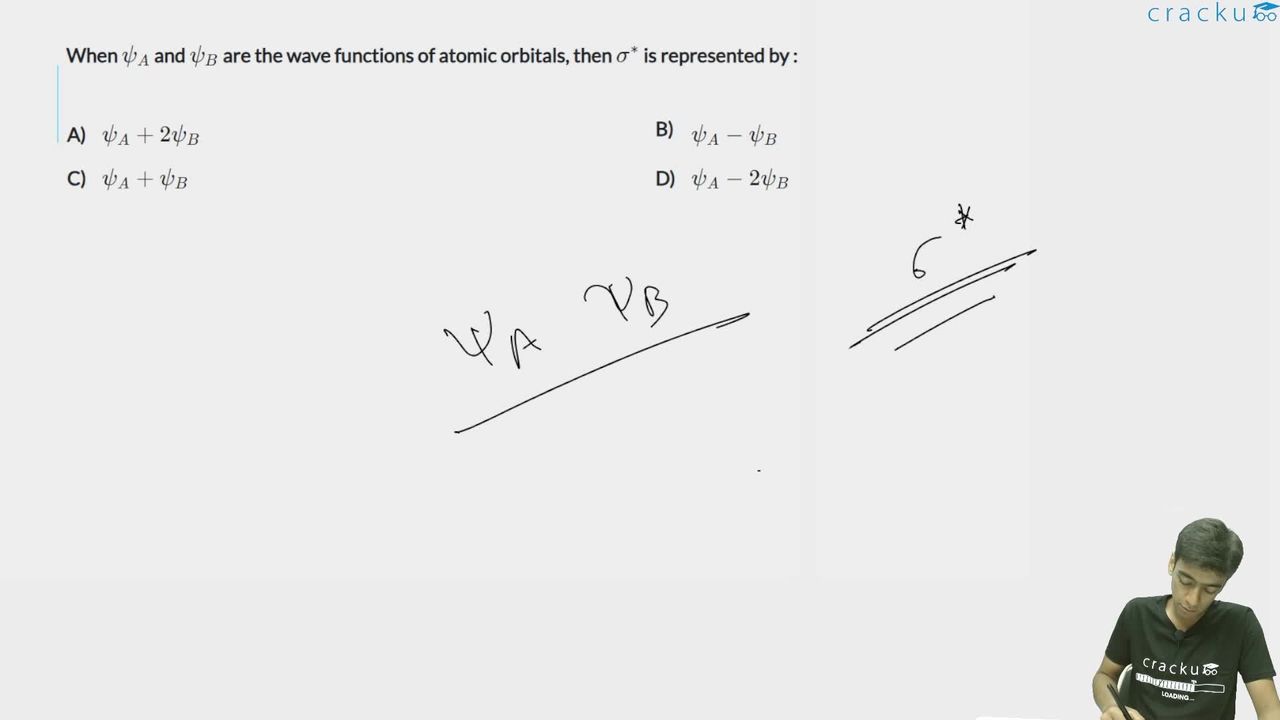
When $$\psi_A$$ and $$\psi_B$$ are the wave functions of atomic orbitals, then $$\sigma^*$$ is represented by :
We need to determine the mathematical representation of an antibonding sigma molecular orbital ($$\sigma^*$$).
Recall the LCAO (Linear Combination of Atomic Orbitals) method
When two atomic orbitals $$\psi_A$$ and $$\psi_B$$ combine, they form two molecular orbitals:
- Bonding MO ($$\sigma$$): formed by constructive (in-phase) combination
- Antibonding MO ($$\sigma^*$$): formed by destructive (out-of-phase) combination
Write the mathematical expressions
The bonding molecular orbital is formed by the addition of the two wave functions:
$$\sigma = \psi_A + \psi_B$$
(with a normalisation constant, which is omitted here for simplicity)
The antibonding molecular orbital is formed by the subtraction of the two wave functions:
$$\sigma^* = \psi_A - \psi_B$$
Understand the physical meaning
In the bonding MO, the wave functions reinforce each other in the internuclear region, leading to increased electron density between the nuclei and a stable bond. In the antibonding MO ($$\sigma^*$$), the wave functions cancel in the internuclear region, creating a node (region of zero electron density) between the nuclei. This results in a destabilising effect that weakens bonding.
The correct answer is Option (2): $$\psi_A - \psi_B$$.
Was this solution helpful?
Click on the Email ☝️ to Watch the Video Solution
Create a FREE account and get:
_1.webp)

Educational materials for JEE preparation

Ask our AI anything

AI can make mistakes. Please verify important information.
AI can make mistakes. Please verify important information.
