
Join Our JEE Preparation Group
Prep with like-minded aspirants; Get access to free daily tests and study material.
Sign in
Please select an account to continue using cracku.in
↓ →
Join Our JEE Preparation Group
Prep with like-minded aspirants; Get access to free daily tests and study material.
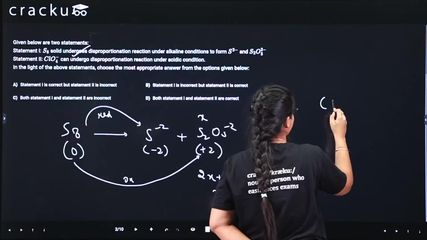
Given below are two statements:
Statement I: $$S_8$$ solid undergoes disproportionation reaction under alkaline conditions to form $$S^{2-}$$ and $$S_2O_3^{2-}$$
Statement II: $$ClO_4^{-}$$ can undergo disproportionation reaction under acidic condition.
In the light of the above statements, choose the most appropriate answer from the options given below:
We need to evaluate two statements about disproportionation reactions.
A disproportionation reaction is one where the same element is simultaneously oxidized and reduced — it goes to both a higher and a lower oxidation state.
Statement I asserts that $$S_8$$ solid undergoes a disproportionation reaction under alkaline conditions to form $$S^{2-}$$ and $$S_2O_3^{2-}$$. In elemental sulfur $$S_8$$, sulfur has oxidation state 0. In $$S^{2-}$$, its oxidation state is $$-2$$ (reduction), and in $$S_2O_3^{2-}$$ (thiosulfate), the average oxidation state of sulfur is $$+2$$ (oxidation). Since sulfur in state 0 simultaneously goes to $$-2$$ and $$+2$$, this is indeed a disproportionation reaction. The reaction with NaOH can be written as:
$$S_8 + 12\,\text{NaOH} \rightarrow 4\,\text{Na}_2\text{S} + 2\,\text{Na}_2\text{S}_2\text{O}_3 + 6\,\text{H}_2\text{O}$$
Thus, Statement I is correct.
Statement II claims that $$ClO_4^-$$ can undergo disproportionation under acidic conditions. In $$ClO_4^-$$ (perchlorate), chlorine is in the $$+7$$ oxidation state, which is the highest possible for chlorine. Disproportionation requires simultaneous oxidation and reduction, but chlorine at $$+7$$ cannot be further oxidized. Therefore, $$ClO_4^-$$ cannot undergo disproportionation, making Statement II incorrect.
The correct answer is Option A: Statement I is correct but Statement II is incorrect.
Was this solution helpful?
Click on the Email ☝️ to Watch the Video Solution
Create a FREE account and get:
_1.webp)

Educational materials for JEE preparation

Ask our AI anything

AI can make mistakes. Please verify important information.
AI can make mistakes. Please verify important information.
