
Join Our JEE Preparation Group
Prep with like-minded aspirants; Get access to free daily tests and study material.
Sign in
Please select an account to continue using cracku.in
↓ →
Join Our JEE Preparation Group
Prep with like-minded aspirants; Get access to free daily tests and study material.
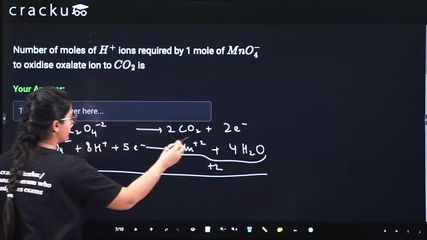
Number of moles of $$H^+$$ ions required by 1 mole of $$MnO_4^-$$ to oxidise oxalate ion to $$CO_2$$ is
Correct Answer: 8
We need to find the number of moles of $$H^+$$ ions required by 1 mole of $$MnO_4^-$$ to oxidise oxalate ion to $$CO_2$$.
First, we write the half-reactions for the permanganate-oxalate reaction in acidic medium. The reduction half is $$MnO_4^- + 8H^+ + 5e^- \rightarrow Mn^{2+} + 4H_2O$$, in which manganese goes from +7 to +2 by gaining five electrons, and the oxidation half for oxalate is $$C_2O_4^{2-} \rightarrow 2CO_2 + 2e^-$$, as each oxalate ion loses two electrons while carbon is oxidised from +3 to +4.
Next, balancing the electrons requires multiplying the reduction half-reaction by 2 and the oxidation half-reaction by 5, which yields $$2MnO_4^- + 16H^+ + 10e^- \rightarrow 2Mn^{2+} + 8H_2O$$ and $$5C_2O_4^{2-} \rightarrow 10CO_2 + 10e^-$$.
Combining these two balanced half-reactions gives the overall ionic equation $$2MnO_4^- + 5C_2O_4^{2-} + 16H^+ \rightarrow 2Mn^{2+} + 10CO_2 + 8H_2O$$.
Since 2 moles of $$MnO_4^-$$ consume 16 moles of $$H^+$$ in this balanced equation, one mole requires $$\frac{16}{2} = 8$$ moles of $$H^+$$.
The correct answer is 8.
Was this solution helpful?
Click on the Email ☝️ to Watch the Video Solution
Create a FREE account and get:
_1.webp)

Educational materials for JEE preparation

Ask our AI anything

AI can make mistakes. Please verify important information.
AI can make mistakes. Please verify important information.
