
Join Our JEE Preparation Group
Prep with like-minded aspirants; Get access to free daily tests and study material.
Sign in
Please select an account to continue using cracku.in
↓ →
Join Our JEE Preparation Group
Prep with like-minded aspirants; Get access to free daily tests and study material.
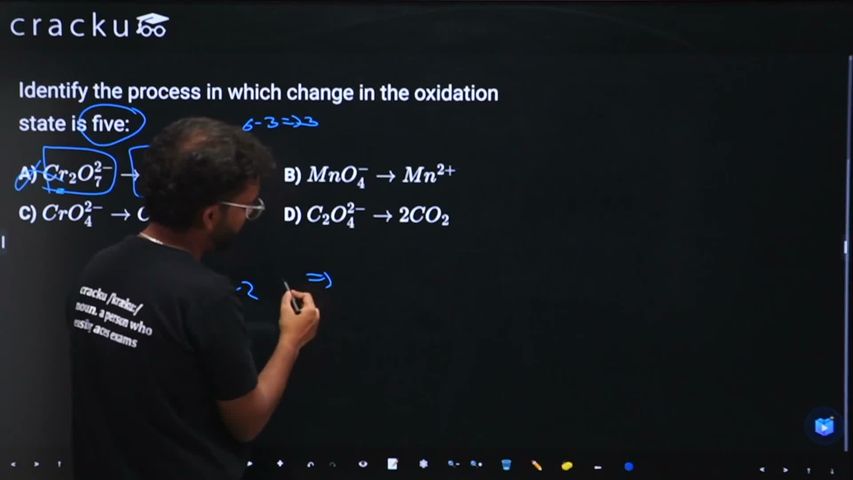
We have to find in which of the given redox conversions the change in the oxidation state of the central element (or of carbon, in the last case) is exactly five. The required principle is:
Sum of oxidation numbers of all atoms in a species $$= \text{overall charge of that species}.$$
Using this rule, we shall calculate the oxidation number of the relevant atom in both the reactant and the product for every option, then subtract to obtain the magnitude of the change.
Option A : $$Cr_2O_7^{2-} \rightarrow 2\,Cr^{3+}$$
Let the oxidation number of chromium in $$Cr_2O_7^{2-}$$ be $$x$$. There are two Cr atoms and seven oxygen atoms.
Oxygen almost always has $$-2$$ as its oxidation number. Hence
$$2x + 7(-2) = -2.$$
Simplifying, $$2x - 14 = -2 \; \Longrightarrow \; 2x = +12 \; \Longrightarrow \; x = +6.$$
Thus $$Cr$$ changes from $$+6$$ in $$Cr_2O_7^{2-}$$ to $$+3$$ in $$Cr^{3+}$$. Hence
$$\Delta = 6 - 3 = 3.$$
The change is three, not five.
Option B : $$MnO_4^{-} \rightarrow Mn^{2+}$$
Let the oxidation number of manganese in $$MnO_4^{-}$$ be $$x$$. Using the same rule,
$$x + 4(-2) = -1.$$
So $$x - 8 = -1 \; \Longrightarrow \; x = +7.$$
Manganese moves from $$+7$$ in $$MnO_4^-$$ to $$+2$$ in $$Mn^{2+}$$. Therefore
$$\Delta = 7 - 2 = 5.$$
Here the change is exactly five.
Option C : $$CrO_4^{2-} \rightarrow Cr^{3+}$$
Let the oxidation number of chromium in $$CrO_4^{2-}$$ be $$x$$. We write
$$x + 4(-2) = -2.$$
This gives $$x - 8 = -2 \; \Longrightarrow \; x = +6.$$
Going from $$+6$$ to $$+3$$ yields
$$\Delta = 6 - 3 = 3.$$
The change is three, so this option does not fit.
Option D : $$C_2O_4^{2-} \rightarrow 2\,CO_2$$
For the oxalate ion $$C_2O_4^{2-}$$, let the oxidation number of carbon be $$x$$ (both carbons are equivalent).
$$2x + 4(-2) = -2.$$
Thus $$2x - 8 = -2 \; \Longrightarrow \; 2x = +6 \; \Longrightarrow \; x = +3.$$
In $$CO_2$$, oxygen is $$-2$$, so for carbon $$y + 2(-2) = 0 \Longrightarrow y = +4.$$ Therefore carbon changes from $$+3$$ to $$+4$$:
$$\Delta = 4 - 3 = 1.$$
This change is only one.
Comparing all four possibilities, only Option B gives a change of five in oxidation state.
Hence, the correct answer is Option B.
Was this solution helpful?
Click on the Email ☝️ to Watch the Video Solution
Create a FREE account and get:
_1.webp)

Educational materials for JEE preparation

Ask our AI anything

AI can make mistakes. Please verify important information.
AI can make mistakes. Please verify important information.
