
Join Our JEE Preparation Group
Prep with like-minded aspirants; Get access to free daily tests and study material.
Sign in
Please select an account to continue using cracku.in
↓ →
Join Our JEE Preparation Group
Prep with like-minded aspirants; Get access to free daily tests and study material.
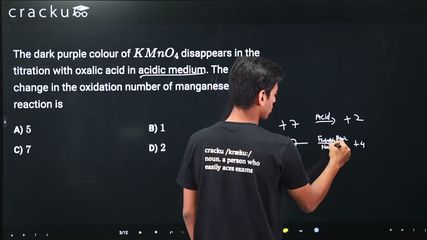
The dark purple colour of $$KMnO_4$$ disappears in the titration with oxalic acid in acidic medium. The overall change in the oxidation number of manganese in the reaction is
We need to find the overall change in oxidation number of manganese when $$KMnO_4$$ reacts with oxalic acid in acidic medium.
The balanced reaction of $$KMnO_4$$ with oxalic acid ($$H_2C_2O_4$$) in acidic medium is:
$$2KMnO_4 + 5H_2C_2O_4 + 3H_2SO_4 \rightarrow 2MnSO_4 + K_2SO_4 + 10CO_2 + 8H_2O$$
In $$KMnO_4$$:
$$+1 + x + 4(-2) = 0$$
$$x = +7$$
So, the oxidation state of Mn in $$KMnO_4$$ is +7.
The purple colour of $$KMnO_4$$ disappears, which means $$Mn^{+7}$$ is reduced. In acidic medium, $$KMnO_4$$ is reduced to $$Mn^{2+}$$ (present as $$MnSO_4$$).
So, the oxidation state of Mn in the product is +2.
Change in oxidation number = Initial oxidation state - Final oxidation state
$$= +7 - (+2) = 5$$
The overall change in the oxidation number of manganese is 5 (it decreases from +7 to +2).
Hence, the correct answer is Option A: $$5$$.
Was this solution helpful?
Click on the Email ☝️ to Watch the Video Solution
Create a FREE account and get:
_1.webp)

Educational materials for JEE preparation

Ask our AI anything

AI can make mistakes. Please verify important information.
AI can make mistakes. Please verify important information.
