For the following questions answer them individually
Two projectiles thrown at $$30°$$ and $$45°$$ with the horizontal respectively, reach the maximum height in same time. The ratio of their initial velocities is
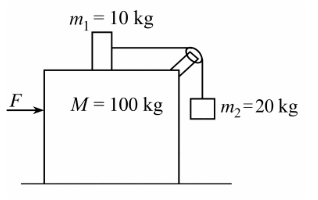
Three masses $$M = 100 \text{ kg}$$, $$m_1 = 10 \text{ kg}$$ and $$m_2 = 20 \text{ kg}$$ are arranged in a system as shown in figure. All the surfaces are frictionless and strings are inextensible and weightless. The pulleys are also weightless and frictionless. A force $$F$$ is applied on the system so that the mass $$m_2$$ moves upward with an acceleration of $$2 \text{ m s}^{-2}$$. The value of $$F$$ is (Take $$g = 10 \text{ m s}^{-2}$$)
A monkey of mass $$50 \text{ kg}$$ climbs on a rope which can withstand the tension ($$T$$) of $$350 \text{ N}$$. If monkey initially climbs down with an acceleration of $$4 \text{ m s}^{-2}$$ and then climbs up with an acceleration of $$5 \text{ m s}^{-2}$$. Choose the correct option ($$g = 10 \text{ m s}^{-2}$$)
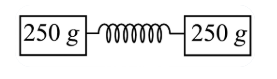
As per the given figure, two blocks each of mass $$250 \text{ g}$$ are connected to a spring of spring constant $$2 \text{ N m}^{-1}$$. If both are given velocity $$v$$ in opposite directions, then maximum elongation of the spring is
The percentage decrease in the weight of a rocket, when taken to a height of $$32 \text{ km}$$ above the surface of earth will be (Radius of earth $$= 6400 \text{ km}$$)
A water drop of radius $$1 \text{ cm}$$ is broken into $$729$$ equal droplets. If surface tension of water is $$75 \text{ dyne cm}^{-1}$$, then the gain in surface energy upto first decimal place will be (Given $$\pi = 3.14$$)
$$7$$ mole of certain monoatomic ideal gas undergoes a temperature increase of $$40 \text{ K}$$ at constant pressure. The increase in the internal energy of the gas in this process is (Given $$R = 8.3 \text{ J K}^{-1} \text{ mol}^{-1}$$)
A monoatomic gas at pressure $$P$$ and volume $$V$$ is suddenly compressed to one eighth of its original volume. The final pressure at constant entropy will be
When a particle executes simple Harmonic motion, the nature of graph of velocity as function of displacement will be
The total charge on the system of capacitance $$C_1 = 1\mu F$$, $$C_2 = 2\mu F$$, $$C_3 = 4\mu F$$ and $$C_4 = 3\mu F$$ connected in parallel is (Assume a battery of $$20 \text{ V}$$ is connected to the combination)