
Join Our JEE Preparation Group
Prep with like-minded aspirants; Get access to free daily tests and study material.
Sign in
Please select an account to continue using cracku.in
↓ →
Join Our JEE Preparation Group
Prep with like-minded aspirants; Get access to free daily tests and study material.
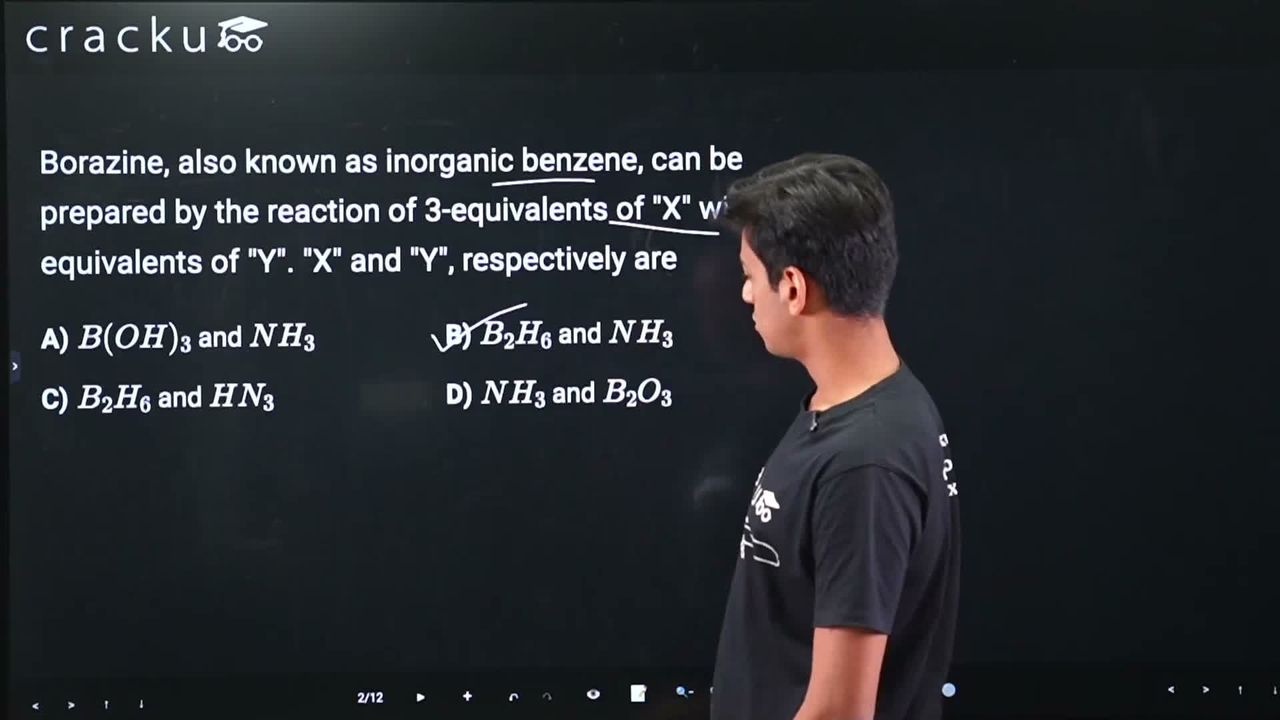
Borazine, also known as inorganic benzene, can be prepared by the reaction of 3-equivalents of "X" with 6-equivalents of "Y". "X" and "Y", respectively are
Borazine (B₃N₃H₆), also known as "inorganic benzene" due to its structural similarity to benzene, can be prepared from diborane and ammonia.
We start by writing the reaction for the standard preparation of borazine by heating diborane (B₂H₆) with ammonia (NH₃):
$$3B_2H_6 + 6NH_3 \rightarrow 2B_3N_3H_6 + 12H_2$$
The question states that borazine is prepared from 3 equivalents of "X" and 6 equivalents of "Y". From the balanced equation, 3 equivalents of $$B_2H_6$$ (diborane) correspond to X and 6 equivalents of $$NH_3$$ (ammonia) correspond to Y, which matches perfectly with the stoichiometry of the reaction.
Next, we consider why the other options do not apply. Option A, $$B(OH)_3 + NH_3$$, is not the standard method and does not match the stoichiometry.
Option C, $$B_2H_6 + HN_3$$, involves hydrazoic acid (HN₃), which is not used in borazine synthesis.
Option D, $$NH_3 + B_2O_3$$, while B₂O₃ can be used in some preparations, does not match the required stoichiometry of 3 equivalents.
Therefore, X = B₂H₆ and Y = NH₃, which corresponds to Option B.
Was this solution helpful?
Click on the Email ☝️ to Watch the Video Solution
Create a FREE account and get:
_1.webp)

Educational materials for JEE preparation

Ask our AI anything

AI can make mistakes. Please verify important information.
AI can make mistakes. Please verify important information.
