
Join Our JEE Preparation Group
Prep with like-minded aspirants; Get access to free daily tests and study material.
Sign in
Please select an account to continue using cracku.in
↓ →
Join Our JEE Preparation Group
Prep with like-minded aspirants; Get access to free daily tests and study material.
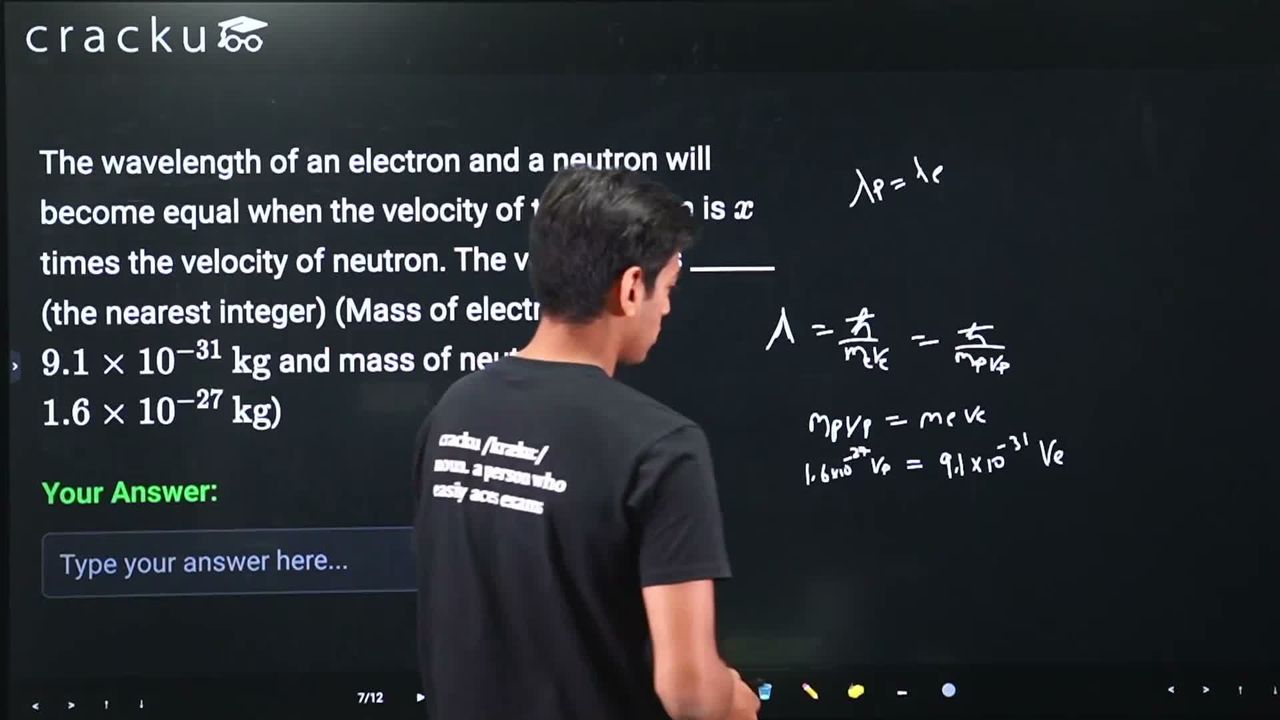
The wavelength of an electron and a neutron will become equal when the velocity of the electron is $$x$$ times the velocity of neutron. The value of $$x$$ is ______ (the nearest integer) (Mass of electron is $$9.1 \times 10^{-31} \text{ kg}$$ and mass of neutron is $$1.6 \times 10^{-27} \text{ kg}$$)
Correct Answer: 1758
We need to find the value of $$x$$ such that the velocity of the electron is $$x$$ times the velocity of the neutron when their de Broglie wavelengths are equal.
The de Broglie wavelength is given by:
$$\lambda = \frac{h}{mv}$$
where $$h$$ is Planck's constant, $$m$$ is the mass, and $$v$$ is the velocity of the particle.
For the electron and neutron to have the same wavelength:
$$\lambda_e = \lambda_n$$
$$\frac{h}{m_e v_e} = \frac{h}{m_n v_n}$$
Cancelling $$h$$ from both sides:
$$\frac{1}{m_e v_e} = \frac{1}{m_n v_n}$$
$$m_n v_n = m_e v_e$$
$$\frac{v_e}{v_n} = \frac{m_n}{m_e}$$
$$m_e = 9.1 \times 10^{-31} \text{ kg}$$
$$m_n = 1.6 \times 10^{-27} \text{ kg}$$
$$x = \frac{v_e}{v_n} = \frac{m_n}{m_e} = \frac{1.6 \times 10^{-27}}{9.1 \times 10^{-31}}$$
$$x = \frac{1.6}{9.1} \times 10^{-27-(-31)} = \frac{1.6}{9.1} \times 10^{4}$$
$$= 0.17582 \times 10^{4}$$
$$= 1758.2$$
Rounding to the nearest integer: $$x = 1758$$
Hence, the value of $$x$$ is 1758.
Was this solution helpful?
Click on the Email ☝️ to Watch the Video Solution
Create a FREE account and get:
_1.webp)

Educational materials for JEE preparation

Ask our AI anything

AI can make mistakes. Please verify important information.
AI can make mistakes. Please verify important information.
