
Join Our JEE Preparation Group
Prep with like-minded aspirants; Get access to free daily tests and study material.
Sign in
Please select an account to continue using cracku.in
↓ →
Join Our JEE Preparation Group
Prep with like-minded aspirants; Get access to free daily tests and study material.
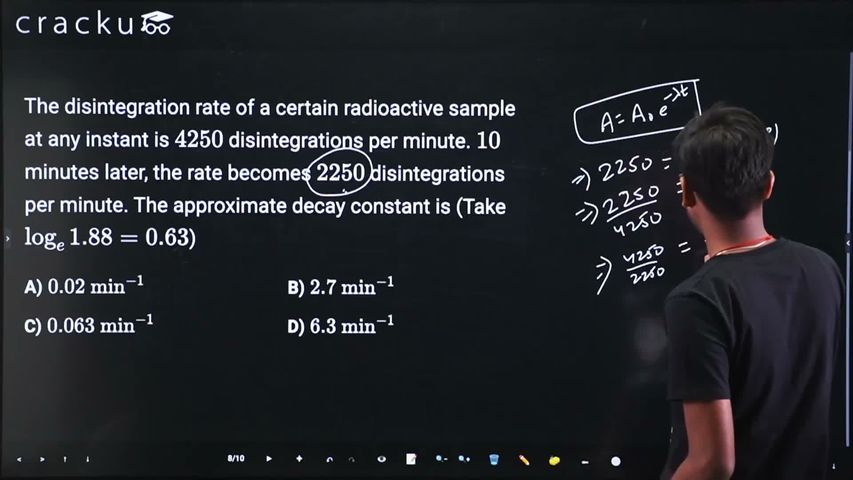
The disintegration rate of a certain radioactive sample at any instant is $$4250$$ disintegrations per minute. $$10$$ minutes later, the rate becomes $$2250$$ disintegrations per minute. The approximate decay constant is (Take $$\log_e 1.88 = 0.63$$)
A radioactive sample has a disintegration rate of $$4250$$ disintegrations per minute initially, which becomes $$2250$$ disintegrations per minute after $$10$$ minutes. We need to find the decay constant. Given: $$\ln(1.88) = 0.63$$.
The activity follows the radioactive decay law: $$A = A_0 e^{-\lambda t}$$ where $$A_0 = 4250$$, $$A = 2250$$, and $$t = 10 \text{ min}$$.
Substituting these values gives $$2250 = 4250 \cdot e^{-\lambda \times 10}$$. This leads to $$\frac{2250}{4250} = e^{-10\lambda}$$ and hence $$\frac{A_0}{A} = e^{10\lambda}$$ so $$\frac{4250}{2250} = e^{10\lambda}$$.
Next, simplify the ratio: $$\frac{4250}{2250} = \frac{425}{225} = \frac{85}{45} = \frac{17}{9} \approx 1.889 \approx 1.88$$.
Taking the natural logarithm gives $$\ln\left(\frac{4250}{2250}\right) = 10\lambda$$ so $$\ln(1.88) = 10\lambda$$. Using the given value $$\ln(1.88) = 0.63$$: $$0.63 = 10\lambda$$ and $$\lambda = \frac{0.63}{10} = 0.063 \text{ min}^{-1}$$.
The correct answer is Option C: $$0.063 \text{ min}^{-1}$$.
Was this solution helpful?
Click on the Email ☝️ to Watch the Video Solution
Create a FREE account and get:
_1.webp)

Educational materials for JEE preparation

Ask our AI anything

AI can make mistakes. Please verify important information.
AI can make mistakes. Please verify important information.
