
Join Our JEE Preparation Group
Prep with like-minded aspirants; Get access to free daily tests and study material.
Sign in
Please select an account to continue using cracku.in
↓ →
Join Our JEE Preparation Group
Prep with like-minded aspirants; Get access to free daily tests and study material.
The mean and variance of a binomial distribution are $$\alpha$$ and $$\dfrac{\alpha}{3}$$ respectively. If $$P(X = 1) = \dfrac{4}{243}$$, then $$P(X = 4 \text{ or } 5)$$ is equal to:
We are given a binomial distribution with mean $$\alpha$$ and variance $$\dfrac{\alpha}{3}$$, and $$P(X = 1) = \dfrac{4}{243}$$.
First, to find $$p$$ and $$q$$, note that Mean $$= np = \alpha$$ and Variance $$= npq = \dfrac{\alpha}{3}$$. From this, dividing gives $$q = \dfrac{1}{3}$$, so $$p = 1 - q = \dfrac{2}{3}$$.
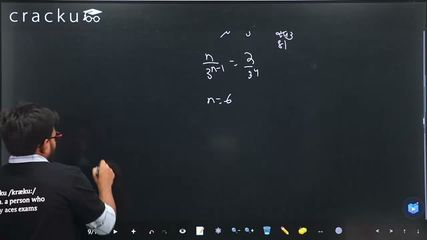
Next, to find $$n$$, use $$P(X = 1) = \binom{n}{1} p^1 q^{n-1} = n \cdot \dfrac{2}{3} \cdot \left(\dfrac{1}{3}\right)^{n-1} = \dfrac{2n}{3^n} = \dfrac{4}{243} = \dfrac{4}{3^5}$$. Hence, $$\dfrac{2n}{3^n} = \dfrac{4}{3^5}$$, which implies $$n = \dfrac{2 \cdot 3^n}{3^5} = 2 \cdot 3^{n-5}$$. Testing $$n = 6$$ gives $$2 \cdot 3^1 = 6 = n$$. $$\checkmark$$
Then compute $$P(X = 4 \text{ or } 5)$$. With $$n = 6$$, $$p = \dfrac{2}{3}$$, $$q = \dfrac{1}{3}$$: $$P(X = 4) = \binom{6}{4}\left(\dfrac{2}{3}\right)^4\left(\dfrac{1}{3}\right)^2 = 15 \cdot \dfrac{16}{81} \cdot \dfrac{1}{9} = \dfrac{240}{729}$$ and $$P(X = 5) = \binom{6}{5}\left(\dfrac{2}{3}\right)^5\left(\dfrac{1}{3}\right)^1 = 6 \cdot \dfrac{32}{243} \cdot \dfrac{1}{3} = \dfrac{192}{729}$$. From this, $$P(X = 4 \text{ or } 5) = \dfrac{240 + 192}{729} = \dfrac{432}{729} = \dfrac{16}{27}$$.
The correct answer is Option C: $$\dfrac{16}{27}$$.
Was this solution helpful?
Click on the Email ☝️ to Watch the Video Solution
Create a FREE account and get:
_1.webp)

Educational materials for JEE preparation

Ask our AI anything

AI can make mistakes. Please verify important information.
AI can make mistakes. Please verify important information.
