Join Our JEE Preparation Group
Prep with like-minded aspirants; Get access to free daily tests and study material.
Sign in
Please select an account to continue using cracku.in
↓ →
Join Our JEE Preparation Group
Prep with like-minded aspirants; Get access to free daily tests and study material.
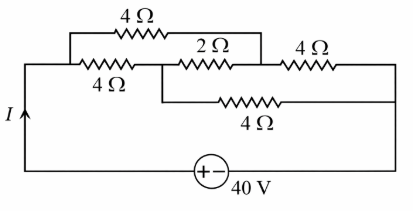
The four edge-resistors form a Wheatstone-bridge arrangement. Let the resistances be $$R_{AB}=2 \,\Omega$$, $$R_{BC}=2 \,\Omega$$, $$R_{AD}=2 \,\Omega$$ and $$R_{DC}=2 \,\Omega$$. The fifth resistor $$R_{BD}=5 \,\Omega$$ is connected between the bridge nodes $$B$$ and $$D$$.
For a Wheatstone bridge, the branch $$BD$$ carries zero current when the ratio of the two resistors in the left arm equals the ratio in the right arm, i.e. when $$\frac{R_{AB}}{R_{BC}}=\frac{R_{AD}}{R_{DC}}$$. Substituting the given values, $$\frac{2}{2}=1=\frac{2}{2}$$, so the bridge is balanced. Hence no current flows through the $$5 \,\Omega$$ resistor and we can remove it from further calculations.
With the central branch ignored, the circuit reduces to two simple series arms placed in parallel between the terminals of the battery:
Left arm: $$R_{AB}+R_{BC}=2+2=4 \,\Omega$$
Right arm: $$R_{AD}+R_{DC}=2+2=4 \,\Omega$$
These two equal resistances are in parallel, so the equivalent resistance between the battery terminals is
$$\frac{1}{R_{\text{eq}}} = \frac{1}{4}+\frac{1}{4}= \frac{2}{4} = \frac{1}{2}$$
$$\Rightarrow \; R_{\text{eq}} = 2 \,\Omega$$
The emf of the battery supplied in the circuit diagram is $$E = 20 \text{ V}$$. Using Ohm’s law, the current delivered by the battery is
$$I = \frac{E}{R_{\text{eq}}} = \frac{20 \text{ V}}{2 \,\Omega} = 10 \text{ A}$$
Hence the current in the circuit is $$10 \text{ A}$$.
Option A is correct.
Was this solution helpful?
Click on the Email ☝️ to Watch the Video Solution
Create a FREE account and get:
_1.webp)

Educational materials for JEE preparation

Ask our AI anything

AI can make mistakes. Please verify important information.
AI can make mistakes. Please verify important information.