
Join Our JEE Preparation Group
Prep with like-minded aspirants; Get access to free daily tests and study material.
Sign in
Please select an account to continue using cracku.in
↓ →
Join Our JEE Preparation Group
Prep with like-minded aspirants; Get access to free daily tests and study material.
Let $$Q$$ and $$R$$ be two points on the line $$\dfrac{x+1}{2} = \dfrac{y+2}{3} = \dfrac{z-1}{2}$$ at a distance $$\sqrt{26}$$ from the point $$P(4, 2, 7)$$. Then the square of the area of the triangle $$PQR$$ is ______.
Correct Answer: 153
We need to find the square of the area of triangle $$PQR$$, where $$Q$$ and $$R$$ lie on the line $$\dfrac{x+1}{2} = \dfrac{y+2}{3} = \dfrac{z-1}{2}$$ at distance $$\sqrt{26}$$ from $$P(4, 2, 7)$$.
A general point on the line is $$(2t - 1, 3t - 2, 2t + 1)$$ for parameter $$t$$.
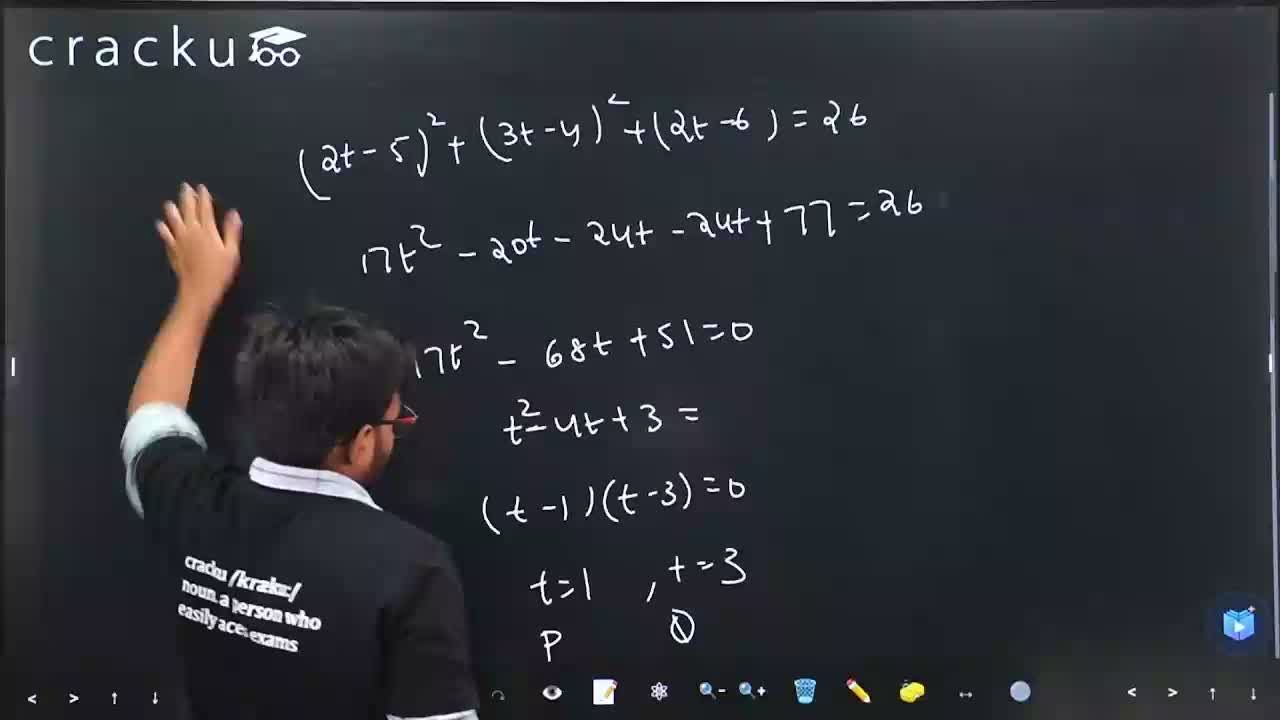
Since the distance from $$P$$ to this point equals $$\sqrt{26}$$, we set $$(2t - 5)^2 + (3t - 4)^2 + (2t - 6)^2 = 26$$. Expanding yields $$4t^2 - 20t + 25 + 9t^2 - 24t + 16 + 4t^2 - 24t + 36 = 26$$, which simplifies to $$17t^2 - 68t + 77 = 26$$. This gives $$17t^2 - 68t + 51 = 0$$ and hence $$t^2 - 4t + 3 = 0 \implies (t-1)(t-3) = 0$$, so $$t = 1$$ and $$t = 3$$.
Substituting back, we obtain $$Q = (1, 1, 3)$$ (at $$t = 1$$) and $$R = (5, 7, 7)$$ (at $$t = 3$$).
Next, $$\vec{PQ} = Q - P = (-3, -1, -4)$$ and $$\vec{PR} = R - P = (1, 5, 0)$$.
The cross product is $$\vec{PQ} \times \vec{PR} = \begin{vmatrix} \hat{i} & \hat{j} & \hat{k} \\ -3 & -1 & -4 \\ 1 & 5 & 0 \end{vmatrix} = \hat{i}(0 + 20) - \hat{j}(0 + 4) + \hat{k}(-15 + 1) = (20, -4, -14)$$, so $$|\vec{PQ} \times \vec{PR}|^2 = 400 + 16 + 196 = 612$$.
Since $$\text{Area} = \dfrac{1}{2}|\vec{PQ} \times \vec{PR}|$$, it follows that $$\text{Area}^2 = \dfrac{612}{4} = 153$$.
The correct answer is $$\boxed{153}$$.
Was this solution helpful?
Click on the Email ☝️ to Watch the Video Solution
Create a FREE account and get:
_1.webp)

Educational materials for JEE preparation

Ask our AI anything

AI can make mistakes. Please verify important information.
AI can make mistakes. Please verify important information.
