Join WhatsApp Icon JEE WhatsApp Group
Question 27

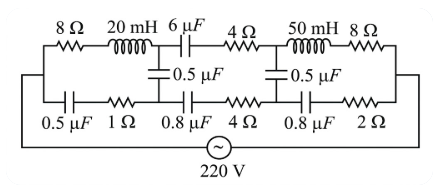
The effective current $$I$$ in the given circuit at very high frequencies will be ______ A.
image


Correct Answer: 44


1. Component Behavior at Very High Frequencies ($$f \to \infty$$)

In alternating current (AC) circuits, the reactances of inductors and capacitors are highly frequency-dependent:

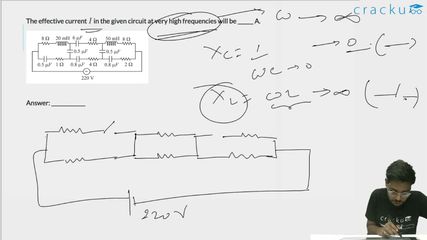
  • Inductors ($$20 \,\, \text{mH}$$ and $$50 \,\, \text{mH}$$): The inductive reactance formula is $$X_L = \omega L$$. As $$\omega \to \infty$$, $$X_L \to \infty$$. This means inductors act as open circuits (broken wires), completely blocking current from entering the outer top branches.
  • Capacitors ($$6 \,\, \mu\text{F}$$, $$0.5 \,\, \mu\text{F}$$, and $$0.8 \,\, \mu\text{F}$$): The capacitive reactance formula is $$X_C = \frac{1}{\omega C}$$. As $$\omega \to \infty$$, $$X_C \to 0$$. This means capacitors offer zero reactance and act as short circuits (ideal connecting wires).

2. Tracing the Simplified Network Paths

By substituting these high-frequency conditions into the schematic, we can track the continuous path from the left terminal of the $$220 \,\, \text{V}$$ source to the right terminal:

  • The current first passes through the initial series resistor on the left:

    $$R_{\text{left}} = 1 \,\, \Omega$$

  • Next, the current reaches a split junction (let's call it Node A). Because the vertical capacitors are now shorted into clean wires, they link the top and bottom paths directly across the same electric potentials:
    1. Path 1: Directs current horizontally through the lower-middle $$4 \,\, \Omega$$ resistor.
    2. Path 2: Directs current vertically upward through the shorted capacitor wire, horizontally across the upper-middle $$4 \,\, \Omega$$ resistor, and back down through the second shorted capacitor wire.
    Both paths re-converge perfectly at the same downstream junction (Node B). Because these two $$4 \,\, \Omega$$ resistors are bounded by the exact same nodes, they form a parallel combination.
  • Finally, after exiting Node B, the current must pass through the last series resistor connected to the right terminal:

    $$R_{\text{right}} = 2 \,\, \Omega$$


3. Calculate the Total Equivalent Resistance ($$R_{\text{eq}}$$)

First, evaluate the parallel network containing the two middle $$4 \,\, \Omega$$ resistors:

$$R_{\text{parallel}} = \frac{4 \times 4}{4 + 4} = \frac{16}{8} = 2 \,\, \Omega$$

Now, combine the entire remaining pathway, since $$R_{\text{left}}$$, $$R_{\text{parallel}}$$, and $$R_{\text{right}}$$ sit sequentially in series with each other:

$$R_{\text{eq}} = R_{\text{left}} + R_{\text{parallel}} + R_{\text{right}}$$

$$R_{\text{eq}} = 1 \,\, \Omega + 2 \,\, \Omega + 2 \,\, \Omega = 5 \,\, \Omega$$


4. Calculate the Effective Current ($$I$$)

Applying Ohm's Law with the source root-mean-square voltage ($$V = 220 \,\, \text{V}$$) and our corrected load impedance configuration:

$$I = \frac{V}{R_{\text{eq}}} = \frac{220 \,\, \text{V}}{5 \,\, \Omega} = 44 \,\, \text{A}$$

Correct Numerical Answer: 44 A

`

Get AI Help

Video Solution

video

Create a FREE account and get:

  • Free JEE Mains Previous Papers PDF
  • Take JEE Mains paper tests

JEE Quant Questions | JEE Quantitative Ability

JEE DILR Questions | LRDI Questions For JEE

JEE Verbal Ability Questions | VARC Questions For JEE

Free JEE Topicwise Questions

JEE Rotational MotionJEE Units & MeasurementsJEE Atomic StructureJEE GravitationJEE Periodic Table & PeriodicityJEE StatisticsJEE Inverse Trigonometric FunctionsJEE Magnetism & Magnetic MaterialsJEE Sequences & SeriesJEE MatricesJEE Alternating CurrentsJEE Carboxylic AcidsJEE Permutations & CombinationsJEE Work, Energy & PowerJEE Electromagnetic InductionJEE Electronic DevicesJEE d and f-Block ElementsJEE Chemical KineticsJEE Heat TransferJEE Three Dimensional GeometryJEE Magnetic Effects of CurrentJEE Hydrocarbons - AromaticJEE Electromagnetic WavesJEE Aldehydes & KetonesJEE Hydrocarbons - AlkanesJEE Applications of DerivativesJEE EquilibriumJEE Indefinite IntegrationJEE Chemical ThermodynamicsJEE ElectrochemistryJEE ProbabilityJEE BiomoleculesJEE Continuity & DifferentiabilityJEE Kinetic Theory of GasesJEE Vector AlgebraJEE Hydrocarbons - AlkynesJEE Differential EquationsJEE Current & ResistanceJEE Straight LinesJEE WavesJEE Redox ReactionsJEE Hydrocarbons - AlkenesJEE DeterminantsJEE SolutionsJEE Ray OpticsJEE Dual Nature of Matter & RadiationJEE Chemical Bonding & Molecular StructureJEE Complex NumbersJEE Sets, Relations & FunctionsJEE Electric Charges & FieldsJEE Laws of MotionJEE Fluid MechanicsJEE Basic Concepts in ChemistryJEE Trigonometric FunctionsJEE LimitsJEE Laws of ThermodynamicsJEE Kinematics - 2D MotionJEE p-Block Elements (Groups 13-18)JEE Simple Harmonic MotionJEE Electric Potential & CapacitanceJEE Coordination CompoundsJEE JEE 2D GeometryJEE CirclesJEE Definite IntegrationJEE EMF & Circuit AnalysisJEE Surface TensionJEE Atoms & NucleiJEE Laboratory Experiments - XIJEE Number SystemJEE Basic Principles of Organic ChemistryJEE Wave OpticsJEE Quadratic EquationsJEE Alcohols, Phenols & EthersJEE Organic Compounds with HalogensJEE DifferentiationJEE Conic SectionsJEE Nitrogen-Containing CompoundsJEE ElasticityJEE Practical Organic ChemistryJEE Kinematics - 1D MotionJEE Purification & CharacterisationJEE Binomial Theorem
Ask AI